







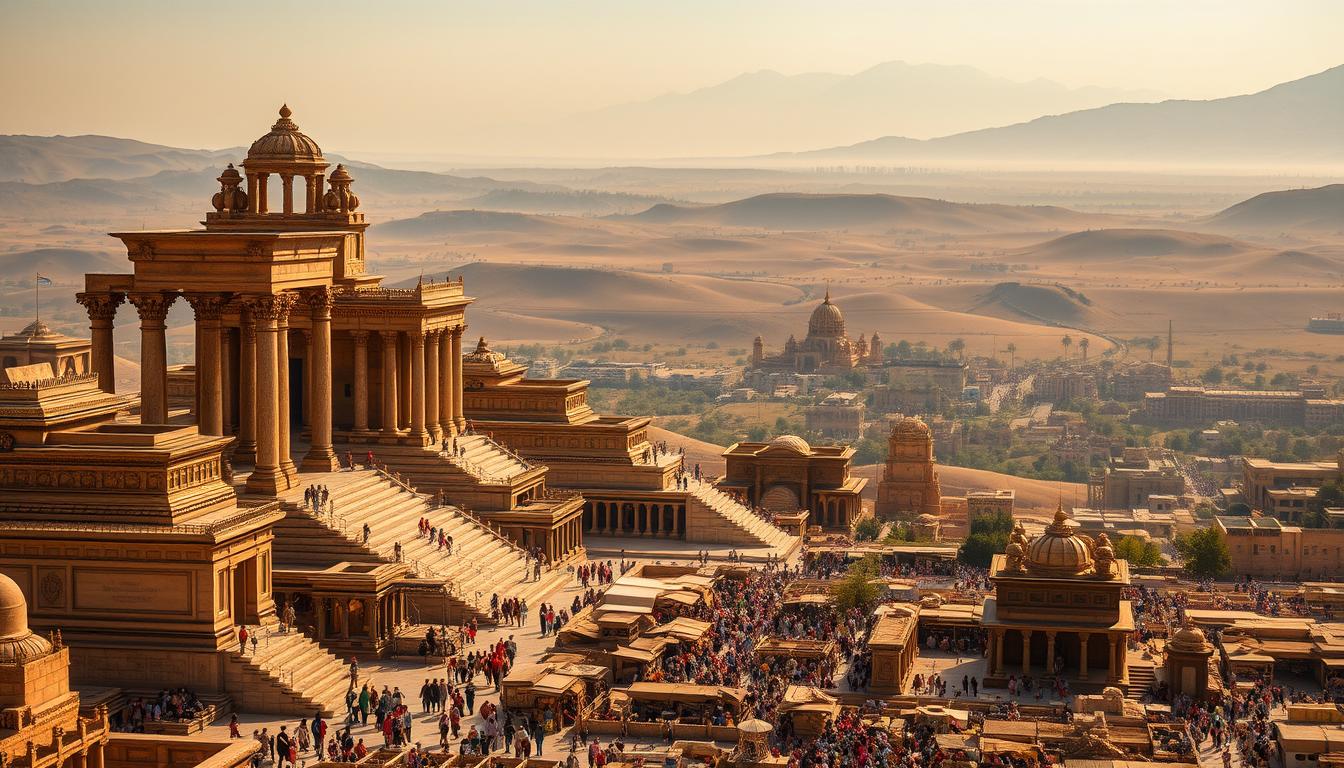
History is filled with golden ages where civilizations reached new heights. Ancient empires like Rome, Egypt, and the Maya left lasting marks. They excelled in architecture, science, and culture.
Places like Machu Picchu and Tenochtitlan show how these civilizations shaped our world. Their achievements continue to inspire us today.
Golden ages were times of great cultural growth. The Sumerians invented writing, the Greeks started democracy, and the Inca built amazing roads. Each era shows how societies can thrive through creativity and connection.
This article looks at these special times, from the Indus Valley to the Ming Dynasty. We’ll see how societies reached their peaks through hard work and smart planning.
Why did some civilizations last while others fell? We’ll find out how they adapted to their environments, built strong trade networks, and organized their societies. Stories of Angkor Wat and Roman aqueducts remind us of our own ability to grow and overcome challenges.
Understanding the Concept of Golden Ages
Golden ages in history are special because of certain traits. They are times when society, art, science, and government all grow together. Places like ancient Athens and Tang China show what a cultural apex looks like. These eras leave a mark that shapes the future.
Golden ages are not perfect, but they are the best times for creativity. Leaders who support education and building create spaces for artists and thinkers. For example, Baghdad in the Islamic Golden Age was a center for learning, blending cultures.
The Gupta Empire made big strides in math and astronomy. These achievements are used today. Golden ages often see cities grow, trade expand, and art get support. But, not everything is perfect during these times. The Renaissance, for example, had great art but also social problems.
The Golden Age of Ancient Greece
The ancient Greek golden age, from the 5th century BCE, made Athens a hub of innovation. Pericles’ rule during the Pericles golden era brought Athenian democracy to life. Citizens could vote and debate openly.
This allowed Greek philosophy to flourish. Thinkers like Socrates and Plato explored ethics and knowledge. The Parthenon stood as a symbol of this era’s greatness.

“We are the school of Hellas,” Pericles declared, capturing Athens’ role as a beacon of democracy and creativity.
Debates in the agora inspired breakthroughs in math, science, and art. Greek philosophy’s questions about justice and truth shaped modern ethics. But, wars and internal strife weakened Athens over time.
Despite this, its legacy remains strong. Innovations from this era continue to influence governance and culture today.
Hippocrates’ medical insights and Sophocles’ plays are just a few examples of its lasting achievements. The ancient Greek golden age shows us how curiosity and freedom can propel societies to new heights.
The Golden Age of the Roman Empire
The Roman Empire’s golden age was a time of great stability. It started under Augustus in 27 BCE, bringing peace to millions across three continents. This period, known as the Pax Romana, was the peak of ancient Rome.
During this time, roads, laws, and trade networks connected cities from Britain to Mesopotamia. The empire turned once-warring regions into provinces united by common governance.
Engineering marvels defined this era. Aqueducts brought fresh water to cities, and stone roads spanned 53,000 miles. This allowed goods and ideas to flow freely.
Emperor Trajan’s reign in 117 CE saw the empire’s largest territory. It stretched from Spain to Iraq. Hadrian’s Wall in northern England symbolized a system managing over 70 million people.
“We live in an age of peace,” wrote Seneca in 55 CE, capturing the era’s prosperity. This stability fueled Roman cultural achievements: Virgil’s Aeneid celebrated Rome’s legends, while jurists codified laws. From marble forums to bilingual inscriptions, the empire blended Greek philosophy, Egyptian religion, and local traditions into a shared identity.
Pax Romana wasn’t just for elites—it enabled farmers, merchants, and artisans to prosper. Markets in Alexandria and Lyon bustled with goods from around the world. Though emperors like Augustus claimed credit, this golden age’s true legacy lies in its lasting impact on governance, architecture, and global interconnectedness.
The Golden Age of Islamic Civilization
From the 8th to the 13th century, the Abbasid caliphate led a cultural and intellectual explosion. This was known as the Islamic golden age. At its heart was Baghdad’s House of Wisdom, a hub for Muslim scholars.
They translated ancient Greek, Indian, and Persian texts into Arabic. This medieval Islamic science era saw breakthroughs in mathematics, astronomy, and medicine. Figures like Al-Khwarizmi and Ibn Sina left lasting legacies.
Islamic cultural achievements flourished too. Cities like Córdoba and Baghdad became hubs of art, architecture, and education. The Great Mosque of Córdoba and the Alhambra showcased artistic mastery.
Universities like Al-Azhar and Al Karaouine became centers of learning. They spread knowledge far beyond their walls. Even everyday innovations like advanced sewage systems and the astrolabe reflected this era’s ingenuity.

These advancements didn’t stay confined to the Islamic world. The House of Wisdom preserved classical texts, allowing Europe’s Renaissance to build on medieval Islamic science. The Arabic number system, including zero, revolutionized global math.
From poetry to hospitals, this era blended faith, curiosity, and creativity. It left a legacy that is felt today.
The Golden Age of the Gupta Empire
Between 320 and 550 CE, the Gupta Empire golden age changed ancient Indian civilization. This Hindu golden era brought big steps in math, art, and philosophy. Leaders like Chandragupta II supported learning, making the classical Indian period a cultural hub worldwide.
Indian mathematical advances grew with Aryabhata’s find of zero and decimal systems. His work on pi and the sky changed astronomy. Medical texts like Sushruta’s surgical guides also showed India’s scientific reach.
Art and Sanskrit literature bloomed with poets like Kalidasa, whose play Shakuntala is forever loved. Sculptures at Sarnath and Nalanda University’s networks spread knowledge across Asia. The Gupta’s tolerance let Buddhism and Hinduism grow together.
Trade networks connected India to Rome and China, boosting wealth. Coins like the gold dinara funded these successes, leaving a lasting mark. This golden age’s innovations continue to influence us today, showing its lasting impact on human progress.
The Renaissance: A New Golden Age in Europe
In the 14th century, the European Renaissance began in Italy. It was a time of great cultural change, known as the Italian Renaissance. Scholars like Petrarch and Erasmus brought back ancient texts, mixing old wisdom with new ideas about human abilities.
This classical revival changed how we learn and create art. It challenged old ways of thinking from the Middle Ages.

Renaissance artists like Leonardo da Vinci and Michelangelo changed how we see the world. Their works, such as Michelangelo’s David and Botticelli’s Birth of Venus, showed a new focus on realism and perspective. These pieces showed humanity’s growing confidence.
Patrons like the Medici family supported these artists. They helped make Florence a center of creativity and innovation.
Science also saw a big leap forward during the Renaissance scientific revolution. People like Copernicus and Galileo questioned old ideas. The printing press helped spread their new thoughts far and wide.
This mix of art, science, and philosophy bridged the gap between the Middle Ages and modern times. It left a lasting impact that we celebrate today.
The Golden Age of the Mongol Empire
At its Mongol Empire peak, the realm forged by Genghis Khan became a bridge between East and West. By the 13th century, his Genghis Khan empire stretched from the Pacific to Eastern Europe. It united nomadic tribes under a centralized rule. This vast territory became a hub for cross-continental connections, powered by the Pax Mongolica.
The medieval Silk Road flourished under Mongol oversight. It transformed the Eurasian trade network into a superhighway of ideas and goods. Merchants carried spices, silk, and technology like gunpowder across deserts and mountains.
Scholars shared knowledge of medicine and math. This Mongol cultural exchange even saw Persian astronomers working alongside Chinese engineers. They blended traditions into new innovations.
Beyond commerce, the empire’s merit-based governance surprised many. Leaders like Ögedei Khan promoted religious tolerance. Buddhism, Islam, and Christianity thrived under their rule.
Though conquests were brutal, the resulting stability allowed cities like Samarkand to become cultural melting pots. By securing trade routes, the Mongols unintentionally laid foundations for globalization. They proved even nomadic rulers could shape history’s trajectory.
The Golden Age of the Ming Dynasty
From 1368 to 1644, the Ming Dynasty was a global leader. The Zheng He voyages sent 300 ships to Africa, the Middle East, and Southeast Asia. These trips, part of the Chinese exploration era, showed off China’s skills and wealth.
These expeditions brought silk, porcelain, and diplomacy to far-off places. They showed China’s technological and economic power. This was years before European explorers like Columbus.

At home, the Ming made great cultural strides. Ming porcelain became famous for its beautiful designs. The Forbidden City and works like Journey to the West showed the era’s creativity.
Innovations in farming and government helped keep the Ming prosperous. This made the Ming a symbol of Chinese imperial peak.
Even though the Ming faced financial problems later, its impact is lasting. Its mix of exploration, art, and governance set a high standard. From Zheng He’s voyages to the Forbidden City, this era shows China’s golden age of influence and creativity.
The Golden Age of the Ottoman Empire
The Ottoman Empire reached its peak in the 16th century under Suleiman the Magnificent. His rule (1520–1566) marked the Turkish imperial golden age. At its height, the empire spanned three continents, combining Islamic power with military and administrative skill.
Suleiman’s armies expanded Ottoman control from the Danube to the Red Sea. They secured dominance in Europe, Asia, and Africa.
Architectural wonders like the Süleymaniye Mosque, built by Sinan, showcased the empire’s zenith. These structures mixed Byzantine domes with Islamic geometric art. They remain awe-inspiring today.
Under Suleiman, cultural achievements thrived. Calligraphy, textiles, and engineering innovations highlighted the empire’s creative spirit.
Economic strength fueled this golden age. Istanbul, then Constantinople, became a center of diplomacy and commerce. The millet system allowed religious minorities to manage their affairs, fostering stability and diversity.
Yet, by the late 16th century, rising costs and inflation started to strain the empire. This marked the beginning of its decline. Despite this, Suleiman’s era left a lasting legacy of unity and innovation in a multiethnic realm.
The Golden Age of the United States
After World War II, the American golden age started. The post-war prosperity brought unmatched economic growth. Factories that made war goods now produced consumer items, creating jobs and wealth.
The middle class grew, buying cars, homes, and appliances. Projects like the Interstate Highway System connected the nation. NASA’s moon landing showed US technological leadership.
Hollywood films and rock ‘n’ roll spread American cultural influence worldwide. TV shows and movies became global trends. Yet, the 20th century superpower faced challenges too.
Racial segregation lasted until civil rights laws were passed. The Cold War’s tensions also cast a shadow over the era’s optimism.
Technological advances like the polio vaccine and computers changed daily life. The American century was marked by debates over fairness. Despite these, the US became a leader in innovation and culture.
Its legacy continues to shape the modern world, blending triumphs and unresolved issues.
Lessons from Golden Ages: What Can We Learn?
History shows us that golden ages share common traits. They had stable governments, invested in knowledge, and welcomed new ideas. The Tang Dynasty’s academies and the Renaissance’s art, backed by the Medici, are examples.
Today, the U.S. is cutting education funding by $881 million. This mirrors past decisions that ended cultural peaks. It teaches us the importance of supporting learning and creativity for progress.
Civilizations often reach their peak when leaders focus on innovation. The Gupta Empire’s science and the Islamic Golden Age’s House of Wisdom thrived with patronage and curiosity. But, overreach and neglect of equity led to decline.
Understanding these dynamics helps us avoid past mistakes. It shows the importance of balancing growth with sustainability.
Looking ahead, what’s our future? Past successes show that valuing education and diversity drives progress. The Athenian Golden Age and Ming China’s maritime achievements were built on stable leadership and investment.
Can we balance growth with sustainability today? Learning from these cycles gives us hope. If we act wisely now, we can build a better future.