




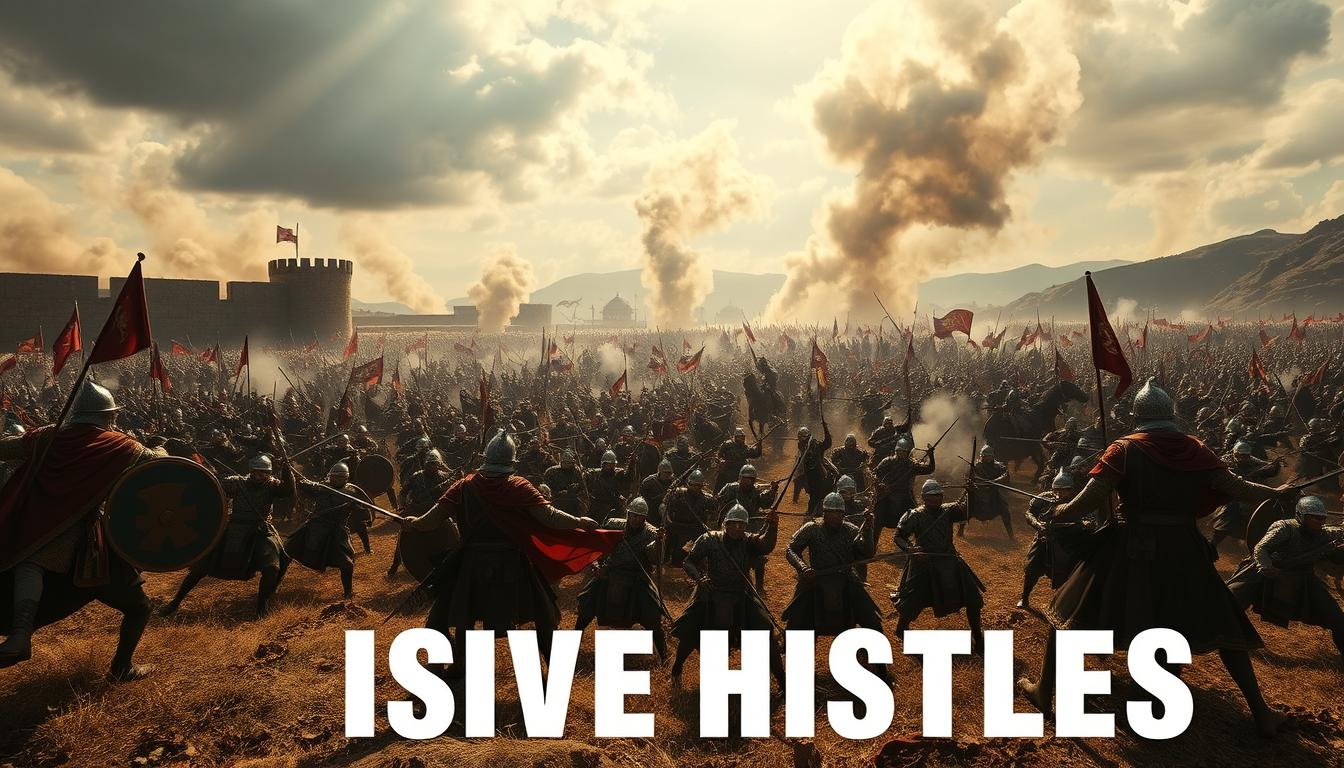
For over 2,500 years, decisive battles have changed the rules of power. Sir Edward Creasy’s 1851 book The Fifteen Decisive Battles of the World showed how battles like Marathon and Waterloo changed history. These battles didn’t just end wars; they created new governments, cultures, and boundaries.
Conflicts like Gaugamela (331 BC) or the Siege of Orléans (1429) changed whole regions. Battles such as Saratoga (1777) or the Battle of Britain (1940) were turning points. They showed that one battle could change centuries of power. Each battle left a mark that we feel today in our borders and beliefs.
From the fall of ancient Persia to the rise of the Han Dynasty, battles have a lasting impact. By studying these moments, we see how battles shaped democracy and the modern world. Every battle has left its mark on our world’s path.
Understanding the Concept of World-Changing Battles
Defining a decisive battle is more than just counting troops or casualties. Historians like Edward Creasy see them as conflicts that change politics or culture. Battles like Marathon (490 BCE) or Waterloo (1815) are military turning points that change global power.
The Battle of Muye (1046 BCE) is a key example. A Zhou army of 50,000 beat the Shang’s 550,000, ending a dynasty. This shows battle significance is not just about size but the impact it has. Even small battles, like Thermopylae’s 300 Spartans, can have big effects over time.
“A battle is decisive when it prevents an empire from rising or topples one already standing.”
Today, we analyze battles like Stalingrad (1942) or Yorktown (1781) to see their lasting impact. But, how we view these battles changes over time. They show how military actions mix with politics, culture, and technology, shaping history.
The Battle of Marathon: The Birth of Democracy
In 490 BC, near Marathon, 10,000 Athenian and Plataean soldiers faced over 20,000 Persians. This Marathon battle significance marked a key moment in the Persian invasion defeat. Led by Miltiades, the Athenians used a clever tactic: weakening their center to strengthen their wings.
Despite being outnumbered, they defeated the Persians. This Athenian victory saved Greece from being conquered.
The Persians lost 6,400 men, while the Athenians lost only 192. The ancient decisive battles legacy of Marathon is legendary. The Athenian hoplites’ discipline and bravery stopped Darius I’s expansion.
This victory allowed Athens to grow culturally and politically. It shaped Western philosophy, art, and governance for centuries.
“The Battle of Marathon, more than any other single event, is the point at which the destiny of the West diverged from the paths taken by other civilizations.”
The Athenians’ victory also inspired a famous myth: a runner’s 26-mile dash to Athens. Though its historical accuracy is debated, it symbolizes endurance. This Marathon battle significance lives on in marathons around the world.
By defeating the Persians, Greece’s democratic ideals survived. They influenced later revolutions and republics. The Battle of Marathon is a key moment in ancient decisive battles, showing that courage and strategy can change history.
The Fall of Constantinople: A Turning Point in History
In May 1453, after 55 days of relentless Ottoman attacks, Constantinople’s ancient walls crumbled. Sultan Mehmed II’s forces used massive cannons to breach the city’s defenses. The Byzantine collapse left Emperor Constantine XI dead, ending a thousand-year-old empire. This Ottoman conquest reshaped medieval power dynamics, marking one of history’s most impactful medieval decisive battles.
The Constantinople fall impact extended beyond Europe’s borders. Scholars fleeing west carried ancient Greek texts to Italy, fueling the Renaissance. The Ottoman conquest redirected trade routes, pushing Europeans to seek new paths to Asia—sparking voyages that later reached the Americas. This East-West civilizational shift altered global politics, as the Ottoman Empire dominated key trade and military pathways for centuries.
“Byzantium is fallen, but not conquered.”
Constantinople’s transformation into Istanbul symbolized a new era. The Ottoman conquest’s legacy lingers in modern geopolitics, from cultural divides to historical alliances. Its fall reminds us how a single battle can rewrite history’s course.
The American Civil War: A Struggle for Unity
The Civil War decisive battles changed the nation, but none more than the Gettysburg significance. This battle in Pennsylvania lasted three days in July 1863. It stopped Confederate General Robert E. Lee’s push into the North. With 51,000 casualties, it was a key moment in the war.
Abraham Lincoln’s Gettysburg Address changed the war’s goal. He said it was to keep a nation “conceived in Liberty.” His famous words
“government of the people, by the people, for the people”
changed how we see American national unity. Winning the war kept the nation together, ending debates over states’ rights.
Victory also led to the end of slavery abolition, with the 13th Amendment. This made the modern nation formation stronger, with more power in the federal government. The war’s 620,000 deaths showed the cost of keeping democracy. It made the country strong enough to lead globally in later years.
The Battle of Waterloo: Napoleon’s Final Defeat
On June 18, 1815, the Waterloo battle significance reached its peak. Napoleon’s 72,000 troops faced off against the Duke of Wellington’s Anglo-Allied forces. This battle marked Napoleon’s end, ending his comeback from exile.
The Prussian army arrived just in time, changing the battle’s outcome. This led to France’s downfall.
The battle’s result changed European power balance. It led to the Congress of Vienna in 1815. This event redrew national borders and stopped revolutionary movements.
It also brought back monarchies. The peace lasted nearly a century, changing 19th century geopolitics. It made Britain more influential and stabilized alliances.
Paintings like Scotland Forever! show the bravery of the cavalry. The battle saw 40,000 French and 24,000 Allied casualties. Without Prussia, Wellington’s army would have lost more.
But their unity led to Napoleon’s final exile to Saint Helena. The battle ended 23 years of war, starting a century of peace. Today, Waterloo is seen as a key moment in history.
The Battle of Stalingrad: A Defining Moment in WWII
When German troops invaded Stalingrad in August 1942, the Stalingrad battle importance grew. Soviet defenders made the city a deadly trap. Over 2 million soldiers fought in the freezing ruins, using rubble as barricades.
By November 1942, Operation Uranus encircled 300,000 Axis troops. They were trapped in a city turned to ashes.

By February 1943, the WWII turning point was clear: 90,000 German soldiers surrendered. This marked Hitler’s first major defeat. The Nazi German defeat ended their eastern advances, forcing a retreat to Berlin.
Over 1.5 million lives were lost, making it history’s deadliest urban battle.
The battle’s legacy lives on in memorials like the 172-foot “Motherland Calls” statue. Stalingrad’s ruins symbolize Soviet resilience. They prove the Eastern Front significance in changing the war’s course.
This clash is a stark reminder of how the Stalingrad battle importance reshaped global power dynamics.
The Vietnam War: Shifting Ideologies and Public Perception
The Vietnam War was a Cold War proxy conflict that changed global and U.S. politics. It was different from traditional wars because of its media war coverage. This coverage showed the harsh realities of war, changing how people saw it.
The Tet Offensive in 1968 was a big turning point. It was a military loss for North Vietnam but a win in the media. TV showed the chaos in Saigon, affecting public opinion.
Protests against the war, like the 1969 Washington, D.C. rally, showed deep divisions. The war cost 58,200 American lives and 2 million Vietnamese. By 1973, the American foreign policy shift led to more checks on the military.
“Hell no, we won’t go!”
Protests and the My Lai Massacre made people question the war. The war’s legacy includes the “Vietnam Syndrome,” making leaders think twice about war. The war ended in 1975 with Saigon’s fall, showing a rare U.S. defeat.
The Vietnam War’s Vietnam War impact is seen in today’s wars. From draft protests to cable news, it changed how we view war.
The Battle of Hastings: The Norman Conquest of England
On October 14, 1066, William of Normandy’s forces clashed with King Harold II’s army near Hastings. The Battle of Hastings impact was immediate: William’s victory ended 600 years of Anglo-Saxon rule. Harold’s death on the battlefield, Norman Conquest significance, marked a turning point. William’s troops used archers and cavalry to break the English shield wall, securing his claim to the throne.

The Norman Conquest transformed medieval England’s political structure. William replaced Anglo-Saxon nobles with Norman lords, introducing the feudal system introduction. Land was redistributed, tying loyalty to military service. This medieval England transformation reshaped laws, governance, and social hierarchies. Castles and Latin-based administrative systems replaced older traditions.
Language evolved as French words blended with Old English, sparking the English language evolution. Terms like “government” and “justice” entered the vernacular. Over centuries, this fusion created Middle English, the precursor to modern speech. William’s reign also linked England to continental Europe, reshaping its cultural identity. From governance to daily life, the Norman legacy remains etched into England’s history.
The Cold War Conflicts: Proxy Battles That Shaped the Globe
The Cold War turned the world into a battleground of ideas. Without direct fights between the U.S. and Soviet Union, places like Korea, Vietnam, and Afghanistan became key spots. The 1950 NSC-68 report pushed the U.S. to boost defense spending, showing a move towards nuclear deterrence and secret actions.
The 1949 Soviet nuclear test and the 1952 H-bomb explosion showed the global power dynamics at work. These events were huge, creating a 25-square-mile fireball.
Wars like the 1975–2002 Angolan civil war saw the U.S. and USSR backing different sides. The Soviet-Afghan War (1978–92) cost the USSR dearly, helping it collapse. The Berlin Airlift (1948–49) showed the clash of ideologies without violence.
The 1962 Cuban Missile Crisis brought the world close to disaster. It showed how fragile nuclear deterrence was.
These conflicts changed the world’s politics. The 1972 SALT I treaty tried to slow down arms races, but secret tactics continued. Today, Ukraine’s fight shows old patterns: U.S./NATO aid vs. Russian aggression.
Decades of superpower competition left marks like divided Korea and authoritarian regimes in Africa. The Cold War’s end in 1991 didn’t erase its impact. Modern conflicts show the Cold War’s global power dynamics are alive today.
The Battle of Gettysburg: Turning the Tide in the Civil War

From July 1–3, 1863, the Civil War decisive battle at Gettysburg was a key moment. Confederate General Robert E. Lee’s second invasion of the North ended in defeat. The final day saw a tragic , where 12,000 Confederate troops faced heavy losses.
Over 50,000 soldiers were lost in the battle. This loss weakened Lee’s army and ended the Confederacy’s hopes for European support. The Union’s victory was a turning point, and soon, Ulysses S. Grant’s capture of Vicksburg further weakened the South.
Abraham Lincoln’s in November 1863 changed the war’s narrative. His words, including “a new birth of freedom,” linked the battle to the nation’s founding. This speech made Gettysburg a symbol of unity and equality, marking a significant .
The Korean War: Dividing a Nation and Its Consequences
The Korean War (1950–1953) was a key part of the Cold War. It was fought between North Korea, backed by China and the USSR, and South Korea, supported by UN forces led by the United States. This war resulted in 2.5 million deaths. The armistice in 1953 left the 38th parallel as a dividing line, causing divided Korea consequences that last to this day.
The Korean War was the first big Cold War military engagement. It tested the UN’s commitment. Over 16 countries joined the UN forces, with the U.S. providing 90% of the troops. The Inchon landing was a turning point, but the fear of nuclear war led to a limited warfare concept. The war ended in a stalemate, leaving a 2-mile-wide demilitarized zone between the two Koreas.
Today, the Korean War significance is clear. South Korea has grown economically, while North Korea remains isolated. This shows the lasting impact of the war’s ideological battles. The unresolved armistice keeps tensions high, affecting regional security. This shows how proxy conflicts can leave deep scars without a clear end.
Conclusion: The Enduring Legacy of Historic Battles
Historical battle analysis reveals how key conflicts like Marathon and Stalingrad changed the world. They taught us about leadership, innovation, and the role of chance. These battles didn’t just end wars; they also changed economies, beliefs, and human rights.
The Civil War’s Emancipation Proclamation and WWI’s 4 million U.S. soldiers show how warfare’s goals and scale evolve. This evolution is key to understanding history.
Conflict impact assessment shows lasting effects. WWI’s 12 million civilian deaths and the Great Depression’s link to the war show how battles affect economies and societies. Today, we debate which battles truly changed history.
The 1917 Houston race riots and the Civil War’s racial tensions remind us of battles’ role in societal divides. Over 100 U.S. programs now explore these legacies, proving their importance.
Warfare has evolved with WWI’s machine guns and tanks, but now includes nuclear weapons and global alliances. Can a single battle like Waterloo define history as decisively today? The answer is unclear. Yet, studying these moments helps us see how they shaped laws, technology, and diplomacy.
The Library of America’s 1,000-page collection of letters and reports keeps these stories alive. From Gettysburg to Verdun, these struggles teach us about conflict’s lasting lessons. They guide us in addressing today’s crises, from civil rights to global peacekeeping.
By learning from the past, we can better face today’s challenges. This ensures history’s lessons inform our choices for tomorrow.