






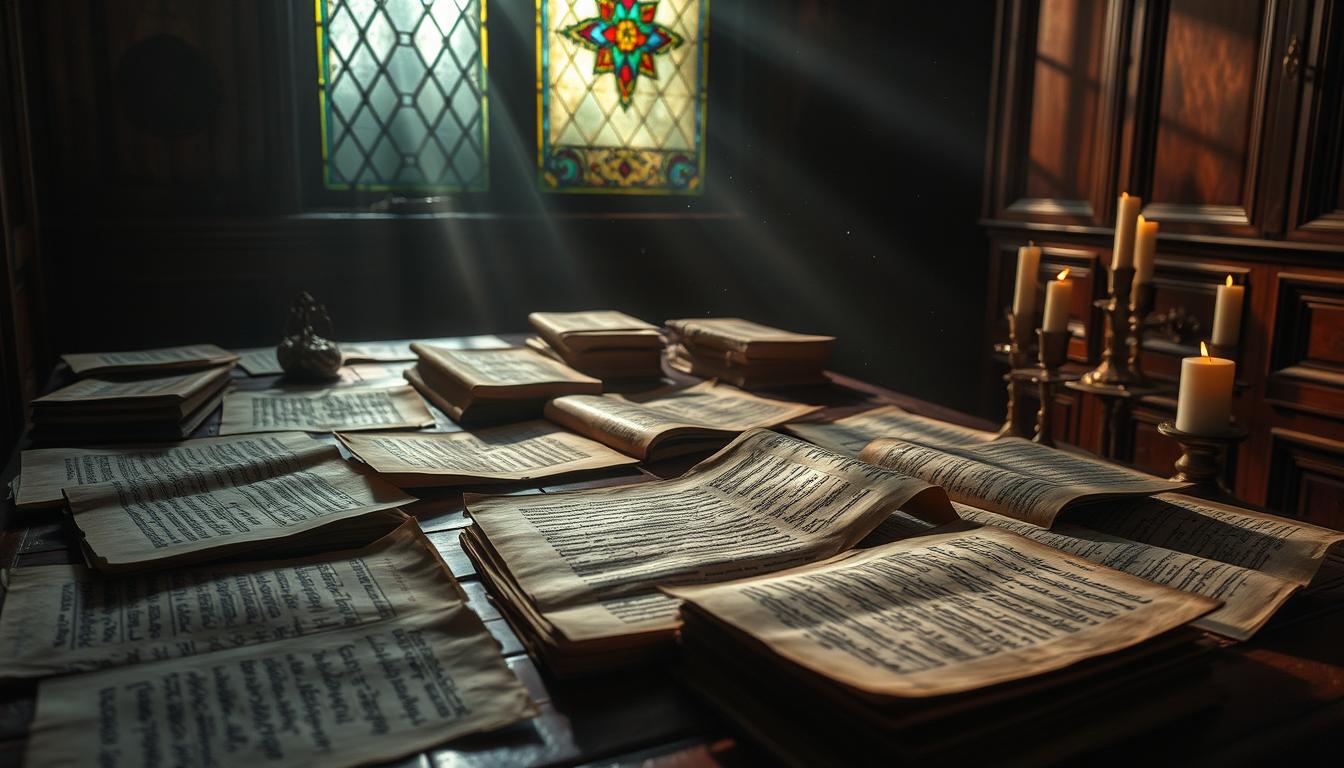
Hidden messages in historical documents tell us stories from our ancestors. The Diamond Sutra from 868 CE is a great example. It shows us clues to forgotten worlds. These old documents, with their detailed designs, keep secrets waiting to be found.
The Vatican Secret Archives have records over 1,000 years old. The Cairo Genizah has 280,000 Jewish fragments. Even hidden notes in book bindings, like 132 finds in a 1577 text, add to history.
Medieval bestiaries influenced art and the 14,000 books saved in Syria’s Darayya change how we see the past. Every mark, from musical notes to coded symbols, invites us to uncover ancient mysteries.
Understanding Hidden Messages in Historical Documents
Historical documents often hide concealed information in plain sight. Scholars use manual manuscript analysis to find clues like erased ink or layered writing. For example, Sparta’s Scytale cipher used parchment wrapped around a rod to decode messages.
Researchers found historical ciphers in love letters and political plots. A 17th-century letter from Sir John Trevanion’s servant used steganography. Hidden words followed punctuation marks, guiding a secret escape route.
Later, encyclopedias taught encryption to the public. This made ciphers accessible to everyone, not just royalty.
Modern studies, like John Matthews Manly’s WWI-era work, reveal human stories. Ellison’s 2022 research shows how concealed information in letters exposes private fears or desires. For instance, Napoleon’s letters revealed doubts he never shared publicly.
These discoveries change how we see history’s quiet struggles and innovations.
Famous Historical Documents with Hidden Messages
The Voynich manuscript and Codex Zacynthius are full of mysteries. The Voynich manuscript has strange drawings and coded text that puzzle experts. The Codex Zacynthius, a 13th-century prayer book, has seventh-century hidden biblical texts hidden beneath it. Modern imaging revealed these layers, showing lost commentaries on the Gospel of Luke.
UV scans of the Black Book of Carmarthen found eerie faces and erased poems. This shows medieval scribes often reused parchment. The Codex Selden’s hidden text, written sideways under plaster, was found using 2016 hyperspectral imaging. These discoveries show how ancient secret writings survive through science.

In 2013, multispectral scans of a 13th-century manuscript revealed a fifth-century Greek play by Euripides. These breakthroughs show how technology uncovers messages hidden for centuries. Even the Novgorod Codex—a 11th-century “hyper-palimpsest”—may have hundreds of hidden layers waiting to be read. Each discovery changes history, showing the past is full of stories waiting to be found.
Methods Used to Discover Hidden Messages
Uncovering secrets in ancient texts needs both old and new tools. Modern methods like multispectral imaging and UV light analysis show hidden layers in fragile documents. These technologies scan pages for invisible ink or erased writing, ensuring no damage to the originals.
Digital reconstruction and manualscript restoration help repair damaged texts. Software rebuilds shredded or faded pages, showing words lost to time. Scientists use these tools to study materials, like analyzing ink chemistry to date manuscripts.
At Spain’s Abbey of Montserrat, scholars María Torallas Tovar and Tea Ghigo used UV light analysis and multispectral scans. Their work uncovered hidden details in medieval texts, such as changes in ink recipes over centuries. This non-invasive approach keeps manuscripts safe while unlocking their stories.
Combining science and history, these techniques let experts decode the past. From revealing erased lines to piecing together fragments, these methods keep historical research evolving. Every discovery starts with the right tools—whether it’s a microscope or a computer.
The Role of Ciphers in Historical Communications
For thousands of years, historical encryption methods kept secrets safe. The Spartan scytale and Julius Caesar’s shift cipher hid military plans. These early methods used simple changes to keep messages secret.
Even simple ciphers like the 1531 Pigpen cipher lasted for centuries. They were hard to crack for casual observers.

In the Renaissance, things got more complex. The Vigenère cipher and France’s Great Cipher needed experts to decipher. By World War II, Germany’s Enigma machine was a huge challenge for codebreakers.
The U.S. military tested cipher decryption on old texts. But the Voynich manuscript, from the 15th century, remains a mystery.
Warfare used ancient codes like the Navajo Code Talkers’s system. It confused enemies. But, the Confederacy’s use of Vigenère ciphers was broken by the Union.
These battles show how cipher decryption shaped history. From Napoleon’s spies to Cold War espionage, it played a big role.
Today’s encryption comes from these early struggles. The DES and AES standards are based on 19th-century ideas. But, the Voynich manuscript and Enigma remind us of the ongoing importance of historical encryption methods in digital security.
The Importance of Forensic Linguistics
Forensic linguistics is all about uncovering secrets in words and writing. It looks at how language changes over time. This helps experts figure out when a text was written.
It also helps find out who wrote something. For example, analyzing a will written by Harold Shipman showed it was fake. This is because the handwriting didn’t match.
Today, we use science and AI to analyze texts. These tools can spot lies or copied work. This makes the legal system fairer.
In the Yorkshire Ripper case, linguists matched a suspect’s accent to threats. This showed how speech can solve crimes. Courts now use this evidence more often.
Linguistic evidence often holds the key to justice when other clues fade.
Tools like stylometry can tell who wrote something by looking at word use and punctuation. This is useful in copyright disputes, like with The Da Vinci Code. Forensic linguistics keeps getting better, making sure texts can’t hide secrets forever.
Hidden Messages in Ancient Civilizations

From Egypt’s pyramids to Mesopotamian tablets, ancient hidden texts show us history’s layers. Egyptian hieroglyphic secrets often had deeper meanings. Symbols could mean different things, like an owl symbolizing wisdom or darkness.
The Rosetta Stone helped scholars understand hieroglyphs. It showed Egypt’s spiritual and political sides.
Mesopotamian scribes used cuneiform messages in clever ways. They wrote hidden words in symbols. Tablets from Babylon had military secrets hidden in economic texts.
Recent finds like cuneiform letters from Ebla have changed how we see ancient trade. Scans at Chicago’s Oriental Institute found hidden ink layers in Egyptian papyri. This shows scribes reused materials to keep secrets.
Unraveling these mysteries takes time. A University of Chicago team worked for nine years on a Coptic papyrus. They found a monk’s diary hidden under other texts.
Viking runes in Hagia Sophia’s walls, from 900 CE, suggest traders’ codes. The Phaistos Disc’s symbols, though, remain a mystery. They challenge our easy explanations.
The Influence of Culture on Hidden Messages
Culture has shaped hidden messages throughout history. Medieval altar bibles held sacred knowledge for the elite. Illuminated texts, made for royalty and clergy, had complex designs for hidden meanings.
The book Hidden Hands shows how parchment and codices kept secrets. They did this through cultural context linked to faith and power.
Political censorship led to creative ways to hide messages. During the Reformation, dissenters hid radical ideas in religious manuscripts. This helped them avoid persecution.
The CIA used invisible ink in World War I. Belgian resistance used knitting to send secret messages. Even enslaved communities in Colombia used braiding to map escape routes.
“Culture’s deepest layers are rarely visible,” noted Edward T. Hall’s Iceberg Model. Surface practices like braiding or embroidery hid deeper resistance. This shows codes thrive where oppression forces creativity.
Today, we must understand these hidden layers. Without knowing the cultural context of 19th-century quilts or 1940s prison codes, we miss their stories. Messages in art or rituals of marginalized groups often used social coding to survive.
From medieval parchments to digital steganography today, culture guides secrecy.
The Quest for Lost Letters and Manuscripts
Timbuktu is known for its 700,000 historical manuscripts. Many of these lost manuscripts are highly sought after. They cover topics like science, medicine, and art in Arabic and African languages.
But, 4,203 were lost or stolen during Mali’s 2012 conflict. This shows how urgent document preservation is.

Local groups and NGOs like SAVAMA-DCI saved 350,000 texts. Now, over 300,000 are kept safe in Bamako. Projects like the Timbuktu Manuscripts Program and Hill Museum’s digitization efforts help keep knowledge alive.
These efforts show how ancient library recovery connects the past to today. They uncover forgotten histories.
Projects like the University of Cape Town’s 2003 effort and funding from Luxembourg show global teamwork. Even a 2008 flood damaged 700 manuscripts, showing we must always be careful. Each found text adds to our understanding of Africa’s intellectual past.
Private Letters and Their Hidden Meanings
Private letters have always carried secrets. In the 4th century, Patriarch Athanasius wrote a letter to Egyptian Christians. Scholars like Torallas Tovar have studied it, revealing its hidden meanings.
This historical letters artifact is written in Coptic. It shows debates in theology, hidden in its words and layout.
“It’s a very interesting piece because it is not only a text but also an historical artifact,” said Torallas Tovar, highlighting how letter coding shaped its survival.
In modern times, Pope John Paul II exchanged secret letters with philosopher Anna-Teresa Tymieniecka. Their 32-year correspondence was later sold to Poland’s National Library. It contained messages hidden from the 1970s Polish secret police.
Their letters were coded due to the SB’s surveillance. This mirrors how lovers and leaders have hidden their true intentions for centuries.
Love and power often led to coded messages. Victorian romantics used flower symbols, while explorers like Lewis and Clark encoded plans in travel logs. Even Jefferson’s request for funds for western exploration was coded, hiding the true scope of the Louisiana Purchase.
The Vatican’s archives, with 80km of shelves, hold such stories. They include Henry VIII’s signed petitions and Mary Queen of Scots’ ciphered plots. These historical letters show that every sealed envelope might hold secrets.
How Historians Uncover Hidden Messages
Uncovering secrets in ancient texts begins with document authentication. Experts check the age, materials, and origins using chemical tests and writing style analysis. Once confirmed, historical research methods help scholars match fragments with other records. This ensures accuracy when studying incomplete texts like Egyptian papyri.
Today, interdisciplinary analysis teams mix technology with tradition. At the University of Chicago, students and researchers use infrared imaging with ancient language studies. Scholarly collaboration across fields like computer science and archaeology uncovers hidden layers. For example, NLP tools scan texts 1,000 times faster than manual work, revealing 90% of concealed data.
Teams use chemical tests to find altered ink, while linguists decode word patterns. Projects like the Oriental Institute’s papyri study let students compare fragments with digital databases. Public volunteers help by transcribing texts online, speeding up analysis and sharing discoveries.
Every step, from lab tests to global teamwork, aims to reveal truths buried in history’s pages. By blending old and new methods, researchers keep uncovering stories hidden for centuries.
The Ethical Considerations in Decoding
Decoding ancient manuscripts brings up big questions about historical ethics and cultural heritage. Scholars like Torallas Tovar face tough choices when studying delicate artifacts like the three-foot Alexandria letter at Montserrat’s Abbey. Who gets to decide what gets decoded? How do researchers balance their curiosity with respect for the original creators?
These questions lead to debates about manualscript ownership.
“The past belongs to everyone, but its stories must be shared responsibly.”
Legal battles, like Spain’s 2015 Supreme Court decision, show the struggle between privacy and access. Courts said even old records need to balance research ethics with personal rights—a big challenge with digital age. GDPR laws now make it hard to keep important texts by erasing personal data on request.
Today, researchers must follow U.S. rules on declassifying documents while also respecting local values. They need to work with communities to set rules for access. For instance, Tovar’s team had to choose between digital analysis and keeping the manuscript safe during the pandemic—a modern take on old ethical problems.
Future of Research on Hidden Messages
New tech like AI document analysis is changing how we find secrets in old texts. Tools like handwriting recognition and machine learning help us read old manuscripts quickly. This helps us find new texts and learn more about history.
Projects like the Heritage Connector use AI to connect museum records online. This shows how digital humanities are making archives more accessible worldwide. Places like the Science Museum Group are working with experts to scan ancient texts, showing how tech can connect cultures.
Preservation technology is key as climate change and politics threaten old documents. Recent wins, like cracking a 1888 weather code, show teamwork can solve old mysteries. This includes archaeologists, coders, and historians working together.
But, there are hurdles. Many archives face challenges in using new tech because of money and training issues. There are also worries about AI being too secret. Yet, new tech like Handwritten Text Recognition (HTR) could make old texts more accessible, just like OCR did for printed ones.
The next ten years might bring more secrets like the 1888 weather logs. As museums and libraries invest in tech and skills, we’ll find more. By combining the latest tech with human knowledge, we can keep history alive and solve mysteries from ancient times to personal letters.