







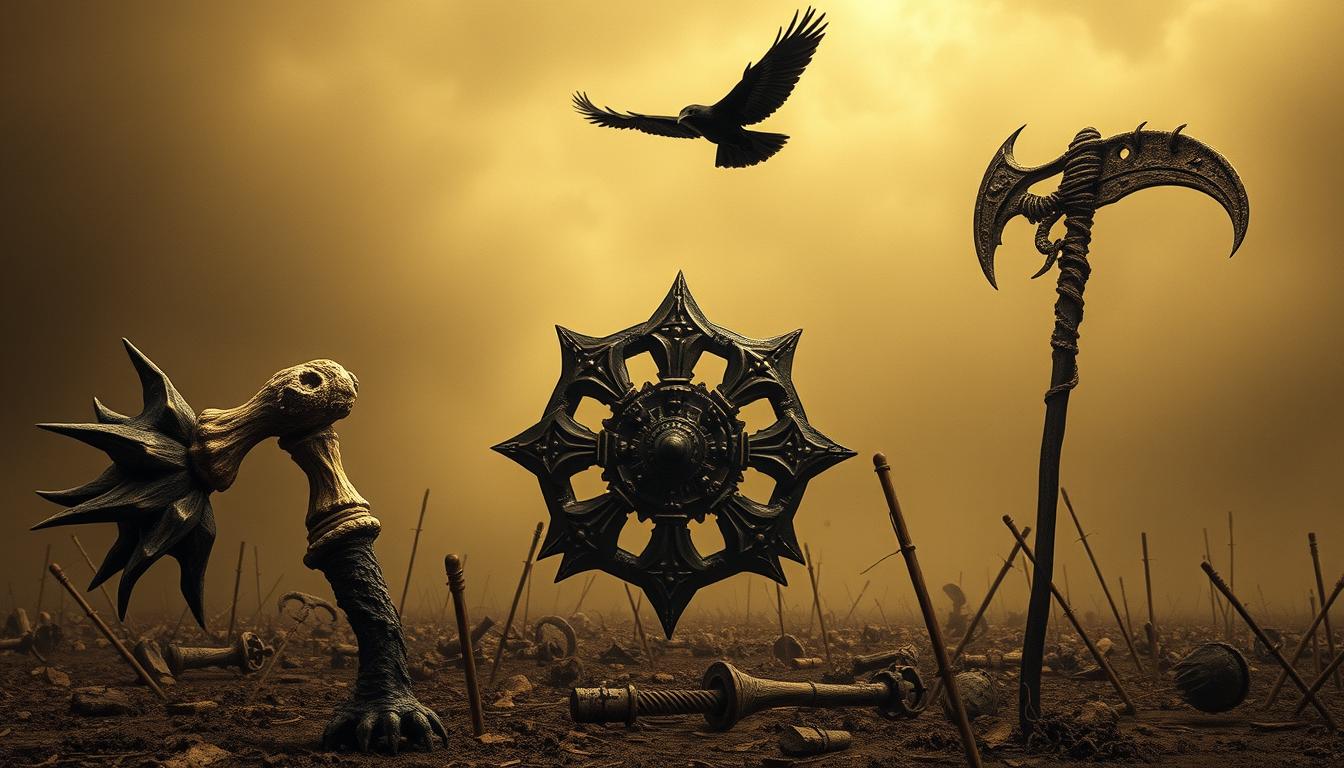
History is full of strange weapons and military inventions that don’t make sense. In World War II, it was called a “war of technology.” Nations used their brains to create weird historical weapons.
Projects like the Bat Bomb cost millions. The Wind Cannon was meant to blast boards from 656 feet. These examples show how creativity and practicality clashed.
The V-3 cannon was designed to fire 300 shells an hour. But, only 4% of its planned units were made. Japan’s balloon bombs needed 30 men to launch but only caused six casualties.
These stories show how desperation led to innovation. They mix creativity with failure. From exploding rats to the huge Gustav gun, these weapons show war’s unpredictable side.
Introduction to Strange Weaponry in History
War has always pushed armies to find creative solutions. Historian Joseph Curatola said, “War accelerates innovation in ways that wouldn’t have happened in peacetime.” This need led to unconventional warfare tools like the Sten Gun, made from scrap metal after Dunkirk.
Such bizarre combat technology emerged when armies faced shortages. For example, the FP-45 Liberator pistol was cheaper than a soldier’s boot but deadly for guerrilla fighters.
Warfare accelerates innovation in ways that wouldn’t have happened in peacetime.
Wartime inventions often focused on speed over perfection. The 1917 Brévaire acetylene mortar used explosive gas, risking explosions during transport.
World War I’s Andrew Graham shell packed 12 rifle barrels into one round to target aircraft. This was a step towards today’s smart munitions. These military innovation history moments show how fear of defeat drove creativity.
From lighted torpedoes to paravanes that clear mines today, these tools have shaped tactics for centuries. As nations tried to outsmart each other, weapons became experiments in survival. Even the strangest designs could change the rules of battle.
The Origins of Unique Weapons
Early ancient unusual weapons show how creativity changed combat before modern times. The Mongols used composite bows to instill fear. Caltrops, spiked devices, tripped horses for over 2,000 years, highlighting warfare innovation history. These tools were more than just weapons; they were psychological tools.

Materials led to new ideas. The khopesh, a curved blade from 2500 BC Mesopotamia, was good for slashing and stabbing. Later, Rome’s serrated gladius and Japan’s spiked armor showed historical weapon development focused on both usefulness and intimidation. Even failed plans, like the SOE’s “exploding rat” idea, mirrored ancient tactics of spreading fear without harm.
From siege towers to poison darts, these innovations paved the way for military technology evolution. Early weapons taught armies to mix fear with function—a lesson seen in today’s drones and cyberwarfare. The past’s most unusual tools were not just relics; they were blueprints for power.
Bizarre Weapons from World War I
WWI saw the rise of strange weapons from the trenches. Tools like flamethrowers and sharpened bayonets became common. Soldiers also faced deadly gases like chlorine and phosgene, part of the war’s odd inventions.
Even oddities like acoustic mirrors, used to detect planes, showed the desperation for Great War strange technology.

“The war demanded every scrap of ingenuity, no matter how wild,” noted a British officer. “We turned to gadgets and gizmos to break the deadlock.”
Chemical warfare led to over 180,000 British gas casualties. Early tanks, like the Mark I, used at the Somme in 1916, often failed. The Vickers machine gun, firing 600 rounds per minute, was a key weapon despite its heavy weight.
Engineers also tested body armor, but it made soldiers slow in trenches.
The Villar Perosa submachine gun, with two barrels firing 900 rounds per minute, was used for air combat. Acoustic mirrors, tall along coasts, listened for enemy planes. These odd experiments paved the way for today’s technology, showing that even failed ideas can lead to progress.
From experimental rockets to flammable “zeppelins,” the war’s innovations were both terrifying and inventive. Though many inventions failed, they marked a turning point in how nations fought wars.
Odd Strategies from World War II
The Allies tried bat bombs, attaching tiny incendiary devices to bats. The U.S. military spent millions on this idea, testing it in 1943. On the other side, the Nazis had the Windkanone, a cannon that fired compressed air to knock planes down. It worked at first but was soon found to be ineffective.
Germany also had the Krummlauf, a curved rifle barrel for shooting around corners. But it had bullet fragmentation issues, limiting its use.

Britain worked on Project Habakkuk, a proposed ice-and-wood pulp aircraft carrier. It was promising but melted during testing. The Allies also built Goliath remote-controlled explosive vehicles, but they often failed due to exposed control wires.
Even animals were used as weapons. Soviet anti-tank dogs were meant to attack but many returned to friendly lines, detonating prematurely.
Japan sent 9,000 incendiary balloons to the U.S., hoping to reach targets. But only 300 were hit, making it a costly gamble. The OSS had a “Who? Me?” chemical spray to humiliate enemies. But it was scrapped because the smell was unbearable.
These World War 2 experimental weapons show the desperation and creativity of war. Many projects were abandoned before they could be used in battle. Yet, they remind us of the unpredictable nature of war.
Unusual Historical Weapons from Ancient Times
Ancient civilizations created ancient bizarre weapons that changed how battles were fought. The Byzantine Empire’s Greek Fire could burn on water, protecting Constantinople. Its exact formula is unknown, but its pump system changed naval battles.
Roman engineers made the corvus, a spiked bridge for boarding ships. This turned naval battles into intense fights.
In the Middle Ages, armies used strange weapons like the trebuchet, which threw heavy stones. They also had the “crow’s foot,” a wheel with blades to break down castle gates. These medieval strange weapons were part of unconventional ancient warfare.
Outside Europe, Chinese forces used smoke bombs with poison. Indian warriors used the urumi, a long steel whip-sword. Japanese had the kusarigama, a sickle with a chain, and African Zande tribes used kpinga knives with many blades.

The Flemish militia’s goedendag was a long, spiked pole that defeated armored knights at the Battle of the Golden Spurs in 1302. Over 1,000 French knights were defeated by these simple tools. This shows how unconventional ancient warfare could win against cavalry.
Even Leonardo da Vinci designed armored “tanks” with scythe blades, though they were never made. These inventions, from blinding canisters to spring traps, show how creativity helped people survive. Each weapon has a story of how cultures adapted to fight.
The Role of Psychological Warfare
The British used dummy paratroopers during WWII to create chaos. These rubber figures, complete with fake explosions, diverted German forces. This tactic shows how psychological warfare tactics can be more effective than physical force.
From Mongol archers’ wailing arrows to the fear-inducing weapons of the Assyrian Empire, history proves a point. Terrorizing the enemy’s mind can save lives while achieving goals.
Modern intimidation warfare technology evolved with Cold War-era projects like the CIA’s MK-Ultra. It aimed to manipulate minds through drugs and hypnosis. Even failed experiments, like the SOE’s “exploding rat” scheme, left enemy ranks paranoid.
The 1951 book *Brain-Washing in Red China* amplified public anxiety about communist mind control. It shaped cultural fears long after the Korean War.
Today, psychological strategies continue. Social media disinformation campaigns and AI-driven deepfakes act as 21st-century fear-inducing weapons. They destabilize trust without a single bullet.
Just as Caesar manipulated Gaulish tribes through staged alliances, modern militaries use information warfare. They aim to fracture enemy cohesion. The line between weapon and weaponized information grows blurrier with each technological leap.
Modern-Day Unconventional Weapons
Modern warfare now includes weapons once found only in movies. Tools like the Long Range Acoustic Device (LRAD) and the Active Denial System are examples. They can harm without killing, using sound waves and millimeter waves to cause discomfort.
Today’s warfare also happens online. Cyberattacks can shut down power grids, and drones can overwhelm defenses. Autonomous drones, guided by AI, mimic swarms to attack targets. This shows how tech and nature are being combined in warfare.
Hybrid systems, like the RPG-mortar combo, show how warfare is evolving. These tools mix old and new tactics. The U.S. Army’s laser weapon system can destroy threats instantly, showing the power of modern tech.
Future of Unusual Weaponry
Future warfare technology is changing combat with next-generation strange military tools. Think of drones guided by AI, making critical decisions on their own. The U.S. Navy’s Mach 8 railgun is just the start. These new tools mix fantasy with reality, thanks to unconventional weapon development.
Future weapons might include tiny bots that sneak into machines or soldiers. DARPA’s EXACTO bullets can change course mid-air. Quantum stealth tech could make troops invisible. Biotech might even create diseases that target specific DNA, raising big ethical questions.
Quantum computing could break encryption in seconds. AI, like the U.S. military’s drones, is changing strategy. These advancements remind us of oddities like the Vomit Gun but on a bigger scale. As militaries push to innovate, the need for ethics and control grows.
Conclusion: The Impact of the Strange Weapons
Strange weapons have shaped military technology for decades. From World War II’s odd designs to today’s stealth jets, they’ve made a big impact. The Regulus missile and Convair Sea Dart’s failures taught engineers a lot.
These failures led to big wins like supersonic flight and submarine-launched missiles. Even the Soviet anti-tank dogs, though a disaster, showed the risks of trying too hard. These stories teach us that failure can lead to success.
Bizarre warfare lessons are found in today’s weapons. The Davy Crockett and M65 Atomic Cannon remind us of past mistakes. But, the F-35C’s ability to take off vertically shows how odd ideas can become useful.
Projects like Project Pluto’s nuclear-powered cruise missile were canceled for safety reasons. This shows the importance of balancing ambition with caution. The B-52 Stratofortress, flying for decades, is a testament to the lasting impact of strange weapons.
The F-35C’s speed and the Lun-class ekranoplan’s 340 mph speed show how past failures guide today’s tech. The Av-8 Harrier’s success in the Falklands War teaches us about the value of adaptability.
Today, drones and AI are changing warfare, and the past’s odd experiments remind us of the power of innovation. The F-35C’s mix of old and new tech is like the V-2 rocket’s role in space travel. The future demands bold ideas and caution, as seen in the Convair XFY’s tricky landings and the Zero Length Launch’s failures.
History’s strange weapons are not just relics. They are blueprints for tomorrow’s breakthroughs. They show us that taking risks and being creative can lead to great things.