






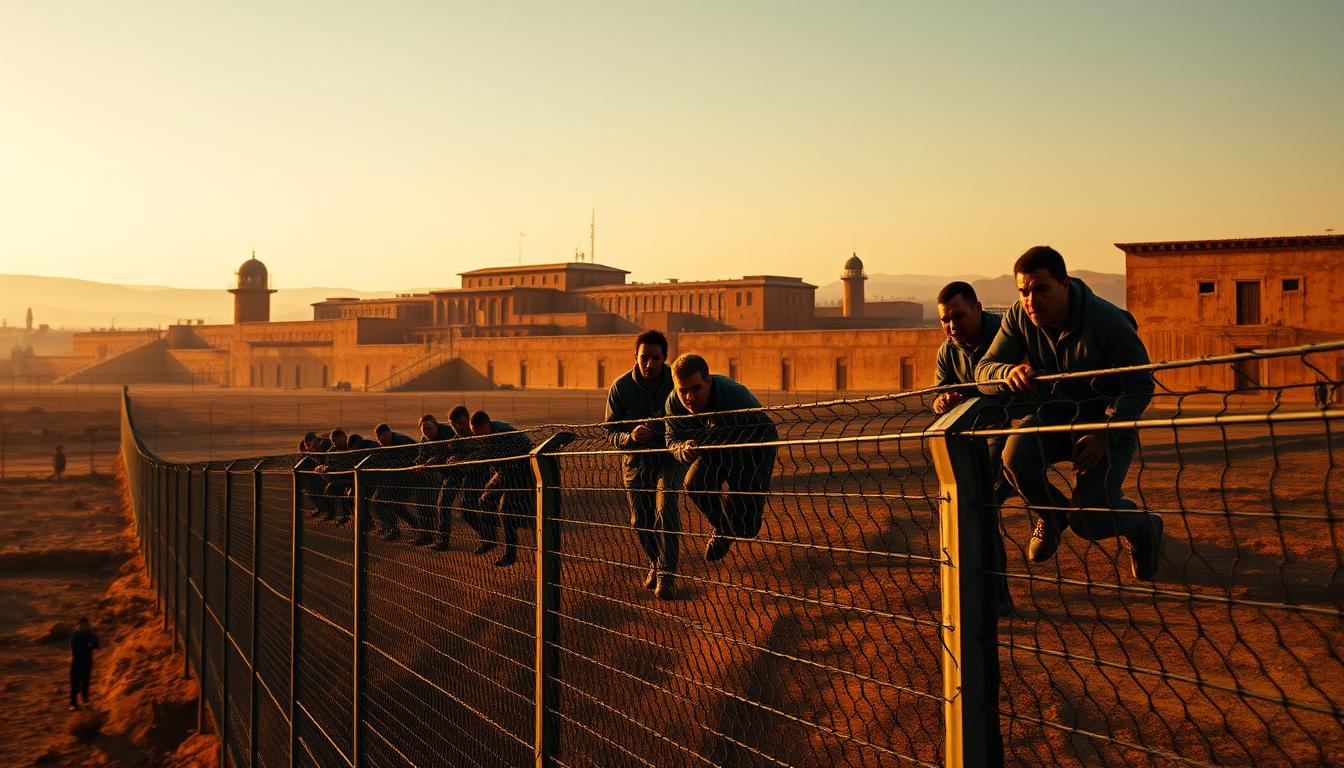
From Colditz Castle to Alcatraz, famous escapes in history have captivated us all. These historical prison breaks show the strength of human will. Stories like the Great Escape remind us of the power of creativity.
With 76 Allied airmen escaping Stalag Luft III, it’s clear that even the toughest walls can be overcome. Each notable escape story is a testament to human ingenuity. From Henry “Box” Brown’s 27-hour box journey to the Alcatraz trio’s night-time escape, these tales inspire us.
These incredible breakouts have happened over centuries. From the Tower of London to the Berlin Wall, each escape is a story of courage. Whether through tunnels, rafts, or bravery, they show our will to be free.
This journey through time shows us the power of courage. It reminds us that even the darkest places can’t keep hope captive forever.
The Great Escape: World War II’s Legendary Breakout
In March 1944, a daring escape plan was set in motion at Stalag Luft III. Over 200 Allied POWs worked together to dig three tunnels—”Tom,” “Dick,” and “Harry.” They aimed to outsmart their Nazi guards.
Squadron Leader Roger Bushell led the effort. The prisoners used Red Cross parcels to make wood for tunnel supports. They also melted records to create compasses.
On March 24, 76 men made their way through the 336-foot “Harry” tunnel. But within days, all but three were caught. The Gestapo executed 50 escapees, a shocking breach of the Geneva Conventions.
The tragedy showed the risks of such escapes. Yet, it also showed the prisoners’ unwavering spirit.
Every shovelful of dirt told a story of creativity. Bushell’s plan, the Roger Bushell Great Escape, aimed to free as many as possible. Though most were caught, the escape disrupted German plans. It inspired films like The Great Escape.
Today, this breakout is a symbol of resistance against all odds.
Alcatraz: The Infamous Prison Break

In June 1962, Frank Morris and the Anglin brothers pulled off the Morris Anglin brothers’ Alcatraz escape 1962. They used a raft made from 50 raincoats and dummy heads from papier-mâché. By dawn, guards found their empty cells, but the trio was nowhere to be seen.
The FBI searched for 10 days after they vanished into San Francisco Bay. They found only a paddle and rubber scraps. The case was closed in 1979, but the U.S. Marshals Service reopened it until 2030. A 2018 letter claiming to be from John Anglin raised new theories, though unverified.
Today, Alcatraz’s cellblocks whisper the Alcatraz escape 1962 mystery. Tourists wonder if the trio survived or drowned in the bay’s cold waters. The question remains: Did the escape from the Rock end in tragedy or triumph? The truth is hidden beneath the waves.
Prisoner of War Escapes: Notable Examples
During WWII POW escapes, Allied prisoners made Colditz Castle a center of rebellion. Known as the “escape academy,” it saw 54 successful escapes. These were achieved through tunnels, disguised tools, and even a glider made from bedframes.
The Colditz Castle breakouts used Allied escape methods like the “Harry” and “Tom” tunnels. Officers like Douglas Bader used prosthetic legs to smuggle materials.
54 prisoners escaped from Colditz Castle, proving ingenuity could outwit the most secure facilities.
Other famous war prisoner escapes include Churchill’s 1899 Boer War escape. He traveled 300 miles on foot with just chocolate and a biscuit. In 1944, 70 prisoners from Stalag XVIII-D fled 160 miles, though 6 died.
Even Japanese camps saw defiance: 60 Soviets escaped Birkenau in 1942, though most were recaptured or killed.
These escapes disrupted enemy plans, tying up troops in manhunts. The 1944 Great Escape at Stalag Luft III saw 76 airmen tunnel out, though most were caught. Yet their courage inspired hope among prisoners.
Even failed attempts, like the 1944 Cowra camp break, kept spirits high despite risks.
Stories like these show how escapes were both acts of survival and psychological warfare. Every escape, whether successful or not, became a symbol of resistance against oppression.
The Story of the Great Train Robbery Considered
In the early morning of August 8, 1963, a daring heist shook Britain. A group, led by Bruce Reynolds, robbed a Royal Mail train near Ledburn, Buckinghamshire. They stole £2.6 million, about £69 million today, in just 30 minutes.
The crew moved the money 27 miles to Leatherslade Farm. They left the driver and crew stunned but unharmed.

Ronnie Biggs’ escape in 1965 became legendary. He jumped a wall at Wandsworth Prison and fled to Australia and Brazil. He changed his look with plastic surgery to avoid capture for 36 years.
His return to Britain in 2001 ended his life on the run. Others, like Buster Edwards, also managed to evade capture, leading to a massive manhunt.
The gang’s plan was to stop the Glasgow-to-London train after 3 a.m. by creating a fake red signal. They had 12 getaway cars and supplies ready at Leatherslade Farm. Their bold move made them infamous.
The robbery exposed weaknesses in security. The stolen money, hidden in 120 sacks, showed how vulnerable cash transport was. Even after the gang was caught, their legend lived on.
Lifeboat Escape: The Righteous Among Nations
In April 1944, Rudolf Vrba and Fred Wetzler escaped Auschwitz. They hid in a forest for days before making their daring escape from Nazi-occupied territories. Their eyewitness account of mass murder saved an estimated 200,000 lives by stopping deportations to death camps.
“We risked everything to expose the truth,” Vrba later wrote, describing their mission to stop the Holocaust’s machinery.
Brave networks like Denmark’s fishing boat routes and Raoul Wallenberg’s diplomatic passports were lifelines. These WWII Jewish rescue operations saved thousands with forged documents, secret routes, and shelter. In Bulgaria, nearly all Jews survived thanks to public protests and Holocaust escape networks organized by officials.
Over 26,000 individuals were honored as Righteous Among Nations for their sacrifices. From Poland’s farmers hiding families to Swedish diplomats issuing visas, their acts reshaped history. Their courage shows even small choices can defy evil’s grip. Their bravery is a beacon of humanity’s capacity to resist darkness.
A Solidarity in Life Rafts: Survivors’ Stories
Sea survival stories show how people can overcome nature’s challenges. Poon Lim, a Chinese sailor, survived 133 days on a raft in the Atlantic after his ship was hit by a torpedo in WWII. His story, like others, shows how determination and creativity can beat the odds. People stuck on life rafts often worked together to catch fish, collect rainwater, and fight off sharks. This teamwork proves that unity is essential for survival.

In 1897, the SS Commodore sank near Florida, leaving four men stranded. Stephen Crane, a journalist, wrote about their 30-hour fight for survival in The Open Boat. After their dinghy flipped near Daytona Beach, they held onto a spar, facing cold and hunger. Billie Higgins, an oiler, drowned, but the others made it to shore. Crane’s story, published in Scribner’s Magazine, became a classic tale of survival at sea.
Survivors of shipwrecks often face mental challenges as much as physical ones. Keeping hope alive required teamwork and sharing stories to avoid despair. Poon Lim used a makeshift spear to catch fish; others prayed or sang to stay sane. These acts of unity turned life raft escapes into victories, showing that trust in others is as important as food or water.
These stories teach us that survival at sea is not just about lasting long—it’s a sign of human connection. From Poon Lim’s solo journey to the Commodore’s crew, these tales show how unity can turn desperation into defiance against the sea’s harshness.
The Escape from Sobibor: A Fight for Freedom
In the shadow of the Holocaust, the Sobibor uprising shines as a rare beacon of resistance. By 1943, Sobibor was one of Nazi Germany’s deadliest Nazi death camp escape sites. Over 250,000 Jews were murdered there. But on October 14, 1943, Soviet Jewish prisoner Alexander Pechersky led a daring revolt against their captors.
This Holocaust resistance effort marked a turning point in the camp’s history.
“We must live as free men or die as free men,” Pechersksy urged the prisoners. His leadership turned despair into defiance.
Over 600 prisoners joined the uprising, overwhelming guards and breaching the camp’s fences. Though 300 fled, most were hunted down. Only about 50 survived the war. Despite the heavy losses, the Sobibor uprising forced the Nazis to dismantle the camp, erasing evidence of their crimes.
The 1987 film Escape from Sobibor later brought their story to global audiences, immortalizing their courage.
Today, the revolt’s legacy endures as proof of human resilience. Pechersky’s strategy—a blend of secrecy and audacity—showed that even in the darkest moments, resistance could spark hope. The Sobibor uprising remains a testament to the cost of fighting for freedom.
Escape from the Berlin Wall: A Symbol of Freedom
Between 1961 and 1989, the Berlin Wall stood as a stark reminder of division during the Cold War. Thousands of East Germans defied danger to cross into West Berlin. They used tunnels, hot-air balloons, and even cars to escape.

In 1964, a daring tunnel under Bernauer Strasse freed 57 people in just two nights. The Strelzyk family’s hot-air balloon escape in 1979 was another bold move. Even some border guards, like Conrad Schumann, defected, making a famous leap over barbed wire.
Despite the risks, hope never faded. Over 140 people lost their lives trying to escape, but each success inspired others. The Wall’s fall on November 9, 1989, was a victory for those who fought against division.
These escapes were more than just fleeing; they were protests against tyranny. From daring tunnels to makeshift balloons, they show humanity’s relentless pursuit of freedom. The Wall’s collapse celebrated the end of division and honored those who risked everything to cross.
Maritime Escapes: The High Seas Adventures
Escape attempts from famous sea escapes and prison island breakouts were often life-or-death struggles. Devil’s Island, a French penal colony, saw over 80 recorded escapes. Henri Charrière, known as Papillon, made a famous maritime prison break in 1943. He and a friend used a raft made of coconuts to paddle into the open ocean.
Australia’s 19th-century island penal colonies were even more deadly. Convicts fleeing Norfolk Island faced sharks and storms. Those who survived the famous sea escapes often died from starvation or shipwrecks.
In the 20th century, Cuban refugees launched fragile rafts toward Florida. Their journeys mirrored the desperation of earlier prison island breakouts.
Escapees faced more than just guards. They battled hurricanes, 20-foot waves, and had to navigate without compasses. The 1944 escape of 12 prisoners from Port Arthur, Tasmania, ended when a storm capsized their boat. Only two survived.
Modern Day Escapes: Current Examples
In recent years, prison escapes have shown new ways to break free. The 2015 escape of Joaquín “El Chapo” Guzmán is a prime example. He dug a mile-long tunnel with lights and a rail system to escape Altiplano Penitentiary. This showed how cleverness can sometimes outsmart security.
Pascal Payet’s 2001 helicopter escape from a French jail and Richard Matt’s 2015 tunnel dig using power tools are other examples. These stories show how technology helps both sides. Even non-prison escapes, like Edward Snowden’s 2013 flight to Russia, are significant.
Now, security uses biometrics and drones to catch escapees. But, human creativity keeps finding new ways to escape. The 2020 Taliban tunnel breach in Afghanistan, freeing 480 prisoners, is a recent example. Authorities use AI and facial recognition to keep up.
From tunnels to digital tricks, the quest for freedom never stops. These stories remind us that the battle for freedom is always evolving. It pushes the limits of what’s possible.
Myth vs. Reality: Famous Escapes Debunked
Escape myths debunked show us the truth behind famous prison breaks. The Great Escape of 1944 had 76 Allied airmen tunnel from Stalag Luft III. But only three managed to escape without being caught.
Historical records reveal that 50 were executed by the Nazis. This harsh reality is often overlooked in the stories of escape. The famous motorcycle chase scene in the 1963 film? That’s just Hollywood magic.
Historian Trevor Roper’s 1945 report confirmed Hitler’s suicide, debunking survival myths that persisted for decades.
Colditz Castle’s escapes were impressive, using 100 tons of sand and 2,400 bed boards. But by 1944, fewer prisoners tried to escape as Nazi guards got stricter. After the war, many survivors struggled with mental health issues, showing that escapes weren’t always easy.
The 1944 Alcatraz escape is another example. All three men drowned, not the happy ending we often imagine.
Historical inaccuracies in escape stories are common because drama sells. But finding the truth is important. It honors the bravery of those who tried to escape. Next time you hear a prison break story, remember: the truth is often more compelling than the myth.
Conclusion: The Enduring Allure of Daring Escapes
Escape stories capture our hearts because they show our never-ending quest to break free. The 1962 Alcatraz escape by Frank Morris and the Anglin brothers is a prime example. Their clever use of tools and decoys shows our ability to think on our feet.
Their disappearance has sparked endless debate, keeping their story alive in our minds. This is why these tales continue to fascinate us.
These stories do more than just entertain; they shape our views on bravery and freedom. Films like Clint Eastwood’s “Escape from Alcatraz” and documentaries have made these tales famous. Even without answers, the mystery of the Anglin brothers’ fate captivates us.
Stories like Sobibor’s resistance fighters and Alcatraz’s unsolved cases teach us about resilience. They show that our spirit can overcome any obstacle. These tales inspire us, reminding us that even in the darkest times, hope and courage can change our fate.