


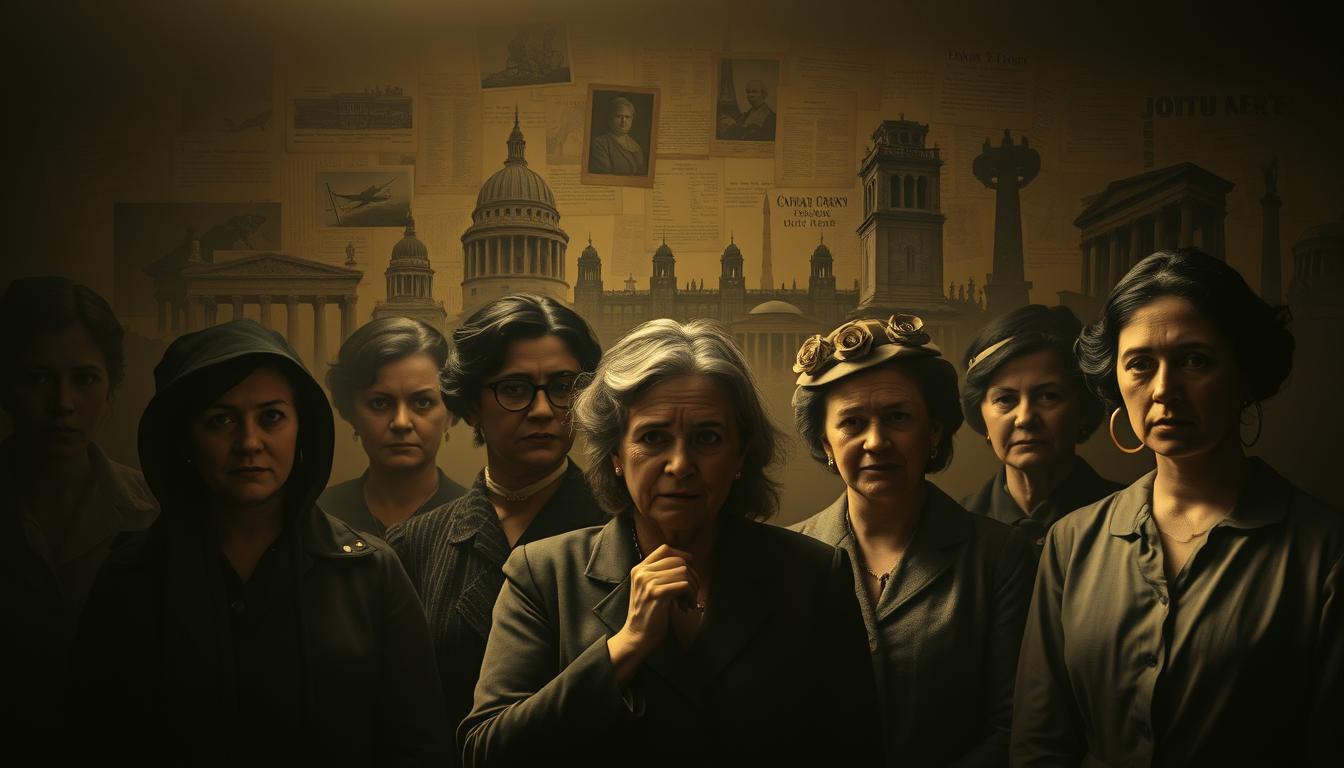
History often forgets the stories of women who changed the world. Sybil Ludington rode 40 miles at midnight in 1777 to warn militia about British forces. Claudette Colvin refused to give up her bus seat nine months before Rosa Parks.
Women like Jane Addams fought for immigrant rights at Hull-House. Hedy Lamarr made wireless tech innovations. Their contributions show how women’s achievements have been erased from history.
Women like Rosalind Franklin, whose DNA image helped discover the double helix, were overlooked. This article tells their stories, celebrating their legacies. It challenges the erasure that has hidden them in plain sight.
The Importance of Recognizing Forgotten Women in History
History shapes our view of the world, but historical gender bias has erased women’s achievements. Countless stories, from science labs to battlefields, remain untold. Rosalind Franklin’s X-ray images revealed DNA’s structure, yet her work was uncredited for decades.
Mary Seacole, a Jamaican-Scottish nurse, aided soldiers in the Crimean War with bravery equal to Florence Nightingale. Yet, she was overshadowed.
These omissions show gender historical inequality. The Matilda effect, named by historian Margaret W Rossiter, highlights how women’s scientific discoveries are often credited to men. Their absence distorts history.
Without women’s history importance, society misses out on role models and half of human progress.
“I wish to persuade you to use your reason,” wrote Mary Wollstonecraft in 1792, challenging the era’s limits on women’s potentials. Her words are as relevant today.
Restoring women to history means rewriting our stories. Bessie Coleman, the first Black woman pilot, and Sor Juana Inés de la Cruz, a 17th-century scholar, show women have always led change. Their legacies inspire today’s activists, like Wangari Maathai, who planted millions of trees.
Every name we uncover, like Enheduanna and Noor Inayat Khan, enriches our shared heritage.
Ignoring these voices perpetuates inequality. By uncovering these stories, we honor the past and empower the future. History belongs to everyone, not just those in power. The fight for equity starts with telling the full truth.
Early Trailblazers: Women in Ancient Civilizations
Before male-centric histories dominated, ancient female authors left their mark. Enheduanna, a high priestess in 23rd-century BCE Sumer, wrote hymns to the goddess Inanna. She is the first named author in history. Her work and Egeria’s 4th-century diary, The Travels of Egeria, show how women in antiquity shaped religion and exploration.
Egeria’s writings about her Holy Land journey are a rare glimpse into her era.

Women also held leadership roles. Melisende of Jerusalem ruled as queen from 1131 to 1153, managing her kingdom through wars and diplomacy. Hypatia of Alexandria, a mathematician, taught at the Library of Alexandria. These ancient female leaders and early women pioneers broke societal barriers.
Though few records survive, their stories suggest a past where female historical firsts thrived. Their legacies remind us that female innovation and power were as vital as men’s—even when history tried to erase their names.
Revolutionaries: Women Who Shaped Political Landscapes
Many women changed governments and laws but are often forgotten. From ancient queens to modern activists, their work is often overlooked. Their struggles show how barriers erased their legacies.
Melisende, Queen of Jerusalem, ruled for decades but is now barely remembered. Despite her husband trying to sideline her, she led a civil war to keep power. Her achievements, like building convents and commissioning art, are rarely noted.
Caroline Norton used her personal struggles to push for change. After facing abuse, she fought for custody rights and property laws. Her efforts led to the 1839 Custody of Infants Act, showing how women can change laws despite obstacles.
Ani Pachen, a warrior nun, led 600 fighters against Chinese occupation in 1958. Imprisoned for 20 years, her bravery mirrors that of many forgotten female leaders. Her story highlights how these women shaped global power.
Claudette Colvin protested on a bus in 1955, nine months before Rosa Parks. Despite starting the Montgomery boycott, she was forgotten due to personal issues. This pattern shows how female leaders are judged differently than men, erasing their contributions to history.
These stories remind us that political change relies on many unsung voices. Their legacies need recognition to complete the story of history.
Unsung Heroes of Science and Technology
History books often miss out on female scientists overlooked who changed our world. Rosalind Franklin’s Photograph 51 was key to figuring out DNA’s structure. But her work was shared without her permission, letting men take the credit.
Jocelyn Bell Burnell was the first to find pulsars, but her adviser got the Nobel Prize alone. These stories show how gender bias in science erased women’s scientific contributions for years.
Women like Hedy Lamarr, who invented frequency-hopping technology for torpedoes, were ignored. Grace Hopper was a pioneer in COBOL programming, but her work was forgotten. Their women in STEM history is incomplete without these pioneers.
Despite obstacles, women like Katherine Johnson helped land Apollo 11. Jennifer Doudna won a 2020 Nobel for CRISPR. Yet, only 30% of STEM researchers are women, and women authors are in just 25% of scientific papers.
The legacy of exclusion is strong, from Lise Meitner’s Nobel snubs to Vera Rubin’s dark matter work ignored for years. Finding these stories is important. From Ada Lovelace’s 19th-century algorithms to Gladys West’s GPS work, their achievements challenge the idea of male genius.
Recognizing these female scientists overlooked is not just about history. It’s about creating a future where all innovators are valued.
Visionaries in Arts and Literature
For centuries, the stories of female artists have been overlooked. Yet, their legacies live on. Rabia Balkhi, a 10th-century poet-princess from Afghanistan, left behind verses that tell of tragedy. It’s said she wrote her final words in blood before being silenced.
Her name is remembered today, but her image was recently erased from a university wall in Kabul. This act of erasure is part of a larger pattern. Forgotten women writers like Emilia Lanier were once unknown. Her book, published in 1611, was forgotten for over 300 years, until it was rediscovered in 1975.
Women like Phillis Wheatley broke barriers by publishing the first English play by a woman in 1606. Others, like the Brontë sisters, used pseudonyms to get their work noticed. Women poets like Balkhi and Wheatley paved the way, despite the obstacles they faced.
Ayesha Singh’s massive artwork, “Skewed Histories,” now spans gallery walls, highlighting these gaps. It serves as a visual call to action.
Today, books like Katy Hessel’s 2022 release, The Story of Art Without Men, bring these stories to light. Exhibitions like “Action, Gesture, Paint” at London’s Whitechapel Gallery showcase 81 women artists who were once ignored. Despite setbacks, like the Trump administration’s 2020 cuts to equity programs, their stories continue to shine. Every brushstroke and verse, once hidden, now shines brightly in the spotlight.
Groundbreakers in Sports and Athletics
Kathrine Switzer made history by running the 1967 Boston Marathon. Race officials tried to stop her, but she didn’t give up. Her bravery broke down gender barriers in sports, inspiring others.
Gertrude Ederle also made a big splash in 1926. She swam the English Channel faster than any man. Both women showed that sports have no gender limits.

Toni Stone became the first woman to play professional baseball in 1953. Manon Rheaume made history in the NHL in 1992. Their stories show the power of determination.
Alice Coachman won Olympic gold in 1948, the first Black woman to do so. She trained on dirt tracks and over sticks. Her success shows talent can thrive despite challenges.
Today, athletes like Becky Hammon are breaking new ground. Janet Guthrie was the first woman in NASCAR in 1976. Billie Jean King’s 1973 match against Bobby Riggs was a turning point.
Despite their achievements, women are underrepresented in sports. Only 8 women made ESPN’s 2023 top athletes list. Yet, every milestone, from Wilma Rudolph to Serena Williams, shows the power of perseverance.
Women in Social Justice Movements
History often forgets female activists forgotten who risked everything to fight injustice. Claudette Colvin, just 15, refused to leave her bus seat nine months before Rosa Parks’ famous protest. Her arrest was ignored because of her skin tone and later pregnancy. Colvin’s bravery shows how women’s rights pioneers faced unfair treatment in the movements they helped create.
Pauli Murray, a female social reformers, wrote legal arguments that Thurgood Marshall used in Brown v. Board of Education. Her 1965 essay linked race and gender discrimination, yet her name is less known than her male peers. Fannie Lou Hamer also fought hard, organizing voter drives despite beatings. Her 1964 speech at the Democratic National Convention exposed the violence she faced.
At the 1963 March on Washington, women protest leaders like Diane Nash and Coretta Scott King were overlooked. Marchers were told to march separately “with their husbands.” Nash, who helped plan the Nashville sit-ins, later said: “We were the heart of the movement but not the face.”
These stories show how women were erased from history. Gwendolyn Zoharah Simmons, one of three women in SNCC’s 1964 Freedom Summer, said male leaders downplayed women’s work. Yet, women like Daisy Bates, who guided the Little Rock Nine, faced cross burnings but got less credit than men. Their strength continues to inspire today’s movements, proving they deserve recognition.
Female Innovators in Business
Josephine Cochrane invented the dishwasher in 1886, starting her journey as a women entrepreneurs history maker. She founded Garis-Cochrane Manufacturing, which later became part of KitchenAid. Her story is similar to others like Mary Anderson’s windshield wipers and Melitta Bentz’s coffee filter. These female business pioneers are often women inventors overlooked in textbooks.

Madam C.J. Walker built a haircare empire from just $1.50 a day. Estée Lauder’s “Tell-A-Woman” sales strategy made her cosmetics a luxury item. Their achievements, part of the female innovation history, are often forgotten. Eliza Lucas Pinckney’s 18th-century indigo success and Sandra Lerner’s tech breakthroughs show how women overcame barriers. Yet, their names are often forgotten businesswomen in histories.
From dishwashers to hybrid cars, their innovations changed industries. Their stories need to be included in the women entrepreneurs history we teach today. Their legacies remind us that business progress relies on voices once silenced—voices now rising from the pages of overlooked chapters.
Overlooked Contributions in Medicine
Henrietta Lacks, a Black mother from Virginia, became a female medical pioneer without her knowledge. Cells from her cervical cancer biopsy, taken without consent in 1951, became the HeLa cell line. These cells revolutionized medical research, aiding polio vaccines, gene mapping, and cancer studies. Yet Lacks died poor, buried in an unmarked grave, her legacy erased from textbooks. Her story mirrors the erasure of countless overlooked healthcare women who shaped modern medicine.
Rebecca Lee Crumpler, the first African American women doctors history graduate in 1864, authored a medical guide for Black communities. Elizabeth Blackwell, the first woman to earn a U.S. medical degree, faced ridicule yet founded hospitals for underserved populations. Their achievements highlight systemic barriers faced by female medical researchers, whose innovations often went uncredited. Fanny Hesse’s 1881 suggestion to use agar for bacterial cultures and Esther Lederberg’s discovery of the lambda phage in 1950 advanced microbiology—but their names remain obscure.
Modern female medical pioneers like Katalin Karikó and Kizzmekia Corbett bridged gaps in mRNA science and vaccine development during the pandemic. Yet disparities persist: 15% of U.S. gastroenterologists are women, and female doctors face ergonomic challenges with lab tools designed for men’s hand sizes. The exhibit “Beyond Home Remedy” highlights herbal texts from 16th-century Englishwomen, whose work as healers was dismissed as “witchcraft” or domestic labor.
These stories reveal a pattern: contributions by overlooked healthcare women are often sidelined, yet their work underpins medical progress. From Henrietta Lacks’ cells to midwives’ herbal guides, their legacies demand recognition. Addressing these gaps requires valuing the female medical researchers who shaped—and continue to shape—the future of healthcare.
Forgotten Women in Environmentalism
History often forgets the female environmental pioneers who led conservation efforts. In the early 1900s, California women’s groups fought to save Big Basin Redwoods. They made it a state park through publicity campaigns. Yet, their work is now largely forgotten. 
Marjory Stoneman Douglas worked to save the Everglades, calling it a “river of grass.” Her efforts laid the groundwork for today’s conservation. But her work is often overshadowed by men like John Muir.
Rachel Carson’s female environmental pioneers work was mocked when she exposed pesticide dangers in Silent Spring in 1962. Critics called her “hysterical.” Yet, her work led to the creation of the EPA.
“The more I study nature, the more I stand in awe.” — Wangari Maathai, founder of the Green Belt Movement
Kenyan forgotten women ecologists like Maathai planted 51 million trees. But she faced government mockery early on. Indigenous leaders like Quannah Chasinghorse also faced erasure.
Recent research by Traci Bliss shows women’s grassroots efforts built parks and policies. Yet, only 12% of global environmental ministerial roles are held by women today.
Rediscovering these stories is important. From ancient Egyptian botanists to modern climate activists, their work shows environmental stewardship is a women conservationists history of courage and vision. It’s time to tell their full story.
The Role of Women in World Wars
During World War II, women in wartime broke the mold as female resistance fighters and overlooked women veterans. Sisters like the Oversteegen and Hannie Schaft led a Dutch resistance. They sabotaged Nazi plans and helped Jewish refugees. Truus Oversteegen shared how they moved from spreading pamphlets to secret missions.
Forgotten female spies like Josephine Baker helped Free France by hiding messages in sheet music. In the U.S., over 350,000 women served in the military. Yet, many, like the WASPs who flew 60 million miles, were not recognized until later. The 6888th Battalion, an all-Black unit, played a key role in Europe’s mail system, but their efforts are often overlooked.
“We had to prove women could handle danger,” said Truus Oversteegen, reflecting on the resistance’s deadly missions.
On the home front, 6 million American women worked in factories and farms. They built tanks and planes but earned only 53% of what men made. Even Soviet female snipers and pilots, who downed enemy planes, were often left out of victory stories. Their bravery changed history, but their stories are often forgotten.
The Legacy of Forgotten Women: Why It Matters Today
Women’s history is more than old books. It shows us what happens when half of history is ignored. This is why women’s history is important: it helps girls see their own possibilities.
Erasing women like Enheduanna, the first known author, or scientist Laura Bassi, distorts our view of history. It leaves out important parts of human achievement.
The erasure of women’s history has real effects. Schools often skip important stories like He-Yin Zhen’s 1908 translation of The Communist Manifesto. This sparked Chinese feminist thought.
Or the story of Mahapajapati Gautami, who led Buddhism’s first nuns 2,500 years ago. These stories are missing, leading to stereotypes that women should only be at home.
Without knowing our past, we can’t build a future where historical gender equality is possible.
Groups like Project Continua are changing this. They highlight figures like Maymie De Mena, who played a key role in Jamaica’s independence. Even the Chautauqua movement in the 1800s showed how women can drive change when they have knowledge.
But today, libraries often lack balance. Only one NYC collection had equal male and female authors, a student found. This shows how much work is left to do.
Rediscovering these stories is not just looking back. It’s about survival. When girls see Bassi’s science or Zhen’s activism, they dream of new possibilities. Equality is not just a dream; it’s built by telling every story that has been left out.
How to Rediscover and Honor Their Stories
Preserving women’s history begins with curiosity. Check out books like Overlooked Ingenuity or the National Women’s History Museum’s digital archives. You’ll find stories of women like Emily Roebling, who led the Brooklyn Bridge’s construction.
These resources bring to light stories left out of textbooks. You’ll learn about WASP pilots who flew 60 million miles during WWII. And about Frances Perkins, the first U.S. female cabinet member who fought for labor rights.
Researching historical women means looking beyond textbooks. Visit local archives, interview elders, or explore your family’s history. Online platforms like “Our Rights Too!” highlight activists like Dolores Huerta.
Podcasts like Remembering the Ladies share stories of suffragists who fought for the 19th Amendment. Share these discoveries on social media or host talks in schools. This keeps their legacies alive.
Support institutions that preserve women’s history. Donate to museums, volunteer to digitize records, or push for curricula that include women like Alice Ball. Celebrate forgotten females by creating lesson plans or community exhibits.
Every action helps correct the record. It ensures names like WASP pilot Barbara Erickson London, who died in service, are remembered.
Uncovering female pioneers requires action. Read Women Forgotten in History, write blog posts, or mentor youth in research. Their stories shape our world, yet often disappear. By sharing these narratives, we rewrite history—one discovery at a time. Start today, and help ensure no more women’s achievements fade into silence.