







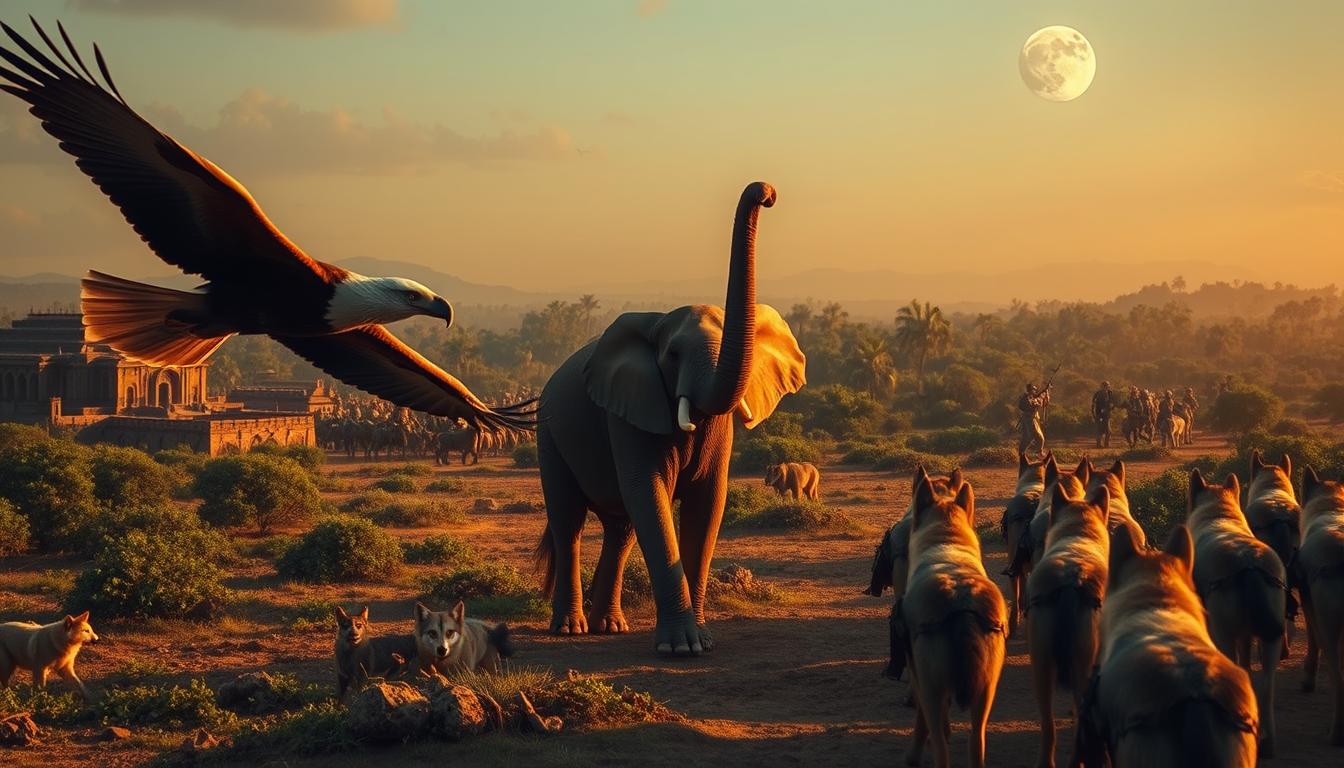
History’s big moments often include animals. Laika, a Soviet dog, was the first living being in space on Sputnik 2 in 1957. Her journey, though sad, showed life can survive in space. This was a key moment for human space travel.
In World War I, Cher Ami, a carrier pigeon, saved 194 U.S. soldiers in France. His message was key to their rescue. The Black Death spread through rat bites, killing 25 million Europeans and changing society.
A pig stole potatoes in 1859, starting the Pig War between the U.S. and Britain. This small incident lasted 13 years. King Alexander of Greece died from a monkey bite in 1920, causing political chaos, as Winston Churchill said, leading to 250,000 deaths.
From space dogs like Veterok and Ugoyok to horses like Jim, animals have helped in science and survival. This article looks at these stories. It shows how animals played big roles in human history, not just as witnesses but as active participants.
The Role of Animals in Warfare
War animals have been our allies in battles for a long time. In World War II, U.S. forces used over 20,000 dogs as military animals. These dogs carried messages, found injured troops, and guarded bases.
Smoky, a small Yorkshire terrier, was a hero. She dragged communication lines through enemy fire, saving 250 soldiers’ lives. Her bravery made her a legend in military history.
Pigeons like Cher Ami were heroes too. This pigeon delivered 12 critical messages, including one that stopped friendly fire, saving 500 soldiers. In Europe, horses carried supplies and riders across battlefields, proving vital in animals in battle scenarios. Their loyalty boosted soldier morale amid chaos.
Animal soldiers faced dangers just like humans. Dogs sniffed out traps, while pigeons flew through gunfire. Though their service raised ethical questions, their impact was undeniable. Their stories remind us of the bond between humans and combat animals, where courage transcended species.
Animals as Symbols of Power
Throughout history, some animals have become symbols of power. Lions and eagles were on the banners of ancient rulers. The British lion’s crest goes back to King Richard I’s time. These animals were more than decorations; they showed who was in charge.
Brandi Bethke, an archaeologist, says dogs were eaten by early elites. This was to gain their “magical” traits. It helped them show their high status.
Today, animal symbols are part of politics. The American Republican Party’s elephant and the Democratic donkey show their lasting impact. Even now, animals like India’s endangered Asian elephants are seen as symbols of good fortune.
In Zimbabwe, the Shona people have a system where each clan has a totem. The lion stands for courage, and the elephant for wisdom. This connects families to nature’s laws.
These symbols are seen in art, governance, and culture. They show animals are more than just creatures; they are key to our identity. From Zulu clan unity to the secretary bird on South Africa’s coat of arms, their influence is strong. Saving these animals helps protect the heritage they represent.
The Impact of Animals on Exploration
Exploration animals have always been by our side in exploring the unknown. During Meriwether Lewis and William Clark’s 1804 journey, they found 122 new species. Each animal they met was a new discovery.
Lewis wrote about the pronghorn’s speed and the jackrabbit’s leaps. These details helped them navigate new lands.
“The jack rabbit could leap 18 to 20 feet in a single bound.” — Meriwether Lewis, September 1804
Royal explorers like Roald Amundsen used sled dogs in his 1910 Antarctic journey. He had 116 dogs, but only 39 made it back. Their strength was key to his success.
In space, monkeys Able and Baker orbited Earth in 1959. They survived tests that helped humans reach space. They were true pioneers.
From Lewis’s prairies to Amundsen’s ice, animals were more than tools. They were partners in historical animal navigation and survival. Without them, our maps would be incomplete, and many horizons would remain unexplored.
How Animals Influenced Agriculture
Agriculture has a long history, and agricultural animals played a key role. Dogs were the first animals domesticated. They helped manage livestock like sheep and goats, making the shift from hunting to animal farming development easier. “This partnership likely started more than 15,000 years ago,” says James Serpell, a University of Pennsylvania expert.
He notes how dogs helped societies transition to herding-based ones.
“Dogs would have helped humans to domesticate animals like sheep or goats with their natural herding ability,” emphasized Serpell, highlighting this symbiotic relationship’s significance.

The livestock revolution grew as humans domesticated oxen and horses. These animals plowed fields and increased crop yields. This led to bigger farms and more food, helping populations grow.
By 6000 BCE, farming history shows most key livestock species—cattle, goats, pigs—were already under human care in the Fertile Crescent.
Animal domestication changed societies. Animals provided labor, fertilizer, and pest control, keeping early farming systems going. The Neolithic Revolution, starting 12,000 years ago, turned nomadic tribes into settled farmers. This laid the foundation for civilizations.
Today, agriculture is shaped by this ancient partnership. It shows animal domestication impact is vital to our global food systems.
Animals in History-Making Discoveries
Animal scientific discoveries started in space. Russia’s Bion satellites and NASA’s Biosatellite missions sent tortoises, rats, and spiders into space. Anita and Arabella, two spiders aboard Skylab 3 in 1973, proved web-spinning adapts in zero gravity. These historical animal experiments ensured human space travel safety.
Medical advances rely on animal contributions to science. The cloning of black-footed ferrets using cells from Willa revived a near-extinct species. California condors, once 22 individuals, now exceed 500. Their recovery included studying a rare virgin birth, the first in wild birds. These breakthroughs show how animals aid conservation science.
Recent studies reveal more: 80% of Iowa deer tested positive for active COVID, giving clues about zoonotic diseases. Sea slugs’ self-decapitation and cockatoos’ tool-use inspire robotics and biology. Even a gray whale’s 16,700-mile migration expanded marine ecology knowledge.
From ancient space tests to today’s genetics work, animals remain vital. Their roles in labs and wild continue unlocking answers to human challenges.
Animals as Messengers of Change
Throughout history, animals have played a key role as animal messengers in history. They delivered vital information during crises. In World War II, carrier pigeons like Cher Ami saved nearly 200 soldiers by carrying a message through heavy fire. These birds showed their worth when human technology failed, highlighting their role as 
Even today, animals are signaling change. Canaries in coal mines warned miners of deadly gases, saving many lives. Their small voices were early warnings of environmental dangers. Now, African giant pouched rats are trained to sniff out landmines, using their animal communication impact to protect communities. These rodents find explosives that radar misses, helping to clear post-conflict zones.
Military strategists also used marine animals. During the Cold War, U.S. and Soviet navies trained dolphins to locate mines and track divers. This use of animal abilities in warfare shows how animals signaling change influenced naval tactics. Also, wildlife migrations alert humans to environmental changes, like birds fleeing storms or fish movements indicating disasters.
From winged heroes to underwater scouts, animals have long been our partners in survival. Their instincts guide us, whether through their wings or trained snouts. This shows that nature’s messages often hold lifesaving answers.
Animals in Cultural Movements
Animals have played a big role in social movements for a long time. In the past, dogs were buried with goods, showing their importance. But as farming grew, this practice changed.
By the 19th century, new values emerged. The SPCA in Montreal became a leader in animal care. Pet cemeteries, like the one by the Kanien’kehá:ka community, showed how human and animal bonds changed.
“Compassion for animals is the litmus test of civilization,” wrote Henry Stephens Salt in 1892, a philosophy that later fueled movements like Earth Day and veganism.
Today, animals are symbols of important causes. The bald eagle stands for freedom, and giant pandas for conservation. Laws, like Canada’s Orca Protection Act, show how symbols lead to policy changes.
The $221 billion U.S. pet industry shows the . It mixes business with caring for animals.
But there are challenges. The 1966 Animal Welfare Act doesn’t cover farm animals, leading to ongoing debates. Activists use to push for change. Their efforts show animals are more than just bystanders; they drive us to rethink our place in nature.
The Connection Between Animals and Health
From ancient times to today, animals in medicine history show how they’ve helped us. Edward Jenner’s smallpox vaccine came from cowpox in cows. This was a big step in therapeutic animal history. These historical medical animals helped create vaccines and treatments we use now.

Disease-detecting animals like dogs finding cancer or canaries warning miners are amazing. They show nature’s early warning signs. Today, we train animals to find health threats. We also learn from old practices, like using leeches in surgery or reptile remedies in Latin America.
Zoonotic diseases like Bubonic Plague or avian flu show we’re connected to animals’ health. Today, 75% of new diseases come from animals. This drives global health policies. The One Health initiative brings experts together to fight antibiotic resistance and climate-driven outbreaks. This shows that when animals are healthy, so are we.
Animals in Entertainment and Media
For thousands of years, animals have been a big part of human culture. They’ve starred in stories from ancient Mesopotamia to today’s movies. Ads like PG Tips’ chimpanzee ads in the 1950s raised important questions about animal rights, marking big moments in animal performers history.
Zoos and rodeos were once loved, but now they’re under close watch. Every year, over 180,000 bulls die in bullfights. Zoos lose ten animals for every one they show. Movies like Blackfish have shown the dark side of animal entertainment, leading to changes in laws.
The 2007 Cloverdale Rodeo incident, where a calf died, led to the event being canceled. This shows how media can push for change.
“The public deserve transparency about how animals are treated behind the camera.” — PETA Report, 2020
Today, there’s a mix of animal media influence and ethics. Groups like the American Humane Association make sure animals are safe. CGI is also used less, but animals are sometimes needed for real scenes.
As people want to know more about animal treatment, the industry is changing. It’s finding a balance between old traditions and new ethics. Animals continue to shape our world, both on and off the screen.
Legends and Folklore Involving Animals
Animal folklore has shaped cultures for thousands of years. Stories like the Tsimshian tale of Asdiwal and a bear woman show how myths mix humans and animals. These tales explain nature or teach lessons. 
Mythical animals are found in cultures worldwide. Ovid’s Metamorphoses tells of humans becoming animals. The Scots believe in silkies, creatures like seals. These stories show both fear and wonder in cultures.
Legendary animals also shape beliefs. In Egypt, gods like Bastet (cat) and Horus (hawk) showed animal traits. Native American totem poles honor clans tied to animals, showing animal myths in society. Today, stories of animals like the golden eagle inspire saving nature.
These tales live on in today’s media and rituals. The Jersey Devil legend is part of local stories, while the Thunderbird is in Indigenous tales. From old rituals to new art, animal myths connect nature and imagination, guiding us.
Conclusion: Animals as Agents of Change
For thousands of years, animals have changed human societies in big and small ways. From Plato’s joke about a chicken to today’s awards for animals, their impact is clear. Dogs, as Angela Perri said, are like “Swiss Army knives,” helping in hunting, war, and as friends. A 2017 study showed they are naturally friendly, showing how humans and animals have worked together for a long time.
Animals have made big changes: horses changed medieval towns, elephants helped colonial economies, and Soviet foxes showed how breeding changes behavior. Stories like Orwell’s Animal Farm and T.H. White’s The Once and Future King show their importance in our stories. Domestication turned wolves into dogs, changing ecosystems and cultures. This shows how animals and humans have always worked together, sometimes as equals.
Today, it’s important to understand this history. Debates about animal rights are like fights for justice for all. New ideas like robotic “animal” guides or conservation efforts show how we’re learning to work with animals better. By seeing animals as more than tools, we can take better care of them. Their stories teach us that we’ve always grown together, even with a simple joke from a chicken.