







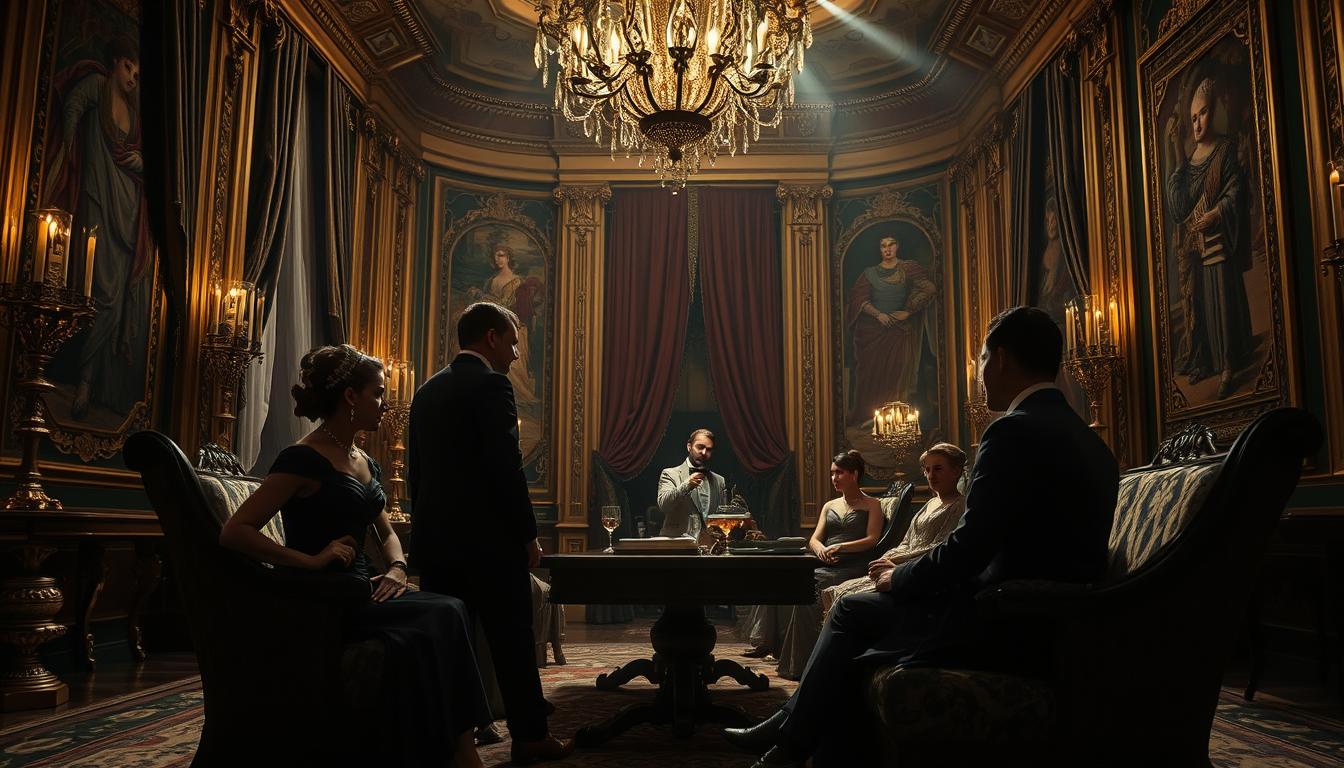
When we think of kings and queens, we see shiny crowns and big palaces. But there’s a darker side to their stories. This book uncovers the royal scandals and family secrets that history often keeps hidden.
For centuries, monarchy scandals have changed empires and broken hearts. Stories like King George VI’s secret surveillance of Edward VIII show even rulers deal with drama. These tales reflect our own battles with love, power, and betrayal.
From Anne Boleyn’s tragic end to Edward VIII’s shocking abdication, we learn the real stories behind the myths. Princess Anne’s 1974 kidnapping attempt and Anthony Blunt’s secret life as Queen Elizabeth’s art advisor show no crown is safe from scandal.
The Scandalous Affair of King Edward VIII
In December 1936, Edward VIII made headlines by stepping down to marry Wallis Simpson, an American divorcee. This move sparked the Edward VIII abdication scandal, leading to a British monarchy crisis. Edward chose love over duty, breaking with tradition and norms.
Wallis Simpson’s past as a twice-divorced socialite was a major controversy. British officials worried about her influence, given her connections to Nazi figures. Her hosting of Joachim von Ribbentrop, Hitler’s foreign minister, raised more concerns.
Edward’s 1937 visit to Germany with Wallis, where they met Hitler, added to the suspicions. After abdicating, Edward became the Duke of Windsor. During WWII, he was sent to the Bahamas by PM Winston Churchill, fearing his pro-Nazi views.
Declassified files revealed a 1940 letter from Edward praising Hitler’s policies. Though the monarchy denied any disloyalty, evidence of his controversial alliances remains. Edward’s story is a reminder of the conflict between love and duty.
His legacy, marked by the Edward VIII abdication scandal, changed how people view royal power. Even today, over 80 years later, discussions continue about how Edward’s decision impacted history.
Queen Victoria’s Family Secrets
Queen Victoria’s time as a 19th century monarch was filled with secrets and scandals. Her close bond with Scottish servant John Brown, after Prince Albert’s death, caused a stir. Newspapers called her “Mrs. Brown,” adding to the gossip.
Despite the rumors, Victoria’s private journals showed her use of secret information to keep her dynasty strong. These journals spanned 69 years, revealing her strategic moves.

Victoria also built secret networks to avoid government checks. She used letters and codes to manage 19th century politics. This double life, as a grieving widow and a wise ruler, shaped her legacy.
Modern shows like The Firm: Blood, Lies and Royal Succession explore how her secrecy affected global power.
Family tragedies added to the mystery. Her nine children faced health issues, including hemophilia, kept hidden by court rules. Yet, Victoria’s diary, edited by her daughter Beatrice, hid her true feelings, including her bond with John Brown.
These secrets show a queen balancing her public role with her personal life. They leave us wondering about love, power, and the price of legacy.
The Dark Side of King Henry VIII
Henry VIII’s reign was marked by Henry VIII wives execution and Tudor royal scandals. His charm was overshadowed by King Henry cruelty. His quest for a male heir led to the Anne Boleyn scandal. He had her tried for treason in 1536.
Anne’s beheading, just three years after marrying Henry, showed his ruthlessness. It became a symbol of his cruelty.
Five of his six wives faced royal marriage controversies. Two of them lost their lives. Catherine Howard, his fifth wife, was accused of adultery in 1542.
Henry’s paranoia went beyond his wives. Over 72,000 executions happened during his rule. Thomas More and Margaret Pole, a 67-year-old grandmother, were among them.
By 1542, Henry weighed nearly 400 pounds. He used a litter to move due to his health issues.
“the greatest tyrant that ever was in England”
His reign also ruined England’s finances. The Dissolution of the Monasteries took wealth from religious places. But it didn’t fix the economy.
Henry dissolved Parliament in 1536. He bullied his advisors and changed religious laws to fit his needs. His final marriage to Catherine Parr in 1543 was marked by threats of execution.
Henry’s story is one of tragedy and tyranny. His daughter Elizabeth I, born from Anne Boleyn, ruled wisely. But Henry’s name is forever linked with fear.
Behind the Tudor royal scandals was a king who changed England through fear, ambition, and a strong will. He controlled his destiny and that of his realm.
Behind the Curtain: The Royal Mistresses
Behind the gilded halls of European palaces, royal mistresses wielded power beyond romance. Madame de Pompadour, for example, used her king’s mistresses power to shape policies and cultural trends for Louis XV. Her influence reached into arts and diplomacy, showing how royal mistress influence could match that of official advisors.
Nell Gwyn, Charles II’s mistress, used her wit to secure titles for her children. This was a stark contrast to the illegitimate royal children often erased from history.

History’s court scandals history is filled with stories like Marie Antoinette’s affair with von Fersen, which fueled public distrust. Even Queen Victoria’s hidden relationships, like her bond with John Brown, sparked whispers in 19th-century Britain. These relationships had royal affairs consequences: some mistresses, like Sweden’s Countess Douglas, gained estates, while others faced ruin.
Catherine the Great, for example, used lovers like Poniatowski to strengthen her rule after overthrowing her husband.
“A king’s ear is the highest prize,” wrote historian Antonia Fraser. “Mistresses held it tighter than crowns.”
Data shows 26 reigning monarchies today deal with such scandals. Belgium’s King Albert II acknowledged a child 51 years after birth, echoing patterns where illegitimate royal children disrupted dynasties. From Nell Gwyn’s survival through blackmail to Madame de Pompadour’s posthumous tribute, these stories show how personal alliances shaped empires. And why their legacies continue to make headlines today.
Scandals in the House of Windsor
In 1982, a shocking incident at Buckingham Palace exposed serious security failures. Drunk laborer Michael Fagan broke into the palace, meeting Queen Elizabeth II. She calmly offered him a cigarette, waiting for help to arrive.
She whispered, “I’ve been invaded,” a moment that stunned everyone. The
“Bloody hell, ma’am, what’s he doing here?”
1992 was a tough year for the Queen, known as Annus Horribilis. Three royal divorces—Prince Andrew, Princess Anne, and Prince Charles—shook the public. Scandals like “Tampongate” and “Squidgygate” made fun of the royals.
The fire at Windsor Castle cost millions, adding to the crisis. These challenges made the monarchy question its image.
Today, the monarchy faces more controversies. Prince Andrew’s links to Jeffrey Epstein caused outrage, leading to lost titles and a 2021 lawsuit. Meghan Markle’s 2020 lawsuit against the Mail on Sunday showed family tensions and security issues.
These incidents show the Windsors’ ongoing struggles with scandal and tradition. Each crisis tests their ability to adapt in a world that demands openness.
The Tragedy of Princess Diana
Princess Diana died in a Paris tunnel on August 31, 1997. This event caused widespread sadness. Her royal marriage breakdown with Prince Charles was well-known. This was due to BBC interviews and books like “Diana: Her True Story,” which showed her emotional struggles.
By 1996, they were divorced. But her death suddenly changed the focus. The crash was blamed on driver Henri Paul’s alcohol level, which was very high. A British jury later said it was an unlawful killing, pointing to paparazzi’s royal harassment as a factor.

There were big security problems. Diana often managed to get away from her guards, as The Secret Royals explains. “She’d slip away like a spy,” people said, showing Diana security issues.
Henri Paul had connections to French intelligence, adding to Diana conspiracy theories. There were rumors of a $1,000 payment to him before the crash. The Mercedes hitting a pillar, not another car, left many questions.
“There were three of us in this marriage,” Diana said publicly, showing the marriage problems. Her time with Dodi Fayed made the media even more aggressive. Her diary hinted at fears of a staged accident, adding to the mystery.
Despite many investigations, like Operation Paget, doubts remain. Diana’s work and her tragic end have left a lasting impact. Her death changed how people see royalty.
The Controversial Life of King Louis XVI
Louis XVI’s reign sparked the Louis XVI French Revolution. His wife, Marie Antoinette, was known for her lavish lifestyle. The 1785 diamond necklace affair, a scandal, damaged her reputation.
Though she was innocent, rumors spread. This deepened public anger, leading to the royal execution history that loomed.
The phrase let them eat cake myth symbolized the monarchy’s unawareness. It never proved true but stuck, showing the French monarchy collapse. By 1789, Louis XVI’s failure to solve famine and debt led to the fall of the Bastille.
After his arrest in 1792, Louis faced trial for treason. His 1793 execution was France’s first royal execution history of a king. Marie Antoinette followed in 1793, her last words showing defiance.
Their downfall ended 1,000 years of monarchy, starting a republic. Today, their story highlights debates on inequality. It shows how excess and disconnect can bring down even the most powerful.
The Opulent Scandals of the Russian Royals
At the heart of the Romanov family scandals was Grigori Rasputin, a mystic. His Rasputin royal influence over Tsarina Alexandra was strong. He was seen as a savior for their son Alexei’s hemophilia, but his behavior was scandalous.

“To save Russia I must abdicate,” Tsar Nicholas II wrote in his diary, marking the Tsar Nicholas II downfall. His decision in 1917 ended 304 years of Romanov rule. The Russian revolution royal family faced even more challenges.
Captured by Bolsheviks, the family’s Russian royal execution in 1918 ended their lives in a basement. Bullets and acid couldn’t stop the mythmaking—over 20 impostors claimed to be Anastasia before DNA confirmed their deaths in 2007.
Centuries of secrets and missteps led to tragedy. Nicholas’s failure to address famine, war, and Rasputin’s excesses lost him his people. Even after their execution, the Romanov legacy lives on.
In 2023, Grand Duke George’s wedding brought back media interest, showing scandals never truly fade. From Rasputin’s shadow to the Russian revolution royal family’s brutal end, their story warns of power, faith, and the price of keeping secrets.
Recent Royal Scandals that Shocked the World
The Prince Andrew scandal changed how people see the monarchy. Accusations of a Jeffrey Epstein royal connection led to Prince Andrew stepping back. This was after Virginia Giuffre made claims against him. His 2019 interview made things worse, leading to calls for him to be held accountable.
The Sussex royal family split happened when Meghan Markle and Prince Harry decided to leave. Their 2021 interview showed family problems and challenges they faced. It brought attention to modern royal controversies worldwide.
These cases showed the monarchy’s old ways have flaws. It’s important for them to be open while keeping their traditions alive.
The Tryst That Changed History: Charles and Camilla
In 1989, a seven-minute call between Prince Charles and Camilla Parker Bowles caused a big stir. This tampongate controversy changed the royal marriage scandal forever. A radio fan recorded their 1,574-word chat, revealing their Charles and Camilla affair.
This leak, known as “Black Wednesday,” happened at the same time as Princess Diana’s call scandal. It made 1992 a terrible year for Britain.
Charles faced a lot of anger for cheating on Diana, who sadly died in 1997. But over time, Camilla’s image improved. By 2023, her coronation as Queen Consort was met with less opposition than expected.
How did this royal second marriage go from scandal to acceptance?
“I can only say I’m truly very, very sorry,” Charles said on TV in 1994, after divorcing Diana in 1996. His wish to marry Camilla, despite the criticism, led to their 2005 union—a milestone in balancing love and duty.
From the shadows of the Charles and Camilla affair to their 2023 crowning, their story shows the monarchy’s strength. Modern polls show most Britons now accept their relationship. This proves that time can soften even the sharpest controversies.
Lessons Learned from Royal Scandals
Royal scandals have shaped the monarchy for centuries. Kings once flaunted mistresses openly, but now royals face constant scrutiny from social media. The royal privacy evolution is clear: today, a prince’s Nazi costume or a princess’s leaked texts make headlines.
Modern scandals push monarchies to balance tradition and transparency. This is a critical balance for their survival.
Royal family modernization often comes after crises. Queen Elizabeth’s 70-year reign saw big changes, from Princess Diana’s legacy to Prince Harry and Meghan’s 2020 exit. These moments pushed the institution toward accountability, addressing issues like diversity and mental health.
Even scandals like Prince Andrew’s legal battles over Epstein’s crimes pressured the constitutional monarchy changes. This reshaped how royals engage with public opinion.
Public relations for the royal family now focus on being relatable. The Sussexes’ Oprah interview or Charles’s marriage to Camilla required reinvention. Yet, scandals also show a paradox: while privacy erodes, the monarchy’s mystique endures.
The British taxpayer spends £50 million yearly on royal duties, but polls show majority support. This resilience comes from adapting, like the 1997 Dodi Fayed tragedy reshaping Diana’s legacy into a public service icon.
Scandals have taught monarchies to evolve or perish. The Profumo scandal’s 1963 fallout or Bill Clinton’s impeachment show how personal misconduct impacts leadership globally. Yet, the monarchy’s survival for over 300 years proves its ability to absorb crises.
As new generations demand authenticity, the royal family’s public relations must blend old grandeur with modern accountability. Scandals, though disruptive, are the monarchy’s hidden teachers—proving even ancient systems can thrive by learning from their mistakes.