





The United Nations started with a big goal: to end war through teamwork. Its Charter’s first lines said they wanted to save future generations from war. This led to a system where diplomats could solve problems peacefully, laying the groundwork for global peace.
Ever sense 1945, there’s been no world war. But today, more countries face violence than before. The 2016 peace resolutions show leaders are changing their ways. They now include women, youth, and minorities in solving today’s problems.
There have been wins, like ending Liberia’s 15-year war and banning landmines. But, with military spending hitting $2.4 trillion in 2023, we need to keep pushing for peace. The UN’s history shows that teamwork can lead to peace, but it’s an ongoing effort.
The Role of Diplomacy in Global Unity
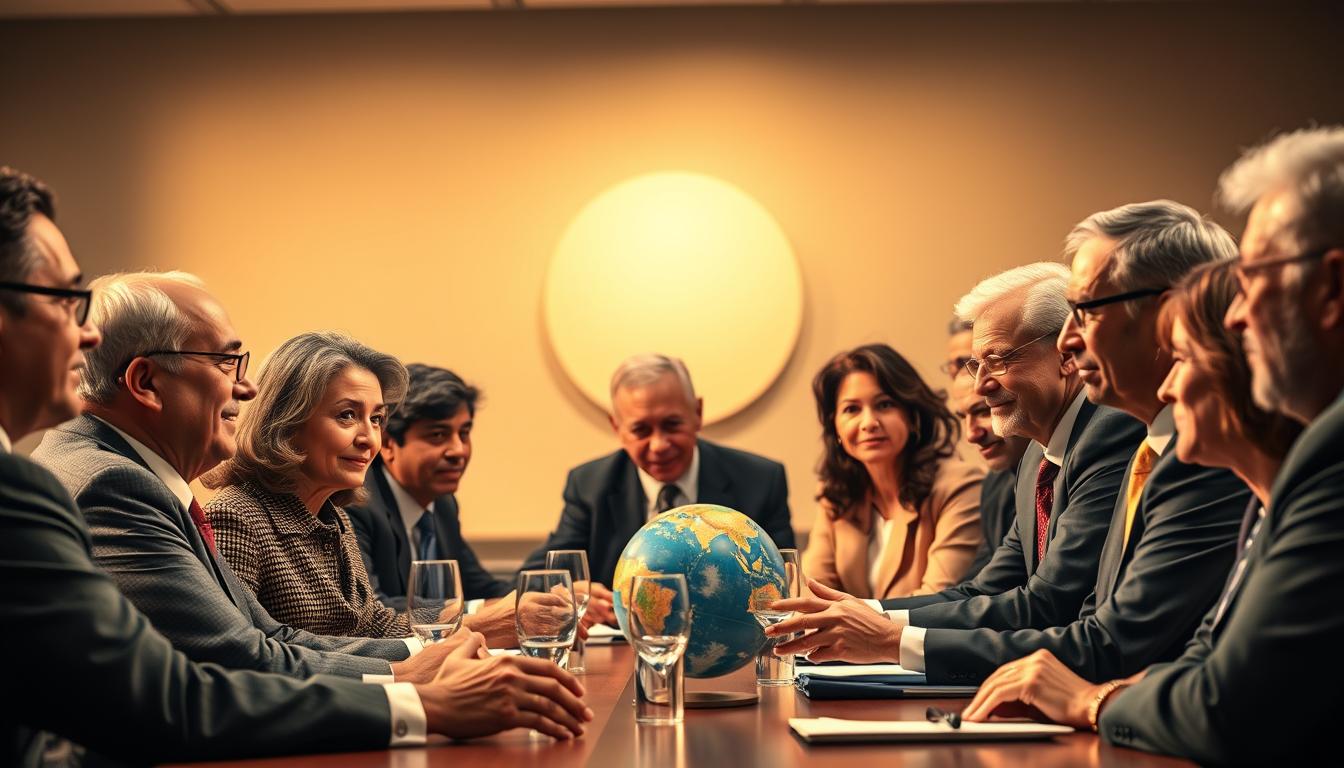
From 51 founding members in 1945, the United Nations has grown to 193 nations today. This growth shows a common belief in the importance of security council diplomacy and conflict resolution strategies for global peace. The UN’s main goal is to use words instead of weapons. “Diplomatic peacemakers” like UN mediators work to turn disagreements into agreements.
Every year, world leaders meet at the UN General Assembly. It’s called “global diplomacy speed dating.” They meet privately to solve disputes before they get worse. These talks often stop crises from turning into wars.
Behind the scenes, diplomatic peacemakers use strategies like mediation and arbitration. The UN’s Charter requires members to solve disputes peacefully. This principle has been upheld for 75 years, saving countless lives. Even in tough times, the UN’s “Uniting for Peace” mechanism ensures progress when the Security Council is stuck.
“We must act as architects of peace, not bystanders to war.” — UN Secretary-General António Guterres
Today, over 1,000 NGOs work with the UN to promote peace. They do important work like demining and protecting children in conflict zones. Their efforts show the power of diplomacy to save lives and build trust. History shows that lasting peace comes from choosing to talk instead of fight.
Influential Leaders in Peace-Building
Every September, world leaders meet at the UN General Assembly. This is where leaders who united nations create peace plans. But many peacemakers work behind the scenes, making big changes quietly.
People like Ireland’s former U.S. Ambassador Anne Anderson and Ghana’s Emmanuel Asante are great examples. They use patience, understanding of cultures, and bravery in their work. Their efforts show us what it takes to make peace.

Peace talks often rely on these quiet heroes. Lise Filiatrault, Canada’s ex-Ambassador to Senegal, helped bring nations together. Liberata Mulamula started important peace efforts in Africa. They show us that peace comes from both big roles and small actions.
Today, we face big challenges. Women make up only 9.6% of peace negotiators, but groups like Pacific Women Mediators Network are changing this. The 2020 Peacebuilding Architecture Review said working together is key. As we look to 2025, their stories teach us that peace is built in many ways, not just in meetings.
The Formation of the United Nations
In 1945, world leaders came together to united nations formation after two devastating world wars. The San Francisco Conference gathered 50 nations to create the UN Charter. This event marked a new era of collective security, led by leaders who united nations like U.S. President Franklin D. Roosevelt, British Prime Minister Winston Churchill, and Soviet leader Joseph Stalin.
“To save succeeding generations from the scourge of war” became the UN’s guiding principle, etched into its founding document.
Diplomatic peacemakers set up key structures, like the Security Council with veto power for the “Big Four” (later Five). They also created a General Assembly for more representation. The Dumbarton Oaks and Yalta Conferences helped make these decisions, ensuring everyone’s voice was heard while keeping stability in mind. By 1945, 29 nations had ratified the Charter, making the vision a reality.
Today, the UN’s legacy lives on with 193 member states and agencies like the IMF and UNESCO. Its founders’ dream of a world where disputes are solved through dialogue is at the heart of global diplomacy.
Case Studies of Successful Peace Treaties
Peace treaty negotiations often use conflict resolution strategies from diplomatic peacemakers. El Salvador’s 1992 peace agreement is a great example. It made sure 1/3 of land went to women, a big step for gender equality. The UN helped by pushing for laws that followed international standards, as a 2015 UN report showed.
South Africa’s Truth and Reconciliation Commission is another success story. It made sure 30% of election candidates were women, helping to heal the country. A UN mediator said, “Reconciliation isn’t just about laws—it’s about trust.” 
In Guatemala, only two women were in the negotiating team, but their input was key. They helped add important gender provisions to the 1996 peace accords. In Northern Ireland, women formed groups to get a seat at the table in 1997 talks. These examples show how diplomatic peacemakers tailor their strategies to fit local needs, even when women are underrepresented.
Studies of 33 peace processes show that UN involvement over time can make a big difference. For example, Nepal has been working on peace for over a decade. The 2007 Kenya peace deal shows how including everyone in talks can save lives. These stories show that, despite challenges, new ways to solve conflicts can lead to lasting peace.
Challenges Faced by Peace Leaders
Modern conflicts are tough for diplomatic peacemakers. Wars keep coming back in places like the Democratic Republic of the Congo and South Sudan. Violence has deep roots there. Regional tensions and armed groups with advanced weapons make conflict resolution strategies hard.
The UN has 70,000 peacekeepers in 11 missions. But, political divisions among Security Council members often slow things down.
Geopolitical rivalries among the Security Council’s permanent members—U.S., Russia, China, France, and the UK—often block action. Deadlocks over crises in Ukraine and Gaza show how power struggles hinder global peace efforts. Even when agreements are made, they often fail to be implemented.
The 2023 UN resolution 2719, enabling African Union-UN collaboration, is a step forward. But, funding gaps and distrust remain.
Places like Darfur show how cultural and historical grievances can resurface. Kofi Annan’s work on conflict prevention, like the Bakassi Peninsula dispute, highlights the need for early action. Yet, only 15% of UN Sustainable Development Goals are on track, with 50% lagging. This shows systemic underfunding and fragmented global cooperation.
Despite challenges, diplomatic peacemakers keep trying. António Guterres says persistence and innovation are key. Efforts like the Pact for the Future aim to strengthen aid systems. The OECD tracks reforms in global funding. Even with setbacks, these leaders remind us that peace needs patience and resilience.
Women in Leadership Roles
Women peace leaders worldwide are changing diplomacy, but they face big challenges. Despite being over half of the world’s population, they hold only 22.9% of cabinet positions. In peace talks, their voices are often ignored, even though they suffer most in conflicts.
Over 90% of modern war victims are civilians, with women and kids hit the hardest.

UN Security Council Resolution 1325 calls for women’s role in peacebuilding. Research shows that communities with more women leaders, like Rwanda’s 64% female parliament, make more inclusive decisions. Norway’s childcare boost and India’s water projects under female-led councils show real results. But, today, only 25 countries have women as their leaders.
“Peace cannot be achieved without equal participation,” said UN Women’s Executive Director. The newly launched UN Women Leaders Network aims to mobilize 100 global leaders by 2025 to bridge this gap.
Even with progress, it won’t be until 2063 that women have equal numbers in legislatures at current rates. Leaders who united nations through grassroots efforts now push for formal recognition. The 2025 Beijing Declaration anniversary highlights the need: when women lead, peace lasts longer.
The Power of International Cooperation
Effective international cooperation is key to solving global problems. The security council diplomacy led by the UN uses conflict resolution strategies to tackle threats. It can impose sanctions or send peacekeeping forces to calm areas.
But, there are big challenges. The Security Council’s permanent seats have not changed in 75 years, leaving out Africa. The New Agenda for Peace wants to update these structures. It aims to include more developing nations and ensure gender equality.
Global goals like the 17 Sustainable Development Goals need everyone’s help. When countries work together, they tackle big issues like climate change and digital gaps. The UN’s Peacekeeping Operations, under Security Council orders, help stop violence.
To achieve lasting peace, international cooperation must grow. We need stronger financial systems and better AI governance. By being open and working together, we can create a safer world for all.
Technological Advances in Diplomacy

Diplomatic technology is changing how countries work together for global peace efforts. The United Nations uses satellite monitoring and AI to check if peace agreements are kept. It also predicts where conflicts might start.
Tools like the Geoguard dashboard show how water problems can lead to violence. This helps in peace treaty negotiations. Virtual Reality (VR) simulations, tested in 2022, let diplomats see crisis scenarios. AI also helps by understanding Arabic dialects, which is useful in talks in places like Yemen.
The UN’s Innovation Cell works with tech companies like Qatar’s QCRI to create tools for peace. In 2023, they started using hybrid meetings that mix online and offline diplomacy. This change helps deal with challenges after the pandemic.
Denmark was the first to appoint a tech ambassador in Silicon Valley in 2017. Now, over 50 countries have tech-focused diplomats in the San Francisco Bay Area.
But, there are also challenges. Over 90% of internet traffic goes through submarine cables, which can be attacked. The UN’s 2021 report says AI can’t replace human judgment. AI helps with data, but diplomats are needed to solve ethical problems and make sure technology respects human rights.
As AI, VR, and geospatial tools get better, the UN wants to make sure technology is fair. By 2030, the UN plans to use technology in all peace efforts. This way, even remote areas can use digital tools. This change makes sure technology supports, not replaces, the human side of global peace efforts.
Education’s Role in Fostering Peace Leaders
Education shapes the next generation of diplomatic peacemakers and leaders who united nations. Schools and universities worldwide are launching peace education initiatives. They teach negotiation, empathy, and solving big problems.
In 2023, UNESCO’s “Recommendation on Education for Peace” urged nations to include conflict resolution in school curricula. Yet, challenges remain: 84 million children might not get an education by 2030. Also, 70% of children in low-income areas face learning poverty.
“Education is the foundation for global citizenship,” declared the 2023 UNESCO resolution. “It must nurture ethical leaders who prioritize justice and sustainability.”
Initiatives like the EC2U Alliance’s SDG16 think tanks and the Race & Pedagogy Institute’s community partnerships bridge theory and action. The THRIVE Framework pushes for systemic reforms. It encourages schools to teach values like equity and sustainability.
By 2030, 300 million students could lack basic literacy, undermining peacebuilding efforts. Schools need to adopt inclusive policies, address funding gaps, and train teachers in trauma-informed practices. Only then can education help create leaders who can turn divides into dialogue.
The Future of Global Peace Efforts
Today, one in five children and a quarter of the world’s population live in conflict zones. The Pact for the Future, adopted by all 193 UN members, shows how working together can solve these problems. It focuses on sustainable development, AI governance, and fairness between generations, showing we can act together even when tensions rise.
Dealing with new threats like cyberattacks and climate change is key. The New Agenda for Peace aims to prevent conflicts by addressing poverty and inequality. With cybercrime costing $6 trillion a year, using AI and digital agreements can help solve these issues. Investing in prevention saves money and is the right thing to do.
New dangers like nuclear threats and resource shortages need strong actions. The Pact limits vetoes on mass atrocities and the Global Digital Compact protects AI. Yet, violence affects one in four people every day. The UN’s 2023 Summit of the Future emphasized the need for common goals, like ending hunger and closing digital gaps. By supporting these goals, we can make a real difference and show that diplomacy works in a divided world.