







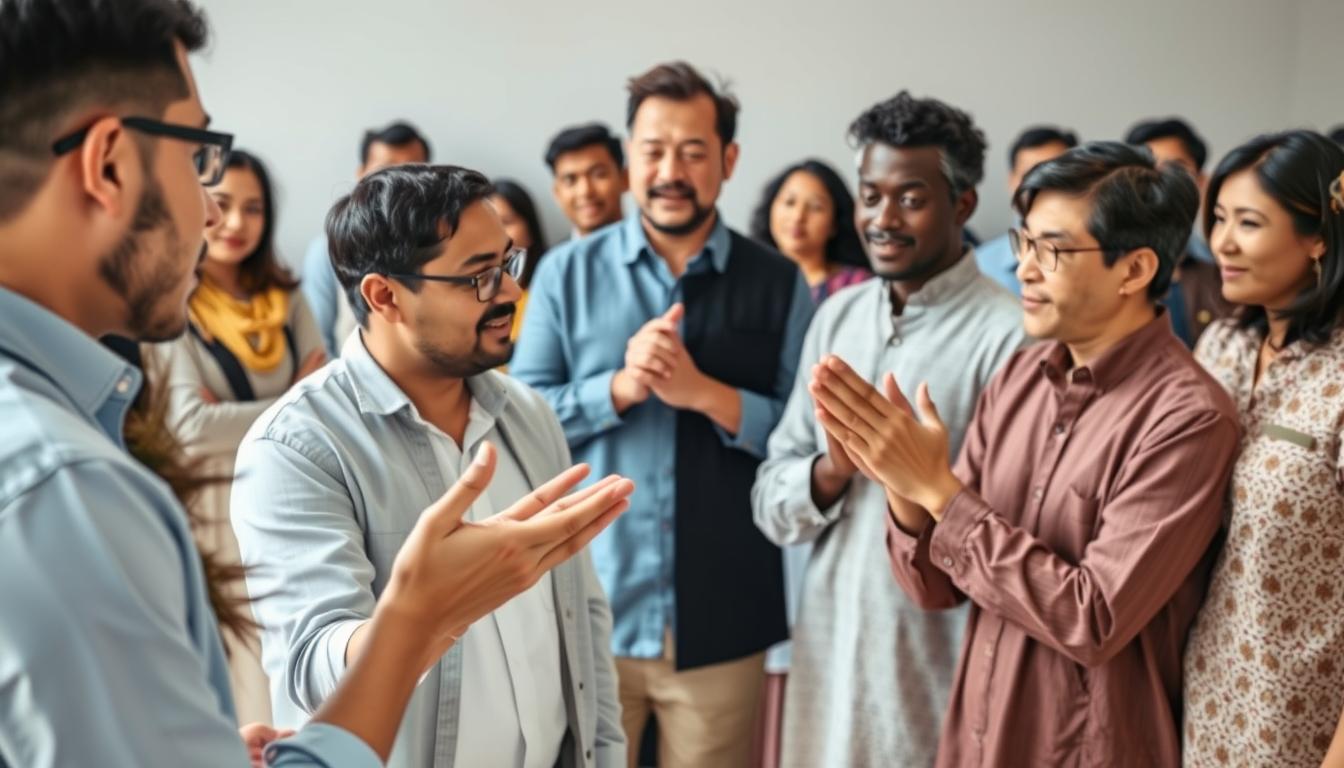
Body language is a silent but powerful way to communicate. It includes gestures, facial expressions, and the space between people. These cues help us show feelings without words, but their meanings change a lot depending on where you are.
Cultural nonverbal communication varies a lot. In Italy, animated hand gestures are as common as speech. Japan has 34 distinct bows to show respect through precise movements. Even a smile can mean different things, like a polite nod in China or a sign of discomfort. These differences are key when we interact with others globally.
From Finland’s relaxed crossed arms to Latin America’s cheek kisses, knowing these signals helps avoid misunderstandings. In a world where borders blur, understanding how gestures, space, and expressions differ helps build bridges between people and cultures.
Why Body Language Matters in Communication
Albert Mehrabian’s research shows that international gestures greatly affect how messages are understood. His studies found that body language is key, making up 55% of how well we communicate. Tone of voice adds 38%, leaving only 7% for the words we say.
This means that facial expressions, posture, and hand movements often mean more than our words. They can convey our true feelings and intentions.
Nonverbal communication accounts for over 90% of human interaction, making it vital for cross-cultural communication.
In global settings, misunderstandings can happen when gestures don’t match cultural norms. For example, the “OK” hand signal is okay in English-speaking countries but not in Germany or Brazil. Direct eye contact is seen as trustworthy in the West but can seem aggressive in Asia.
These differences show how important it is to understand these nuances in cross-cultural communication.
Studies reveal that 93% of people get confused when verbal and nonverbal signals don’t match. This can lead to tension at work. For instance, 65% of employees say misreading body language has caused problems.
Even silence has meaning. Finns see pauses as thoughtful, while others might think it means disengagement.
Learning to read and adapt nonverbal signals can improve relationships. It can help in business deals and travel. By understanding these cues, we can connect better across cultures, turning misunderstandings into chances for connection.
Global Variations in Gestures
Global body language can be tricky. A thumbs up is okay in the U.S. but not in Greece or Nigeria. Even leaders like George W. Bush have made mistakes, like in Australia in 2004.
These mix-ups happen often: 70% of gestures mean different things in different places. It’s important to know this.

In Brazil, the “OK” sign is okay at home but not abroad. President Nixon learned this the hard way in 1953. The peace sign is popular in Europe but can be seen as rude in Australia.
A simple head shake can mean “yes” in Bulgaria but “no” in the U.S. Cross-cultural trainer Lena Torres warns, “A simple wave can mean ‘come here’ or ‘go away’ depending on the region.”
“A simple wave can mean ‘come here’ or ‘go away’ depending on the region,” warns cross-cultural trainer Lena Torres. “Misreading these cues risks reputation and trust.”
60% of travelers get gestures wrong, leading to unintended insults. In Japan, people bow instead of shaking hands. In Finland, crossing your arms might seem rude. Knowing these gestures is key to connecting with people from other cultures.
The Importance of Context in Interpretation
Understanding cultural body language interpretation goes beyond just looking at gestures. The setting and the people involved greatly affect what’s meant. For example, a firm handshake might show confidence in the U.S. but could be seen as aggressive in Japan.
Even simple actions like nodding can have different meanings in different places. In Bulgaria and Greece, a nod can mean “no.” This shows how gesture meaning by country can change a lot.
With globalization, things get even more complex. A thumbs-up in America might be seen as rude in Greece. The Paul Ekman Group found that 90% of facial expressions are universal. But, how we interpret them can vary a lot.
In Japan, sitting cross-legged in a meeting might show disrespect to elders. In Nordic countries, people often use fewer gestures to avoid being too obvious.
Context also includes the time and place. In China, a long silence might mean agreement, but in the West, it could seem awkward. Cultures vary in how they communicate, with some relying on unspoken cues and others on clear words.
Misunderstandings can happen when we ignore these differences. For example, pointing with your feet is very rude in the Middle East. To adapt, we need to pay attention to our surroundings, the people we’re with, and the cultural norms.
A warm hug in Italy might feel out of place in Sweden. Even the time of day can affect how we greet each other. Learning about gesture meaning by country starts with curiosity, not making assumptions. This way, we can make sure our communication works, not fails.
Gestures in Everyday Life
Counting or nodding can mean different things in different places. Body language is key, making up to 80% of what we communicate. For example, in the U.S., counting starts with the index finger, but in Europe, it’s the thumb.
In India, tilting your head means “yes,” but in Bulgaria, it means “no.” These examples show that gestures don’t always mean the same thing everywhere.

Pointing is another gesture that varies. In Asia, people often point with their palm, while Italians might shape their fingers into a “pinecone” to show confusion. In Brazil, the “okay” sign is seen as a peace symbol, but in the U.S., it’s common.
In Iran, a thumbs-up is as rude as the middle finger is in other places. These universal gestures often carry hidden cultural meanings.
Facial expressions also vary. Studies show that Asian cultures tend to show emotions less intensely. This makes understanding each other more complex.
Edward T. Hall’s theory on personal space is another important aspect. Latin cultures like to be close, while North Americans prefer more distance. Adapting to these norms helps build connections.
Travelers and professionals can better connect by observing local customs. A smile or open posture can help bridge cultural gaps. Making small adjustments to international nonverbal cues can turn misunderstandings into respect. Whether in Tokyo or Rio, using gestures wisely fosters connection.
Understanding Personal Space Across Cultures
Personal space norms shape how we interact every day. But they vary a lot from one culture to another. Anthropologist Edward T. Hall started studying proxemics in 1966. He showed how cultural values set our comfort zones.
In the U.S., we like to keep 3-4 feet apart when talking. But in the Middle East, being close means you’re friendly, not a threat. In Tokyo, women-only subway cars show how crowded spaces lead to compromises.
Mongolian etiquette demands a handshake after accidental touch to reset social norms. These differences can lead to misunderstandings. What feels too close to one person might seem too far to another.
Gender also affects personal space. In the Middle East, space rules between genders are stricter. In Northern Europe, privacy is key in work settings. To get along, watch how locals interact and adjust slowly.
Being aware of cross-cultural communication helps avoid awkward moments. Whether in Milan or Seoul, understanding these differences makes working together smoother.
Respecting personal space builds trust. If unsure, mirror the other person’s distance. A small step back or forward can make a big difference. Being culturally sensitive turns conflicts into chances for understanding.
The Influence of Culture on Body Language
Global body language shows how culture shapes our expressions. Emotions like joy or surprise look similar everywhere. But, gestures vary a lot. A smile might mean friendliness in the U.S., but in Japan, it could mean disagreement.

In Japan, a high-context culture, people use few gestures because they rely on shared knowledge. In contrast, the U.S., a low-context culture, values direct speech. This difference affects everything, from business meetings to casual greetings.
Even simple actions have hidden meanings. A thumbs-up in the U.S. means “good job,” but in Greece, it’s seen as rude. In Bulgaria, a nod can mean “no.” These examples show how cultural nonverbal communication changes based on local values.
Social hierarchies also influence body language. In Japan, the depth of a bow shows respect. The Maori press noses during the hongi to share breath and unity. These rituals show cultural values like respect or connection.
Eye contact also varies by culture. Americans see it as a sign of trust, but in Japan, too much can be seen as invasive. In the Middle East, leaning close is a way to check if someone is honest. In Korea, people smile less in public than in Western countries. These differences are important in work settings or when traveling.
“Culture teaches us to read between the lines,” say experts. Mastering these cues builds bridges in our interconnected world.
Interpreting Facial Expressions Internationally
Facial expressions seem universal, but their meanings change across cultures. Paul Ekman found six basic emotions—happiness, sadness, anger, fear, surprise, and disgust—that look the same everywhere. But, cultural rules affect how we show these feelings. For example, a smile in North America means friendliness, but in Japan, it might hide discomfort. Cultural differences in gestures also apply to facial expressions: a nod in Greece can mean “no,” and a blink might signal interest. Ekman said,
“Cultural norms dictate when emotions are shown, but core expressions are shared globally.”
Eye contact has different meanings too. In the U.S., it shows you’re paying attention, but in Japan, less eye contact might show respect. Micro-expressions, which are quick facial changes, reveal hidden feelings. But they disappear fast. Misunderstandings can happen: Americans might see Japanese neutrality as unfriendly, while Asians might think U.S. smiles are fake. International nonverbal cues like these need careful attention.
Smiling also varies a lot: in China, it’s often polite, not real, while in Russia, it shows self-control. Even blinks can mean something—a faster blink might show attraction. To get along, travelers and professionals should watch how locals express themselves. Small details, like a raised eyebrow in Spain or a lowered gaze in India, can build trust. Knowing these patterns helps avoid misunderstandings and makes communication smoother.
The Impact of Technology on Body Language
Technology changes how we share and understand body language across cultures. Video calls make us rely more on faces and upper bodies. A smile can mean different things in different cultures.

Emojis try to fill the gap, but their meanings vary worldwide. What’s friendly in the U.S. might offend in the Middle East. This is a big issue in digital meetings.
A 2020 study showed that people who use tech less understand body language better. Young adults with lots of screen time often get facial expressions wrong. Tools like Imentiv AI use Paul Ekman’s research to help understand emotions better.
Most smartphone users need to adjust. Show your full face on camera, pick a simple background, and learn about eye contact in different cultures. While tech can’t replace empathy, it helps us understand each other better.
How to Avoid Misunderstandings in Communication
Traveling or working internationally? Start by learning international gestures and local customs. Researching basic non-verbal norms for your destination can prevent accidental offense. For instance, a thumbs-up might mean approval in the U.S., but it’s rude in parts of the Middle East. Use resources like cultural guides or translation agencies to decode regional cultural communication barriers.
Avoid assumptions about body language. In Japan, indirect speech shows respect, while directness is valued in Germany. Adjust your style: mirror others’ posture and eye contact. Silence during talks might signal thoughtful consideration in high-context cultures like France, not disinterest. Keep interactions respectful by observing cues like personal space—Latin Americans prefer closer proximity than Norwegians.
“70% of business misunderstandings stem from cultural differences,” notes a global study. “Preparation reduces risks.”
Use simple, clear speech. Avoid slang and speak slowly. Active listening—nodding or paraphrasing—can boost understanding by 60%. If you make a mistake, apologize sincerely. For example, a firm handshake might need softening in cultures prioritizing gentler contact. Prioritize curiosity over judgment when encountering unfamiliar customs.
Remember: 90% of communication is non-verbal. Practicing cultural awareness builds trust. Start small: learn a few key gestures, watch reactions, and stay open to feedback. With effort, you’ll navigate cross-cultural interactions confidently.
Resources for Further Exploration
Want to learn about gesture meaning by country? Check out Kiss, Bow, or Shake Hands, a guide to global etiquette. Books like Edward T. Hall’s Beyond Culture show how nonverbal habits affect cross-cultural interactions. For quick tips, try online tools like iCultural, which offer video examples of universal gestures and their variations.
Academic studies, like David Matsumoto’s on display rules, reveal how emotions are shown differently. For example, the thumbs-up means “ok” in the US but “zero” in France. Mehrabian’s 7-38-55 rule explains why body language is key in communication.
Apps like Culture Cross can help you understand handshakes. In Japan, a bow is used instead of a handshake, while Germans prefer short ones. Workshops by Cross-Cultural Solutions teach professionals about these differences.
Even universal gestures, like the “O Ring,” have different meanings. In Japan, it means “money,” but in Turkey, it’s seen as “rude.” Use Gudykunst’s AUM theory to ask locals for feedback, reducing misunderstandings.
Keep exploring! Follow anthropologists like Hall and Matsumoto, and revisit studies on display rules. Learning continuously helps you respect cultural differences, turning gestures into bridges, not barriers.