







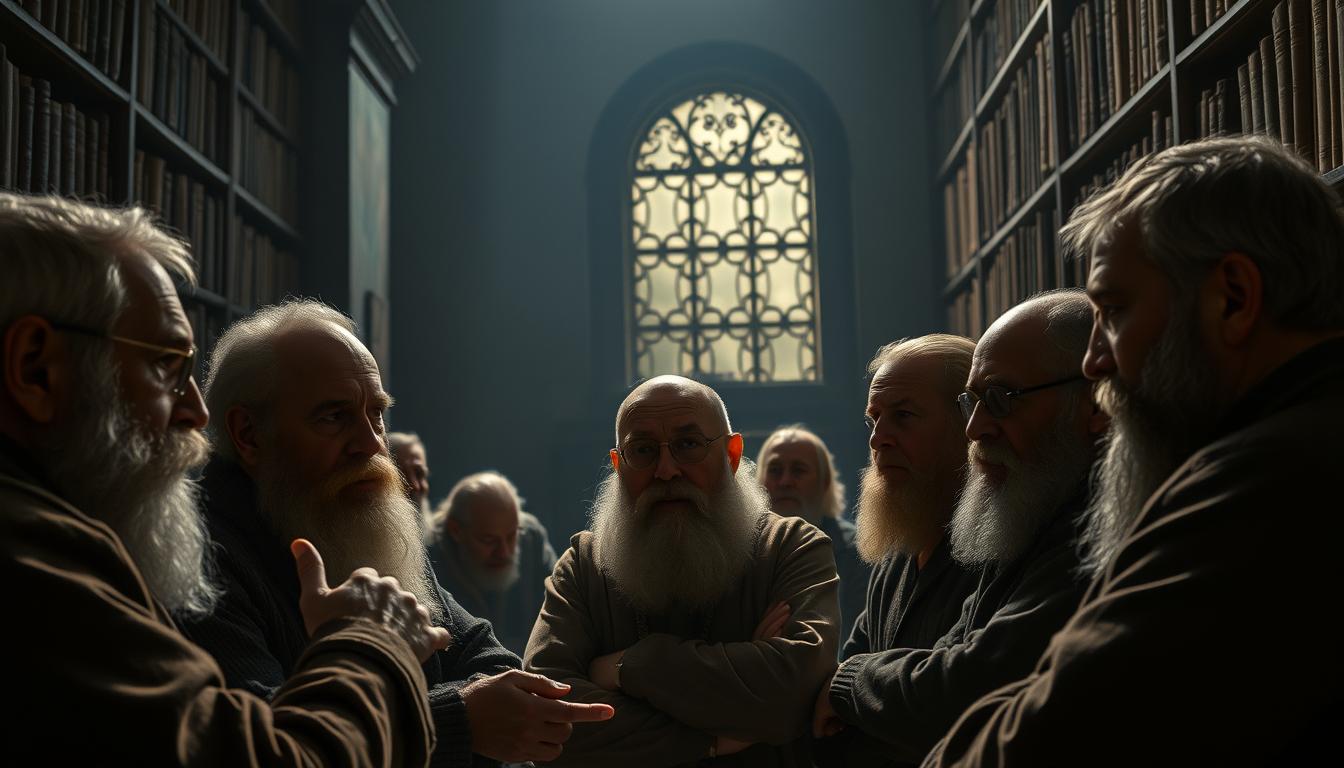
Philosophers who questioned everything have changed how we view the world. From ancient times to today’s science, they started a big change. Thinkers like Albert Einstein challenged old ideas, while Socrates asked big questions that changed what we know.
Socrates, a key figure in ancient Greece, said wisdom starts with knowing what we don’t know. He used tough questions to teach ethics, never giving answers. His ideas, over 2,000 years old, guide us today in seeking truth and right and wrong.
Descartes doubted everything, and Marx changed how we see money. Each new generation adds to this tradition. These thinkers show us: progress comes from questioning. Their work, from Socrates’ debates to today’s global talks, shows how curiosity changes us. Let’s see how their ideas affect us now.
The Importance of Questioning Everything
Questioning the familiar drives intellectual progress. Every big step in science, ethics, or knowledge started with someone asking, “What if we’re wrong?” Philosophical doubt isn’t about being cynical. It’s a way to find deeper truths.
Take Einstein, for example. His challenging assumptions about gravity and space-time changed everything. He showed us that growth comes from questioning the usual ways of thinking.
Critical inquiry changes how we view the world. Socrates believed that living without questioning is pointless. He encouraged people to test ideas through talking.
Even today, questioning common sense helps us see biases. Ask yourself: Who gains from this belief? What proof is there for it? These questions help us avoid bad information and poor choices.
“Dare to know!”
This Enlightenment motto sums up the power of doubt. Descartes used extreme skepticism to start over and understand reality. From old debates to new ones, always questioning keeps us moving forward, not backward.
Socrates: The Father of Western Philosophy
In 469 B.C.E., Athens welcomed a thinker who changed how we search for truth. Socrates, a soldier turned philosopher, introduced philosophical questioning. This became a key part of ancient Greek philosophy. His Socratic method is a dialogue that uncovers flaws in thinking.
He famously said, “The only true wisdom is knowing you know nothing.” This shows his belief in wisdom through inquiry.

In 399 B.C.E., Socrates faced a trial in Athens. He was accused of “corrupting the youth” and impiety. A jury of 500 Athenians judged him.
When offered exile, Socrates chose death by hemlock. He said his life was spent on “human and political virtue.” His last words were, “Crito, we owe a cock to Asclepius,” showing his dedication to philosophy even in death.
Though Socrates didn’t write anything, his legacy lives on through students like Plato. Plato recorded Socrates’ dialogues. The Socratic method is used in law schools and classrooms today. It challenges learners to question their assumptions.
Socrates’ trial shows the struggle between free inquiry and societal norms. This theme is important in debates about education and dissent.
René Descartes: Doubt as a Method
René Descartes turned doubt into a way to find new knowledge. Born in 1596, he challenged every belief to find foundational knowledge. His methodical doubt made thinkers question everything until it was proven true.
This systematic questioning led him to say, “I think, therefor I am.” This showed that just by thinking, we exist.
“It is not enough to read but to read well.” – René Descartes
Descartes’ Cartesian philosophy valued clear thinking over old ways. In “Meditations on First Philosophy,” he compared knowledge to building a house. He said a strong foundation is key, just like in building.
He threw away shaky ideas to build truth on one solid point: the mind’s doubt. This method ignored what our senses trick us into believing. Instead, it focused on ideas we know from the start and logical thinking.
Descartes’ ideas are important today for critical thinking. By doubting everything, he showed how careful questioning can uncover basic truths. His systematic questioning helps us find clarity in a world full of information. He showed that doubt can lead to certainty.
Friedrich Nietzsche: Challenging Norms
Friedrich Nietzsche (1844–1900) changed how we think about moral questioning. He said old values were no longer valid. His idea of the “death of God” in The Gay Science (1882) marked a shift towards nihilism.
Nietzsche believed in existential philosophy. He encouraged people to create new value creation systems. This was to replace old beliefs that no longer worked.
“What doesn’t crush me makes me stronger.” — Nietzsche

Nietzsche thought holding onto strict moral codes held people back. He believed in the “will to power” theory. This theory said people should use challenges to grow, not just accept what society says.
In Zarathustra, he dreamed of a future where people overcame “herd mentality.” They would find their own meaning in life.
He criticized the idea of valuing pity as a virtue. Nietzsche said facing struggles with courage, not pity, makes us stronger. By 1888, his last year of creativity, he saw nihilism as an opportunity to start anew with ethics. His ideas continue to spark discussions on authenticity, freedom, and finding purpose in a changing world.
Karl Marx: Questioning Society and Economy
Karl Marx changed social philosophy by revealing economic system flaws. His historical materialism said societies change through class conflicts, not just ideas. Born in 1818, Marx wrote about power’s impact on labor and wealth early on.
By 1842, as a journalist, he fought against censorship laws. This showed his future critiques of society.
“Philosophers have only interpreted the world; the point is to change it.”
Marx’s economic critique focused on capitalism’s heart. In Das Kapital, he explained how profit systems make workers feel disconnected from their work’s value. His 1844 manuscripts talked about four types of alienation, linking worker exploitation to inequality.
The Communist Manifesto (1848) saw class struggle as history’s driving force. It encouraged readers to question the status quo.
Marx also questioned colonialism and global markets. He wrote over 300 articles for the New York Tribune, showing how industrial capitalism relies on global exploitation. Despite his modest estate of £250 at death, his ideas lived on. His 1859 “Preface” outlined his materialist view: economic structures shape all social relations, not the other way around.
Marx’s impact on debates about inequality is lasting. His focus on class, not just morals, has changed how we think about work, wealth, and justice. Even his critics agree: Marx’s question, “who benefits?” has reshaped discussions.
Simone de Beauvoir: Gender and Existence
Simone de Beauvoir changed how we see gender with her feminist philosophy. Born in Paris in 1908, she was France’s youngest philosophy agrégation pass in 1929. Her 1949 book The Second Sex is key to existential feminism. She said, “One is not born, but becomes, a woman,” showing gender roles are made, not given.

De Beauvoir linked existentialism to gender questioning. She said women’s identities were trapped by patriarchal systems. She pointed out how society sees women as “Other,” taking away their freedom. Her work showed how social constructs like marriage and motherhood restrict women’s choices.
“Freedom is the recognition of necessity,” she wrote, urging women to confront societal constraints.
Her legacy includes signing the 1971 Manifesto 343 for abortion rights and winning France’s Prix Goncourt. Today, her call to reject rigid roles inspires those fighting gender stereotypes. De Beauvoir’s work shows questioning norms is the first step to change.
Martin Heidegger: Being and Time
In 1927, German philosopher Martin Heidegger changed philosophy with Being and Time. This work changed how we think about existence. Heidegger focused on phenomenology, studying human experience as it happens. Born in 1889, Heidegger first studied theology before turning to philosophy.
Heidegger said people often live “inauthentically,” caught up in societal norms. He believed in authentic existence, facing life’s core questions. His technological critique warned that modern tech makes us and nature mere resources.
“Understanding developments in continental philosophy after Heidegger is impossible without Being and Time,” says philosopher Simon Critchley.
The book, though unfinished, sparked debates in philosophy, theology, and science. Heidegger’s warning about technology’s dominance is a challenge today. His work connects ancient questions with today’s tech world, showing philosophy’s lasting impact.
Jean-Paul Sartre: Freedom and Responsibility
Imagine a world where your choices define who you are—not fate or society. That’s the heart of Jean-Paul Sartre’s philosophy. Born in 1905, Sartre spent his life radical questioning what it means to be human. He believed that “existence precedes essence,” meaning we don’t have a fixed purpose at birth. Instead, every decision we make authenticity shapes who we become.

Sartre saw existential freedom as a double-edged sword. Yes, you’re free to choose—but that freedom comes with ethical responsibility. In his essay “Existentialism is a Humanism,” he famously said, “Man is condemned to be free.” No excuses: your choices matter. Even in Nazi-occupied France, Sartre’s time as a prisoner of war sharpened his view that people act—not just react.
His concept of “bad faith” exposes how we dodge this truth. When someone hides behind labels like “I’m just a worker” or “I can’t change,” they escape accountability. Sartre called this self-deception. Authenticity, on the other hand, means owning your power to act. His plays, like No Exit, dramatize how people face—or avoid—the weight of their choices.
Sartre’s legacy endures in activism and ethics. His fight against colonialism and torture in Algeria showed how philosophy fuels action. Today, his ideas remind us: freedom isn’t just a right—it’s a call to shape the world through choices that reflect our authenticity.
“We are our own destiny,” Sartre wrote. “There is no higher power to blame but ourselves.”
His words urge us to embrace the anxiety of freedom—and the courage to live without excuses.
Contemporary Thinkers: Questioning Today’s Issues
Today, philosophy faces urgent global challenges. It builds on postmodern questioning and critical theory. Scholars debate power, ethics, and justice, challenging old views. The Stanford Encyclopedia of Philosophy now lists over 1,600 entries, with recent topics like Artificial Intelligence and Environmental Ethics.
Postmodern thinkers like Foucault showed how power shapes knowledge. Lyotard’s work exposed how systems control us. Critical theory applies these ideas to capitalism and inequality. Nancy Fraser has linked feminism, racial justice, and ecology, reshaping fairness debates.
Judith Butler’s work, like Gender Trouble and Who’s Afraid of Gender?, challenges gender norms. Scholars like Sarah Stroud and Simon Keller explore ethics in love and relationships. Amitav Ghosh’s The Great Derangementcritiques the neglect of climate change in literature and policy.
Philosophical activism drives justice movements. Olúfẹ́mi Táíwò’s essays on “elite capture” highlight systemic biases. Fraser’s work shows how ideas spread globally. Liam Bright’s research on ethics in social welfare won a Leibniz Prize.
The field now welcomes diverse voices, moving beyond the old canon. Eileen O’Neill’s research highlights overlooked women philosophers. As technology and climate crises grow, philosophy continues to question ethics in a changing world.
The Ongoing Journey of Inquiry
A questioning mindset isn’t just for scholars. Anyone can live a philosophical life by making curiosity a daily habit. Start by asking why we do things or looking at things from a new angle. Socrates’ Socratic Method shows how to turn everyday moments into chances to learn and grow.
Being curious means balancing doubt and openness. Like Descartes, doubt can help us clear up our thoughts. But don’t let it stop you from taking action. Nietzsche’s ideas remind us to question everything without dismissing all answers. A questioning mindset is about staying curious, not having all the answers.
Thinkers like Marx and Wittgenstein show how language and systems shape our thoughts. Use their ideas to question your own beliefs. Ask yourself: What choices reflect my values? How do my actions show my understanding of freedom? These questions help turn abstract ideas into a real, living philosophy.
Inquiry makes life richer by encouraging reflection, not just debate. It’s a path to clarity, where every question can change how we see things. Let the ideas of thinkers inspire you to keep questioning, learning, and growing. The journey is endless, but it’s yours to explore, one thoughtful step at a time.