





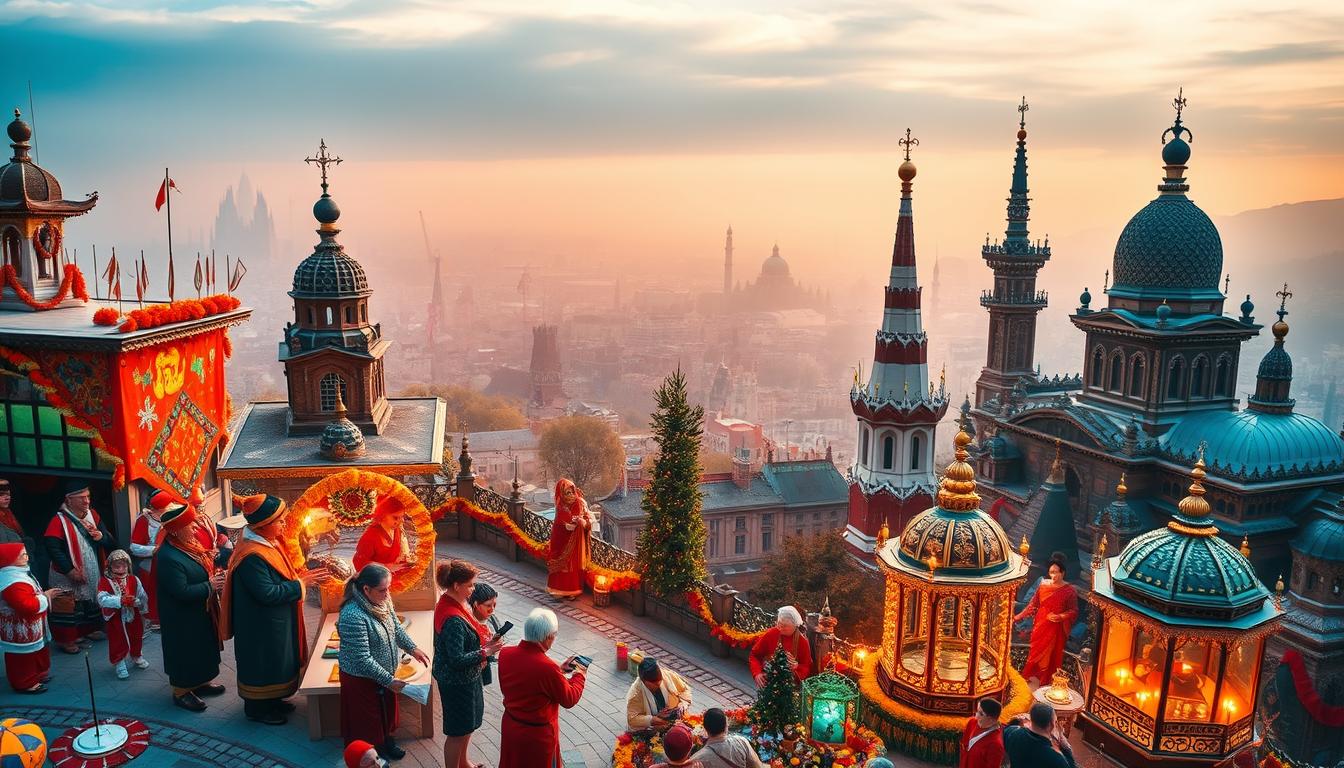
Many traditional festivals we enjoy today have surprising stories. Mardi Gras started in 1699 when French explorers marked ground in Louisiana. April Fools’ Day began in 1582 due to a calendar mix-up.
Even Santa Claus has a long history. He evolved over centuries, influenced by poems, artists like Thomas Nast, and Coca-Cola.
Celebration origins often mix the sacred with the absurd. The first Mardi Gras parade in New Orleans happened decades after its start. The BBC’s 1957 “spaghetti harvest” hoax shows how humor and media shape traditions.
Christmas, declared a U.S. federal holiday in 1870, was once a day when schools and shops were open. These global holidays with unexpected origins remind us that every tradition is a story in motion.
The Origins of Valentine’s Day: From Martyrdom to Romance
Valentine’s Day history starts with bloodshed, not roses or chocolates. At least three Christian figures were executed by Rome’s emperors. Valentine of Rome died in 269 A.D. and Valentine of Terni in 273 A.D. Their deaths made February 14 a day of remembrance.
By the fifth century, Pope Gelasius I combined this somber day with Lupercalia. This pagan festival celebrated fertility and matchmaking. It was a raucous event.
Lupercalia’s connection to Valentine’s Day is clear. This mid-February feast had rituals like drawing names from jars. This was like modern valentines.
When the church moved St. Valentine’s feast day to February 14, it took these traditions. By medieval Europe, the holiday became more romantic. Poets like Geoffrey Chaucer played a big role.
“For this was on St. Valentine’s Day, when every bird cometh there to choose his mate,”
he wrote, making the romantic story strong.
By the 1840s, Esther A. Howland made cards for Valentine’s Day. Today, 145 million cards are exchanged every year. This shows how ancient traditions and modern love came together.
Thanksgiving: A Feast Rooted in Survival
Thanksgiving history is more complex than the story of Pilgrims and Native Americans eating together. The 1621 Plymouth Pilgrims’ feast was a celebration of survival after a harsh winter. It combined European harvest festivals with Native American celebrations, like the Wampanoag’s thanksgiving for good crops. But, this event wasn’t an annual tradition. 
Sarah Josepha Hale pushed for Thanksgiving to be a national holiday. She worked for decades until President Lincoln made it a federal holiday in 1863, during the Civil War. By 1941, Congress set the holiday on the fourth Thursday of November. But, the holiday’s true origins are often forgotten.
Today, Thanksgiving is about family and being thankful. But its history is more complex. The 1621 feast was different from what we think of today, with no pumpkin pie. Ingredients like refined sugar were not available back then.
Thanksgiving’s traditions have changed over time. But its history reminds us of the importance of survival and the need to reexamine our national stories. The Wampanoag’s role in the 1621 feast is often overlooked. Their harvest festivals, like the nasaump, came before Plymouth’s.
Halloween: From Harvest Festival to Trick or Treat
The Celtic harvest festival of Samhain is where Halloween origins begin, 2,000 years ago. It marked the end of harvest and the start of winter. People believed spirits of the dead roamed with the living. Bonfires lit to honor ancestors also kept away evil spirits, a tradition seen in today’s jack-o’-lanterns.
Romans conquered Celtic lands and mixed Samhain with their festivals for Pomona, goddess of fruit. Later, the Christian church renamed it All Hallows’ Eve. Yet, old traditions like costumed processions and “guising” (a trick-or-treating precursor) stayed. Irish and Scottish immigrants brought these traditions to America in the 1840s, fleeing the Potato Famine.
“The Headless Horseman’s spectral ride in Washington Irving’s 1820 tale The Legend of Sleepy Hollow helped cement Halloween’s spooky narrative in American culture.”
Costume traditions have grown from warding-off rituals to today’s huge industry. The 1950s made Halloween a family-friendly event. Candy companies like Mars and Hershey promoted trick-or-treating as a safe activity. By 2023, Americans spent $12.2 billion on costumes and decorations, showing Halloween’s big impact.
Today, celebrations like bonfires and pumpkin carving connect us to the past. The LGBTQ+ community sees Halloween as “Gay Christmas.” It’s a time for transformation and connection. Halloween is a mix of fear, fun, and forgotten traditions, enjoyed worldwide.
Christmas: Pagan Roots to Christian Celebration
Christmas history is a mix of old traditions and religious beliefs. Early cultures celebrated the return of light during the winter solstice. The Romans had Saturnalia from December 17, with feasting and gift-giving.
Germanic tribes lit fires to honor the sun’s rebirth during Yule. These customs were later combined with the nativity story in the 4th century. Church leaders set Jesus’ birthday on December 25, matching existing festivals.

Early Christians took up evergreens, seen as symbols of life in winter. Chariot races for Sol Invictus at Rome’s Circus Maximus inspired new holiday processions. The first Christmas hymn, “Jesus, Light of All Nations,” was written in 336 AD.
It linked divine light to seasonal themes. Yet, debates over the nativity story continue. Scholars point out biblical texts don’t give exact birth dates. Bede’s writings suggest Yule could be in late November or January.
“the hoariest of ‘facts’”
In Renaissance Europe, Christmas was banned in Puritan areas, seen as too pagan or extravagant. Victorian-era reforms brought back caroling and gift-giving, blending old with new. Today’s Santa Claus, popularized by 1930s Coca-Cola ads, combines Norse mythology with modern marketing.
From Saturnalia’s excess to Yule’s fires, Christmas is a rich mix of faith, folklore, and cultural change.
Easter: A Blend of Pagan and Christian Practices
Easter has its roots in ancient spring festivals and Christian beliefs. The name Easter might come from Eostre, a Germanic goddess of spring, as scholar Jakob Grimm suggested in 1835. This mix of old traditions and Jesus’s resurrection brings a special meaning to the holiday.
Spring festivals celebrated new life, with eggs and rabbits symbolizing plenty. The Easter bunny’s story started in 16th-century Germany, where the Osterhase left eggs. This tradition came to America with Pennsylvania Dutch settlers. By the 1700s, it combined with Christian stories, making candy hunts a family tradition.
Eggs hold deep meaning across cultures. Medieval Christians decorated them during Lent, and Cadbury’s Victorian-era chocolate eggs made them a global favorite. Today, we see the scale of Easter with 16 billion jelly beans and giant eggs. Yet, the tradition of egg hunts and giving eggs to lords dates back to the 13th century.
“The hare is the most willing companion of the child, and so easily won over with a piece of bread.”
From hot cross buns to Norway’s crime novels, Easter has many traditions. Its date, tied to the spring equinox’s first full moon, shows its dual nature. Whether through chocolate or parades, Easter brings together old and new, sacred and fun, into a lively holiday.
New Year’s Eve: Celebrations Through the Ages
For over 4,000 years, New Year’s Eve history shows a rich mix of calendar celebrations around the world. The ancient new year wasn’t always on January 1. The Babylonians celebrated in spring with their 11-day Akitu festival.
Later, the Romans also had their ancient new year at the vernal equinox. But Julius Caesar changed it to January 1 in 46 B.C. with his Julian calendar reforms. This change made January 1 a key date in Western tradition.
Yet, some European regions didn’t accept this change until Pope Gregory XIII updated the calendar in 1582.

Today, midnight traditions carry on ancient wishes for a fresh start. In Spain, people eat 12 grapes at 12 chimes for good luck each month. Japanese Buddhist temples ring bells 108 times to get rid of earthly desires.
New York’s Times Square ball drop, starting in 1907, attracts millions. Dillsburg, Pennsylvania, drops a pickle to honor German heritage.
From Babylonian barley offerings to today’s fireworks in Lagos and Seoul’s Bosingak bell strikes, these rituals connect past and present. Each calendar celebration shows what’s important to different cultures. As clocks strike midnight, these traditions remind us that time is a shared human story.
Cinco de Mayo: More than Just a Fiesta
The Battle of Puebla is at the heart of Cinco de Mayo history. In 1862, a small Mexican army beat France’s forces. Led by General Ignacio Zaragoza, this victory symbolized Mexican resilience. But, many confuse it with Mexican Independence Day, which is on September 16.
In Mexico, Cinco de Mayo is mainly celebrated in Puebla. In the U.S., it has grown into a bigger celebration for Mexican-Americans.
In the 1860s, Mexican-American communities in the U.S. started celebrating Cinco de Mayo. By the 1980s, beer and tequila brands helped make it more popular. In 2013, $600 million in beer was sold, more than during the Super Bowl.
While this increased visibility, it also led to stereotypes. This raised concerns about cultural appropriation.
Now, cities like Los Angeles host big events, like the Fiesta Broadway parade. Schools and communities use Cinco de Mayo to teach about Mexican heritage. It’s a time to remember resistance and pride. Congress recognized the holiday in 2005. But, it’s important to balance fun with respect for Mexican history.
Lunar New Year: Traditions Across Cultures
The Lunar New Year has roots in ancient myths, like the story of Nian. It started in the Shang Dynasty (14th century B.C.) and grew into the spring festival celebrated in Asia. Each year, it goes through 12 zodiac animals, like the rat, ox, tiger, and dragon. These animals shape cultural identity.
These Asian celebrations share common values but also have local twists. They reflect the diversity of cultures.
In Vietnam, Tết is celebrated with kumquat trees and Bánh chưng, square sticky rice cakes. They symbolize the earth’s four directions. Korean Seollal focuses on honoring ancestors with Tteokguk soup. Tibet’s Losar includes Buddhist rituals.
Even though traditions vary, family reunions and giving red envelopes (hong bao) are common.
The modern Chinese New Year lasts 15 days, ending with the Lantern Festival. San Francisco’s parade, starting in the 1860s, attracts hundreds of thousands. It mixes diaspora pride with global interest.
North Korea also celebrates Lunar New Year, starting in 2003 after a long ban.
Food plays a big role, with dishes like fish (yú) and longevity noodles. These foods symbolize good fortune. Even with more prepackaged food, traditions like ancestral altars and zodiac fortune-telling remain strong.
From Seoul to New York’s Chinatowns, the festival brings people together. It connects communities through ancient practices and modern expressions.
Diwali: The Festival of Lights and Its Origins
Every year, the Hindu festival of lights brings together millions to celebrate hope and renewal. It centers around the Rama and Sita story. This story tells of Lord Rama’s victory over the demon king Ravana, symbolizing good over evil.
Families in India and the U.S. get ready by cleaning and decorating. They use rangoli patterns and light oil lamps to show purity and joy.
In 2023, Diwali starts on November 12, with Lakshmi worship for prosperity. Temples are filled with prayers, and homes exchange sweets like jalebi and almond burfi. For South Asian Americans, this year’s celebration is special, blending with U.S. history.
Over one billion people, including 4 million in the U.S., celebrate with fireworks, gifts, and new clothes. This shows the spirit of renewal.
Diwali has ancient roots but also changes with local traditions. In the U.S., communities hold public displays and cultural events. The five-day celebration includes Govardhan Puja, honoring Krishna’s victory.
This Indian cultural festival brings together different stories into one colorful celebration. From Ayodhya to New York, Diwali connects past and present, uniting faith, family, and hope.
International Women’s Day: From Socialism to Global Recognition
The International Women’s Day history started in 1908. That year, 15,000 garment workers in New York protested for better pay and voting rights. A year later, the Socialist Party of America made February 28, 1909, the first National Women’s Day.
German socialist Clara Zetkin suggested an international women’s rights celebration in 1910. This led to the first March 8 celebration in 1911. Over a million people across Europe joined in.

In 1917, Russian women’s strikes on March 8 (February 23 on the Julian calendar) sparked the February Revolution. This forced Czar Nicholas II to step down. March 8 became a symbol of female empowerment.
Soviet Russia made it a state holiday tied to socialist ideals. By the 1970s, the feminist holiday spread beyond communist nations. It got UN recognition in 1977.
Today, the March 8 celebration is celebrated in over 100 countries. In former Soviet states, it’s marked with flowers and gifts. Activists worldwide use it to push for progress.
The 2024 theme, “Invest in Women: Accelerate Progress,” shows its growth. From socialist beginnings to a UN-backed women’s rights celebration, International Women’s Day connects past struggles to ongoing female empowerment.
Earth Day: How a Movement Became a Holiday
Gaylord Nelson’s vision was sparked by the 1969 Santa Barbara oil spill. He started Earth Day on April 22, 1970, with a teach-in. This event drew 20 million Americans to rallies and school programs.
This celebration changed politics, leading to laws like the Clean Air Act. It was a grassroots effort, with unions and schools working together.
By 1990, Earth Day went global, uniting 200 million people in 140 countries. Today, over 1 billion people join in, from cleanups to digital campaigns. The 2016 Paris Agreement signing during Earth Day shows its political strength.
The movement has grown, from pollution concerns to climate action today. Earth Day’s legacy connects activism with policy. The original team had a small budget, but today’s Earth Day Network works with 17,000 groups worldwide.
From beach cleanups to pushing for renewable energy, Earth Day continues to make a difference. It links education with the demand for change, showing its lasting impact.