



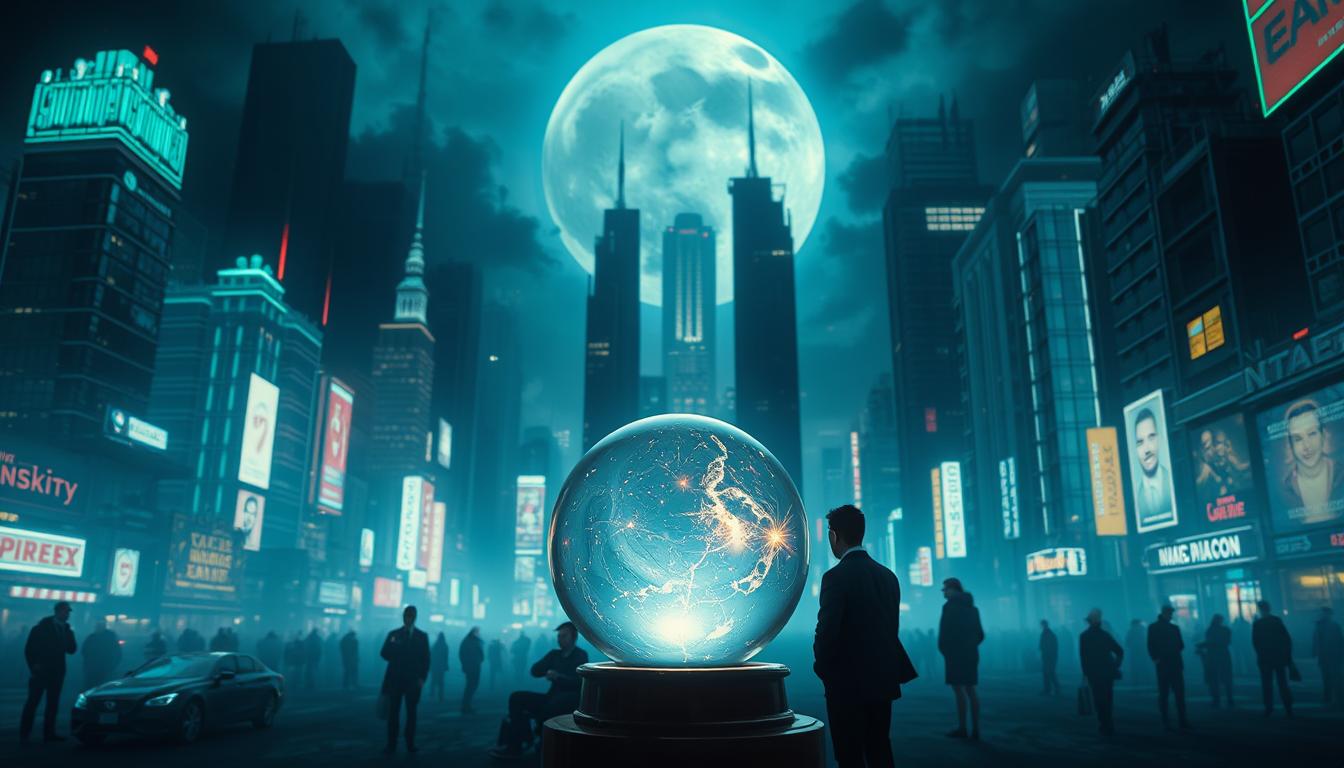
For centuries, people who predicted the future have amazed us. John Elfreth Watkins foresaw telegraphed photos in 1900. Nikola Tesla predicted wireless communication would connect the world in 1909.
These predictions show how some people saw future technologies before they existed. They envisioned smartphones and space travel long before they became reality.
Historical predictions cover science, war, and daily life. Alexis de Tocqueville warned about U.S.-Russia rivalry in 1840. This mirrored the Cold War.
Jules Verne predicted a moon landing in 1865. Apollo 11 made it happen in 1969. Mark Twain even predicted his own death tied to Halley’s Comet in 1910.
Watkins foresaw ready-cooked meals and electric farming tools in 1900. But strawberries the size of apples are yet to come. Tesla dreamed of a global “huge brain” for instant communication in 1929.
These stories show how predictions mix bold guesses with surprising accuracy. They shape our view of what’s possible.
The Science of Prediction: How It Works
Predicting the future isn’t just guessing. The science of prediction uses pattern recognition and forecasting methods. It turns data into useful insights. For example, Einstein’s theory was proven right during a 1919 solar eclipse.
MIT’s algorithms track social interactions. Early predictive analytics used physical models like the MONIAC computer. The Club of Rome’s 1972 World3 model warned about resource limits, sparking ongoing debates.
Today, forecasts combine quantitative data and qualitative expert opinions. Weather predictions have improved a lot. They used to take weeks to forecast just a few hours, but now they’re accurate for 24 hours.
But, pattern recognition is not always easy. The BBC’s 1995 vision of 2025 showed cyber riots and space mining. But, reality didn’t match those predictions. This shows how forecasting methods need to keep improving.
Scientific predictions help prove theories. The 2015 discovery of gravitational waves confirmed Einstein’s theory. But, there are also biases. Political agendas often ignore warnings, like reports before the pandemic.
Now, predictive analytics balances models with human judgment. This avoids relying too much on one method. By using history, math, and critical thinking, we can better face the future. This helps us plan for things like climate change and new tech breakthroughs.
Nostradamus: The Seer of Century
Michel de Nostredame, known as Nostradamus, is a fascinating figure in history. Born in 1503, he was a visionary who wrote Nostradamus predictions in cryptic quatrains. He combined astrology and medicine in his work. His book Les Prophéties, published in 1555, has 942 verses that spark debate today.
His 16th century predictions allegedly foresaw events like the Great Fire of London in 1666. He also predicted the rise of leaders like Napoleon and Hitler. Modern events like the moon landing and 9/11 are seen as prophecies that came true, but their interpretations are often debated.

Nostradamus wrote 6,338 prophecies across almanacs and books. He believed in cosmic patterns. His quatrains used symbols like “beasts” and “fire from the sky,” leaving room for endless analysis. Even his death in 1566 at age 62 became part of the myth—he reportedly predicted his own demise.
Today, his legacy lives on. Over 200 editions of his work and 2,000 commentaries show his enduring appeal. Whether accidental or intentional, Nostradamus remains a bridge between mysticism and history. He invites us to wonder what tomorrow might hold.
Jules Verne: A Visionary Novelist
Jules Verne’s From the Earth to the Moon (1865) is a stunning example of Jules Verne predictions. It predicted a mission to the moon with a crew of three, a launch from Florida, and a splashdown in the ocean. These details matched NASA’s Apollo 11 mission over a century later.
In Twenty Thousand Leagues Under the Sea, Verne envisioned a submarine called the Nautilus. This was decades before real submarines were built. His From Earth to Moon prediction also included solar sails and electric cars, technologies we have today.
Verne mixed 19th-century science with his imagination. His 1889 story “In the Year 2889” predicted video calls and skywriting ads. These ideas became real in our time.
His novels like The Mysterious Island foresaw electric vehicles. Paris in the Twentieth Century hinted at global communication networks. Verne’s research made his visions believable.
Today, his works inspire engineers and writers. NASA engineers looked to his books during the Space Race. With over 4 billion copies sold, Verne’s science fiction prophecies link literature and innovation. His legacy shows how storytelling can shape tomorrow’s technology.
Arthur C. Clarke: Futurist and Author
Arthur C. Clarke started making Arthur C Clarke predictions in 1945. He proposed geostationary communication satellites that now orbit 36,000 km above Earth. These satellites are key to our global telecom networks.
His 1968 novel 2001 A Space Odyssey introduced the “Newspad” tablet. This idea is seen in today’s devices. Samsung even used his sci-fi technology predictions in a legal battle with Apple.

Clarke also predicted video calls and remote work, which are now common. He believed that advanced tech is like magic, as stated in his Third Law. His ideas, from GPS to space elevators, blended fiction with science.
Clarke wrote over 100 books, including the Oscar-nominated 2001 A Space Odyssey. His work has shaped our world, from satellites to smartphones. Even his posthumous lunar launch in 2024 shows his lasting impact on tech and imagination.
Ray Kurzweil: The Tech Prophet
Ray Kurzweil is a visionary inventor known for his futurist predictions about AI. He predicts the technological singularity by 2045, when machines could be smarter than humans. He also believes AI will match human thinking by 2029, changing healthcare and work.
Kurzweil’s AI prophecies include medical nanobots and AI-driven longevity by 2030. He has a good track record, predicting the rise of mobile tech. Now at Google, he works on AI tools that understand human language, pushing tech limits.
Debates on timelines are ongoing, but Kurzweil’s 86% accuracy rate shows his impact. His new book, The Singularity Is Nearer, talks about merging AI with humans by 2045. His work combines science and imagination, guiding us to the future.
The Mayan Calendar: Myths and Realities
The 2012 prophecy tied to Mayan calendar predictions captured the world’s attention. But, the calendar was just a tool for tracking time, not predicting doom. The Mesoamerican predictions of the Maya focused on celestial cycles. Their Long Count calendar marked 13.0.0.0.0 on December 21, 2012—a cycle end, not an apocalypse.

The Long Count spans 5,125 years, divided into units like b’ak’tuns (144,000 days). The 13th b’ak’tun’s conclusion was a cultural milestone, not a catastrophe. Scholars say it was like a clock returning to zero. The 2012 prophecy came from modern speculation, not Maya texts.
“The Maya did not predict the end—they marked cycles,” explained experts Stephen Houston and David Stuart, debunking apocalyptic claims. Their research shows ancient inscriptions like Tortuguero Monument 6 referenced events, but its damaged glyphs were misread as prophecies.
No ancient forecasting methods foresaw disaster. Inscriptions from La Corona and Xultún reveal the Maya calculated astronomical events millennia ahead, not societal collapse. The Popol Vuh, their creation story, describes four prior worlds, but scholars confirm the 2012 date held no doomsday meaning. The Maya’s focus was tracking Venus’s cycles and solar years, not predicting their own fall.
While the 2012 hype faded, the Maya’s legacy endures in their precise math and astronomy. The calendar’s complexity shows their genius, not fear of endings. As archaeologist David Stuart noted, their inscriptions often tied future dates to rulers’ reigns, not global events. The myth persists, but the reality is a civilization mastering time’s rhythms.
The Wright Brothers: Aviation Innovators
Orville and Wilbur Wright, early aviation pioneers, started as bicycle mechanics. Their skills in balance and mechanics sparked their interest in flight. In 1903, their Wright Flyer made history with the first powered flight. It flew 120 feet in 12 seconds at Kitty Hawk, North Carolina.
After years of testing, their fourth flight that day reached 852 feet. This showed their designs could overcome gravity.
The brothers focused on control systems, not just power. Their wind tunnel tests and wing-warping techniques changed flight technology forecasts. They believed planes would carry people, mail, and change warfare.
These Wright brothers predictions helped create today’s air travel and military aviation.
Despite early failures, like the 1901 glider’s poor flight, they kept trying. Their 1902 glider flew 600 feet, proving their ideas. By 1908, they showed their machine’s worth, getting contracts and inspiring others.
Their story shows how innovation and prediction shape the aviation future. They proved that practical experimentation is better than guessing.
Steve Jobs: The Future of Technology
Steve Jobs changed how we use technology. He focused on making things simple and easy to use. At the 2007 iPhone launch, he said it would change smartphones forever, starting the smartphone revolution.
“The Web will have a dial tone everywhere,” he once said. This idea became true with the internet everywhere.
“The digital future is about devices that fit in your pocket,” Jobs emphasized, blending tech with creativity.
Jobs predicted 10% of U.S. commerce would go online by 1995. By 2018, this became a reality. His App Store and iTunes started a new way to share digital content.
The iPhone’s success led to a big change from traditional PCs. By 2018, Apple sold 16 million iPhone X units, showing its strong position.
Today, people check their phones 52 times a day. This shows Jobs’ idea of making technology easy to use. Even as PC sales dropped, Apple kept pushing for better designs.
Jobs’ work shows how important vision is in shaping our digital world. His devices mix art and engineering, showing his lasting impact.
Climate Change: Warning Signs Over the Decades
Looking back, climate science history shows a clear pattern. Early warnings about climate change now match today’s reality. In 1896, Svante Arrhenius predicted how CO2 could trap heat, linking it to fossil fuels and warming.
By the 1960s, models showed global warming forecasts. They predicted rising temperatures due to industrial activity. These warnings spoke of melting ice, extreme weather, and rising seas—trends we see today.
Today’s data backs up these climate change predictions. Earth’s temperature has gone up 1°C from 1900. 2016 and 2020 were the hottest years on record.
The Arctic ice has shrunk by half, and oceans are 30% more acidic than before. The IPCC’s 2018 report warns of severe effects if warming isn’t limited to 1.5°C. It predicts a 1.1-meter sea rise by 2100.
Research over decades confirms scientists were correct. Early warnings about CO2’s impact were right as glaciers retreated and storms grew stronger. Today, the Paris Agreement tries to cut emissions. But, we need quick action to meet these goals. The science is clear: global warming forecasts are happening now.
Oops! The Y2K Bug: A Near-Miss Prediction
In the late 1990s, the Y2K bug predictionsfilled the news. The millennium bugwas a problem with computer systems using only two digits for years. Experts feared a computer crisis forecastbanks, utilities, and transport might fail when clocks hit 2000. They thought systems might see “00” as 1900, causing big problems.
Billions were spent to fix this issue. Companies and governments worked fast to update their systems. They changed code and tested important infrastructure based on early technology predictions.

When January 1, 2000, came, things didn’t go as bad as feared. Some said the fixes were too much, while others credited them for preventing disaster. The question remains: did the fixes really save us, or was the scare too big?
Today, Y2K’s impact is seen in how we prepare for tech issues. It shows how technology predictionscan lead to action, even when the risks are not clear. It’s a lesson in balancing caution and evidence when facing future tech challenges.
The Role of Futurists in Society
Today, professional futurists guide governments and companies towards the future. They use strategic forecasting and future studies to explore possibilities. Organizations like the World Future Society teach them to spot trends, from climate changes to new technologies.
Methods like scenario planning and horizon scanning help professional futurists predict challenges. For example, Visa’s 2012 London Olympics forecast showed the power of prediction industry insights. Even when predictions are wrong, like with Y2K, they start important conversations.
Now, education includes degrees in futurism, like the University of Hawaii’s MA and PhD in Alternative Futures. This field combines history, technology, and sociology to avoid past errors. Futurists analyze data and culture to create strong plans.
“Foresight requires imagination beyond spreadsheets,” notes Ilkka Tuomi, stressing creativity in predictive work. Ethical futurists also consider how predictions can shape outcomes, inspiring action or skepticism.
Futurists play a key role in making decisions, from corporate boards to policy debates. As automation increases, their expertise is more important than ever. They help guide decisions in a world where past trends can’t predict the future.
Conclusion: The Impact of Predictions on Society
Predictions shape our world in many ways. From Nostradamus’s cryptic quatrains to Jules Verne’s novels, historical prophecies spark curiosity and caution. Today, future forecasting influences tech and policy. But, as Octavia Butler showed, predictions are not always right.
Her work warned of growing inequality and forgetting our past. These issues are now in today’s news. Butler’s prediction analysis shows how crises reveal our flaws. The pandemic, like the Cold War or Y2K, exposed hidden inequities.
Her 2000 essay for Essence said predictions reflect our current struggles. Even flawed forecasts, like those on school reopenings, show how fear and hope shape us. As future forecasting grows, so must our thinking.
Ray Kurzweil’s tech dreams and Arthur C. Clarke’s space visions show innovation’s power. Yet, Butler’s legacy cautions against blind faith in predictions. Her awards highlight storytelling’s ability to question and challenge.
Predictions are important, but so are the actions they spark. The stock market and governments react to forecasts, but real change needs critical thinking. Butler said every action has consequences—so let’s choose wisely. The future is built, not just seen. By learning from historical prophecies and balancing hope with doubt, we can make purposeful steps forward.