



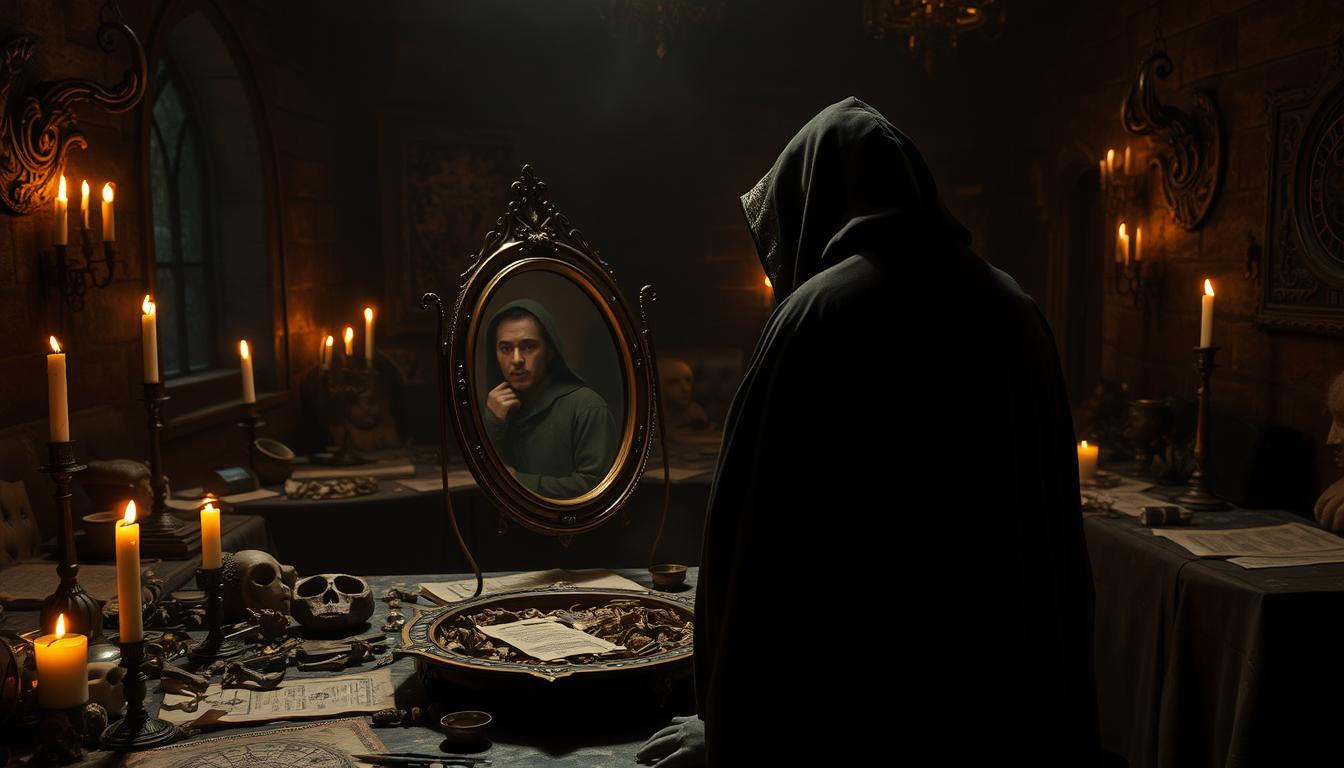
In ancient times, mystery and guesswork were common. Yet, ancient prediction methods were surprisingly accurate. They covered topics from atomic theories to cosmic origins, laying the groundwork for modern science.
This article looks at how historical forecasting techniques shaped societies. It shows how logic and mysticism blended together. Many ideas thought to be myths actually came before scientific proof by thousands of years.
Leucippus and Democritus proposed atomic theories in 450 BC—2,400 years before science confirmed them. Indian religions like Hinduism also taught atomic doctrines. This shows predicting the future in ancient times was accepted long before scientific discovery.
Heraclitus’s ideas of “fire” and “flux” match thermodynamics and quantum theory. His philosophy shows how ancient divination practices mixed with science. Anaximander’s evolutionary ideas, lost for centuries, were rediscovered long after Darwin.
Thales guessed Earth was round in the 7th century BC—a theory proven 1,000 years later. The Rig Veda described a universe expanding from a single point 3,000 years ago. This mirrors modern Big Bang theories. These examples highlight ancient minds grasping truths we’re unraveling today.
The Need for Forecasting: Understanding the Past
Ancient societies used history of prediction methods to face life’s unknowns. Farmers watched the seasons to plant, sailors read the skies, and leaders sought divine guidance. These actions merged survival skills with cultural beliefs.
“People are fascinated by origins, people are fascinated by mysteries,” says Andrea M. Berlin, highlighting our eternal curiosity. “We’re very curious about what we can’t see, about what came before.”
Early people predicted the future to survive. The origins of divination came from needs like knowing when floods or droughts would hit. They used rituals like reading animal bones or the stars to manage risks.
Modern archaeology shows these practices were practical. By studying past events, societies aimed to avoid future crises. For example, tracking the moon or animal behavior helped plan harvests. These efforts evolved into systems that mixed science and spirituality, helping people survive.
Oracles: Ancient Channels to the Divine
Ancient oracle sites like the Delphi oracle were key in ancient mysticism. At Delphi, people went to a sacred cave. There, the Pythia, a priestess, would inhale fumes and enter trances to share Apollo’s prophecies.
These rituals were oracle prediction methods used in governance, war, and personal choices.

King Croesus of Lydia got a mysterious answer from the Delphi oracle. This shows how oracles worked—giving veiled messages. To get answers, people had to purify themselves and make offerings. The answers were often unclear, leaving room for interpretation.
For example, Croesus misinterpreted the oracle and lost a war. This shows the power and danger of divine advice.
Oracles used different methods across cultures. Greeks looked at entrails, while Chinese used oracle bones. The Delphi oracle was famous for its influence in politics, helping settle disputes and guide leaders.
Even Alexander the Great sought guidance from Zeus Ammon at Siwa. Science suggests that gas emissions at Delphi might have caused the Pythia’s visions. This mix of mysticism and natural phenomena is intriguing.
From water readings to smoke signals, these practices shaped societies. The oracle of Dodona, older than Delphi, used oak leaves and water sounds for guidance. Even after the last Delphi prophecy in 362 AD, people worldwide kept believing in these divine channels.
This shows the lasting appeal of how oracles worked as spiritual and societal tools.
Astrology: Celestial Guidance Through the Ages
Thousands of years ago, ancient people looked up at the sky to understand the future. The Babylonians were the first to use ancient astrological practices. They divided the sky into 12 parts, known as the zodiac. They recorded the planets’ movements to predict things like harvests and wars.
These celestial prediction methods were key for leaders. They mixed science and mysticism to make important decisions.
By 140 AD, Greek astronomer Claudius Ptolemy created the Tetrabiblos. It linked star positions to human traits. In Egypt, astrologers used Sirius’s rise to predict the Nile’s floods. This showed how planetary forecasting was linked to survival.
Islamic scholars later kept these traditions alive. They made great strides in astronomy and medicine using cosmic knowledge.
Even though some thought astrology was old-fashioned, it came back in the modern era. Today, the zodiac’s zodiac history is seen in horoscopes online. From ancient clay tablets to modern apps, humans keep trying to understand the stars. It’s a never-ending journey between the heavens and our hopes.
Divination: Seeking Answers from the Unknown
Across continents and eras, ancient divination methods helped societies deal with uncertainty. The exhibition Oracles, Omens and Answers shows artifacts like Shang Dynasty oracle bones and Egyptian celestial globes. These prove divination’s deep roots.
Etruscan priests studied animal entrails, while Egyptian astrologers used armillary spheres to track celestial signs. These acts of reading omens were more than superstition. They offered frameworks for decision-making.

Divination techniques varied widely. Cleromancy involved casting marked sticks or dice, while pyromancy relied on flame patterns. The Mambila people of Cameroon interpreted spider movements to guide community choices.
Each practice aimed to decode the universe’s hidden messages. They blended ritual with intuition.
Even in modern times, fortune telling history persists. During the pandemic, apps for tarot and Yijing surged, echoing ancient practices in digital form. WitchTok communities revive these traditions, showing how divination techniques adapt yet remain timeless.
These methods, though rooted in mystery, fulfilled a universal need. They helped find clarity in chaos.
Prophets and Seers: Voices of Prediction
In ancient times, ancient prophets and historical seers played a key role. They connected people with divine guidance. In Israel, figures like Samuel and Isaiah used prophetic traditions to challenge leaders and inspire change. They were known as visionaries who interpreted signs and visions, often through dreams or divine encounters.
These visionaries acted as moral guides. For instance, Samuel advised kings, while Jeremiah warned of Babylonian exile. Their messages were not just predictions but calls to action. The prediction through visionaries highlighted the consequences of a society’s choices, not fixed futures. Even Daniel’s apocalyptic visions in Babylon focused on lessons for his people, not mere forecasts.
Prophets like Elijah and Elisha combined supernatural acts with ethical teachings. This reinforced their authority. Biblical texts show that true prophets must align with God’s word (Deuteronomy 18:20-22). This distinguishes genuine historical seers from false claims. Their legacy lives on in religious texts and rituals, shaping laws, cultures, and collective identity.
The Use of Symbols and Dreams in Prediction
For thousands of years, people believed dreams were windows to hidden truths. Ancient dream interpretation history shows how Mesopotamians, Egyptians, and Greeks used dreams to make decisions. They developed symbolic prediction methods that influenced their rituals, politics, and personal choices.
One famous story is Thutmose IV’s dream at the Great Sphinx. He promised to restore the statue in exchange for kingship. This story is carved into the Dream Stele.
“The gods speak through sleep,” wrote Greek physician Galen, reflecting beliefs that dreams held divine wisdom.
These cultures kept records of ancient dream analysis in books like the Egyptian Dream Book of Artemidorus. It listed meanings for thousands of symbols. For example, a flying dream might mean freedom, while losing teeth could signal danger.
They also watched for omen symbols in everyday life. Like sudden animal behavior or strange weather. For instance, a storm’s timing could predict war or prosperity.
Today, studies suggest dreams might be connected to our intuition. Surveys show 17.8% to 38% of people recall dream interpretation history experiences that seem like precognition. But scientists argue if these visions are just coincidence or if there’s a deeper pattern.
Despite the debate, the fascination with dream interpretation remains strong. It connects ancient practices with today’s interest in the subconscious mind.
Seismic Readings: Predicting Natural Disasters
Ancient people used nature’s signs to predict earthquakes. In Egypt, priests watched the stars and Nile water levels. They used nilometers to guess when floods in ancient times would happen. This mix of science and ritual helped them know when to plant or leave.
In China, the Han Dynasty made bronze seismoscopes around 132 CE. These tools used pendulums to sense earthquakes. Yet, big disasters like the 1556 Shensi earthquake showed the limits of these early systems.
Mesopotamians looked at river flows and animal acts to predict floods. Priests saw signs like cracks in the ground or strange animal moves as warnings. These methods helped people survive, like building high homes or planning harvests.
Today, ancient earthquake prediction ideas help modern AI systems. Japan and Australia use these ideas to warn people quickly about earthquakes and wildfires.
The USGS focuses on long-term safety over quick forecasts. But, ancient and modern systems aim to act fast. From old nilometers to AI, we keep trying to stay ahead of disasters.
Historical Records: Patterns in the Past
Ancient civilizations used ancient historical documentation to predict the future. Babylonian astronomers tracked solar and lunar cycles for over a thousand years. They linked these cycles to farming seasons, helping them forecast floods or famines.
The Maya were also skilled in tracking Venus’s phases. Their records are so accurate, they match today’s calculations.

Many cultures saw time as a wheel, not a straight line. The Aztecs and Egyptians believed events repeated in cycles. They used pattern recognition in history to prepare for future crises.
Chinese dynasties studied flood records to design better irrigation systems. They believed past disasters would happen again. This cyclical time concepts mindset influenced their laws, rituals, and even wars.
Rulers often looked at archives before making big decisions. Egyptian pharaohs checked Nile flood logs to avoid crop failures. Greek oracles used past omens from temple scrolls to guide leaders.
These methods show early using history to predict strategies. They combined faith and data. Today, scholars study these records to understand how ancient societies mapped their world through repetition and recurrence.
The Role of Folklore in Future Predictions
Traditional predictive folklore helped ancient societies predict changes. Sayings like “Red sky at night, sailor’s delight” show weather folklore history linked to cloud patterns. Stories about animal behavior predictions also existed, like frogs fleeing before quakes or birds migrating early before winter.
One Irish proverb warns, linking nature’s signs to advice. Cultural prediction stories like these helped plan farming or warn of disasters. They stored wisdom in community memory.
Some folklore is scientifically true. The red sky saying matches atmospheric science, and animal restlessness before storms is linked to seismic waves. Others, like using groundhog shadows for spring dates, are symbolic. These traditions gave comfort and structure before modern tools existed.
Communities adapted these systems to their needs. Japanese farmers tracked cherry blossoms for planting, and Amazonian tribes read spider web patterns for storms. Though many tales were later disproven, they were based on generations noticing nature’s patterns. Folklore’s legacy connects observation and culture, showing humanity’s ongoing quest to understand the future.
Scientific Foundations: Bridging Past and Present
Ancient science history reveals how early predictions shaped today’s forecasting. Babylonian astronomers used math to track the sky, predicting eclipses and planet paths. Their work started a tradition of linking observations to rules.
Greek thinkers like Thales and Aristotle sought natural explanations, not magic. Zhang Heng’s seismoscope in 132 CE was a breakthrough. It used physical methods to sense earthquakes, blending theory with practicality.

“The core network involved in memory and imagination overlaps, showing how humans mentally project time,” noted neuroscientists in 2007 studies.
Over time, evidence-based prediction grew from these beginnings. Babylonian records and Greek logic paved the way for modern science. Ancient methods, without today’s tech, relied on systematic records and logic.
Thales and Aristotle tried to explain events with what they saw, not magic. Zhang Heng’s device marked a shift towards using physical evidence. This shows how ancient curiosity led to today’s science.
Today, we use Babylonian math in astronomy and ancient tools in seismology. These roots show how ancient curiosity sparked today’s science.
Legacy of Prediction: Influence on Modern Practices
Ancient prediction’s impact is clear in today’s divination. Astrology, once a ritual, now fills daily horoscopes. Weather sayings like “red sky at night” guide some communities, showing old wisdom meets new tools.
JBS Haldane’s 1923 ideas on wind energy and genetic modification live on in CRISPR and lab-grown meat. The 1924 forecast of pocket wireless sets became smartphones. The “To-Day and To-Morrow” series predicted video calls and space travel. Bernal’s “Bernal spheres” idea inspired today’s space habitat designs.
Today’s challenges echo ancient ones. Modern models struggle to separate meaningful data from noise, a problem Haldane noted in 1940. The Cambridge Analytica scandal shows data-driven forecasting’s ethical challenges. Horizon scanning, though advanced, often misses bold ideas like Haldane’s “machines that think,” now a reality in AI.
Science validates ancient dreams with breakthroughs like artificial wombs and CRISPR. Yet, prediction’s core is humans seeking patterns to navigate uncertainty. Whether through DNA editing or cloud-watching, the quest to foresee tomorrow connects past and present. This legacy shows every tech breakthrough echoes those who once read stars and bones to map the future.