







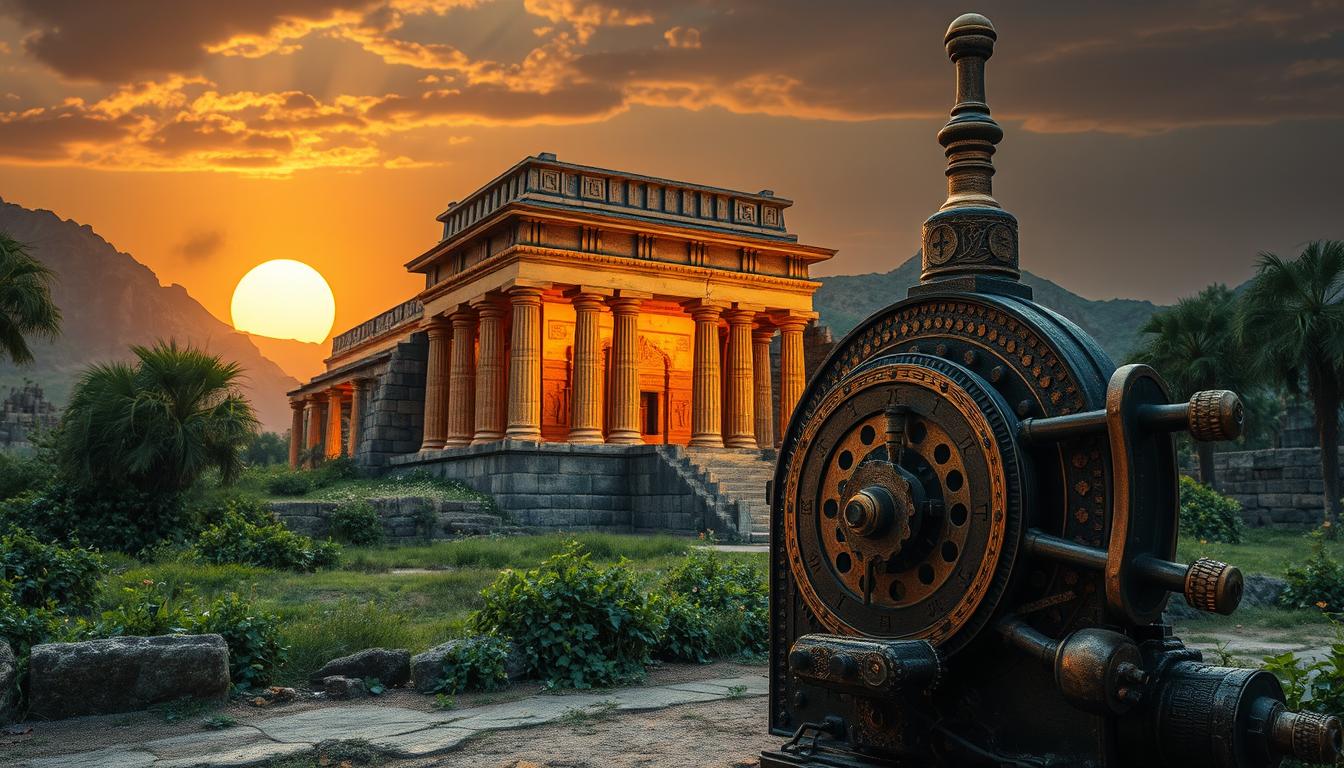
When you think of vending machines, you might picture today’s convenience. But, over 2,000 years ago, ancient engineers already had this idea. Hero of Alexandria made a holy water dispenser in Egyptian temples. You’d insert a coin, and it would pour out a measured amount.
This early example shows how ancient technologies ahead of their time solved everyday needs long before the industrial age. Forgotten inventions like the Antikythera mechanism—a 37-gear device tracking celestial events—prove our ancestors built historical innovations far beyond their era’s limits.
The Baghdad battery used copper and iron, while the Houfeng Didong Yi detected earthquakes with dragon-headed pointers. These technological marvels of antiquity challenge modern assumptions. Even Roman concrete, mixed with volcanic ash, is strong enough to hold up the Pantheon’s dome today.
This article reveals how ingenuity across civilizations left clues to inventions we marvel at. It proves ancient technologies shaped the world we know.
Ancient Greek Innovations in Mechanics
The antikythera mechanism, found in 1901 near a Greek island, is a marvel of ancient greek technology. This 2,000-year-old device tracked lunar phases and solar eclipses with bronze gears. It showed off advanced greek mechanical engineering. Its 30+ gears, including differential systems, were similar to those in cars, showing ancient genius.
Hero of alexandria was a pioneer in ancient automata. He created the first vending machine, a coin-operated holy water dispenser. His steam-powered aeolipile and automated temple doors used hydraulics and pneumatics. These inventions were a mix of art and mechanics, laying the groundwork for robotics and automation today.
Archimedes’ screw was used for irrigation, and water wheels powered mills. The Antikythera’s precision and Hero’s devices show how ancient greek technology foreshadowed modern tech. They calculated celestial events and automated daily tasks, showing ancient engineers understood principles we use today.
Roman Engineering Marvels
Roman concrete technology changed building forever. They mixed lime, volcanic ash, and aggregate to create opus caementicium. This durable ancient materials also built harbors and piers that lasted, a mystery to scientists today.
“Roman aqueducts carried water over 350 kilometers across Rome, supplying 1 million cubic meters daily,”
showing their skill inancient roman engineering. These systems used gravity and arches to bring clean water to distant towns.
The Romans built public works like roads and sewers. They paved over 250,000 miles of roads, connecting the empire. Their heating systems and aqueducts kept buildings clean and warm.
Today, we see their impact in places like the Pont du Gard and Appian Way. The Colosseum’s foundation and the aqueducts show their lasting influence. Every modern bridge and building owes a debt to ancient Rome’s ingenuity.
Chinese Inventions That Shaped Civilization
Over 1,800 years ago, Zhang Heng created the first ancient seismoscope. This bronze jar could detect earthquakes by dropping balls into dragon mouths. It showed the direction of the tremors. His zheng heng inventions like this device were unmatched by the West for centuries.

China’s early chinese inventions changed history. The compass, paper, gunpowder, and printing were key. These, known as the Four Great Inventions, changed society. Paper replaced bamboo, and Bi Sheng’s movable type printing in the 11th century boosted literacy worldwide.
Chinese navigation technology included magnetic compasses and sternpost rudders. These allowed voyages to Africa. Gunpowder formulas from 850 AD evolved into weapons. Su Song’s 1088 water-powered clock showed the precision of ancient chinese technology.
Marco Polo’s 1271 journey brought these marvels to Europe. Innovations like paper money and the South-Pointing Chariot (with differential gears) are timeless. These breakthroughs laid the foundation for modern science and exploration.
Egyptian Pyramids: Architectural Feats
The Great Pyramid of Giza is a key part of ancient egyptian architecture. It was built 4,500 years ago. Its 2.3 million limestone blocks, each up to 15 tons, fit together with incredible precision.
The pyramid’s base is 13 acres and only tilts a bit from true north. This shows how skilled the ancient builders were.
“The precision of these structures challenges assumptions about ancient capabilities,” remarked a 2022 study.
Builders used sleds, ramps, and copper tools to move the stones. A 2022 experiment showed 20 workers could pull a 2-ton block across wet sand. The Pyramid of Sahure had a copper pipe network for drainage, showing advanced egyptian engineering.
This hints at a society that knew a lot about egyptian mathematical knowledge. They used geometry and ratios to align structures with the stars.
Despite being very old, the Great Pyramid’s core blocks are in perfect condition. Their joints are so tight that modern tools can barely fit in. This ancient egyptian architecture shows the power of precise calculations and teamwork.
Even today, trying to build something like this would be a huge challenge. It proves the genius of the ancient Egyptians is timeless.
Advanced Ancient Agriculture Techniques
Early irrigation systems, like Mesopotamia’s canals and qanats, started around 6000 BCE. They changed ancient farming techniques forever. These early irrigation systems made deserts into fertile lands, helping mesopotamian farming empires grow.
By 3500 BCE, plows in Czech Republic and Indus Valley sites made soil better. Babylon’s 1500 BCE seed drills were a big step in agricultural innovations.

Terrace agriculture made the most of mountainous areas. The Inca’s Andean terraces and China’s hillside fields stopped soil loss. These methods are used today.
These innovations helped cities like Ur and Harappa grow. From water-lifting shadufs to selective breeding, ancient people mixed science with tradition. Their work is seen in modern drip irrigation and erosion control, showing ancient wisdom in farming.
Remarkable Egyptian Medical Practices
Ancient Egyptian medicine was truly groundbreaking. The Edwin Smith Papyrus, from 1600 BCE, documented 48 trauma cases. It showed detailed diagnoses and treatments.
This document highlights early surgical techniques, like rhinoplasty. Mummy evidence confirms these surgeries were successful. Their ancient medical tools—copper scalpels, obsidian blades, and forceps—were made with great precision. This shows their advanced surgical skills.
The egyptian medical papyri were a source of knowledge. The Ebers Papyrus, from around 1550 BCE, listed over 800 prescriptions. It combined ancient pharmacology with remedies from plants, minerals, and animals.
Honey-soaked bandages and poppy extracts for pain relief show their natural medicine knowledge. Even false teeth and prosthetic toes found in tombs show their innovative care.
Surgeons used tourniquets and cauterization to stop bleeding during surgeries. They even performed cataract surgery. Their understanding of the vascular system was centuries ahead of others.
These practices set the stage for global medicine. They influenced Greek and Roman traditions. The legacy of their systematic approach is seen in papyri and tools. It proves ancient Egyptian medicine was a key part of medical history.
The Incan Road System: Engineering Excellence
The Incan road network stretched over 25,000 miles across the Andes. It was a wonder of ancient andes engineering. It crossed mountains, deserts, and rivers.
This pre-columbian infrastructure featured 150-foot-wide suspension bridges made from ichu grass. The Q’eswachaka bridge is a famous example, used today. Engineers built stone paths and terraced roads up 16,000-foot peaks. They did it all without iron tools or written plans.
The incan suspension bridges were community treasures. Villagers rebuilt them every year. The inca transportation system used llamas and human runners, called chasquis, to carry messages 150 miles a day.
These messages were sent via khipus, or knotted strings. The roads were paved with stone slabs, up to 12 inches thick. They had drainage channels to withstand earthquakes and floods.
Today, parts of the network are used in six countries. It shows how well it was built. Researchers use ground-penetrating radar to study its design. This system, built in 84 years, connected 10 million people and 750,000 square miles of empire. It’s a sign of ingenuity without wheels or writing.
Maritime Innovations of the Ancient World
From the earliest reed boats of Mesopotamia to China’s massive treasure ships, ancient maritime technology drove exploration and trade. By 5500 BC, Mesopotamian pottery showed sailing ships. The Sumerians built vessels from bundled reeds. Egyptian seafarers used cedar ships to reach Punt, their journeys recorded in temple reliefs.
Ancient shipbuilding saw a big leap with the Phoenicians. Their biremes and triremes ruled Mediterranean trade. The 2556 BC dock at Wadi al-Jarf, Egypt, showed ancient harbor construction skills, helping pyramid projects. Chinese shipbuilders in the Ming Dynasty made 400-foot junks with watertight compartments, long before Europeans.
Early navigation methods used stars and ocean currents. Polynesians crossed the Pacific by following wave patterns and bird flight. Arab sailors used the kamal, a wooden strip with markers, to measure star altitude. The Vikings’ longships reached North America by 1000 AD, showing their open-sea skills. These methods helped cultures trade spices, silk, and ideas across continents.
Naval engineering breakthroughs like the Greek fire weapon, used by the Byzantines, shaped military strategy. Ancient civilizations combined reed boats, star charts, and watertight hulls to build a global network. Their innovations are seen in today’s shipping and navigation systems.
The Insights of Ancient Astronomers
Ancient astronomy shows how early cultures used tools to understand the sky. The Babylonians made ancient star charts, like the “Three Stars Each” from 1100 BCE. They tracked Jupiter’s path using geometry.
These charts were both scientific and practical, linking to farming and rituals. They showed how ancient star charts were used in everyday life.
Babylonian astronomy left a lasting mark with clay tablets that predicted planetary motion long before calculus. Their work influenced Egyptian solar calendars and sites like Stonehenge. These structures were aligned with solstices, showing the connection between astronomy and daily life.
Ptolemy’s Almagest brought together star data with epicycles, building on earlier discoveries. This work laid the foundation for modern technology like GPS. It shows how ancient innovations are the basis for today’s precise calculations.
From sundials to star charts, ancient minds shaped our understanding of the universe. Their tools and methods are the roots of our modern knowledge.