




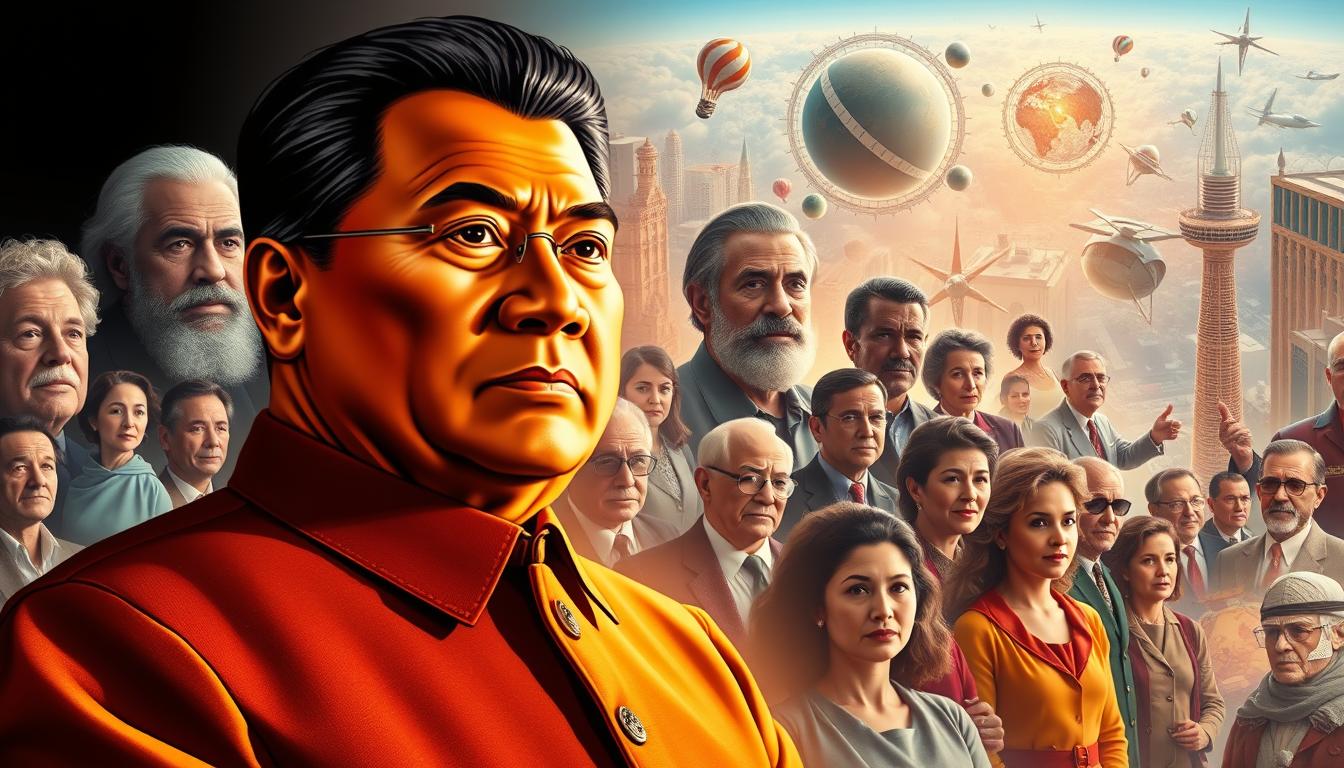
History is shaped by those who redefine what’s possible. The greatest visionaries of our time are world-changing individuals. Their ideas and actions continue to influence us today.
Influential figures leave their mark on progress. Their stories highlight how impactful personalities can start revolutions. This includes tech breakthroughs and social justice milestones.
From leaders who started AI ethics to activists fighting for equality, each story shows how one person can change everything. The next sections will dive into why these modern history makers are so important.
Visionaries in Technology and Innovation
Every device in your pocket or app on your screen owes thanks to tech industry pioneers. Sir Tim Berners-Lee invented the World Wide Web in 1989. It started as a way for scientists to share data. Now, it connects billions worldwide.
His goal was to allow researchers a place to share information online so that others could see it any time of the day.
” Today, his work supports everything from social media to e-commerce.
Modern technological visionaries like Elon Musk carry on this legacy. His companies, from electric cars to reusable rockets, break new ground. Dean Kamen’s digital innovators at FIRST Robotics teach students to solve real-world problems through engineering.
“Failure is a stepping stone,” says Musk. This is a mantra shared by innovators from Steve Jobs to Ann Marie Sastry. Her Sakti 3 Corporation is leading the way in next-gen batteries for electric vehicles.
History’s revolutionary inventors often started small. Jack Kilby and Robert Noyce independently invented the integrated circuit in 1959. This sparked the chip revolution. HP’s founders, Bill Hewlett and Dave Packard, started with just $538 in a garage.
Even Steve Wozniak and Steve Jobs’ Apple II, built in a garage, became a blueprint for tech entrepreneurship.
Today’s tech entrepreneurs focus on big challenges like climate change and healthcare. Bill Gates’ Microsoft legacy now fuels his philanthropy. Larry Page and Sergey Brin’s Google changed how we access information. Their stories show that innovation thrives where curiosity meets persistence.
These pioneers remind us: the next breakthrough could start anywhere, from a lab to a race track.
Influential Leaders in Human Rights
Rosa Parks’ act of defiance in 1955 sparked the Montgomery boycott. This was a key moment led by civil rights pioneers like her and Dr. Martin Luther King Jr. Their bravery changed the world, showing how one person can make a big difference.
Parks’ quiet act of resistance lit a fire for bigger movements. It inspired people like Malala Yousafzai, an equality champion who fought for girls’ education worldwide, even after a near-fatal attack.

Nelson Mandela spent 27 years in prison before becoming South Africa’s first Black president. His message of forgiveness won over 80% of the population after apartheid. Alicia Garza, a rights movement founder of Black Lives Matter, also fights for change, turning anger into action.
These leaders, from Gandhi to Mandela, share a common trait: unwavering determination. MLK Jr. once said,
“Injustice anywhere is a threat to justice everywhere,”
echoing today’s activists. Their stories teach us that change often starts with one person’s courage to stand up.
Pioneer Environmental Activists
“In nature, nothing exists alone.” — Rachel Carson, whose 1962 book Silent Spring exposed the dangers of pesticides, sparking the modern environmental movement.
Lois Gibbs changed communities in 1978. She found toxic waste near her home in Niagara Falls. Her fight led to the U.S. Superfund program.
Today, leaders like Wangari Maathai show the power of grassroots efforts. Her Green Belt Movement planted over 30 million trees, linking ecology to women’s rights.
Sustainability pioneers start as ordinary citizens. Greta Thunberg, a teen, inspired global strikes. Mari Copeny, known as “Little Miss Flint,” raised funds for her city’s water crisis.
These visionaries turn personal concerns into action. Rachel Carson warned us with science, and David Brower expanded the Sierra Club. Today, innovators like Anna Du, a 12-year-old, design tech solutions for ocean plastics. Their work shows every action can make a difference.
Groundbreaking Artists and Creatives
Artistic visionaries like J.K. Rowling show how creativity can start global movements. Her Harry Potter series, born from personal struggle, became a huge hit. But literature is just one way artists change society.
Take Marcel Duchamp’s 1917 Fountain, a urinal seen as art. This artistic revolutionaries broke rules, showing anything can be art.

Picasso’s Cubism changed how we see things, while Andy Warhol made soup cans cultural innovators. Jackson Pollock’s drip paintings changed what we think of art. These artists didn’t just make art—they questioned what it could be.
“Every human being is an artist,” declared Joseph Beuys. His words live on in today’s art, where social activism meets beauty.
Today, influential creators like Banksy use street art to speak out against power. Filmmaker Spike Lee mixes stories with racial justice. Kerry James Marshall’s paintings bring forgotten histories to light, showing art’s power to teach.
Even after they’re gone, artists like Frida Kahlo stay with us. Her self-portraits are symbols of strength.
From Duchamp’s challenges to Warhol’s pop art, these artists show creativity knows no bounds. Their work lives in galleries, classrooms, and movements that push art’s limits. Every piece of art is a call to reflect and challenge the world.
Transformative Figures in Medicine
Medical pioneers like Dr. Antoni Ribas have changed cancer treatment with immunotherapy trials. His work led to Keytruda, a drug for melanoma and lung cancer. Katalin Karikó and Drew Weissman also made big strides in vaccine science.
Their mRNA research, winning the 2023 Nobel Prize, helped make vaccines fast during the pandemic. This saved millions worldwide. It also opens new ways to fight HIV and influenza, showing innovation can beat disease.
Public health champions like Nancy Lublin use tech to tackle big issues. Her Crisis Text Line uses AI to help over 100,000 teens yearly. In Kentucky, Kids First Dental Services use mobile clinics to help kids, tackling big health gaps.
Other heroes like Katsuhiko Hayashi and Luhan Yang are pushing the limits. Hayashi’s lab grew eggs from skin cells. eGenesis is working to make pig organs safe for transplants, solving a big problem.
These innovators show that kindness and science go together. From mRNA’s impact to dental care for kids, their work shows healthcare is a right and a call to action. Every breakthrough, from lab-grown organs to AI care, shows a shared goal: to heal everyone.
Visionaries in Business and Entrepreneurship
Entrepreneurial visionaries like Muhammad Yunus show that profit and purpose can go hand in hand. He founded Grameen Bank and introduced microfinance, helping millions escape poverty. KIND Snacks’ Daniel Lubetzky also combines kindness with business, giving employees stock options to build a sense of ownership.
Tariq Farid grew Edible Arrangements from a small start to over 1,200 stores, focusing on holiday gifts. David Neeleman’s JetBlue changed the airline game by putting customers first. Travelocity’s $1.2B IPO in just six years shows the impact of digital innovation.
The Honest Company’s founder kept a $1.7B valuation by being transparent. Jeff Bezos, despite controversy, made Amazon a cloud computing giant, showing the power of vision. Modern Meadow is working to reduce land use for meat by 99%, blending ethics with growth.
Every success story shares a common trait: long-term thinking. Visionaries like those using the Ninety platform set goals for 5-15 years, balancing innovation with practical needs. They leave a lasting impact, creating jobs and showing what’s possible.
Champions of Scientific Advancement
Scientific geniuses like Charles Darwin and Gregor Mendel changed how we see life. Darwin’s theory of evolution is the base of all modern biology. Mendel’s work on inheritance laid the groundwork for genetics.
Research pioneers like Louis Pasteur and James Watson have made huge impacts. Pasteur’s work on pasteurization has greatly reduced foodborne illnesses. Watson’s discovery of DNA’s double helix structure has boosted genetics research by 50%.
Breakthrough scientists like Rosalind Franklin and Jennifer Doudna carry on this tradition. Franklin’s Photo 51 was key to DNA discoveries. Doudna’s CRISPR-Cas9 technology now drives 60% of genetic research.
Alexander Fleming’s discovery of penicillin has saved an estimated 200 million lives. The U.S. Department of Energy is making progress in fusion energy, moving us closer to clean energy.
From Linus Torvalds’ Linux OS to Tim Berners-Lee’s World Wide Web, innovation knows no bounds. The Turing Award honors pioneers like Grace Hopper, whose work on compilers changed programming. Today, we face challenges like quantum computing and AI, but the same curiosity that drove Einstein and Mendel is needed.
As scientists work together worldwide, they bridge the gap between labs and everyday life. Their work, like CRISPR or fusion power, is vital for those who need it most.
Social Entrepreneurs Shaping Communities
Across the globe, community changemakers are changing how we tackle big problems. People like Muhammad Yunus, who started Grameen Bank, show that small loans can make a big difference. His work has inspired over 10 million social enterprises, creating $2 trillion a year and employing 200 million people.
These social innovation leaders don’t just give money; they build lasting solutions. Geoffrey Canada’s Harlem Children’s Zone is a great example. It combines schools and health services to fight poverty. Jacqueline Novogratz’s Acumen Fund also shows that making money and doing good can go hand in hand. 
Ashoka has 3,500+ global fellows, including those focused on climate change. They’ve changed 74% of local policies. Programs like Dela V, backed by IKEA and Ashoka, train community builders to tackle big issues. Kiva’s $1.5 billion in microloans also shows how small investments can lead to big changes.
Today’s impact entrepreneurs use technology to make a difference. Osso VR helps improve surgeries, and Ecosia plants trees with every search. These innovators show us that with determination and heart, every community can change the future.
Notable Figures in Education Reform
Malala Yousafzai is a true education revolutionary. She was shot by the Taliban for standing up for girls’ education. Now, she leads the Malala Fund, helping millions. Her bravery inspires classroom reformers everywhere.
“One child, one teacher, one book, one pen can change the world.” — Malala Yousafzai
Salman Khan is a learning innovator who made Khan Academy free. It offers over 3,000 lessons. Geoffrey Canada, a teaching pioneer, created the Harlem Children’s Zone. He lifted whole communities with education.
Ann Cotton’s Camfed initiative empowers girls in Africa. In the U.S., YES Prep Schools send 100% of graduates to college. Even in tough places, classroom reformers like Sir Ken Robinson inspire change with TED Talks seen by 12 million.
Today, reformers use technology too. Arizona State University saw better pass rates with Knewton’s tools. From Pakistan to Harlem, these leaders show education is a lifeline for progress.
Prominent Voices in Civil Society
Democracy defenders like Todd Beamer show us the power of courage. On September 11, 2001, his call to action on Flight 93 inspired many. This courage drives leaders who connect communities and power.

Václav Havel went from playwright to president, showing dissent can lead to progress. His peaceful change in Czechoslovakia set a global example. Kailash Satyarthi’s work has freed over 80,000 children, showing the impact of social movement founders.
Civil society leaders like Jimmy Carter use their experience to push for change. The Carter Center works on elections and disease, showing lasting impact. Ela R. Bhatt’s Self-Help group has empowered 1 million women workers, changing economies.
Malala Yousafzai, a Nobel laureate at 17, shows how youth can fight for education rights. Avaaz.org’s 8 million members fight for climate justice. Bryan Stevenson’s EJI battles racial bias, showing collective action can last.
These stories show that together, we can make lasting change. Democracy grows when ordinary people become changemakers.
Innovators in Sports and Philanthropy
Sports are more than games for athletic changemakers who blend passion with purpose. Muhammad Ali and Billie Jean King were , using their platforms to challenge norms. Today, like LeBron James use their fame to make a difference. His I PROMISE School helps 2,000 kids every year, showing athletes can change communities.
Megan Rapinoe, a , fights for LGBTQ+ rights. like Sanya Richards-Ross and Meb Keflezighi inspire with both medals and mentorship.
Organizations like the SHaRM Foundation rebuild lives after disasters, combining athletic influence with global impact. Mary Wittenberg’s NYRR programs help over 200,000 youth yearly, showing running’s wide reach. Even niche areas like obstacle racing and RunPro Camp’s grants highlight grassroots innovation.
These efforts echo Ali’s legacy: sports as a force for justice, equality, and resilience.
With 50,000 runners in NYC’s marathon and 60,000 at Atlanta’s Peachtree event, a movement is growing. Athletes are leading on issues like gender pay equity and disaster recovery. Their stories show greatness is about leaving tracks of change for future generations.
As courts and fields become battlegrounds for progress, these pioneers show every stride can lead to a fairer world.