







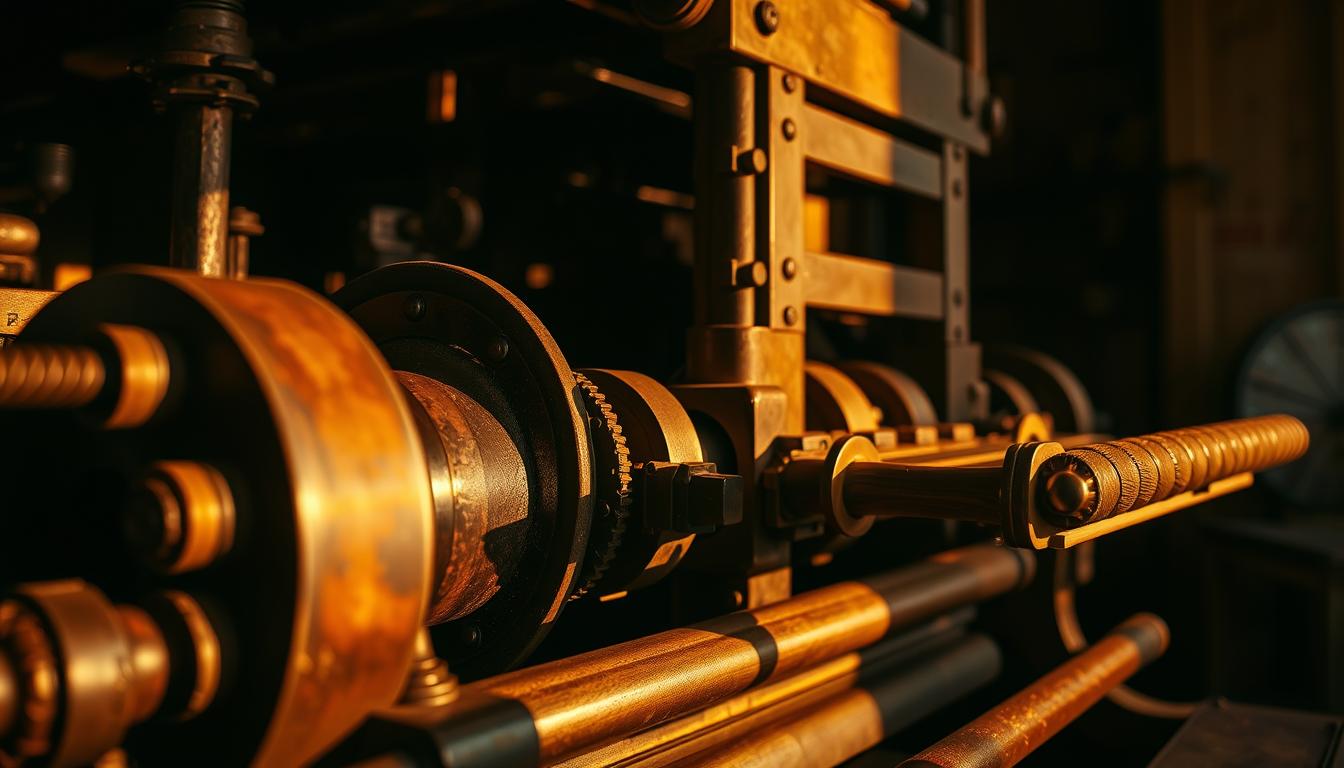
Knowledge is power, and the Gutenberg invention changed human history. Born in 15th-century Mainz, Germany, this machine started a communication revolution. Francis Bacon called it one of humanity’s greatest innovations, alongside gunpowder and the compass. Its legacy lives on in how we share knowledge today.
Before the printing press, books were rare. They were copied by hand for monasteries and elites. Gutenberg’s machine enabled mass production.
By 1500, over 10 million books spread across Europe. This transformed knowledge dissemination, making ideas available to more people than ever before.
Mass printing boosted literacy and education. Martin Luther’s 95 Theses spread widely, sparking religious reform. The printing press didn’t just copy texts—it connected cultures and generations. Today, its impact endures in how we access information, from classrooms to digital platforms.
Introduction to the Printing Press
Johannes Gutenberg’s Gutenberg press changed how we communicate. Born in Mainz, Germany, he was a goldsmith. He combined his skills with old tools to create something new.
His machine used a screw from wine presses and movable type printing. It used metal letters that lasted long. Before him, medieval printing technology was slow. It used wooden blocks or copying by hand, making books rare.
Gutenberg made metal letters that could be rearranged. This movable type printing let him print many copies of texts. His first big project was the 42-line Bible.
By 1455, his workshop was churning out Bibles fast. This was a big change from the old days. Though Korea had metal type before, Gutenberg’s idea spread fast across Europe.
His press made printing easier. It had steps like setting type, inking, and pressing. This made books cheaper and more available.
By the 1470s, presses in Venice helped spread knowledge. The Gutenberg press was key to modern publishing. It connected the old ways to the new information age.
Historical Context of the Printing Revolution
In the centuries before the printing press, medieval manuscript production was slow. Scribes copied texts by hand, making handwritten books rare and expensive. A single book in the 14th century could cost as much as a house.
This made knowledge hard to get. The University of Paris’s library had only 300 manuscripts by 1300. This showed how much information scarcity there was.

Monasteries and scholars kept Europe’s books safe. But, the Renaissance beginnings brought a new need for old texts. Universities grew, and students needed more books than scribes could make.
Only a few could read, making knowledge hard to find. This limited cultural and intellectual growth.
By the 15th century, the need for education and old texts grew. The slow pace of medieval manuscript production was about to change. A single press could soon make thousands of pages every day.
This contrast made Gutenberg’s invention not just possible, but necessary.
How the Printing Press Changed Communication
Before the printing press, news spread slowly. It relied on word-of-mouth or hand-copied manuscripts. The press changed this, starting the first news networks.
In 15th-century Venice, printers sold news pamphlets to sailors. These sailors carried updates across seas. When they arrived, local printers copied the sheets and sent riders to spread them across towns.
This system made information a shared public resource. It’s like today’s communication technology, like social media.
Martin Luther’s 95 Theses spread across Europe in weeks, not years. This showed the press’s power for information distribution. Townspeople gathered in squares to hear pamphlets read aloud.
This was like modern podcasts or viral content. For the first time, ideas could spread faster than their originators. This created a feedback loop of public discourse.
Print’s speed made societies adapt. Both literate and illiterate people engaged with news. This blended oral traditions with written records.
This shift laid the groundwork for today’s media evolution. Now, anyone can publish and consume content globally. The printing press wasn’t just a tool. It rewired how we share stories, knowledge, and revolutions.
Printing Press and the Spread of Ideas
Before the printing press, knowledge accessibility was only for the wealthy. Monasteries and universities kept books locked away, making them rare and pricey. The printing press changed this, making ideas available to everyone.
By 1500, over 1,000 presses across Europe were producing millions of books. This spread information democratization quickly.

Church leaders tried to control idea dissemination by banning books. But each list of forbidden texts became a guide for printers. In Venice, 100 shops filled markets with banned works, making censorship futile.
Martin Luther’s 95 Theses, printed in 1517, reached readers before church authorities could stop them. Luther’s writings became Europe’s first viral sensation, showing intellectual access could beat authority.
Spain’s 1475 Barcelona presses and Portugal’s Lisbon printers joined the movement. By 1600, even small towns had access to groundbreaking works like Copernicus’ astronomy or Galileo’s telescopic discoveries. This shift paved the way for the Scientific Revolution, making knowledge available beyond ivory towers.
Today’s digital age echoes these battles. Just as 15th-century rulers failed to stop printed dissent, modern governments face similar hurdles. The printing press didn’t just print books—it changed who controlled truth, a lesson that continues to impact our connected world.
The Impact on Education and Literacy
The printing press started a reading revolution that changed education history. Before Gutenberg’s invention, books were rare and handwritten, only for the rich. By 1500, the press had made 15–20 million copies of 30,000 different works. This made knowledge available to many.
Schools and universities could now use the same textbooks. This led to standard curricula. Books became affordable for families who weren’t wealthy, starting a growth in literacy.
The learning transformation began with silent reading. Unlike before, when knowledge was shared aloud, people could now study privately. This allowed students to learn at their own speed, using page numbers and indexes.
Teachers no longer had all the knowledge. People could read scientific and religious texts on their own. By 1520, books were translated into local languages like German and English. This let ordinary people read for the first time.
Standardized spelling and punctuation made texts easier to understand. This was a big step in education history. It helped more people learn to read, driving literacy rates up.
The printing press did more than spread ideas. It laid the groundwork for today’s education systems. Every classroom today owes a debt to Gutenberg’s innovation.
The Printing Press and Culture
The printing press changed culture by making writers famous. Before it, scribes copied texts by hand, leading to mistakes. Printed books let authors like Shakespeare and Dante reach more people.
These authors became known for their works, which shaped history and ideas. Their writings are timeless, influencing how we see the world.
Literature grew fast with the printing press. The Gutenberg Bible showed how books could be uniform. This led to more novels and sonnets, written for everyone, not just the rich.
Printers paired text with woodcut illustrations, making art common. Religious scenes and diagrams spread, educating many. Martin Luther’s 95 Theses used woodcuts to spread his message, combining text and art.
Standardized books united cultures. They made searching for information easier. This helped create national languages from local dialects.
Today, the printing press’s impact is seen in global publishing. Authors and artists use print to tell stories and express art.
Economic Changes Driven by Printing
The printing press changed book trade economics by making ideas into products. The publishing business grew as scribes lost their control. Commercial printing created new jobs. People like Benjamin Franklin started in print shops, building wealth and influence.
Book prices fell by 2.4% every year for centuries. This made knowledge available to more people.
In 16th-century Germany, competing printers pushed for new ideas. Cities with many publishers saw book costs drop 25% faster than places with only one. This print capitalism led to more scientific and business texts. Universities began to focus more on science and math, improving economic productivity.
Today, we see similar changes. 3D printing is changing manufacturing, just like printing changed books. Bioprinting could change healthcare, like printing changed medicine. The publishing business showed us that competition makes things cheaper and more innovative. This lesson is shaping industries from books to biotech.
The Printing Press and Scientific Advancement
Imagine a world where discoveries like gravity or planetary motion were only in handwritten manuscripts. The printing press changed this, making scientific breakthroughs available to all. It allowed for the exact copying of diagrams and formulas, becoming a key tool for scientific method development.
Astronomer Copernicus used printed tables to improve his sun-centered model. This shows how experimental sharing speeds up progress.

Before the press, scientists worked alone. Printed journals and books created a network for research communication. This let thinkers in Italy, England, and beyond build on each other’s work.
When Galileo shared his telescope findings through pamphlets, others could knowledge verification his claims. This sparked debates that shaped modern science. This feedback loop is the basis of peer review today.
Without the press, science would remain a whispered secret among elites.
Standardized printed texts made things reliable. Scholars no longer had to rely on handwritten copies. This allowed Isaac Newton to reference Galileo’s laws directly, fueling the Scientific Revolution.
The printing press didn’t just spread ideas—it turned curiosity into a global effort. Its legacy is in every research paper, textbook, and open-access journal. It shows how sharing knowledge drives progress.
Global Impact of the Printing Press
By the 1500s, Venice’s printers had turned ships into messengers of ideas. News pamphlets from European ports reached Asia, Africa, and the Americas. This fueled the global printing spread.
Traders and missionaries carried Bibles, maps, and scientific texts. They linked distant societies through cross-cultural communication. By 1556, the first press in Goa, India, spread Portuguese and Sanskrit texts.
While Mexico City’s 1544 press shared Spanish and Indigenous languages. These exchanges created a web of international knowledge transfer. But they also amplified colonization effects.
Printers in Buda (1472) and Kraków (1473) adapted presses to local languages. This showed technology’s adaptability. Yet colonial powers often used presses to control narratives.
In India, the 1580 polyglot Bible for Emperor Akbar highlighted cultural clashes. It preserved Persian and Arabic texts while promoting European perspectives. By 1821, presses in Hawaii and Tahiti brought literacy to Pacific islands.
Books like Copernicus’s De revolutionibus spread scientific ideas. But colonial regimes suppressed Indigenous publications. In the Americas, the Cherokee Phoenix newspaper (1828) showed how printing could empower marginalized groups.
The printing press became a double-edged tool. It connected the world while reshaping it. Its legacy echoes today in global digital networks, where information flows faster but carries echoes of that first global printing spread.
Technological Evolution of Printing
Gutenberg’s printing press started a series of advancements in printing technology. Early improvements, like iron frames and screw mechanisms, made presses faster and more reliable. By the 1800s, steam power replaced human labor, ushering in a new era of speed and scale.

Industrial printing took off with rotary presses and linotype machines. These upgrades allowed newspapers and books to flood markets, making knowledge widely available. Offset printing, introduced in the late 1800s, became key for high-volume production. It enabled colorful, detailed prints at low costs.
Today, digital presses eliminate physical plates, allowing for on-demand printing for any quantity. Each innovation built on the last, from Gutenberg’s hand-cranked devices to modern laser-driven systems. Mechanical improvements like steam and automation cut costs, while new materials and designs boosted quality.
This steady evolution let printing spread ideas globally. It turned books and newspapers into everyday tools for education and commerce. Industrial printing didn’t just change how we print; it reshaped society by making information accessible to all.
The Decline of Traditional Print
Digital transformation is changing how we communicate. Print media is facing new challenges. Electronic publishing has become the norm, with many turning to screens for news and stories.
Traditional print decline is clear in numbers: U.S. newspaper circulation dropped to its lowest in 2020. Print advertising revenue fell over 60% in a decade. The Village Voice ended its print run in 2017, while Newsweek shifted online in 2013.
Numbers tell the story. The New York Times now has 7 million digital-only subscribers. Yet, weekday print sales dropped from 55.8 million in 2000 to 24.2 million by 2020. Local newspapers feel the strain too: Ontario’s Metroland Media Group filed for bankruptcy, laying off 600, including 68 journalists.
Younger readers prefer screens—adults spend 3.5 hours daily on mobile devices, up 20 minutes from 2019. Global digital ad spending hit $333 billion in 2020, outpacing traditional ads.
Print’s legacy persists, but adaptation is key. Some publishers now offer free print copies to attract readers. Others focus on online content. Yet, the shift isn’t just about money—it’s about changing habits.
As younger generations favor digital, the print audience ages. The core of sharing knowledge remains, now blending old and new. The printing press sparked one revolution; digital is the next chapter in how we connect and learn.
Conclusion
The printing press changed how ideas spread, starting with Gutenberg’s Latin Bible in 1455. By 1500, Europe’s libraries grew from 300 manuscripts to thousands of books. This made knowledge more accessible to everyone.
This change didn’t just make books more common. It also made people more literate. In 1500, a teacher could buy a Cicero text for a month’s pay. This was a big change from centuries before, when only the elite could read.
The printing press’s impact is seen in today’s technology, like offset and digital systems. But its real power was in making information available to all. Venice’s news pamphlets in the 15th century and Paine’s “Common Sense” in 1776 show how printed words can spark change.
Today’s digital age is similar, but the printing press started it all. Debates about access and control today remind us of Gutenberg’s era.
Looking back, we see how one invention can change society and how we think. From 15th-century Bibles to 21st-century blogs, the core idea is the same: who controls knowledge shapes society. The printing press’s story teaches us that innovation is about more than tools. It’s about how they change our minds.