







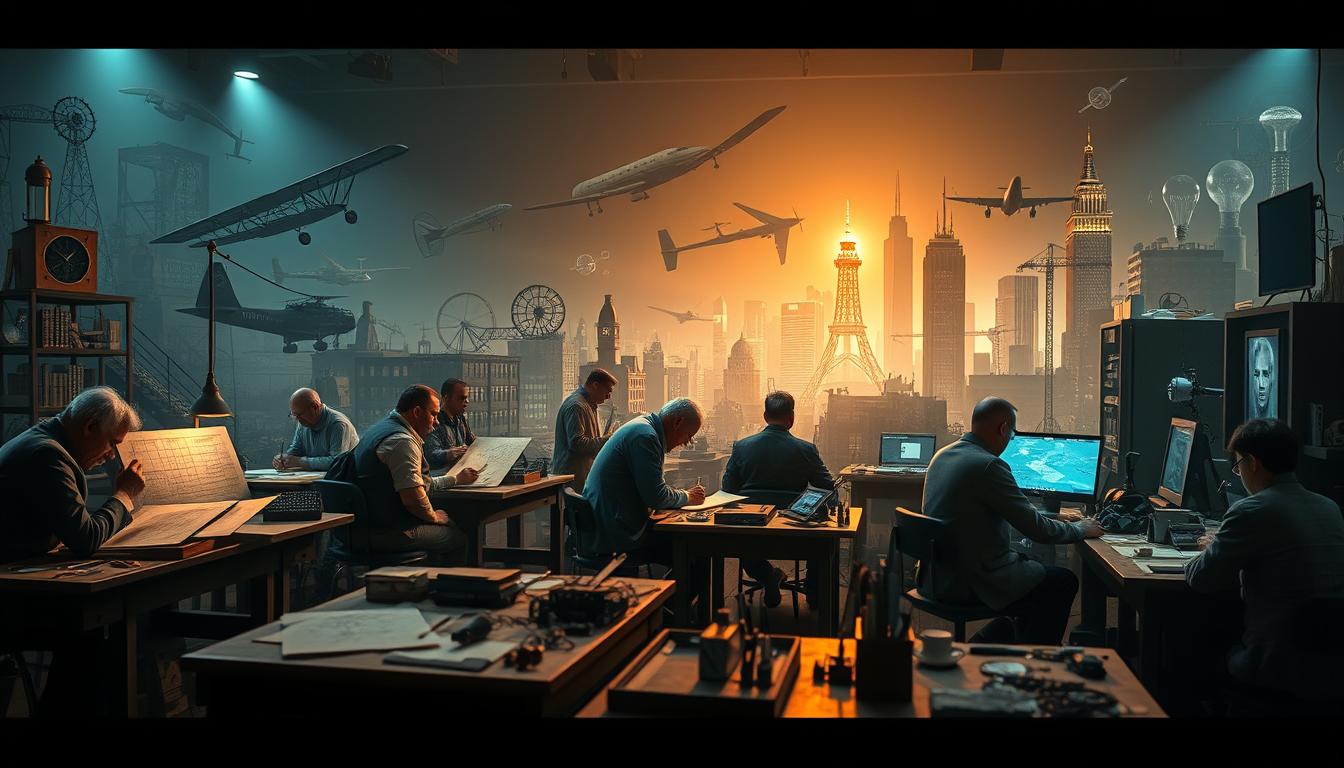
Human curiosity has always driven us forward. People like Galileo Galilei and Nikola Tesla have shown us the power of bold ideas. They’ve changed how we see the world.
Visionary entrepreneurs, such as Steve Jobs and Leonardo da Vinci, didn’t just invent. They disrupted the status quo. Their work shows how imagination can shape our lives.
Great innovators, like Gutenberg, have reshaped societies. His printing press could produce 3,600 pages daily. This article looks at how innovators used curiosity to solve problems.
They’ve left lasting legacies, like Disney’s animation or Edison’s light bulb. By studying their journeys, we learn what drives real change.
Introduction to Industry Innovators
“Passion is the genesis of genius.” – Galileo Galilei
Industry pioneers like Leonardo da Vinci and Nikola Tesla are driven by curiosity. They don’t just invent; they reimagine the world. Tesla’s work on alternating current systems changed how we get electricity today.
Business revolutionaries often face doubt. Eli Whitney’s 1793 cotton gin invention was criticized but doubled U.S. cotton production. Despite setbacks, innovators keep pushing forward, leading to big changes.
Walt Disney believed in making the impossible possible. From steam engines to digital platforms, pioneers see failure as a step towards success. Their legacy is to question the status quo, never give up, and push the boundaries of what’s possible. Every breakthrough begins with a spark of curiosity.
Technology Pioneers in the 21st Century
“The doers are the major thinkers. The people that really create the things that change this industry are both the thinker and doer in one person.” — Steve Jobs
Steve Jobs was a true tech innovator and Silicon Valley leader. He set the stage for today’s technological visionaries. Elon Musk, for example, follows in his footsteps. Musk’s Tesla, started in 2003, changed the car game with the Model S in 2013.
SpaceX, founded in 2002, also made waves. Its 2012 Dragon spacecraft was a big step in reusable rockets. It shows how private companies can explore space.

Antonio Neri wants to make cloud computing easy for everyone. His “Everything as a Service” idea fits with the rise of remote work. Sheila Lirio Marcelo started Care.com in 2006, connecting millions worldwide.
Salman Khan’s Khan Academy offers free education to 100 million people every year. It shows how tech can make learning accessible to all.
Today’s innovators are like Jobs but work faster thanks to global connections. A study of 16 tech leaders names Musk and Zuckerberg as key figures in AI, space, and social media. They prove Jobs right, that innovation happens where ideas meet action.
Revolutionizing Healthcare and Medicine
In 1940, nearly 1 in 5 soldiers with bacterial pneumonia died. By World War II, penicillin cut that rate to 1%. Alexander Fleming’s discovery started a wave of medical innovation that keeps going.
Today, mix AI, genetics, and engineering to change care. They use algorithms to spot cancer in scans quicker than humans. They also use CRISPR to edit genes and cure inherited diseases.
Pharmaceutical breakthroughs like 3D-printed drugs, like the FDA-approved Spritam epilepsy treatment, show the limits of biotech revolutionaries. Wearables track heart rates in real time. Telemedicine connects rural patients to specialists instantly.
These changes mean care is faster and more tailored. They show a health industry transformation.
AI looks through huge amounts of patient data to predict outbreaks or suggest treatments. Machine learning speeds up drug discovery, saving money and time. But, there are challenges: making sure AI is used ethically, keeping patient data safe, and balancing innovation with safety.
Experts like Seth Stephens-Davidowitz say big data’s power must respect privacy rights. From lab discoveries to bedside care, today’s healthcare leaders are shaping medicine’s future. Their work could bring treatments once seen as science fiction into our daily lives.
Fashion Industry Disruptors
Fashion innovators are changing the clothing industry transformation with new ideas. People like Coco Chanel, who changed women’s fashion, and today’s fashion entrepreneurs using technology, keep things fresh. Now, 75% of shoppers want to buy less, pushing brands to be more eco-friendly.
Big names like Gucci and Dior are leading this change. They mix old traditions with new tech. For example, Gucci made a film on NFT and AR sneakers, showing fashion’s digital growth.

Retail disruption is big as brands sell directly to customers. Dress-X got $2M for digital clothes, and RTFKT sold $3.1M in virtual sneakers in minutes. These fashion innovators use blockchain and AI to track where clothes come from, making things clear.
Alvanon and BodyBlock AI now use body data to make clothes that fit better. They say goodbye to the old one-size-fits-all idea.
“Innovation must balance heritage with modernity,” said Dior CEO Pietro Beccari, highlighting luxury’s tech pivot.
Even with the industry bouncing back to 2019 levels by 2021, only the top 20% did well. They used tech and cared about the planet. With prices going up, brands are using digital tags and recycled materials to stay on top. Today’s style revolutionaries are making fashion’s future exciting, one step at a time.
Sustainability Trailblazers
Sustainability innovators are changing industries by linking profit to the planet’s health. People like Patagonia’s Yvon Chouinard lead the way, saying, “There is no business on a dead planet.” They show that caring for the Earth and success can go hand in hand.
Walmart is a great example of this change. They promise to buy MSC-certified fish and cut down on packaging. This move helps reduce emissions and encourages suppliers to be more eco-friendly.
Climate solution creators, like those in the Sustainability50, are making a big difference. For example, Cécile Ndjebet is restoring mangroves and degraded lands in Cameroon. This shows that big changes are possible.
Groups like Asociación Ecosistemas Andinos have planted 3 million trees in Peru. Arcenciel is treating 87% of Lebanon’s medical waste. The UN aims to restore 350 million hectares by 2030. These efforts show how innovators can turn problems into chances for both people and the planet.
Financial Sector Transformations
From paper money to blockchain, financial innovation has changed how we manage cash. Today, fintech pioneers like mobile apps and crypto platforms make high-end services available to all. The move from coins to digital wallets shows how smartphones and AI have changed banking.
Apple’s team-up with Goldman Sachs is a great example. It drew $1 billion in deposits in just days. This shows how tech solutions can quickly earn people’s trust.

Payment system revolutionaries have lowered transaction costs. Investment industry disruptors like robo-advisors now handle 30% of U.S. investments. But, there are challenges like cybersecurity threats and strict rules.
Banks are facing higher IT costs, but new systems could cut expenses by 60%. AI is also changing how lenders assess risks, helping them adapt to rising defaults.
Non-bank financial institutions now hold trillions, more than traditional banks have held at any time. But, growing is tough because old systems clash with new tech. Margins are also shrinking due to digital demands.
Yet, the future looks bright. Hyper-personalized services and clear blockchain systems could change how we trust financial institutions. As markets evolve, staying ahead means mastering technology and understanding customer needs.
Media and Communications Disruption
From the telegraph’s electric pulses to today’s social feeds, media innovators have changed how we share ideas. The digital media revolution started with Johannes Gutenberg’s printing press. It grew with Tim Berners-Lee’s web, letting anyone share content worldwide. Now, 81% of Americans have smartphones, making everyone a possible creator in this communications transformation.
Traditional publishers are facing big changes. Publishing disruptors like DAZN are changing the game. They offer live sports with AI-driven recommendations. Their services, powered by 5G, are like Netflix for TV.
The Wall Street Journal now updates stories hourly. They focus on digital over print deadlines.
“The coolest government Twitter account,” as named by followers, the U.S. Consumer Product Safety Commission proves even agencies can be social media pioneers. Yet challenges loom: 35% of firms are stuck in the past, using paper. Misinformation spreads fast, calling for ethical innovation.
DAZN’s AI tailors content, while startups like TikTok change storytelling. For brands, adapting means using real-time feedback. This turns customers into collaborators. Those who don’t adapt risk being left behind as people want instant, personalized experiences.
Changes in Education and Learning
Education has always changed with society. The first industrial revolution in 1789 made formal education key for a growing workforce. By the 1800s, laws like the Morrill Acts made education a public good. But, quality gaps, dropout rates, and changing curriculum needs remained for years.
“Innovation doesn’t happen in a vacuum—it builds on past ideas to create better solutions.”

Today, EdTech creators like Salman Khan, founder of Khan Academy, carry this legacy. His free online lessons show learning innovation, helping bridge global education gaps. Maria Montessori’s child-centered methods, over a century old, inspire today’s teaching revolutionaries.
These educational industry pioneers use AI and data to make lessons fit each learner. They focus on personalization.
The fourth industrial revolution brings new needs: creativity, critical thinking, and teamwork. Schools now mix STEM with “power skills” for AI careers. Lifelong learning is now a must as technology changes jobs. Educators blend history with digital tools, keeping education relevant in our fast world.
Automotive Industry Innovators
The journey of the automotive industry from steam-powered curiosities to global networks is a long one. Early transportation pioneers like Henry Ford made cars a part of everyday life. His 1908 Model T, priced at $825, became a symbol of the times.
By 1927, 15 million Model Ts were made, showing how mass production could make travel affordable. Ford’s Highland Park plant, with its moving assembly line, cut carbuilding time from 12 hours to 90 minutes. This was a major car industry transformation that changed economies.
Today, vehicle technology revolutionaries focus on making cars sustainable and autonomous. Tesla’s Elon Musk made electric vehicles competitive with gas engines. Now, carmakers invest in AI and lightweight materials.
Even big names like GM and Ford are moving towards electric SUVs and hydrogen fuel cell research. Startups like Rivian are changing trucking with electric fleets. Companies like Waymo are testing self-driving taxis in cities.
Mobility disruptors are changing how we think about transportation. Ride-sharing apps, scooters, and drones are mixing vehicles with services. As cities go green, innovation focuses on batteries, charging, and smart roads.
The future looks bright with flying taxis and hyperloop highways. It shows that the story of cars is far from over. Those who dare to think differently are shaping our future.
Conclusion: The Lasting Impact of Innovators
Innovation has changed many fields, from medicine to smart cities. It shows that new ideas lead to progress. For example, innovation boosts productivity by 2% each year, helping economies grow.
But, only 2% of this growth is used. Now, innovators outside the U.S. are filing more patents than Americans. This shows we need to change how we think about innovation.
Creating a legacy of change isn’t just about big names like SpaceX or CRISPR. It’s about setting a path for the future.
South Korea shows how important STEM education is. There, 38% of students study science and tech, compared to 16% in the U.S. This difference in education can lead to big changes.
Policies also play a big role. For example, the EB-5 visa program has brought $400 billion to U.S. projects. But, the H-1B visa caps are too low, leaving talent gaps.
Innovation’s future depends on encouraging curiosity and creativity. It’s not just about money.
The next big things will come from quantum computing and climate tech. Even small profits can lead to big changes. For example, broadband in poor areas has boosted GDP by 1.3%.
Future innovators must learn from the past. They should build on decades of research, like AI. The legacy of innovators is not just in products but in the systems they create.
It’s time for everyone to be curious and act as change agents. This is how we move forward.