







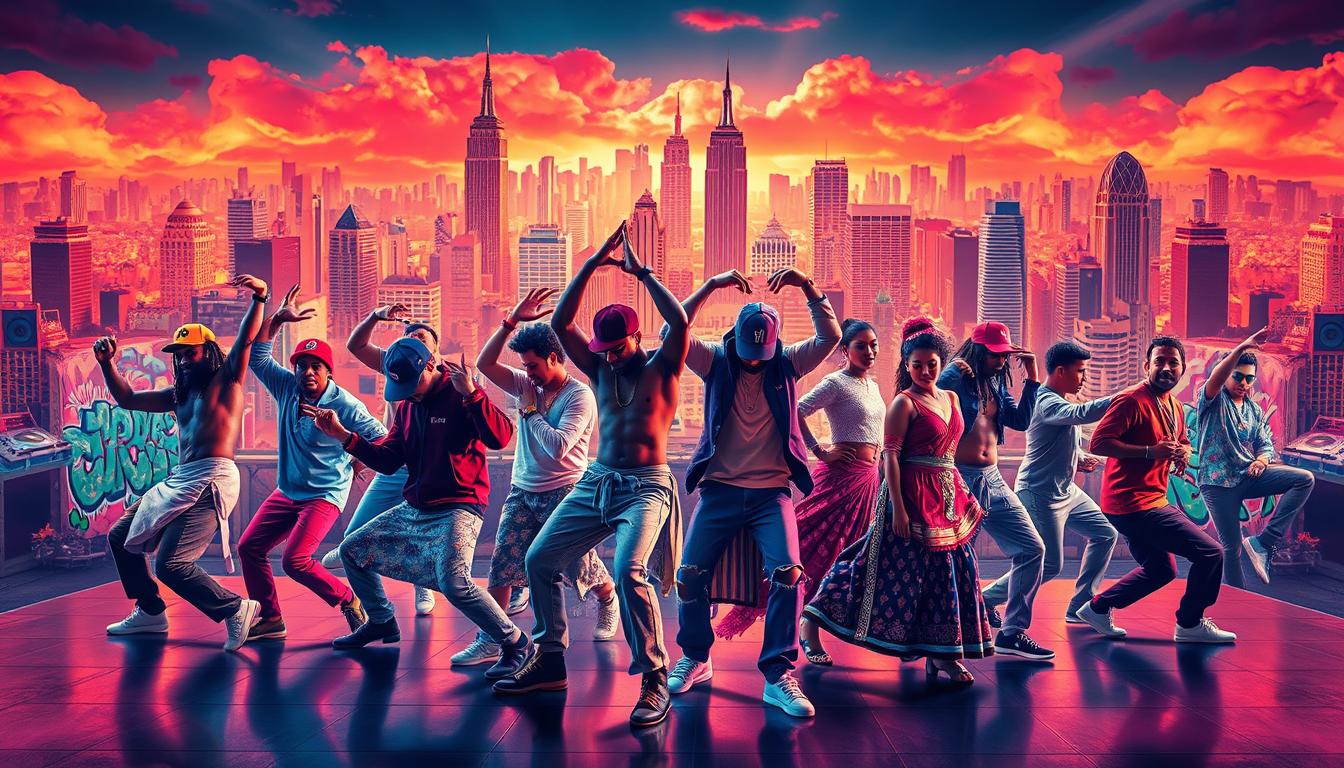
Hip-hop started in the Bronx in the 1970s. Now, it’s a $8 billion global phenomenon. It combines MCing, DJing, and breakdancing, making it the world’s favorite music. It even has its own academic study at the University of Arizona.
It crosses borders, mixing local traditions with big ideas like identity and justice. This makes hip-hop a powerful force worldwide.
In Ukraine, rappers speak out against political issues. In South Korea, hip-hop’s market is growing by 25% every year. This shows how hip-hop changes music and society.
Many songs today talk about big problems. Artists from all over push for equality. Fans in Brazil and South Africa help spread its influence, showing hip-hop’s power to connect people.
Hip-hop’s impact goes beyond music. It influences streetwear, with 60% of styles inspired by it. It also brings people together, with 70% seeing it as a symbol of unity. With songs in 20+ languages and youth movements everywhere, hip-hop continues to shape the world.
The Rise of Hip-Hop: A Brief History
In the 1970s, the Bronx was where hip-hop first started. DJs like Kool Herc and Grandmaster Flash made parties in basements into big cultural events. They made the music go longer by adding extra beats, which became a key part of the Bronx’s hip-hop scene.
“Hip hop is perhaps the most recent genre to be added to the list of original American music. Its origins lie in the Bronx during the early 1970s.”—Second source
The first hip-hop party was on August 11, 1973, at Kool Herc’s party. It mixed Jamaican sounds with local creativity. Soon, breakdancers, graffiti artists, rappers, and DJs came together, creating hip-hop’s four main parts: MCing, DJing, breaking, and aerosol art.
By 1979, the Sugarhill Gang’s “Rapper’s Delight” made hip-hop popular everywhere. It mixed fun rhymes with serious messages.
As hip-hop grew, leaders like Afrika Bambaataa turned street culture into a movement. The Bronx’s tough times pushed artists to be creative. By the 1980s, scratching and sampling became key skills, helping hip-hop spread all over the world. Today, the Bronx’s hip-hop roots guide its global success.
Hip-Hop and Identity: A Cultural Statement
Hip-hop identity is at the heart of its global appeal. It started in the Bronx’s marginalized communities and now reaches youth worldwide. Artists use hip-hop to share stories of resilience.
Early figures like Afrika Bambaataa turned block parties into unity events. They showed that hip-hop’s authenticity comes from raw, honest stories.
Cultural expression in hip-hop grows when artists mix local traditions with global sounds. Senegal’s Wire MC combines Indigenous gatherings with rap. Japan’s Hime weaves tanka poetry into her music.
These acts show hip-hop’s core values adapt to different cultures without losing its true spirit. The cypher—a circle of shared verse—becomes a universal language. It unites voices from Nairobi to Rio.

For Southeast Asian American youth, hip-hop bridges cultural gaps. A 2023 study found many see themselves as “yellow on the outside, White in the middle, and Black at the core.” Through rap, they tackle stereotypes and find their place in a culture that feels both foreign and familiar.
“Rap gives voice to specific struggles while connecting to shared human truths,” Jay-Z wrote in Decoded. This captures hip-hop’s ability to be both local and universal.
Hip-hop’s strength lies in its ability to adapt. It’s a platform where global voices share their stories. Authenticity in hip-hop isn’t about where you’re from—it’s about being honest. French pioneer MC Solaar said, “Hip-hop’s heartbeat is the stories we refuse to let the world forget.”
Globalization of Hip-Hop: Crossing Borders
“Hip-hop has gained huge success around the world, dominating music charts. Yet, while rooted in American culture, it soon inspired global artists to reimagine its sound.”—Historical industry analysis
From the Bronx to Berlin, hip-hop globalization changed music and culture. Early fans in Europe, like France’s IAM or the UK’s Wiley, mixed local beats with rap’s edge. International rap scenes now flourish in Seoul, where K-pop meets hip-hop, or Lagos, where Afrobeat and rap mix. These local hip-hop adaptations show creativity has no limits.
Events like Germany’s Battle of the Year attract 8,500 fans, featuring breakdance crews from 20 countries. MTV Base Africa aims for 50% African content, boosting voices like South Africa’s Tuks and Nigeria’s Burna Boy. These global hip-hop scenes mix local stories with hip-hop’s themes of struggle and pride.
In Paris to São Paulo, artists like Diamond Platnum (France) or Emicida (Brazil) blend slang, folklore, and social issues in their rhymes. This isn’t copying—it’s growth. Hip-hop’s essence—storytelling and resistance—becomes a common language. It shows culture’s strength in uniting while celebrating differences.
The Role of Technology in Hip-Hop’s Expansion
In the 1970s, turntables and drum machines became key in hip-hop. DJs like Kool Herc used the Technics SL-B2 turntable to extend breaks. Synths like the Roland TR-808 gave beats their unique sound. These tools turned everyday gadgets into creative instruments, letting pioneers make tracks without expensive studios.

MIDI technology in 1987 was a game-changer. Salt-N-Pepa’s 1987 hit “Push It” used sampled loops, showing how hip-hop technology changed sound. By the 2000s, digital platforms like SoundCloud let artists share tracks worldwide. Auto-Tune and DAWs made production easy, opening doors for creators everywhere, not just in NYC or LA.
Streaming platforms and hip-hop are now closely linked. Spotify and YouTube let fans in Jakarta find rappers from Lagos. TikTok can make hits go viral in an instant. Social media hip-hop spreads trends, teaching production tips and connecting producers worldwide. Festivals like Coachella stream globally, boosting local artists to a worldwide audience.
Today, AI tools and cloud software let producers in Lagos work with engineers in Seoul. The genre’s 50th anniversary in 2023 shows tech’s role in its growth. From mixtapes on cassettes to algorithm-driven playlists, hip-hop’s story is one of innovation and progress.
Hip-Hop Movements and Social Justice
Hip-hop has always been a voice for those without one. Starting in the 1970s Bronx, it has grown into a global movement. Songs like Grandmaster Flash and the Furious Five’s “The Message” (1982) highlighted poverty and neglect in cities.
Today, artists use their music to speak out against racism, police violence, and inequality. This tradition of using hip-hop for social justice continues.
“A University of Georgia study found over 500 criminal cases used rap lyrics as evidence, showing how hip-hop’s messages resonate beyond music.”
French rappers like IAM talked about immigration, while Chilean artists supported student movements. Brazilian MCs like Emicida documented police violence in favelas. Palestinian rappers like Tamer Nafar spoke out against occupation.
The 2020 Black Lives Matter uprisings saw artists like J. Cole and Lil Baby release protest songs. Kendrick Lamar’s “Alright” became a rallying cry after police shootings in 2016. The RAP Act aims to protect artists from having their lyrics used against them in court.
Hip-hop is used in classrooms to teach about social critique and in protests like Tunisia’s Arab Spring. Childish Gambino’s “This Is America” shows how hip-hop combines art and activism, shaping movements globally.
Fashion Forward: Hip-Hop’s Style Impact
Hip-hop fashion changed streetwear into a global trend. It moved from Bronx block parties to luxury runways. Early stars like Run-DMC wore Adidas and tracksuits, making sportswear iconic. Their 1986 deal with Adidas showed hip-hop’s market power.
In the 1990s, FUBU and Cross Colours became big, selling over $350 million by 1998. Dapper Dan in Harlem started the logomania trend before Louis Vuitton and Virgil Abloh. This mix of street and high fashion changed fashion forever.
Tommy Hilfiger’s 1994 deal with Snoop Dogg boosted sales by $200 million. By 2004, Sean “P. Diddy” Combs won the CFDA, marking hip-hop’s design impact. True Religion jeans, even at $200+, were popular thanks to mixtapes like 2 Chainz’s T.R.U. REALigion.
Today, hip-hop’s influence is seen in global fashion. Pharrell at IvS, Kanye’s Yeezy, and Rihanna’s Fenty are examples. Virgil Abloh’s work at Louis Vuitton showed streetwear’s luxury value. The 2022 Super Bowl’s lineup, featuring Snoop Dogg and Dr. Dre, showed hip-hop’s lasting style influence. From denim to genderless designs, hip-hop fashion is all about self-expression.
Language and Lingo: Hip-Hop’s Unique Lexicon
Hip-hop slang has changed how we talk around the world. Words like “dope” (first used in 1979 by Spoonie Gee) and “fleek” are now common. These terms show how hip-hop mixes creativity with storytelling.
Phrases like “ghosting” (from 1990s rap battles) have inspired new slang. Terms like “stan” and “kicks” are now used by everyone. This shows hip-hop’s huge impact on language.
Global hip-hop vocabulary grows by mixing different languages. French rappers use English slang with French words. Nigerian Afrobeats stars mix Pidgin English into their songs.
This mixing shows hip-hop’s 50-year journey. Even schools like UCLA teach hip-hop linguistics. It shows how hip-hop changes English.
Terms like “cake” (meaning confidence or wealth in Megan Thee Stallion’s songs) show women’s influence on slang. They challenge old ideas.
Hip-hop’s wordplay turns language into art. It’s not just about words; it’s about feelings and humor. Terms like “wildin’” (from Ice-T’s 1988 songs) are now part of our language.
TikTok makes these trends even bigger. Hip-hop’s language keeps growing, showing its power in shaping our speech today.
Hip-Hop in Film and Television
Early documentaries like Style Wars and Wild Style started showing hip-hop’s energy in the 1980s. They featured graffiti, breakdancing, and MC battles. This set the stage for future stories.
Television soon followed, bringing hip-hop into homes worldwide. Shows like Yo! MTV Raps and The Get Down introduced urban rhythms and street styles. They made hip-hop a part of everyday life.

Big hits like 8 Mile and Straight Outta Compton showed hip-hop’s global appeal. 8 Mile‘s “Lose Yourself” won an Oscar, showing rap’s cultural impact. Series like Atlanta mix humor and drama, exploring today’s hip-hop world.
These projects use hip-hop’s visual style to show real-life stories. From flashy clothes to gritty city views, they reflect struggles and victories.
Now, filmmakers worldwide use hip-hop’s visual language. French films like Boris the Black Spider and Korean TV shows mix local beats with hip-hop’s spirit. This shows hip-hop movies and TV are more than just entertainment. They reflect identity and resistance.
From subway trains to streaming, hip-hop’s visual legacy keeps growing. Its stories are as timeless as its music.
Influence on Other Music Genres
Hip-hop has spread far and wide, changing pop music and creating hip-hop-inspired genres everywhere. Artists in Seoul and São Paulo mix their own sounds with hip-hop beats. Reggaeton combines Puerto Rican rhythms with rap, and French hip-hop fusion music blends electronic beats with Arabic tunes.
This shows hip-hop is more than a fleeting trend. It sparks creativity and innovation.
“Rappers in France paved the way by singing in their native tongues, showing others how to stay authentic while innovating.”
is seen in trap beats mixed with catchy hooks. Korean hip-hop uses traditional instruments like the gayageum, making music that reaches fans worldwide. Today, over 100 sub-genres exist, from UK grime to Brazil’s funk carioca.
Collaborations, like those between Bad Bunny and J Balvin, break new ground. They mix Spanish lyrics with trap beats. Even jazz-hop fusions, like Kendrick Lamar’s work, blend saxophone solos with rap.
This global music fusion celebrates cultural exchange. As hip-hop celebrates its 50th year, its impact is felt in every beat that connects people across the globe.
The Role of Dance in Hip-Hop Culture
Breakdancing started in the 1970s Bronx, at neighborhood block parties. It spread worldwide, bringing styles like popping, locking, and krumping. Today, dancers from Seoul to Paris connect, mixing local moves with global ones.

“Dance became our universal language—no words needed.” — B-boy pioneer Richard “Crazy Legs” Colón
Hip-hop dance went from street battles to stage shows. Movies like Breakin’ (1984) and Beat Street introduced these dances to the world. By the 2000s, TV shows like You Got Served made dance battles popular. Now, TikTok trends keep breakdancing fresh, showing hip-hop’s ongoing evolution.
The 2024 Paris Olympics will feature breakdancing, marking its rise to fame. Yet, its essence remains the same: expressing oneself through dance. Dancers worldwide, from Korea to France, keep this tradition alive. They blend martial arts with breaking, showing the art of turning struggles into dance.
Economic Impact of Hip-Hop
Hip-hop has grown from block parties to the boardroom, changing the hip-hop economy. The rap music industry now brings in over $15 billion a year for the U.S. economy. This supports jobs in music, fashion, and tech.
Pioneers like Jay-Z show hip-hop’s business side. His $2.5 billion net worth includes a $600 million champagne brand and Roc Nation, a $140 million entertainment company.
Artists like Killer Mike and Nipsey Hussle have taken hip-hop beyond music. Killer Mike has businesses in banking, real estate, and co-working in Atlanta. Nipsey Hussle’s Marathon Clothing helped revitalize Los Angeles neighborhoods.
Even worldwide, hip-hop inspires entrepreneurs. Rick Ross has invested in Tanzania real estate. Chance the Rapper supports Chicago nonprofits.
“Hip-hop’s blueprint for wealth creation challenges traditional industry norms,” says industry analyst J. Ivy.
But, there are challenges. Black artists face funding and recognition gaps. Advocates like Congresswoman Maxine Waters push for music and business education. This aims to balance the playing field.
As hip-hop’s influence grows, it’s changing how we think about creativity and commerce. From streaming royalties to brand deals, hip-hop is rewriting the rules.
The Future of Hip-Hop: Trends and Predictions
Hip-hop is evolving, with new trends showing a future where many voices are heard. Places like Lagos, Jakarta, and Bucharest are becoming key, mixing local sounds with rap. Artists like Rema, Bad Bunny, and Blackpink are already breaking cultural barriers, showing hip-hop’s future is in mixing cultures.
Platforms like TikTok and YouTube are helping this change. They let artists from Chicago, Manila, and Cape Town inspire each other. This mix of styles is creating something new and exciting.
Technology will play a big role in hip-hop’s future. We’ll see AI beats, VR concerts, and new ways to share music. Artists might even start rapping in languages like Wolof and Tagalog, helping to preserve cultures.
Hip-hop also needs to work on being more inclusive. It should focus on issues like gender equality and climate change. This will help the genre grow and stay relevant.
The hip-hop industry is already huge, worth $25 billion in 2020. Brands like Nike are teaming up with artists, but fair pay is important. With Gen Z leading the way on TikTok, new artists will be discovered.
But hip-hop’s true strength is its ability to change and stay true to its roots. From Drake’s global hits to K-pop’s rap songs, the genre keeps evolving. As the music industry grows to $60 billion by 2030, hip-hop will continue to shape culture and tell new stories every day.