







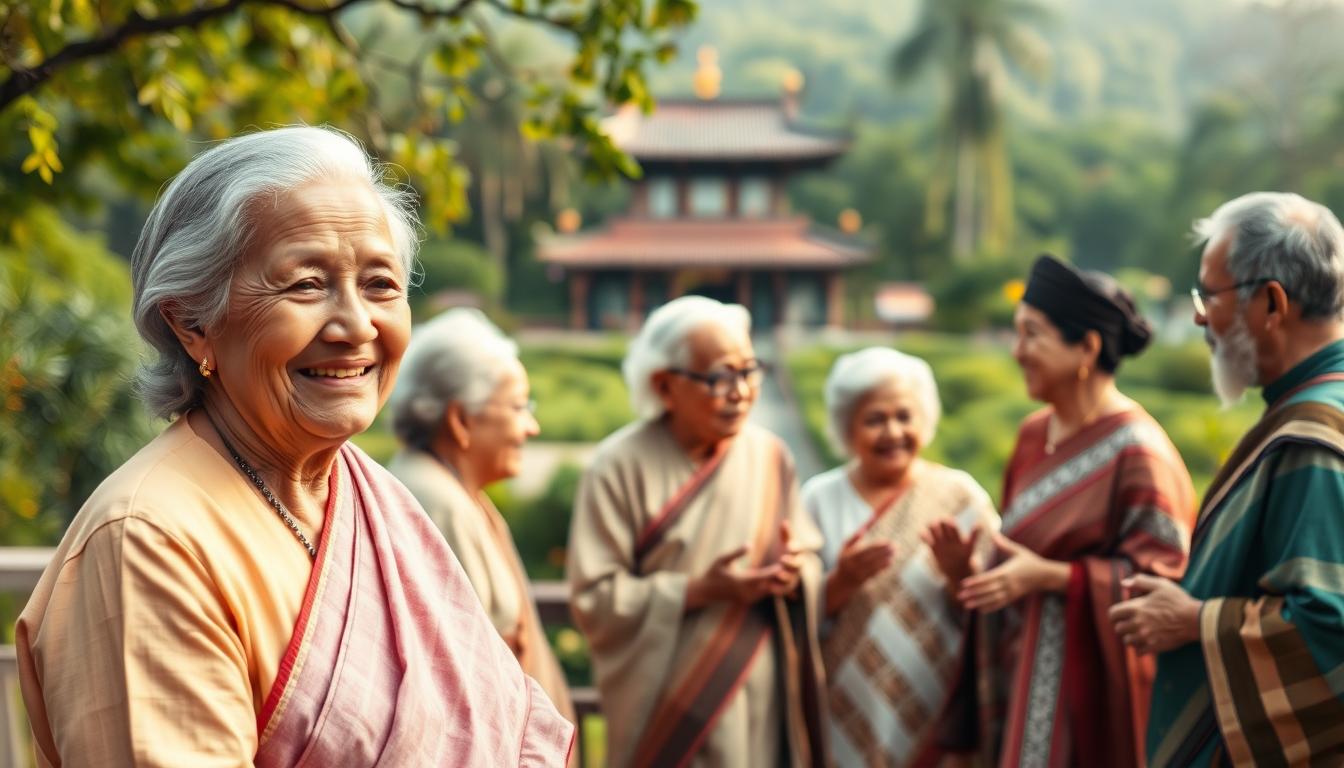
Global aging trends show us how different cultures view aging. By 2022, 10% of the world’s population will be 65 or older. This number is expected to rise to 16% by 2050.
In Europe and North America, about 1 in 5 people are elderly today. But in Sub-Saharan Africa, less than 4% of the population is elderly. These numbers tell us a lot about how societies treat their older generations.
In Korea, turning 60 is a big deal, celebrated with feasts. In the U.S., retirement communities are common. Japan has a high percentage of people aged 80+, while the U.S. has a lower percentage. This shows how different cultures value their elderly.
Even within families, traditions vary. In some societies, adult children care for their elderly parents. In others, like East Asia, this is common. These differences show how family structures and traditions shape our views on aging.
Wealth also plays a role. In richer countries, up to half of elderly women live alone. In poorer areas, this number is much lower. Status also matters, with some cultures giving more respect to elders.
These differences in cultural attitudes toward aging are shaped by many factors. They reveal how family structures, economy, and tradition influence our views on aging.
Behind these numbers are real people with stories. France’s 2003 heatwave killed 15,000 elderly people, highlighting their vulnerability. Laws like France’s 2004 mandate to visit parents aim to prevent neglect.
As populations age, understanding aging across societies becomes more urgent. This article explores why some cultures value their elders, while others may neglect them.
Understanding Cultural Perspectives on Aging
Defining old age isn’t just about counting years. Around the world, different cultures mark when someone becomes “elderly.” For example, the Afikpo Igbo in Nigeria call someone “senior” at 84. This is much older than when people retire in Western countries.
Studies show big differences in how people view aging. A 2017 survey found Taiwanese people saw aging more positively than those in the UK. Yet, the gap wasn’t as big as expected. Another study looked at 26 cultures and found most believed aging made people less physically strong but wiser.
In many cultures, becoming a grandparent or finishing life stages means you’re old. This is different from Western ideas of retirement or when you can get Medicare. These views on aging affect how much respect and responsibility older people get. As more people live longer, understanding these differences is key.
The Value of Elders in Different Cultures
Elder storytellers play a key role in many cultures. They keep history and traditions alive. For example, the Ju/’hoansi of the Kalahari Desert rely on elders to share stories. These stories teach morals and history, preserving cultural identity.
Among the Ju/’hoansi, virtually every old person is able and willing to tell stories.
In rural Ireland, elders pass down songs and legends. They are not just storytellers. Elders also lead their communities, like the Mam Maya in Guatemala, who solve conflicts.
In Mali, Dogon elders make beautiful baskets, keeping old techniques alive. They also lead spiritual rituals and ceremonies. Elders are respected for their wisdom, known as “Geronda” in Greece.
Even in societies that change quickly, elders keep traditions alive. Their contributions shape community identity.
Societal Attitudes Toward Aging
Cultural differences in eastern western aging attitudes often spark debates. But recent aging perception research shows surprising overlaps. East Asian societies like Japan and South Korea have always respected elders. Yet, Western nations are now showing more appreciation for longevity.
A 2017 study compared Taiwan and the UK. It found only small differences in how people view aging. This challenges the idea of strict stereotypes.
Global cross-cultural aging studies involved 3,435 participants from 26 cultures. For example, Japan’s youth often talk to older adults (average score 3.0, scale 1-5). Australia scored 3.8. These results show that age-based stereotypes are not set in stone.
Even in the US, 65% of young adults now see aging as a positive phase. This shows that attitudes are changing.
“Stereotypes about aging are increasingly fluid, shaped by media and migration,” noted a 2022 report in the Journal of Gerontology. This aligns with data showing 94.4% of study participants worldwide reject rigid age labels.
Modern aging perception research also shows changing norms. In South Korea, 18.4% of young adults now teach elders about technology. This flips traditional roles. Spain’s “silver universities” also show Western societies value lifelong learning.
These trends blur old divides, showing attitudes evolve as cultures mix. Whether in Tokyo or Toronto, today’s views blend tradition and modernity.
The Role of Family in Elder Care
Elder care often focuses on family. In many places, families live together, sharing the care of elderly members. This is common in Asia and Africa, where grandparents, parents, and children live together.
In countries like the U.S., this is changing. There, 45% of elderly women live alone. This shows how different cultures view elderly care.

In the U.S., 17.7 million family members care for older adults. They often struggle to balance work and caregiving. This can lead to stress, with 40% feeling mentally strained and 63% feeling very stressed.
Yet, 70% find joy in caring for their loved ones. Cultural values play a big role. For example, African American caregivers often feel a strong sense of duty. LGBTQ+ individuals, on the other hand, may rely more on non-relatives.
In Eastern Europe, like Romania, 65% of elders get help from their families. This shows the importance of family bonds.
Global changes bring new challenges. In the U.S., 50% of caregivers work while caring for others. This can be financially tough. Indigenous Australian communities face even bigger challenges, with 65% of elders needing care due to dementia.
As more people age, families worldwide must adapt. They need to balance old traditions with new needs. This requires support, like education for caregivers, to improve care and reduce stress.
The family’s role in elder care is vital. But how it’s done varies, depending on culture, values, and resources.
The Importance of Rituals and Celebrations
Elder honoring ceremonies and age celebration rituals are key in many cultures. The Afikpo Igbo of Nigeria have four named grades for aging, giving elders important roles like village leaders. These cultural traditions for elderly make sure elders are respected in society.
In the teachings of Confucius, “Filial piety is the root of all virtues,” a belief embedded in modern Chinese law requiring adult children to care for aging parents.
Korean traditions celebrate the 60th kohCui or “old and rare” with feasts. In Japan, 92% of seniors live with family, unlike the U.S. where 31% live alone. These traditions strengthen family bonds, as seen in India where elders often lead households.
Without these aging rites of passage, elders might be ignored. Japan’s growing elderly population relies on these traditions to stay included. The U.S. has longer life expectancy but lacks formal ways to honor elders. Cultural traditions, like China’s zodiac celebrations or Native American wisdom-sharing, keep elders at the heart of community.
These practices also boost well-being. Japanese elders living with family have fewer health issues than U.S. peers. Rituals show that aging is a valued stage, turning birthdays into community events.
Spiritual Perspectives on Aging
In many cultures, spiritual aging views are key. Religious beliefs often see elders as having deep spiritual authority. For example, Indigenous traditions view elders as keepers of spiritual wisdom. Hinduism’s dharma phase focuses on spiritual growth in later life.

A study by the Park Ridge Center found a link between aging and wisdom across religions. In Chicago nursing homes, 77.6% of elders saw religion as important. This is different from younger people. Globally, 95.8% of Nigerian and 99.8% of Pakistani elders believe in religion, showing elders’ spiritual importance.
“Elders hold unique insights born of decades of living,” noted researchers, “their perspectives enrich intergenerational understanding.”
Beliefs about aging also affect health. Research by Hummer et al. (1999) showed that being religious can make you live longer. It can cut down mortality risk by nearly half. Spiritual views challenge ageism, seeing aging as a time of deeper meaning, not decline.
Economic Implications of Honoring Elders
Elder economic contributions shape how societies value their older members. In traditional societies, elders often controlled land or livestock. This ensured resource allocation to elderly populations stayed tied to their roles in production. Their knowledge of agriculture or trade gave them influence and respect.
Modern economies shift this dynamic. Industrialization reduces reliance on manual labor, diminishing the economic aging impact of elders’ physical output. Yet, their wisdom remains vital. Studies show older adults often contribute disproportionately in roles like mentorship or childcare. This balances their financial support needs with societal gains.
Elder financial support systems now face challenges as life expectancy rises. By 2030, the U.S. population aged 65+ will double. This strains pension systems. Yet, leveraging elders’ expertise boosts productivity. For example, some firms hire retirees for advisory roles, blending experience with innovation.
Research highlights older adults’ generosity. In economic experiments, they often give more in trust-based scenarios than younger peers. This aligns with the silver economy concept. Elders’ contributions extend beyond traditional work, creating new value streams.
Education and Aging: A Lifelong Journey
Educational systems shape how societies view aging. In traditional vs modern knowledge debates, elders in rural communities guide apprentices in crafts or farming. They preserve elder knowledge transmission. On the other hand, urban areas focus on formal schooling, sometimes overlooking these skills. This shift impacts how we respect older generations.

China’s elderly population is expected to reach 487 million by 2050. Over 80% of urban seniors practice Tai Chi, combining physical activity with teaching across generations. In Shanghai, community centers host elders leading sessions, blending lifelong learning cultures with modern health programs. These efforts reduce loneliness by 40%, showing the importance of active roles.
Modern education often undervalues experiential learning. But some schools now partner with elders to teach history or crafts. This education impact on aging fosters mutual respect. For example, seniors in cities like Beijing mentor youth in traditional arts. In return, youth share tech skills.
“When elders teach, they’re not just passing time—they’re sustaining heritage,” says a community leader in Fuxing Park, where 60% of visitors are seniors actively sharing knowledge.
In the U.S., lifelong learning programs help bridge divides. Programs like intergenerational classrooms let elders share life lessons while learning digital skills. Such exchanges show the value of both traditional vs modern knowledge. By balancing these approaches, aging becomes a phase of continued contribution, not decline.
Legal Protections for the Elderly
Elder protection laws are key to keeping the elderly safe worldwide. Yet, many countries struggle to enforce these laws. In some places, cultural values clash with modern laws, making it hard to prevent elder abuse.
In the U.S., laws like the Age Discrimination in Employment Act (ADEA) aim to stop bias in the workplace. But, in 2015, only 2.7% of cases by the EEOC found clear evidence of age discrimination.
“Older persons should have access to the same rights, opportunities, and treatment as all members of society.” — Madrid International Plan of Action on Ageing, 2002
Legal systems around the world show the values of their cultures. In some places, laws help ensure the elderly have financial security. In others, family support is more common.
In the U.S., about half of nursing home costs are covered by Medicaid. This shows a big gap in elder care. Efforts to prevent elder abuse vary too, with some countries using hotlines and penalties, while others rely on community reports.
Elderly legal rights also cover healthcare and pensions. In 2015, Social Security cuts left many seniors poor. The Supplemental Security Income (SSI) only allows up to $8,804 a year, leaving many at risk. Also, the Family and Medical Leave Act doesn’t cover 40% of workers, making it hard for caregivers to support their loved ones.
Global efforts, like the African Commission’s new protocol, aim to fill these gaps. But, progress depends on laws that respect cultural values. Laws alone can’t ensure dignity. It’s only when laws match societal values that the elderly can truly thrive.
The Role of Government in Supporting Elders
Elder social security and government support for the elderly vary a lot around the world. In the U.S., over 55 million people aged 65+ depend on Medicare and Medicaid. Yet, nearly 8 million older adults live close to poverty, and 40% rely on Medicaid for care.
Elderly welfare systems need to change as more people age. Countries like Sweden and Norway spend a lot on public pensions and healthcare, making sure everyone has access. In contrast, Japan combines policies with cultural values, where 90% of elders prefer to live with family.

In the U.S., states have different aging policies. Thirty states have laws that make adult children support their aging parents. But many think the government should do more. A 2023 survey showed 70% of Americans want the government to fund elder care more.
This view matches global trends. 39 national plans now focus on elder care training, while 36% of U.S. nursing home staff report elder abuse every year.
“Strong elder social security systems reflect societal values,” said experts analyzing 50 national policies. Countries that focus on elder welfare see better health, including longer lifespans by up to 7.5 years.
As the U.S. elderly population grows to 78 million by 2030, finding a balance is key. Programs like the 2023 White House Conference on Aging focus on prevention and support across generations. Future policies must tackle rising costs while meeting diverse needs.
Case Studies: Societies with High Respect for Elders
In elder respect case studies, Japan is a standout as a high elder status society. With 28% of its population aged 65+, Japan honors elderly artisans as “living national treasures.” It also has laws that make caring for elders mandatory. This approach combines economic security with strong family bonds, which research shows is key to successful aging.
By 2030, one in three Japanese will be over 65. Yet, their society ensures elders are at the heart of community life.
In elder-honoring communities like Singapore, laws require monthly care payments to seniors. Scandinavian nations also value experience through strong elder care systems. Studies show that societies with tight social structures, where elders guide decision-making, tend to thrive.
The Dogon of Mali, for example, relies on elders to solve disputes. This mirrors research that high elder status societies do well when elders have clear roles.
Data shows that cultures with tight social bonds often have older leaders. In business, East Asian firms often choose seasoned leaders. This can lead to a 7.6-year longevity boost, as seen in positive aging perceptions. Japan’s strong social networks (average 11.3 close ties) contrast with smaller networks in Lebanon (5.8), studies show.
These patterns suggest that successful aging cultures value integration over isolation. They blend tradition with modern support systems.
Future Trends in Cultural Perspectives on Aging
As the world ages, how we see elders is changing. By 2060, the U.S. will have 94.7 million older adults, almost triple the 2000 number. This growth shows we must change how we view elders.
Global views on aging vary. Taiwan has positive views, while many places have negative stereotypes. A 2017 survey showed the U.K. had dimmer views of aging than Taiwan. This shows we need to create cultures that value all ages.
Technology and urban design are now key for elders. Innovations like smart homes and parks for all ages help them stay independent. Researchers also highlight the importance of bonds between generations.
A 2013 book looked at aging practices in different countries. It showed how traditions adapt while keeping cultural identity. This is important as birth rates drop and people live longer.
Efforts like the World Health Organization’s “active aging” framework are underway. Yet, challenges remain: 80% of U.S. adults over 50 face age discrimination. We need policies that value elders’ wisdom and contributions.
As cities redesign for all ages, inclusion is key. The future requires blending global lessons with local strengths. This way, no one is left behind.