






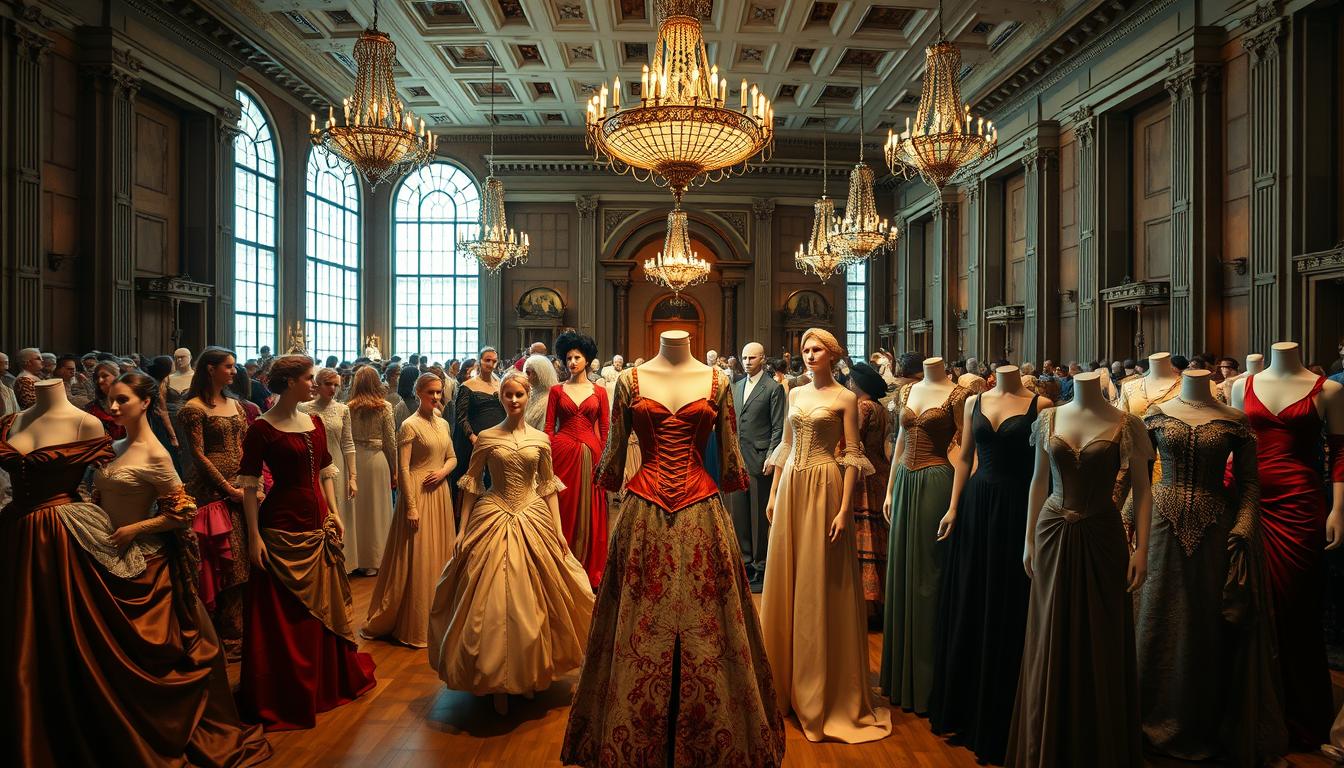
Fashion is more than just clothes; it’s a story of our past. From ancient times to now, clothes have shown how society has changed. Every piece of clothing tells us about what people valued, feared, or dreamed of.
This journey shows that fashion is not just about looks. It has shaped politics, economies, and our daily lives. It’s a powerful way to understand history.
The 20th century saw big changes in fashion. The 1920s brought simpler styles for women, breaking old rules. Christian Dior’s “New Look” in the 1950s used heavy gowns, while Balenciaga’s designs were lighter.
In the 2000s, fast fashion made luxury styles affordable. This changed how people dress every day. Even the 2020s pandemic brought back cozy activewear, showing fashion’s role in adapting to crises.
Every era’s fashion choices tell us about society. Punk’s ripped clothes and the 1990s supermodel era show fashion’s influence. Trends like the 1960s miniskirt or the 2010s focus on sustainability reveal deeper changes in values.
This article explores how fashion has not just followed history but helped shape it. From corsets to athleisure, clothes have silently watched humanity’s journey.
The Evolution of Fashion Through the Ages
From ancient times to today’s runways, clothing history timeline shows how fashion changes with society. Ancient Egyptians wore gold-embellished linen, like Cleopatra, to show wealth. Greeks wore linen for comfort, starting a trend for practical design.
These early styles show how ancient fashion influences mixed usefulness with meaning. Over time, fabrics changed from handmade to global goods, shaping fashion historical evolution.
In the 19th century, Charles Frederick Worth started haute couture, a big fashion transformation. The 20th century saw big changes too. Flapper dresses in the 1920s and Coco Chanel’s designs changed women’s fashion.
After World War II, mass production made fashion more available. Today, fast fashion and tech innovations like AI and blockchain are changing fashion again. They’re making fashion more sustainable and transparent.
Now, athleisure mixes sport and style, and brands like Everlane focus on being open. Even face masks became fashion statements during the pandemic. This shows how fashion keeps changing with culture, technology, and values.
Every era, from medieval to today’s trends, shows how we keep finding new ways to express ourselves through clothes.
Fashion in the Ancient World
In ancient times, clothes were more than just for keeping warm. They spoke of power and who you were. In Egypt, the rich wore thin linen, while the poor had coarser fabrics. Gold jewelry and fancy wigs showed off wealth, while cheaper items used wool and palm fibers.
Even kids’ clothes told stories about society. They often went bare until they were six years old. This showed what was expected of them.

Greece was a leader in historical clothing styles. They created the chiton and peplos, showing off their skill in draping. The chlamys, a woolen cloak, was both useful and a sign of status.
Rome’s Tyrian purple dye was a symbol of wealth. Only the rich could wear it. This showed how early fashion innovations used color to mean different things.
In China, the Shang and Zhou dynasties wore wide-sleeved robes. The Han Dynasty made silk so valuable it became like money. Mesoamerican cultures, like the Aztecs, made beautiful clothes from cotton and agave.
These cultures showed that traditional garment evolution happened everywhere. Trade routes like the Silk Road helped share these textile traditions. They turned clothes into a way to connect cultures.
Today, we can see the influence of these ancient styles. The eye of Horus and Greek draping are in modern fashion. These old choices remind us that fashion’s roots are deep and lasting.
The Renaissance: A Turning Point in Style
The Renaissance was a key moment in historical style evolution. Fashion moved from being practical to an art form. Textile production jumped by 400%, making silk and velvet key in renaissance fashion history.
This medieval to renaissance transition made clothes more than just clothes. They became a way to show off wealth and taste. Each stitch told a story of status.
Renaissance clothing was a silent way to show status. Only nobles could wear gold or furs, thanks to sumptuary laws. Gowns with 10-foot trains or stiff ruffs showed who was important.
Even the way clothes were made was special. Techniques like goldwork and beading took years to master. This made outfits like wearable art. Catherine de’ Medici and Elizabeth I used their gowns to show power, and others followed their style.
Today, designers are inspired by this era. Gucci’s 2018 campaign brought Renaissance art to life. Valentino’s brocade gowns remind us of 16th-century luxury. The era’s structured corsets also inspire today’s fashion.
From renaissance clothing symbolism to today’s runways, this era’s mix of art and fashion is timeless. It continues to inspire fashion today.
The Industrial Revolution and Mass Production
The Industrial Revolution began in 18th-century Britain and changed industrial revolution fashion forever. It moved from handcrafted textiles to new textile manufacturing history methods. James Hargreaves’ spinning jenny and power looms, along with Isaac Singer’s 1851 sewing machine, cut production time in half.
Factories started making mass produced clothing history on a huge scale. This made clothes affordable for working families. It was the start of fashion democratization, where stylish clothes were no longer just for the rich.

Standard sizes and ready to wear evolution made clothes a part of daily life. By the 20th century, ready to wear became more popular than high-end fashion. Paris led the Prêt-à-Porter movement.
But, there were downsides. Child labor, long work hours, and pollution increased. Early factories also released a lot of carbon emissions. By 2017, CO2 levels had risen to over 400 ppm, similar to levels in the 1800s.
Fast fashion today has its roots in this time. While mass production helped many people, it also raised questions about ethics and sustainability. The revolution’s impact is seen in every T-shirt and jeans, showing fashion’s ongoing balance between innovation and responsibility.
The Roaring Twenties: A Decade of Change
The 1920s saw a big change in fashion. Women ditched corsets for loose dresses, showing off their newfound freedom. Flapper dresses, with their dropped waistlines and short hemlines, were a bold statement against old rules.
This change was part of a bigger shift in society. Women were getting the right to vote and becoming more independent. It was a time of great change.
In speakeasies and dance halls, fashion was all about being modern. Cloche hats and knee-length skirts were the must-haves. Flapper dresses were perfect for secret parties, with their hidden details and glamour.
Designers like Coco Chanel made fashion both practical and stylish. They used new materials like rayon to make high fashion more accessible.
Short haircuts and dancing shoes were big in the 1920s. Even men’s fashion changed, with wider-legged pants and tailored suits. But, despite the glamour, racial injustices were a dark shadow over the decade.
The stock market crash in 1929 brought an end to the excess. But the 1920s left a lasting mark. The little black dress, made famous by Chanel, is a timeless piece of that era’s spirit. Fashion in the 1920s was more than clothes; it was a language of freedom.
Fashion During WWII and Its Aftermath
WWII changed fashion a lot. Governments made rules to use less fabric for clothes. This was to help make more military gear. 
Because of this, clothes became simpler. Dresses got shorter, and skirts narrower. Wool and silk were used for uniforms instead of clothes.
Women working in factories wore practical clothes. They had padded shoulders, slacks, and headscarves. These styles showed their new roles in society.
In 1947, Christian Dior changed fashion again. His New Look collection had big skirts and tight waists. It used lots of fabric, showing a move away from wartime simplicity.
This change was big. 6 million American women who worked during the war now saw fashion become fancy again. Dior’s designs were a big contrast to the simple clothes of the 1940s.
After the war, people wanted more. In 1946, there were riots in Pittsburgh for nylon stockings. This showed how much people wanted luxury again.
Even kids’ clothes changed. Boys wore jeans, and zoot suits became popular among young people. These styles showed rebellion and style.
Accessories also got creative. Plastic bracelets made from aircraft parts were one example. They showed how people could be creative even when resources were limited.
Hairstyles also changed. Women had short curls, and men had slicked-back hair. When factories closed, fashion swung from simple to fancy. This showed the country was recovering and gender roles were changing.
The New Look didn’t just change fashion. It also showed how fashion can reflect and shape society. It was a big step back to the way things were before the war.
The Rise of Youth Culture in the 1960s
1960s youth fashion was a bold move away from old ways. Young people, with more money, started to show their own style. This style was a countercultural style influence that rejected strict rules.
In London, boutiques like those of Mary Quant and André Courrèges led the mod fashion revolution. Quant’s miniskirt, which went above the knee, stood for freedom. Courrèges’ designs in PVC and metallic fabrics brought a futuristic look to high fashion.
The hippie movement clothing came as a reaction to war and social issues. Tie-dye, bell-bottoms, and ethnic patterns became symbols of protest. London’s Kensington Market boutiques sold Indian-inspired clothes, mixing global styles.
Men’s fashion also changed. Gone were the suits; in came collarless jackets, like The Beatles wore. Rock stars like Jimi Hendrix sported bold patterns and military looks.
Designers like Yves Saint Laurent and Pierre Cardin followed youth trends. They made clothes for both men and women and used new fabrics. Even kids’ clothes got in on the action, with bright colors and denim. By the late 1960s, fashion was more than clothes—it was a way to show rebellion and identity. It set the stage for today’s streetwear and focus on sustainability.
The Global Influence of Fashion in the 1980s
The 1980s were a time of bold fashion. Power dressing became a big deal, with suits that showed off confidence. Designers like Claude Montana and Thierry Mugler made suits that looked sharp and professional.
Women wore these suits in boardrooms and on the streets. Designer brand evolution was also big, with Karl Lagerfeld making Chanel cool again. Versace’s bold prints caught the eye of people all over the world.

MTV changed fashion with music videos. Artists like Madonna and Run-DMC became style icons. Madonna’s cone-bra look and bold outfits showed that fashion could express who you are.
At the same time, global fashion expansion grew. Japanese designers like Yohji Yamamoto brought new styles to the West. In China, the Zhongshan suit fell out of favor as Western styles became more popular.
“Fashion is about saying something without words.” — Vivienne Westwood, reflecting on the New Romantic movement’s theatrical flair.
The 1980s left a lasting mark on fashion. Neon leg warmers and power suits are just the beginning. Fashion in the 80s showed us that it’s more than clothes—it’s about ambition, culture, and standing out.
Today, we see the influence of the 80s in designer logos and streetwear. The lines between high fashion and everyday style are blurring. The 80s taught us that fashion is a powerful way to express ourselves.
The Digital Age: Fashion in the 21st Century
Social media has changed how trends start. Sites like Instagram and TikTok let regular people set trends. Brands like H&M and Zara use these platforms to boost fast fashion.
Viral challenges and influencer posts can make sales soar overnight. Athleisure, once a small trend, became popular thanks to social media. It shows how social media can change what we wear every day.
But there’s a big push for sustainability in fashion. Fast fashion’s harm to the environment is huge. For example, in 2023, some brands used 50% recycled materials in their collections.
Brands are now focusing on being eco-friendly. They’re using new methods like waterless dyeing and virtual prototyping to reduce waste. Apps like Depop make buying secondhand fashionable.
People want to know who made their clothes. Hashtags like #WhoMadeMyClothes are making brands more transparent.
Technology is changing fashion too. AI and AR are making big impacts. Virtual try-ons are cutting down on returns, and 3D printing could hit $1 billion by 2025.
Brands like Nike are using AI to guess what’s next in fashion. Virtual fashion shows during the pandemic showed digital fashion’s strength. Now, e-commerce takes 20% of retail sales, mixing shopping with social media.
Fashion today is all about tech, ethics, and creativity. Consumers are shaping the future of style with every click and purchase. Every like, share, and choice for sustainability matters.
Fashion as a Reflection of Identity and Politics
Clothing is more than fabric today; it’s a canvas for identity and politics. Identity expression through clothing has become a way to show values. Over 70% of consumers pick brands that match their beliefs, showing fashion’s role in social change.
Movements like fashion activism challenge norms. 50% of LGBTQ+ individuals use fashion to express gender identity. Brands like Marine Serre’s upcycled collections also fight against fast fashion’s harm to the environment.
Cultural appropriation debates are ongoing. The kimono, saree, and Yoruba agbada’s popularity raises questions about respect and inspiration. Naomi Campbell’s saree-inspired gown at the Met Gala sparked discussions about cultural exchange versus exploitation.
Brands like Maison Margiela and Issey Miyake show how to honor origins while innovating. Yet, the industry faces challenges like California’s garment worker labor reforms. This shows fashion’s global impact goes beyond trends.
The $2.5 trillion industry is moving towards ethics and diversity. Your choices have a big impact. The 9.7% annual growth of sustainable fashion shows consumers want brands to be accountable.
Every purchase is a vote for the world you want. Fashion’s history shows change is possible. Now, it’s time to create a future where style respects heritage and humanity.