







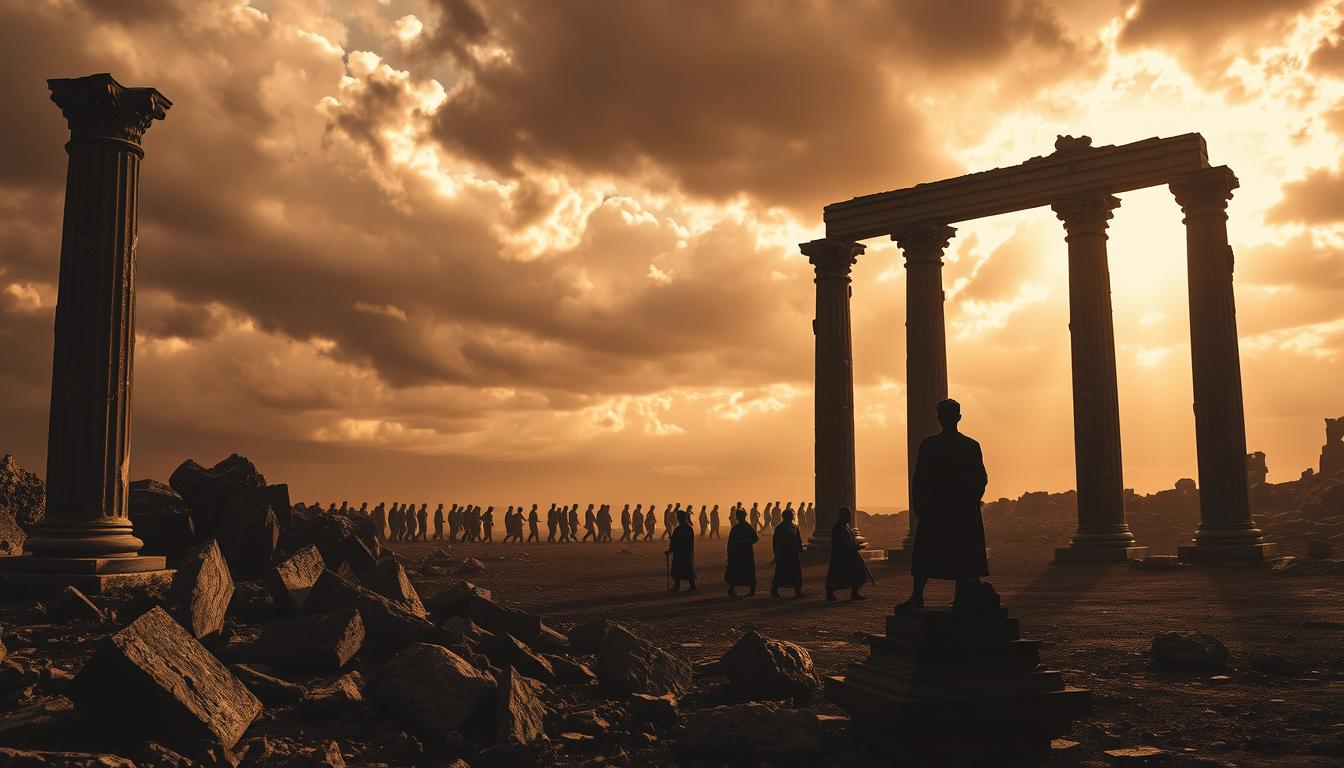
History repeating itself is more than a saying—it’s a guide for human actions. For 150 years, we’ve seen societies react to new technologies in similar ways. For example, we’ve regulated electronic media just like we did with earlier inventions.
Sigmund Freud believed that people repeat mistakes because of a deep urge. Philosophers like George Santayana and Hegel also saw history as a cycle of learning and failure. They warned that forgetting the past leads to repeating it.
Studies with over 500 people show that history shapes our future predictions. When we don’t know what’s coming, we look to the past for clues. This is why we see patterns in history, from wars to economic crashes.
Today’s tech boom is similar to the disruptions of the 19th century. The rise of the gig economy, like Uber and Fiverr, echoes old labor struggles. The current corporate dominance mirrors the inequalities of the First Gilded Age.
From Napoleon’s failed Russia campaign to the parallels with WWII, history’s patterns are clear. They offer a roadmap to understanding tomorrow’s challenges.
Understanding the Concept of Cyclical History
Freud’s idea of repetition compulsion suggests a profound truth: historical cycles guide human progress. Ancient cultures like the Greeks, Hindus, and Aztecs saw time as a cycle, not a straight line. The Hindu concept of kalpas—eon-length cycles—echoes this, and Norse myths like Ragnarok show endless destruction and rebirth. These philosophical views on history show societies grow, decline, and start anew, like the seasons.
Philosophers like Ibn Khaldun saw empires as natural cycles of growth and decay. His 14th-century theories said nomadic conquerors lose their edge once settled. Oswald Spengler later built on this cyclical view of history, comparing civilizations to organic life cycles. Even today, thinkers like Yuval Noah Harari say human behavior repeats—wars, inequalities, and crises.
“What is done cannot be undone, but it can be repeated,”
Nietzsche’s “eternal recurrence” idea shares this view. Marx famously said history repeats as “tragedy, then farce,” showing social movements mirror past struggles. Today, data analysis shows economic booms and busts follow 19th-century patterns. This proves pattern recognition in history is vital for understanding our future.
Examples of Historical Recurrence
Historical parallels show up when past choices come back to haunt us. The 1800 U.S. election is a prime example. John Adams and Thomas Jefferson’s campaigns were filled with warnings of tyranny or moral collapse. This mirrors today’s political debates, showing how old fears never truly fade.
Yet, the 1800 election also showed a key lesson. It was the first time America peacefully changed leaders. This moment of calm in the storm teaches us about democracy’s strength.
Global health crises also show patterns from the past. The Black Death in the 14th century and the AIDS crisis share similarities with the 2020 pandemic. Each brought stigma, economic troubles, and a search for scapegoats.
Public health measures like quarantines were used then and now. This shows how history teaches us to face fear. It’s not just about learning from the past; it’s about living through it.

Economic crashes also follow a familiar pattern. The 1637 Dutch Tulip Mania and the 2008 housing bubble are similar. Both saw a speculative bubble burst, causing panic. This shows how our emotions drive financial decisions.
Even George Washington’s warnings from 1796 are relevant today. His words about “ill-founded jealousies” echo in today’s politics. This highlights how history’s lessons are timeless.
“The past isn’t dead. It isn’t even past.” — William Faulkner’s words capture how history’s patterns persist, from election strife to disease panic. These echoes urge us to ask: what cycles are we repeating right now?
The Role of Human Behavior in History
Human behavior often follows patterns seen in the past, shaping our societies. Like how people repeat actions to deal with trauma, societies do the same. The ancient Greeks noticed this, seeing governments cycle from monarchy to democracy to anarchy.
This cycle isn’t random. It comes from our collective memory and biases. These patterns are part of our psychological history.
Our collective memory picks and chooses what to remember. The Treaty of Versailles’ harsh terms, for example, were forgotten but fueled WWII. Economic booms and busts, like the 1920s crash and 2008 crisis, show us ignoring warning signs.
Studies show that those less familiar with history use simple analogies. This can lead to wrong predictions about today. It’s a way our biases affect our views.
Historical psychology shows that unresolved issues, like inequality or political divides, come back. Today’s populist movements remind us of the early 20th century. By understanding these patterns, we can prevent them from happening again.
The Influence of Politics Over Time
Political cycles shape societies like tides, moving between democracy and authoritarianism. Crises often lead to repeating patterns. For example, Germany’s Weimar Republic saw the Nazi Party’s vote share rise from 37% in 1932 to 44% in 1933. This was due to economic collapse and fear, showing the cycle of democracy to authoritarianism.
“The US election doesn’t matter,” said Larry Fink, echoing pre-1933 German business leaders who underestimated political risks.
History shows that ignoring warning signs can lead to repeating patterns. The 1930s global economy saw nationalism grow as institutions failed. Germany’s post-WWI reparations weakened its politics, similar to today’s tensions over Ukraine and the Middle East. Today, the federal debt is $658 billion, and GDP growth is slowing, hinting at past crises.
Democracy’s weakness is clear. The 1970s saw inflation, and today’s money supply changes show economic stress can lead to political shifts. But today’s world is more connected, making autarky more costly. By understanding these cycles, we can avoid past mistakes.
Technological Advancements and Their Repetition
Looking back, innovation often builds on what came before. The printing press and the internet changed how we share information. They followed similar tech adoption patterns. Today, web development goes through cycles every few years, just like before.
Frameworks like Next.js or Nuxt.js bring back server-side rendering, a concept PHP introduced long ago. Modern web development also sees the return of file-based routing and serverless functions. This shows how old ideas keep coming back.
Research shows code patterns repeat over time. For example, gRPC is efficient, but SOAP was good at finding information. Both were needed for communication. Studies of 420 million code lines found that programming is more predictable than English.
Even tools like MUSE, which use existing code, face challenges when they get too complex. This is similar to past issues with new technologies.
PHP 8.0 remains relevant today, and DARPA’s work on open-source code shows evolution is key. Developers always look for new tools to stay excited. But, old problems like privacy and economic changes keep coming back.
Understanding these patterns helps us make better choices in tech today. It shows that progress often builds on what we’ve learned before.
The Impact of Cultural Movements
Cultural history cycles shape how societies express creativity and values over time. Movements like the Renaissance’s humanism or the Romantic era’s focus on emotion show clear patterns. These shifts are not random—they connect past and present through cultural pattern recognition.
For example, the 2020 surge in sales of Boccaccio’s Decameron during the pandemic shows how people turn to historical stories in crises.

Modern movements often echo older traditions. The “In America: Remember” installation, with its sea of plastic flags, mirrored 19th-century memorials. This shows how cultural pattern recognition helps us understand shared human experiences.
Even digital art today borrows from medieval manuscript illuminations, proving recurring themes in visual storytelling.
“Memory is not merely a personal faculty but a social construction,” noted sociologist Maurice Halbwachs. This applies to cultural cycles: each generation reinterprets history through its lens. The 1960s counterculture’s rejection of corporate life resurfaced in 2020s critiques of tech monopolies, showing how recurring cultural movements reflect timeless tensions between freedom and control.
Understanding these cycles helps us avoid treating trends as isolated events. By studying cultural history cycles—from Renaissance frescoes to today’s social media activism—we see that creativity and dissent follow familiar paths. This awareness turns past art history patterns into tools for navigating the present, proving history’s echoes are as relevant as ever.
Historical Lessons in Climate Change
Climate history shows us that societies often make the same mistakes over and over. The Maya and Easter Island civilizations collapsed because they ignored the limits of their environment. This is similar to what we’re seeing today with the climate crisis. Often, people deny the problem and wait too long to act, leading to disaster.
Looking at environmental history, we see a pattern. First, people ignore warning signs. Then, they debate solutions. And only after that do they try to fix the problem. In the 1930s, farmers thought they could make rain by plowing fields, but this was a myth.
Scientists like Joseph Fourier and Eunice Newton Foote studied the effects of CO2 in the 1800s. But their warnings were ignored back then, just like today. This shows a pattern of ignoring science.
Civilizations have collapsed because of overconfidence. The IPCC’s 2018 report warned us to act fast to limit warming. We’ve seen progress, like the Kyoto Protocol and Greta Thunberg’s climate strikes. But history teaches us not to get too comfortable.
Our choices today are critical. The fate of ancient societies should teach us a lesson. We must act now to avoid repeating their mistakes.
The Recurrence of Inequality
History shows us inequality history patterns where wealth gaps lead to unrest and change. Ancient Rome, feudal Europe, and the Gilded Age all had wealth concentration cycles. In each case, the top 10% controlled most of the wealth, causing rebellions or reforms.
Today, the wealthiest 10% hold 75% of global wealth, echoing past crises.

Recurring social movements, like the French Revolution or 2020’s protests, fight against injustice. The Taiping Rebellion and U.S. Civil War were sparked by inequality. Even natural disasters, like Egypt’s 14th-century famine and plague, fueled revolt.
The Seshat Databank found over 200 societies faced crises due to inequality. More than half collapsed or fractured.
Economic inequality patterns repeat because elites often block fair resource sharing. When rulers spend on wars or luxuries instead of public needs, instability grows. The 2008 crash and pandemic responses showed this.
Nations with lower inequality, like South Korea, handled crises better than polarized countries. Yet, history shows no society escapes this cycle permanently. Understanding these loops helps today’s leaders avoid past mistakes and build systems that break the pattern.
Economic Patterns: Booms and Busts
Economic cycles shape our world, yet boom bust patterns keep repeating. The Dutch Tulip Mania crashed in 1637, and the 2008 housing market collapse followed. Financial bubble history shows how greed and fear control markets.
Each crisis, from the South Sea Bubble to today’s crypto dips, follows a pattern. It starts with overconfidence, then denial of risk, and ends in panic.
“The economy is a machine of human nature, not just numbers,” says Ray Dalio, whose Big Cycle theory links financial/economic forces to societal stability.
History’s recurring economic crises have common causes: easy credit, wealth gaps, and ignoring warning signs. The 12th-century agricultural boom turned to famine, and Rome’s elite fights led to its downfall. Today, we face similar dangers: debt mountains, inequality, and climate risks.
The 2008 crash showed how fortunes can be lost quickly. Similar stories keep happening, as if on auto-pilot.
Why can’t we learn from history? Dalio says it’s because of cycles of debt, innovation, and conflict. Each boom bust pattern brings pain, but we forget. The post-war stability and 1990s tech boom offered hope, but greed always returns.
Now, with AI changing jobs and climate disasters growing, we must listen to history. Breaking the cycle requires more than policies. It demands facing our human habits directly.
War Strategies: Learning from History
Warfare pattern recognition shows us how military strategies repeat over time. During the Civil War, Confederate leaders used tactics from the Revolutionary era, like guerrilla warfare. But they didn’t fully adapt. For example, Gen. Robert E. Lee’s 1862 campaigns faced the same supply line issues as Napoleon’s.
These repeated strategies often come from overconfidence or outdated plans. Human factors also play a big role in these mistakes. In 1864, Union sharpshooters used tactics from the Revolutionary era. But Confederate commanders ignored their success, missing the lessons from 1777.

Why do these patterns keep happening? Cultural biases and political pressures can cloud judgment. The 1861 General Order No. 13 focused on symbolism over strategy, copying Revolutionary icons without fixing flaws. Today, leaders face similar traps, overvaluing technology and underestimating human strength.
The U.S. Navy’s 1945 pine-oil crisis is a recent example of resource miscalculations. These mistakes are seen in both world wars and today’s planning. By studying past mistakes, today’s strategists can avoid disasters and create better plans.
The Role of Education in Understanding History
History education is key to teaching historical literacy. Schools should teach why events happen, not just when. This way, students learn to spot patterns and break cycles.
Old teaching methods don’t grab students’ attention. Many find school boring, and just memorizing facts doesn’t help them think critically. Today’s lessons should link the past to the present.
For example, studying Jim Crow laws and today’s social movements shows ongoing fights for justice. The Library of Congress offers primary sources, like civil rights letters, to help students understand the roots of conflict.
Teachers like Dr. Sheree Turner say historical literacy means looking at causes, not just events. Assignments on the pandemic or BLM let students connect their lives to history. Writing about their world helps them see how decisions shape the future and avoid past mistakes.
To break historical cycles, teachers need to be curious. Schools should train teachers to move from just memorizing to understanding. When students ask “why?” instead of “what?”, they start to see history as a bridge to the present. This empowers them to make thoughtful choices, not repeat old mistakes.
Looking to the Future: Breaking the Cycle
Breaking historical patterns starts with understanding why cycles repeat. Recognizing patterns is key when societies face biases like cognitive dissonance. This bias makes people ignore lessons that challenge their views.
Poland’s recent shift toward nationalism under President Andrzej Duda mirrors past authoritarian trends. This shows how ignoring historical warnings risks repeating mistakes. The 2020 pandemic echoed the Spanish Flu’s societal disruptions, highlighting the need for preparedness.
Avoiding historical repetition requires proactive steps. Daily reflection and feedback loops help identify personal and societal blind spots. Tools like Myers-Briggs Type Indicator (MBTI) or DISC assessments can highlight behavioral patterns.
Poland’s 2020 milestone of 30 years of sovereignty contrasts with current EU concerns over judicial independence. This proves that even nations with progress can drift back into familiar conflicts.
Creating historical change demands education and collaboration. Teaching critical thinking in schools equips future generations to question assumptions. Technology, like AI analyzing economic data, could spot speculative bubbles before they trigger crises like 1929 or 2008.
Hungary’s democratic decline mirrors Poland’s trajectory, urging global leaders to prioritize transparency and equity.
Human agency matters. Hungary and Poland’s political shifts show how nationalism thrives on inequality—echoing 20th-century crises. Yet, structured debriefs after crises and adaptive policies can disrupt cycles.
The EU’s push for regulatory frameworks, like post-2008 financial reforms, proves change is possible when societies acknowledge their patterns.
History’s lessons aren’t destiny. Combining mindfulness practices with global cooperation offers pathways to rewrite outcomes. By learning from past mistakes and embracing progress, societies can forge new trajectories—one mindful decision at a time.