







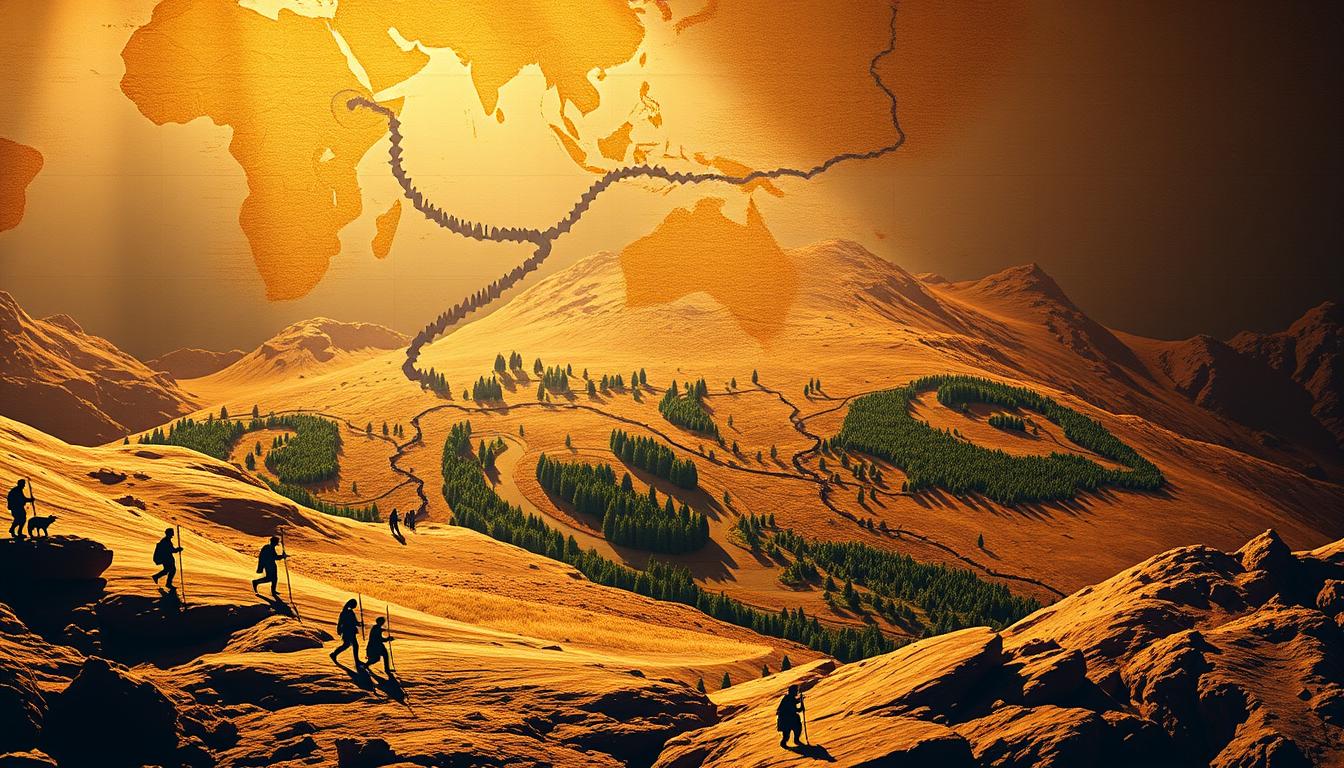
Early human migration started in Africa over 300,000 years ago with Homo sapiens. These ancient people slowly moved beyond Africa through paths like the Sinai and Arabian Peninsulas. They followed ancient lakes that came and went over thousands of years.
This timeline shows a story of trial and error. Groups moved into Asia and Europe, sometimes meeting Neanderthals. Today, 2% of non-African DNA shows they interbred, shaping our species’ history.
By 54,000 years ago, Homo sapiens reached Europe, as seen in Aurignacian tools. Migrations into Asia and Oceania left fossils in China and Indonesia, hinting at multiple waves. New discoveries, like 23,000-year-old footprints in New Mexico, challenge old ideas about when humans reached the Americas.
Each find reshapes our understanding of ancient dispersal routes. It shows how our ancestors filled Earth with their paths.
From Africa’s cradle to the Americas, these journeys were tough. They involved adapting to ice ages, volcanic eruptions, and changing landscapes. Genetic clues and ancient artifacts, like those in Chile’s Monte Verde site, show how humans thrived despite these challenges.
Every clue, from Denisovan DNA in Pacific Islanders to pre-Clovis tools, adds to this evolving story. It tells us about early human migration.
The Origin of Early Humans

Modern research shows human origins Africa are rooted in discoveries like the Jebel Irhoud remains in Morocco. These earliest human fossils, dated to 315,000 years ago, reveal Homo sapiens evolution began earlier than once thought. Nearby, the Florisbad Skull from South Africa at 259,000 years old and Ethiopia’s Omo remains at 200,000 years further confirm Africa as the birthplace of modern humans.
Scientists use methods like thermoluminescence dating to analyze artifacts and bones. These findings challenge older theories, pushing back timelines by 100,000 years. Key traits like skull shape and tool use mark the transition to anatomically modern humans. The first humans adapted to Africa’s diverse landscapes, evolving in response to environmental changes.
Early human fossils from sites like Jebel Irhoud show gradual changes in facial structure and brain capacity. These changes hint at complex social behaviors and toolmaking that defined Homo sapiens evolution. Africa’s varied ecosystems likely drove innovation, from stone tools to early art forms.
The African Out-of-Africa Theory
The Out-of-Africa hypothesis suggests humans spread from East Africa. Around 70,000–50,000 years ago, a small group, maybe under 1,000, crossed into Arabia. This was a major step in human migration, driven by climate changes and the search for resources.

Genetic studies back this journey. Mitochondrial DNA shows all non-African people come from haplogroup L3, an African “family tree.” Studies of Aboriginal Australians and Melanesians show they share markers with this group. This proves their ancestors were part of this early wave.
Fossils in the Levant also support this theory. They show early human settlements outside Africa.
Two paths guided this expansion: a southern route across the Red Sea and a northern path through Sinai. Genetic bottlenecks and events like the Toba eruption around 75,000 years ago may have shaped these paths. This wave was the only one to leave lasting descendants, creating the genetic diversity we see today.
Alternative Migration Theories
Most scientists agree with the Out-of-Africa model. But, other theories also get a lot of attention. The multiregional human evolution theory suggested humans evolved in different places. Now, genetic evidence shows this idea is not as strong.
New theories are challenging the old ways of thinking. They suggest humans might have traveled in ways we didn’t think possible before.

The Solutrean hypothesis is one of these ideas. Bruce Bradley thinks that during the Ice Age, people from Europe crossed the Atlantic. They brought their tool-making skills to North America.
Bradley points out that tools found in the U.S. look similar to those in Europe. This suggests a link across the ocean. Some argue that Asian migration is more likely, but Bradley believes crossing the Atlantic is possible.
Another theory is the trans-Pacific migration theory. It suggests that people traveled by sea from Asia to the Americas. Studies have found genetic links between Amazon tribes and East Asians. This supports the idea of sea travel beyond the Beringia land bridge.
These theories show how science is always changing. Even though most theories say humans came from Africa, there are many mysteries. Places like Kennewick Man and Monte Verde are keeping scientists busy. They are studying tools, genes, and climate to learn more about our history.
Tools and Technologies of Early Migrants
Prehistoric tools were key in humanity’s early travels. From basic stone flakes to detailed bone harpoons, paleolithic technology grew as humans faced new hurdles. The Oldowan toolkit, from 2.6 million years ago, kicked off this journey.
Later, tools like Acheulean handaxes (1.76 million years ago) made hunting and food prep better. This helped people survive in different places.
By 43,000 years ago, the Aurignacian culture brought big changes in stone age innovations. Tools made from bone, antler, and ivory, like the 90,000-year-old Katanda harpoon, showed great skill. These tools were not just useful; they also fit the environment.
Coastal migrants made fishing gear, while those in cold areas created special clothes. Each new tool let people live in more places.
Archaeologists follow migrations by looking at tool types. Changes in blade shapes and materials show cultural shifts over time. For example, bone points in Europe show a journey from Africa to Asia.
Even small tool changes, like sharper blades or decorations, suggest shared knowledge. These prehistoric tools were more than just survival tools. They connected continents.
Migration Paths Across Asia
Early Asian human migration took two paths: the coastal route and inland trails. Groups followed the coastal migration route to reach Australia by 65,000–50,000 years ago. This was the first time humans went beyond ancient human populations Asia that H. erectus had occupied.

Genetic studies reveal Denisovan interbreeding in Melanesians and Aboriginal Australians. Their DNA shows interbreeding in Eastern Asia, like Tibetans’ high-altitude adaptations. The D-M174 lineage, found in Andamanese people, dates over 60,000 years.
Recent research shows coastal migrants carried this DNA. It has shaped Asia’s genetic diversity even today.
Coastal travelers used marine resources, while inland groups faced deserts and mountains. Genetic diversity in India, second only to Africa, hints at early settlements. These ancient journeys laid the foundation for modern populations across the continent.
They blended survival strategies with genetic exchanges. These exchanges continue to influence human biology today.
The Dispersal into Europe
Modern humans, known as Cro-Magnon humans, first reached Europe around 54,000 years ago. A tooth found at Grotte Mandrin in France proves this. Early groups were later replaced by Neanderthals, but a new wave of Upper Paleolithic Europe settlers returned by 45,000 years ago. This marked a turning point in Neanderthal replacement.
These pioneers brought advanced tools and art, changing European prehistoric cultures. Climate was a factor in their arrival. Temperatures were 7–15°C colder than today, pushing Homo sapiens to adapt.
The Cro-Magnon humans thrived, leaving behind evidence like Aurignacian tools and Chauvet’s cave paintings. Their success outpaced Neanderthals, who vanished by 40,000 years ago. Despite interbreeding, Neanderthals left only 2% of their DNA in modern European DNA.
“Early humans adapted faster to ice age conditions, enabling their dominance,” noted a 2013 PLoS ONE study analyzing ancient DNA.
European prehistoric cultures flourished with new innovations. Gravettian blades and complex burials emerged. The Lincombian-Ranisian-Jerzmanowician tool complex spread quickly across Europe, showing fast cultural exchange.
While Neanderthals’ fate is debated, their legacy lives on in our genes. It’s a quiet echo of ancient encounters.
Migration into the Americas
The Beringia land bridge theory has long explained how the first Americans arrived. This land bridge between Siberia and Alaska was there during the last Ice Age. It allowed people to migrate between 26,000 and 19,000 years ago.
Genetic studies confirm Indigenous groups split from Siberian populations around 36,000 years ago. This supports the Beringia land bridge theory. But, the exact timing of their migration south remains a mystery.
Traditionally, the Clovis culture was seen as the earliest settlers, with tools dating back to 13,500 years ago. But, discoveries like Monte Verde in Chile (14,500 years) and Paisley Caves (14,300 years) suggest an earlier presence. There are also 23,000-year-old footprints in New Mexico and 15,500-year-old tools in Texas.
These findings indicate humans reached South America much earlier than thought. The question is, how did they get there? Ice sheets blocked inland routes until 13,000 years ago. Some believe they followed the coast, while others suggest an ice-free corridor.
Genetic data supports a split between North and South American groups starting 14,500 years ago. This matches archaeological findings. Yet, claims of 30,000-year-old tools in Mexico are disputed.
Today, scientists use pollen analysis, luminescence dating, and radiocarbon tests to date discoveries. A 2023 study confirmed New Mexico footprints were 23,000 years old. These findings change our understanding, showing first Americans adapted to harsh climates long before glaciers retreated.
The debate is ongoing, but each new discovery tells a story of resilience and exploration. It shows the journey of the first Americans across continents.
The Effects of Agriculture on Migration
The Neolithic Revolution began about 12,000 years ago. It changed how humans moved. People started farming instead of hunting, leading to ancient population growth.
Communities grew and settled, creating more food. This food helped build bigger, denser societies. As a result, farming migration happened as groups moved into new lands.
happened through migration and cultural exchange. In the Fertile Crescent, new crops like wheat and barley spread to Europe by 9,000 years ago. Africa also saw early farming, with innovations like sorghum and millet.
These changes allowed groups like the Bantu to move across sub-Saharan Africa. They brought iron tools that made farming more efficient.
Rivers and fertile soils guided these movements. In Mesoamerica, maize cultivation after 9,000 years ago led to population booms. Genetic studies show farming communities often merged with hunter-gatherers.
By 1000 BCE, African populations heavily relied on agriculture. The Bantu migrations, fueled by ironworking, reshaped genetic and linguistic landscapes.
These changes show how agriculture drove ancient population growth and its lasting impact. From the Fertile Crescent to sub-Saharan Africa, farming merged innovation with human mobility.
Modern Understanding and Ongoing Research
Paleogenomics has changed how we see human migration. It tells us stories from ancient DNA. Scientists now know how small groups left Africa 60,000–80,000 years ago.
They survived harsh climates and adapted to new diseases. The discovery of Denisovans through DNA in a Siberian bone fragment shows how genetic clues rewrite migration routes. These breakthroughs highlight interbreeding between Neanderthals and early Homo sapiens, leaving a 2% Neanderthal imprint in modern non-African genomes.
Fossil dating methods now pinpoint key events, like the Toba eruption’s 70,000-year “nuclear winter,” which may have narrowed human populations. Genetic studies also reveal survival adaptations: Tibetans’ high-altitude genes and European lactase persistence.
Questions linger: How did climate shifts steer routes? Why did some groups thrive while others vanished? Ongoing projects sequence genomes from ancient remains, while improved fossil dating methods clarify timelines. Each discovery, like the 300,000-year-old Moroccan fossils, reshapes our narrative. This evolving story invites curiosity—what ancient DNA will next reveal?