






The birth of democracy started in ancient Greece. It was there that the idea of people ruling themselves first appeared. In 507 BCE, Athens replaced its tyrants with demokratia, a system combining “dēmos” (people) and “kratos” (power).
This marked a big change from rule by kings to decisions made by citizens. Even though only male citizens could vote, it was a start. It shaped the course of history.
In Athens, citizens could debate laws directly. But only 30,000 men could vote. People like slaves and non-citizens were left out.
Despite its problems, these early attempts at self-governance were important. They inspired ideas that spread far beyond Greece. They helped build the foundations of today’s political systems.
The Concept of Democracy: A Historical Overview
The word “democracy” comes from ancient Greece. It mixes the Greek words dēmos (people) and kratos (power). By the 5th century BCE, democratic principles started to shape new ways of ruling. Democracy was different from other systems like monarchy or tyranny because it was ruled by the people.
But, early democracies didn’t include everyone. In Athens, only free adult males who owned property were citizens. This meant only about 30% of the population could vote.
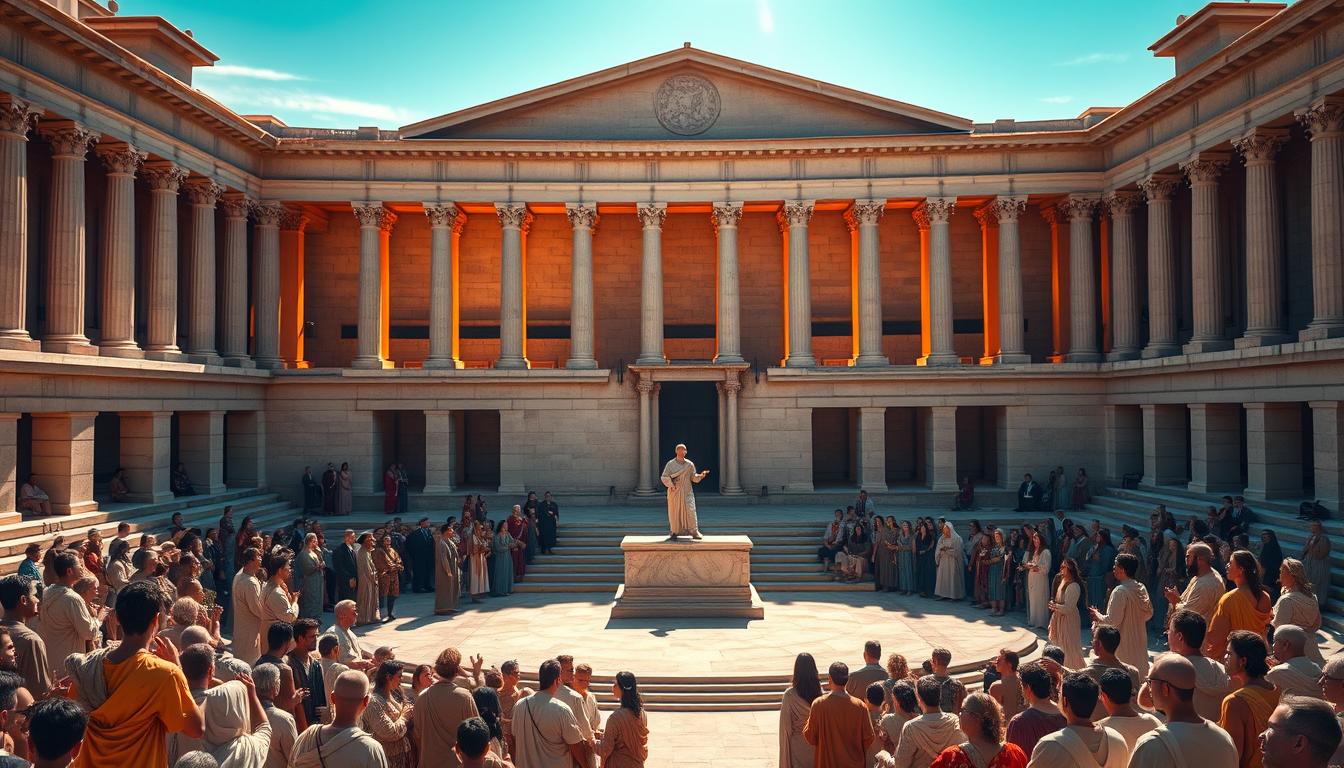
Athens was a pioneer in collective governance. They had the boule (council) and ekklesia (assembly). Citizens voted on laws directly, and they even paid poorer men to attend.
Over time, even lower-class citizens could hold important roles. But, women, slaves, and foreigners were not allowed to participate in politics.
These early attempts at democracy set the stage for later ones. Even though Athenian democracy ended by 322 BCE, its ideas of citizen assemblies and voting systems were key. Today, we learn from these ancient political systems. We see how modern democracies try to live up to the ideals of political participation from the ancient world.
Ancient Greece: The Cradle of Democracy
Athenian democracy started in Athens under Cleisthenes reforms in 507 B.C. This system, called demokratia, changed how people governed. Citizens directly helped make policies.
The ekklesia, or citizen assembly, met often on the Pnyx hill. It was designed for 6,000 men. There, they discussed laws, wars, and budgets.
The boule, or Council of Five Hundred, handled daily tasks. Members changed weekly to include more people.

But Athenian democracy wasn’t for everyone. Only free adult males with Athenian parents could vote. Women, slaves, and foreigners had no say.
By the 4th century B.C., you had to have both Athenian parents to vote. This made fewer people eligible. Yet, the idea of direct citizen involvement inspired other democracies.
In the dikasteria courts, up to 6,000 jurors decided cases each year. They were paid from taxes and naval funds. Rich citizens helped with public projects through liturgy duties.
This balance of civic duty and governance was unique. Athenian democracy’s impact on history is huge, marking the first big try at collective rule.
The Roman Republic: A New Political Structure
Rome kicked out its last king in 509 BCE and started the Roman Republic. This new system mixed old traditions with new ideas. It brought up Roman political institutions like the Senate and the people’s assemblies.
Rome was different from Athens because it had elected leaders. This was an early form of representative democracy.
The Senate and Assembly were key in Roman politics. The Senate gave advice and handled money. The assemblies, like the Centuriate and Tribal, voted on laws and leaders.
Votes were counted by groups, not each person. This made Rome’s system work better for its growing lands than Athens’ local democracy.
Rome had to deal with rich elites and common people. Reforms like the 471 BCE Lex Publilia helped commoners. Over time, the Roman Republic changed, balancing power between different groups.
It lasted for 482 years, showing how systems can grow. But corruption and wars later tested its strength.
Rome’s way of choosing leaders was different from Athens. Rome chose leaders to represent the people. This idea has shaped Western politics, showing that big groups can be managed by elected leaders.
The Influence of the Enlightenment

In the 1700s, philosophers brought back ancient democratic ideas. They mixed them with newdemocratic philosophy. John Locke said thatnatural rightslike life, liberty, and property come from God, not rulers. Hissocial contractidea, that governments protect these rights, guided many.
Thomas Jefferson followed Locke in the Declaration of Independence. He said, “All men are created equal,” showing that power comes from the people. This idea challenged Europe’s absolute monarchies. Montesquieu’s idea of dividing government powers into branches helped shape the U.S. Constitution. Rousseau’s focus on the people’s will changed how we see governance.
These ideas sparked revolutions in America and France, ending old systems. The Bill of Rights made Locke’snatural rights law. Montesquieu’s ideas helped prevent tyranny. By combining ancient wisdom with Enlightenment thinking, they created a system where power goes from people to leaders. This change helped start modern democracies.
But, today’s fights over voting rights and representation show these debates are ongoing. The Founders’ vision is an ongoing experiment. It shows that thesocial contract between rulers and people is always evolving.
The United States: A Democratic Experiment
The United States was a bold start in American democracy. The founding fathers looked at ancient Greece and Rome to build a democratic republic. They created a constitutional government with three branches to stop any one person from having too much power.
At the 1787 Constitutional Convention, they tried to balance freedom and order. The constitutional government gave rights but left out enslaved people, women, and Indigenous communities. The founding fathers knew it wasn’t perfect but saw it as a start.
The democratic republic had its early struggles but grew. Over time, American democracy let more people participate through changes and movements. This ongoing effort keeps working to improve, learning from past errors.
The Expansion of Democratic Ideals
Democracy has grown from ancient Athens to today’s global democracy. In Athens, only free men could vote. Yet, debates about who should vote continued.
Aristophanes’ 391 B.C. play Assemblywomen showed a funny idea: women leading the state. This hinted at early questions about voting rights. By 1840, the U.S. voting rights were limited, excluding women, African Americans, and others.

Women’s suffrage movements worldwide pushed for universal suffrage. The U.S. 19th Amendment (1920) gave women the right to vote. Later, civil rights acts addressed racial barriers.
Indigenous peoples and minorities in many nations kept fighting for full participation. This shows the ongoing struggle for democratic expansion.
After World Wars and the Soviet collapse, democratic expansion sped up. Post-1991, former Soviet states moved toward democracy. By the 2000s, over 120 countries held competitive elections.
Latin America moved from dictatorships to democracies. India’s federal democracy is another example of diverse paths to inclusion.
Modern challenges continue, but history shows progress. Voting rights once denied, like for women, minorities, and workers, can change through advocacy. Each step forward makes democracy more inclusive, showing it’s a dynamic system.
Comparative Democracies: Lessons from Around the World
Democratic systems vary a lot, influenced by history and culture. The UK has parliamentary democracies, while Brazil has a presidential system. Each model shows how different democratic institutions can be.
The book A Different Democracy (2014) compares the US with 31 other nations. It shows how different systems adapt. Scholars note that multi-party systems in Europe differ from the US’s two-party system. This affects voter choices and how governments work.
Global governance lessons come from places like Brazil’s participatory budgets and Estonia’s digital voting. These show democracy is always changing. For example, Sweden’s proportional representation helps minority voices, while the US’s system often doesn’t.
Such differences are important. They affect who leads and how policies reflect what people want. Election rules play a big role in this.
“No two democracies are alike, yet all share a common thread: adapting to serve citizens,” argue the book’s authors. They highlight how democratic institutions evolve through comparative politics.
Modern challenges like misinformation or media control show why studying global models is key. South Korea’s strong civic tech contrasts with areas where media control weakens democracy. The book emphasizes understanding these differences to strengthen democracies.
Whether through ranked-choice voting or anti-corruption watchdogs, each nation’s experiments offer tools for renewal.
Modern Challenges to Democracy
Today, democracies face threats to democracy that remind us of ancient fears. Social media makes divisions worse by spreading false information. This leads to distrust in institutions.
Like Thucydides warned, today’s “demagogues” use emotions to sway public opinion. This weakens democratic resilience. Hungary and Turkey show how leaders can undermine democracy by taking more power.

“The people are the worst rulers,” warned Aristotle. Today, his warning resonates as polarization splits societies into opposing camps.
Economic inequality is a big problem for democracies around the world. In the U.S., people are angry because wages haven’t grown and inequality has increased. The World Bank says democracies struggle when income falls below $16,750 per person.
Countries like Ecuador and Nicaragua are in crisis because leaders won’t step down or let others speak out. But, cities like Minneapolis are trying new voting methods to build trust.
Technology brings both good and bad. It helps people come together but also spreads hate and lies. The 2020 U.S. election showed this. Yet, places like Timor-Leste show democracies can change for the better.
To fight threats to democracy, we need to be open, educate people, and tackle inequality. History teaches us that democracies last when citizens hold leaders accountable and work together.
The Future of Democracy
Modern participatory democracy is changing fast. Digital platforms now let millions join in civic engagement through polls and forums. Imagine a global assembly where people debate policies in ways the ancient Greeks could only dream of. Yet, this
Technology brings tools like AI-driven spaces for discussion. But, there are big risks too. Misinformation spreads quickly, and data tracking could harm privacy. Josiah Ober, in The Civic Bargain, says democracies survive by adapting.
Future future governance must balance tech’s power with safeguards for truth and fairness. Will social media bring us together or tear us apart? Can algorithms focus on wisdom over clicks?
By 2030, being a citizen might mean earning “civic points” for voting or community work. Yet, trust is hard to build: 70% of global democracy trends depend on cultural values, not just tech. As authoritarian regimes grow, the battle for open governance will rely on innovation that keeps core principles intact. Democracy’s next chapter is about more than voting—it’s about reimagining how billions participate in self-rule in a world of data and division.
Conclusion: Reflecting on the Birth of Democracy
Athens’ experiment with citizen-led governance changed history. The Council of Five Hundred and sortition gave power to the people. This showed that political participation can work in small groups.
Even though Athens’ democracy wasn’t perfect, it laid the groundwork for today’s systems. It taught us about democratic values like equality and making decisions together.
Today, civic responsibility is just as important as it was back then. People vote and participate in their communities just like the Athenians did. Over 90 countries now follow Athens’ example, showing democracy’s strength.
But democracy needs our active support to survive. We must fight for transparency and justice, just like the ancient Athenians did. Every vote and voice matters in keeping democracy alive.
Democracy is a work in progress, not a finished product. It needs our courage to participate and make a difference. By voting, protesting, and making informed choices, we honor the legacy of those who first ruled themselves.