







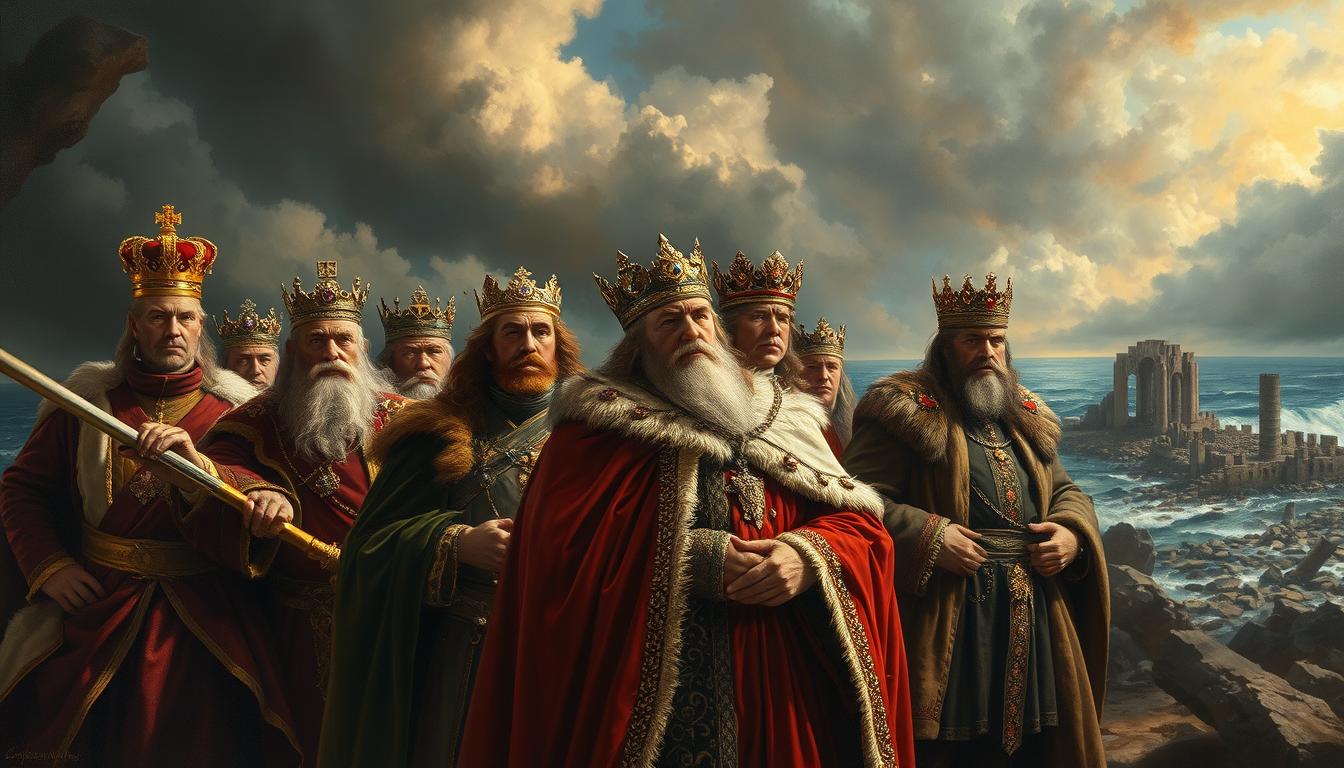
Royalty who broke the rules often reshaped history. Famous rule-breaking monarchs have defied expectations. Queen Elizabeth II, the longest reigning monarch alive, surprised everyone by hugging Michelle Obama in 2009.
Her 9 notable protocol breaks, like inviting Meghan Markle’s mother Doria to a Christmas gathering in 2018, showed a shift from tradition. Even Diana, Princess of Wales, rewrote norms by removing “obey” from her 1981 wedding vows, a change that challenged centuries of tradition.
Monarchs who defied convention left lasting impacts. Diana’s barefoot race at a school in 1991 or her iconic White House dance with John Travolta broke royal decorum. These acts highlight how revolutionary kings and queens, like Catherine the Great or Henry VIII, used their power to drive change.
This journey explores eight rulers—from Elizabeth II to King Bhumibol—who bent or shattered rules, proving that even crowned heads can redefine their legacies. Their choices, from progressive reforms to public stances, remind us tradition isn’t always meant to last forever.
1. Introduction to Rule-Breaking Monarchs
History’s most memorable rulers were not just powerful. They were unconventional monarchs who changed the game. These royal rebels broke the mold, leaving lasting impacts on our world. Their bold choices in religion, politics, and social reforms reshaped kingdoms and cultures.
Their stories highlight how daring to challenge tradition made them monarchs who changed history.

Traditional monarchs were all about inherited power. But royal tradition breakers went beyond that. Henry VIII’s break with Rome in 1534 and Elizabeth I’s victories against Spain’s Armada in 1588 show their bold moves.
Even small choices, like Jane Grey’s brief reign or Catherine the Great’s reforms, challenged expectations. Their legacies show that true leadership is about courage, not just crowns.
Monarchs who ignored old laws or welcomed new ideas often faced backlash. Yet, their choices set new paths for centuries. These rulers remind us that even kings and queens could be pioneers, not just symbols.
Their legacies, from the Magna Carta’s rights to modern constitutions, show how rebellion can lead to progress.
2. Henry VIII: The King Who Changed Religion
Henry VIII’s religious changes changed England’s identity. His first wife, Catherine of Aragon, didn’t give him a male heir. He wanted an annulment, but the Pope said no.
This led Henry to break with Rome. In 1534, he became the head of the Church of England through the Act of Supremacy. This made him the king who created Anglican Church. It also weakened the Pope’s power, showing Henry as the king who challenged the Pope.

Henry’s Tudor monarchy reforms included taking over Catholic monasteries and their wealth. He then gave the land to his supporters. This move didn’t just change the religion; it also made the crown more powerful.
His six marriages and three surviving children caused a lot of religious trouble. His third child, Elizabeth I, later found a balance between Protestant and Catholic. She made the Church of England strong again under her rule as “Supreme Governor.”
Henry’s legacy as a reformer is strong. His move away from Rome changed England’s path from European Catholic states. It affected diplomacy and culture. His story is a mix of ambition, faith, and politics, marking a key part of English history.
3. Catherine the Great: An Enlightened Empress
Catherine the Great was a female rule-breaking monarch. She changed Russia with Catherine the Great reforms. These reforms mixed Enlightenment ideas with her own power.
Born in Prussia, she married Peter III at 16. But her dreams were bigger than her marriage. In 1762, she led a coup to take the throne at 33.
This bold step began her 34-year rule. She grew Russia’s borders by 20%, adding 520,000 square kilometers. Her rule mixed Russian imperial innovations with old power ways.

As the enlightened empress of Russia, Catherine talked with Voltaire and Rousseau. She even wrote a constitution proposal. Though it wasn’t passed, it showed her love for Enlightenment ideas.
She started schools, universities, and the Hermitage Museum. But her reforms didn’t help peasants stuck in serfdom. While she pushed for education for the elite, she made serfdom worse, trapping 95% of people in feudalism.
Her legacy is full of contrasts. She modernized St. Petersburg, grew the navy, and beat the Ottoman Empire at Çeşme Bay. Yet, she also crushed rebellions like Pugachev’s in 1773.
Catherine’s story shows how a German princess became Russia’s longest female ruler. She mixed bold ideas with tough actions. Her rule shows the mix of progress and power.
4. Queen Victoria: Redefining Royalty
Queen Victoria’s 64-year reign was a turning point in the Victorian monarchy changes. Britain’s empire grew to one-fifth of the world’s land during her time. Yet, her real impact was in balancing Queen Victoria’s influence with democratic changes. She made the monarchy fit into modern governance, keeping it relevant despite political reforms.

Victoria’s personal choices changed the royal family transformation. Her 1840 wedding started a fashion trend with her white lace gown. This trend is popular even today. She also arranged marriages for her nine children, creating alliances across Europe.
Her grief after Prince Albert’s death in 1861 changed how people saw her. It showed the mix of personal loss and royal duty.
Her work with Prime Ministers like William Gladstone and Benjamin Disraeli showed the constitutional monarchy evolution. Even without power, Victoria united the nation. She supported 150 charities and visited industrial cities like Leeds. During her 1897 Diamond Jubilee, she used telegrams to connect with colonies.
Victoria’s reign showed that monarchies can change. She kept tradition alive while embracing new ideas. This approach helped the monarchy survive into the 20th century, setting a model for future royals.
5. King Solomon: Wisdom vs. Tradition
King Solomon’s rule changed ancient Israel in big ways. He chose diplomacy and trade over his father David’s war path. His 700 foreign princess wives brought wealth but also controversy.
These marriages mixed foreign customs into Israel’s life. Solomon focused on building, like the First Temple and a big palace. His unconventional governance made Israel rich but also sparked debate.
Solomon taxed farmers and used forced labor. He divided Israel into 12 parts to meet his needs. His 40-year rule brought a lot of wealth, but also problems.
The Bible criticizes his acceptance of foreign gods. This shows how Solomon’s unconventional governance tested Israel’s faith. His story today is about finding balance between new ideas and tradition.
6. Queen Elizabeth II: A Constitutional Trailblazer
Queen Elizabeth II, the longest-reigning British monarch, changed the monarchy in big ways. Over 70 years, she updated old traditions while keeping her duties. Her 1953 coronation was the first on TV, bringing royal events into homes everywhere.
She also made the monarchy more open. She started paying taxes in 1993 and let documentaries like the 1969 BBC special show her life. These moves showed the royal family modernization, moving from secret privilege to some openness. The 2013 Succession to the Crown Act, which put birth order before gender, showed her support for equality.
Her leadership on the world stage also grew. She helped guide the Commonwealth through changes, showing unity over old empire ties. In 2020, she spoke to the nation during the pandemic, bringing people together. By visiting over 150 countries, she showed a new way of diplomacy for a world without empires.
Elizabeth’s legacy is a mix of keeping things the same and making changes. From TV coronations to pandemic speeches, she led the monarchy into the modern era. Her rule shows that even old institutions can change slowly but deeply, making a big difference.
7. King Bhumibol Adulyadej: A Progressive Monarch
King Bhumibol Adulyadej ruled for 70 years, changing the Thai monarchy modernization forever. He was known as Rama IX and focused on helping people at the grassroots level. His royal development projects brought water and farming help to poor areas, connecting the palace with the people.
This approach was new for a monarch, making him a problem solver, not just a figurehead.
He balanced the Asian constitutional monarchy with Thailand’s unstable politics. Even with limits on power, Bhumibol used his moral strength to solve big problems. His simple life and visits to the people made him a symbol of approachability.
Even after his death in 2016, his influence remains strong. His successor, King Vajiralongkorn, must keep these values alive. Bhumibol’s mix of old and new shows a monarchy can stay relevant by changing with its people.
8. The Future of Monarchs Who Break the Rules
Evolving monarchies stand at a critical juncture. Young royals like Princess Kate and Prince William are redefining what it means to be royal. Kate’s 2024 cancer diagnosis announcement, using her first name instead of “HRH,” was a bold move away from tradition.
Camilla’s selfie with a fan in Australia and Prince William’s TikTok video show the royals embracing the digital world. These actions reflect their efforts to connect with modern audiences.
Modern monarchies face challenges like balancing budgets and maintaining public trust. Funeral costs have skyrocketed, and 41% of young voters now prefer elected leaders over the monarchy. Yet, King Charles’s cheek kiss in Guernsey and Kate’s new position at Trooping the Colour show the royals are making changes.
These changes aim to make the monarchy more relatable while keeping its symbolic power. The future of royal traditions depends on being open and honest. Analysts point out the monarchy’s £67B valuation doesn’t match its £1.15B operational costs.
While breaking protocol gets attention, sticking to traditions like state banquets is essential. Prince George’s generation will have to make even more choices as social media magnifies every action.
Royal tradition and innovation have always been at odds. Henry VIII and Catherine the Great faced similar challenges. Today’s heirs must show that the monarchy is more than just ceremonial. TikTok trends and YouGov polls are changing how we talk about the monarchy. Adaptability will decide if evolving monarchies thrive or disappear.
9. Conclusion: The Legacy of Rule-Breaking Monarchs
History’s boldest monarchs show us that change needs balance, not just rebellion. Leaders like Henry VIII and Catherine the Great were successful because they knew when to keep traditions and when to change them. Their decisions have shaped how we govern today.
Monarchs like Queen Victoria and Elizabeth II teach us that bold reforms can respect tradition. Henry VIII’s religious changes and Catherine’s Enlightenment policies worked because they met their time’s needs without forgetting the past. Even King Solomon’s mix of wisdom and tradition shows adaptability and continuity can go hand in hand.
Today’s leaders, from CEOs to politicians, can learn from these strategies. The English Bill of Rights, for example, balanced power between ruler and people, a principle seen in the U.S. Constitution. Like Elizabeth II, today’s leaders must guide through change while honoring the past. The key is to know when to break rules and when to keep them, ensuring innovation builds on the past, not erases it.