



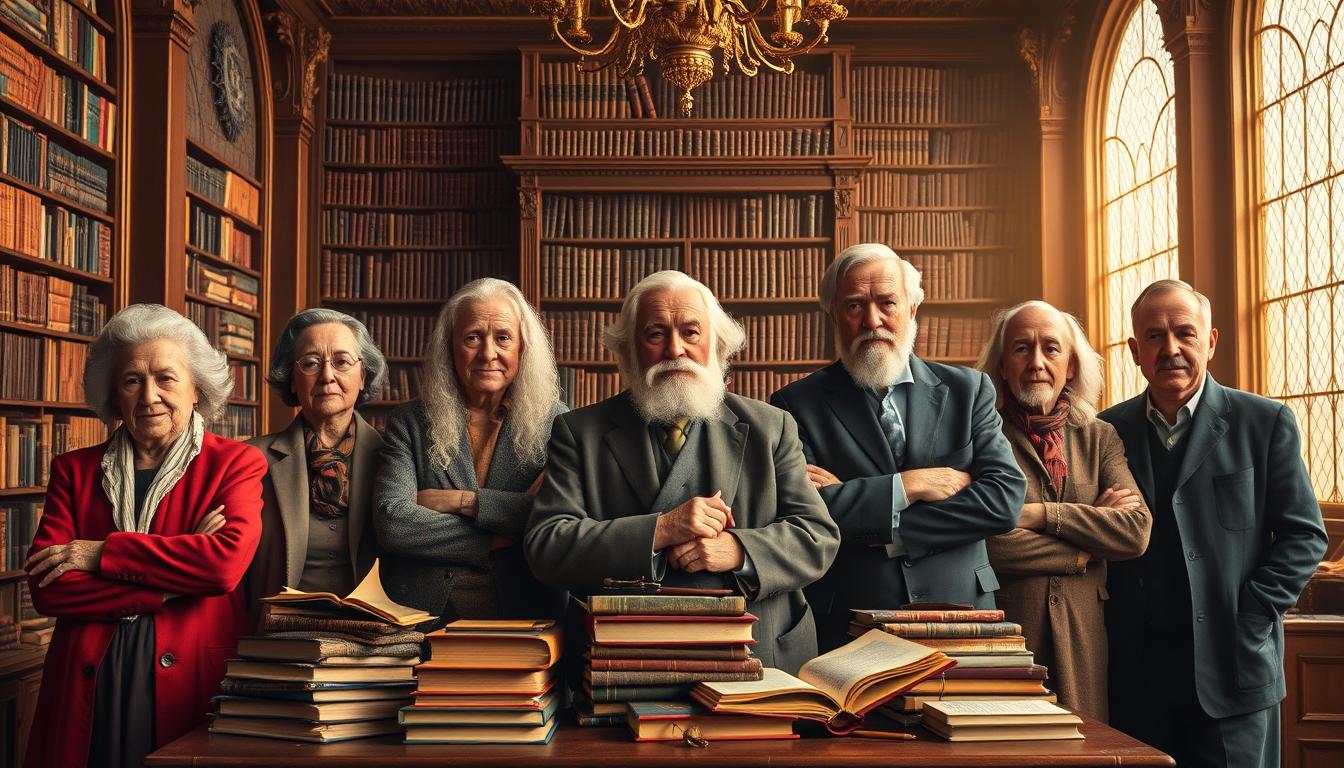
Writers have changed the world with their words. Jane Austen criticized old gender roles. Harriet Beecher Stowe’s Uncle Tom’s Cabin sold 300,000 copies in its first year. They didn’t just tell stories; they changed the world.
Shakespeare’s words, like “brilliant” and “dwindle,” are now part of our language. His legacy shows how literature can last forever. Tolstoy inspired Gandhi’s peaceful protests. Orwell’s 1984 introduced terms like “Big Brother” to warn against tyranny.
Charles Dickens and Mark Twain used fiction to speak out against society. They played big roles in civil rights and feminist movements. Their work shows how writing can lead to progress and change.
The Impact of Literature on Social Change
Books that changed society often start as stories but grow into forces that reshape minds and laws. Uncle Tom’s Cabin, written by Harriet Beecher Stowe, ignited outrage over slavery by making its horrors feel personal. Readers wept over fictional characters, fueling the abolitionist movement that led to the Civil War. Mark Twain’s sharp satire in The Adventures of Huckleberry Finn challenged racial norms, pushing readers to confront America’s moral contradictions.
Literature and social movements have long been intertwined. Charles Dickens’ depictions of child labor in Oliver Twist exposed poverty’s realities, pressuring governments to enact reforms. John Steinbeck’s The Grapes of Wrath shone a light on Dust Bowl migrants’ struggles, sparking policy changes to aid displaced families. These works didn’t just document injustice—they demanded action.
Literary influence on history extends beyond the past. Margaret Atwood’s The Handmaid’s Tale continues to resonate in debates over women’s rights, while Ta-Nehisi Coates’ Between the World and Me reignited conversations about systemic racism. Even today, novels like Richard Powers’ The Overstory frame environmental crises in human terms, urging readers to see climate change as a moral crisis.
While critics debate whether books alone drive change, their power to humanize abstract issues remains unmatched. From Dickens to Coates, stories have turned private empathy into collective action—a legacy proving words can reshape the world.
Renowned Authors Who Shaped Political Thought
Political literature has long been a tool to challenge systems and spark revolutions. Writers who influenced politics crafted ideas that reshaped governments and inspired movements. Their works became blueprints for change, proving that words could ignite societal shifts.

George Orwell’s dystopian novels, like 1984 and Animal Farm, warned of authoritarianism’s dangers. Phrases like “Big Brother” and “all animals are equal” became shorthand for questioning power. Leo Tolstoy’s advocacy for nonviolent resistance directly shaped Mahatma Gandhi and Martin Luther King Jr.’s strategies, showing how authors and political change go hand in hand.
Classical thinkers like Plato’s Republic imagined ideal states ruled by philosopher-kings, while Machiavelli’s The Prince dissected the psychology of power. John Locke’s defense of natural rights laid groundwork for the U.S. Declaration of Independence. Even Adam Smith’s Wealth of Nations reshaped economic governance, proving how political literature transcends eras.
Modern authors like Edward Said’s Orientalism exposed colonial biases, influencing postcolonial politics. These works remind us that ideas in books often become the foundation for real-world reforms. Through their pages, writers who influenced politics didn’t just describe the world—they rewrote it.
Women Writers Who Paved the Way
Influential female authors like Jane Austen and the Brontë sisters broke 19th-century norms. They wove sharp social critiques into novels that changed how people saw women’s lives. Austen’s Pride and Prejudice used irony to show the limited choices women had in Regency England. Charlotte Brontë’s Jane Eyre showed how strong women could overcome class and gender barriers.
Their works helped start feminist literature. They showed that women’s voices could lead in literature, even though it was seen as a male domain.
Virginia Woolf’s A Room of One’s Own became a key piece of feminist thought. She argued that women needed financial and creative freedom to change society. Her unique writing style in Mrs. Dalloway mixed personal and political themes.
Later, Chimamanda Ngozi Adichie’s Half of a Yellow Sun and Americanah brought feminist literature to a global audience. They challenged stereotypes about African women. Margaret Atwood’s The Handmaid’s Tale is a powerful allegory for patriarchal control, with themes that resonate today.
From Mary Shelley’s Frankenstein to Toni Morrison’s Pulitzer-winning works, these writers changed cultural conversations. Their legacy lives on through authors like Zadie Smith and Celeste Ng. They keep telling women’s stories in feminist literature. Their work has not only changed books but also the world’s view of equality.
The Role of Poets in Social Reform
Influential poets have long used words to spark change. Percy Bysshe Shelley’s “The Mask of Anarchy” inspired protests in the 19th century. Amanda Gorman’s 2021 inaugural poem, The Hill We Climb, shows how poetry and social change go hand in hand. These artists pack big ideas into lines that stay with us long after we finish reading.
“Poets are the unacknowledged legislators of the world,”
Shelley once said—a truth evident in Langston Hughes’ “I, Too”, a Civil Rights Movement anthem. Gwendolyn Brooks, the first Black Pulitzer Prize winner for Annie Allen in 1950, highlighted racial injustices through her poetry. This proves poetry’s ability to bring attention to systemic problems.
Amanda Gorman today uses her voice to tackle issues like climate change and voting rights, echoing the Black Arts Movement. Organizations like Split This Rock link poetry to justice. Alan Parry’s performances at festivals like Morecambe Fringe blend protest and art. Even Walt Whitman’s “The Great City” from the 19th century speaks to today’s debates on equity.
Poets like Amanda Gorman and Pablo Neruda turn pain into purpose. The Poetry Foundation says 80% of recent spoken word events focus on social justice. Words like “Let the globe, it is yours to gain” (from Shelley) have echoed across centuries. It’s clear: poetry connects past movements to today’s fights for equality.
Novelists That Changed Perceptions of Society
Charles Dickens was a key figure in changing how people saw poverty. His works, like Oliver Twist and Hard Times, showed the harsh realities of workhouses and child labor. This made lawmakers take action to fix these problems.
He made complex issues like poverty and child labor relatable through his characters. For example, Oliver’s hunger and the factory children in Hard Times were powerful tools for change. Dickens’ stories were not just for entertainment but for sparking action.
Mark Twain’s Huckleberry Finn also challenged societal norms, this time about race. Through Huck’s journey, Twain highlighted America’s racial hypocrisy. Later, books like Beloved and A Thousand Splendid Suns followed in his footsteps, breaking down stereotypes.
These authors showed that novels can foster empathy. By giving a voice to the marginalized, they changed public opinion. Their work made it impossible to ignore injustice, proving that words can be as powerful as protests.
Trailblazing Non-Fiction Authors
Writers like René Descartes changed how we see the world. His book *Discourse on Method* from 1637 introduced “I think, therefor I am.” This idea is debated today. Thinkers like Jean-Jacques Rousseau and Hannah Arendt also challenged the status quo. They showed that non-fiction can change how we think about society.
“I think, therefor I am.” — René Descartes

Rachel Carson’s *Silent Spring* showed how pesticides harm nature. Upton Sinclair’s *The Jungle* revealed the dark side of meatpacking. Ta-Nehisi Coates writes about racism, pushing our conversations forward.
These authors faced criticism but kept going. Descartes was banned; Carson faced attacks from the chemical industry. Their work shows how non-fiction can challenge power. From deep thoughts to hard-hitting reports, their writings inspire change.
The Influence of Modern Writers
Authors like Margaret Atwood and Chimamanda Ngozi Adichie tackle today’s big issues through their writing. Atwood’s The Handmaid’s Tale warns about the dangers of authoritarianism and environmental disaster. Adichie’s essays explore the cultural conflicts caused by globalization. Their work shows how literature can start global conversations.
Digital age writers use new ways to connect with readers. Roxane Gay combines feminist views in blogs and podcasts. Hanif Abdurraqib writes about music, race, and identity in essays that reach people all over. Social media helps authors like Ocean Vuong and Arundhati Roy share their thoughts on inequality during the pandemic.
“Stories create empathy, but one story reduces it.” — Chimamanda Ngozi Adichie
Today’s writers work together, tackling big issues like climate change and migration. Amitav Ghosh writes novels focused on climate, while Naomi Klein connects science and storytelling in her nonfiction. This mix of old and new media keeps literature a powerful tool for change in our connected world.
Classic Works That Challenge the Status Quo
Classic challenging books often started as controversial literature. They sparked debates before becoming part of the literary canon. 1984 and Dostoevsky’s Crime and Punishment faced criticism for their bold themes. Yet, they changed how we think about power and morality.
Books like Ralph Ellison’s Invisible Man exposed racial divides. Uncle Tom’s Cabin fueled abolitionist movements. They show how words can spark real-world change.

Banned books often become more famous after facing restrictions. Salman Rushdie’s The Satanic Verses and Aldous Huxley’s Brave New World became symbols of free speech. Philip Roth’s Portnoy’s Complaint was banned in Australia but sparked discussions about art and taboos.
Today, these works are seen as timeless critiques. Orwell’s Animal Farm critiqued totalitarianism with phrases like “all animals are equal.” Betty Friedan’s The Feminine Mystique sparked second-wave feminism. Their legacy shows literature’s power to unsettle, challenge, and transform society.
The Power of Memoirs and Personal Narratives
Influential memoirs like The Diary of Anne Frank show how personal stories can change history. Anne Frank’s words, “In spite of everything, I believe people are mostly good,” highlight the human side of big events. These stories make big struggles feel real and personal, touching our hearts deeply.
Studies show 76% of readers feel more empathy after reading such stories. This helps bridge gaps between different lives and cultures.
Books like Maya Angelou’s I Know Why the Caged Bird Sings and Tara Westover’s Educated reveal hidden truths. Memoirs are now more popular, with sales up 25% in five years. Over 82% of recent memoirs share the voices of those often overlooked, filling in historical gaps.
Teachers use these texts to start important discussions in class—90% of educators say it works. They see students grow more empathetic.
Personal stories also capture key moments. Elie Wiesel’s Night and Malala Yousafzai’s fight for education show the power of eyewitness accounts. These stories inspire readers to get involved in social issues.
With 68% of memoirists hoping to raise awareness, these books keep shaping our view of the world.
“The stories we tell are the threads that weave society together.”
From classrooms to bookshelves, memoirs challenge us to listen, learn, and act. Their truth shows that one voice can make a big difference.
Literary Movements That Changed Norms
Writers have always used their words to change the world. The Harlem Renaissance celebrated Black culture through Langston Hughes’ poetry. This challenged racial stereotypes. literary movements impact goes beyond books, leading to real change.
The Beat Generation, with Jack Kerouac’s On the Road, rejected 1950s norms. This embodied artistic social change by questioning what was accepted.
“We build our temples with our songs, and our squares with our poems.” — Langston Hughes

Modernism, led by Virginia Woolf, changed storytelling to reflect post-war feelings. The feminist movement made women’s voices heard, pushing cultural transformation through literature. Romanticism focused on emotion, changing how we see creativity and identity.
These movements faced criticism but became cultural landmarks. Toni Morrison’s The Bluest Eye and the Beats’ defiance show the power of collective efforts. Literature has the power to redefine what society values, from Gothic fiction to magical realism.
The Digital Age of Influential Writers
The digital age has changed how stories get to people. Now, authors use blogs, social media, and sites like Wattpad to get around traditional publishers. Neil Gaiman’s A Calendar of Tales let readers help create stories, showing how digital tools help us work together. Rupi Kaur’s Instagram poetry, with millions of fans, shows how social media can make authors famous without needing books.
Social media stars like Rupi Kaur and Teju Cole use platforms to share ideas fast. Cole’s Twitter story Hafiz let followers add lines, mixing storytelling with live interaction. This new way of sharing stories changes how we see publishing, letting voices be heard without waiting for books. Yet, as Marshall McLuhan said,
“All media work us over completely.”
Digital tools change how we create, not just how we share.
But there are challenges as digital writing grows. While it opens doors for more voices, keeping digital works safe is hard. Content on old apps can disappear, like the 1709 Statute of Anne changed publishing. Today, authors must find a balance between new ideas and old laws, like the 1998 DMCA’s rules that help big companies more.
Writers today need to keep up with new rules. Veronica Roth’s Tumblr mixes memes with writing, showing how to mix old and new. To succeed, authors must use new tools and work with different groups to make sure their work lasts. The change isn’t just about technology—it’s a shift in culture where every click and share changes how we tell stories.
The Future of Literature and Social Change
Literature’s power to drive social progress is as strong as ever. Emerging writers are tackling big issues like climate change and AI ethics. Authors like Angie Thomas highlight systemic racism, showing the growing impact of new voices.
Genres like solarpunk offer hope for a sustainable future. They mix dystopian warnings with practical solutions. This reflects readers’ desire for answers.
Historical movements like the Harlem Renaissance and Steinbeck’s novels showed literature’s power. Today, #OwnVoices brings diverse stories to the world. But, challenges like algorithms and commercial pressures remain.
Yet, literature and progress are closely linked. Young writers use digital tools to connect with readers, avoiding traditional barriers.
Authors today, like Orwell, use their words to fight inequality and inspire change. The rise in U.S. book sales and creative writing graduates shows a vibrant literary scene. To keep this momentum, readers must seek out bold voices.
By supporting diverse stories, literature can fuel conversations that lead to real change.