






Humans have been tracking time for thousands of years. They used the Sun, Moon, and stars to guide them. The Babylonians and Egyptians started using ancient timekeeping methods over 5,000 years ago.
They divided days into 12 parts and created calendars. Egypt’s calendar had 365 days, with 12 months and 5 extra days. These early systems laid the groundwork for timekeeping history.
Later, mechanical breakthroughs came, starting with England’s first weight-driven clock in 1283. Leonardo da Vinci drew pendulum sketches in 1493. This led to Christiaaan Huygens’ 1656 pendulum clock, which reduced errors greatly.
Each step forward in timekeeping helped us measure time better. From ancient China’s water clocks to Rome’s sundials, progress was made. Timekeeping has been essential for agriculture, trade, and exploration.
Every innovation, from Huygens’ pendulum to quartz crystals, shows timekeeping’s importance. It has become a cornerstone of civilization.
The Importance of Timekeeping in Human History
The importance of timekeeping was clear to early societies. They needed time measurement significance to survive. In Egypt, farmers tracked the Nile River’s floods with obelisk shadows.
This timekeeping in civilization helped them plant crops at the right time. It turned deserts into fertile land. Without it, they couldn’t plan for harvests or avoid famine.

Religious and social rituals also needed precise timing. Shadow clocks from 1500 BCE divided days into parts. This helped communities sync prayers and festivals.
These tools were more than just tools—they were lifelines. The societal impact of timekeeping was huge in trade too. Merchants used water clocks for meetings, boosting commerce.
Even early clocks like the Tower of the Winds in Athens showed cities’ reliance on shared time. It was the glue that held societies together. Without it, projects like pyramids or global trade routes wouldn’t have been possible.
Every sundial and water clock was a step toward our organized world today.
Early Methods of Measuring Time
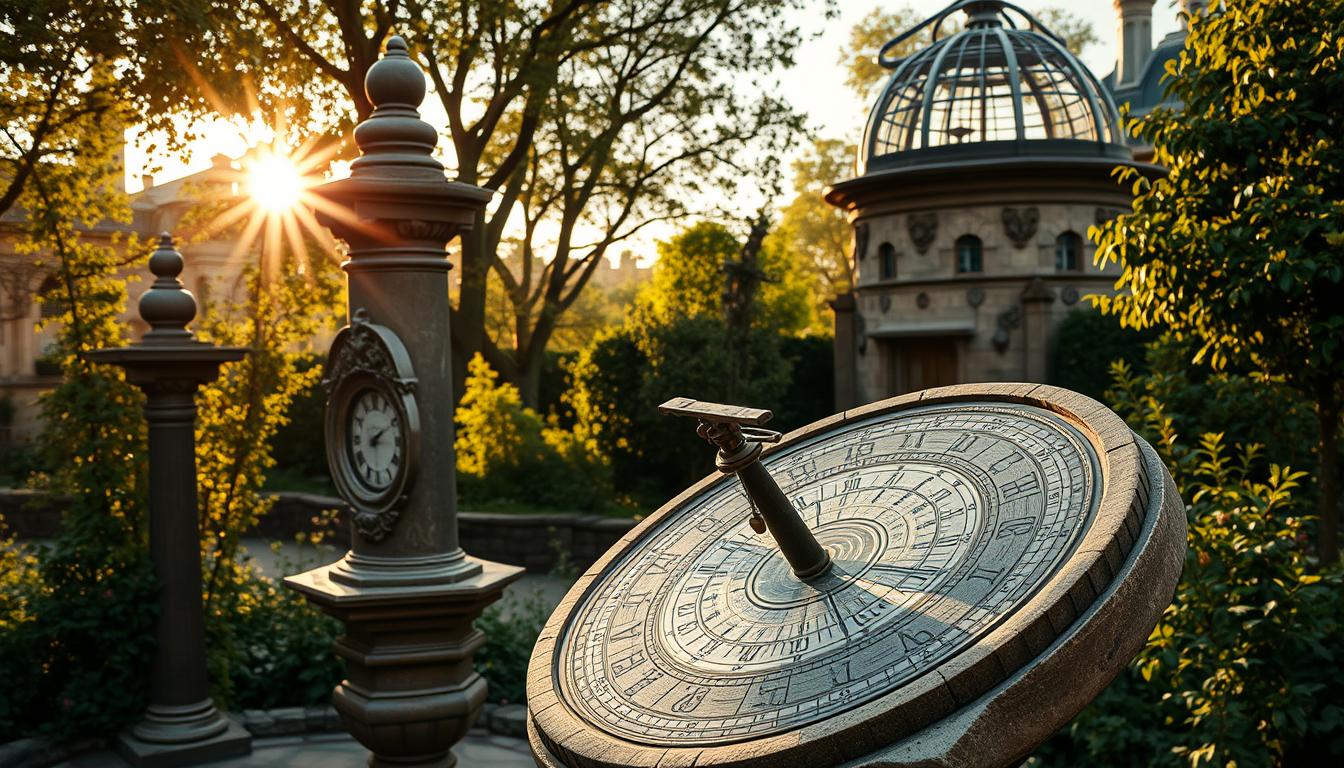
Before clocks and calendars, people used natural timekeeping to keep track of time. Sundials, among the first primitive clocks, worked by using shadows from the sun. Ancient Egyptian obelisks and Babylonian shadow clocks divided days into parts based on sunlight.
They also watched moon phases, with records of this dating back 30,000 years. 
Stonehenge shows how ancient cultures marked important celestial events. Egyptian astronomers mapped stars like Orion 32,500 years ago. Mesopotamians created a base-60 system, which we see in hours and degrees today.
By 1500 BCE, the Babylonians linked 12 lunar cycles to a year, making a 12-constellation zodiac.
Early calendars were based on natural cycles. Egyptian farmers used the Nile’s flooding to mark seasons. Chinese astronomers updated their calendars every 300 years to keep up with precession.
These early timekeeping methods helped us divide days into 24 equal hours—a concept finalized in Hellenistic Egypt. From shadow-stones to star maps, our first steps in timekeeping came from observing the world.
The Development of Mechanical Clocks
Medieval timekeeping made a big leap with the invention of mechanical clocks. By the late 13th century, the first mechanical clocks appeared in European monasteries like Dunstable Priory. The first weight-driven clock there started working by 1283.
These early clocks used falling weights and escapement systems to keep time. They marked a big change from sun dials and water clocks.

Monasteries played a key role in improving clock technology. They needed clocks to manage their prayer schedules. The Salisbury Cathedral clock (1386) and Wells Cathedral clock (1392) were among the first to show off their complex gears and bell-striking features.
These clocks used a verge-and-foliot escapement. It was like a seesaw that controlled the clock’s motion. This allowed for hourly chimes that helped organize community life.
In the 17th century, innovation really took off. Christiaan Huygens created the pendulum clock in 1656. It was much more accurate than earlier clocks, reducing daily error to under a minute.
By 1675, pocket watches became available. They were small and spring-driven, making timekeeping personal. The Industrial Revolution later made clocks more affordable and common, turning them into household items.
Over time, clocks went from being huge structures to precise instruments. Even though quartz and atomic clocks are now more common, mechanical timepieces are treasured. Their gears and chimes remind us of the ingenuity that first tamed time centuries ago.
Standardization of Time Across Regions
Before the 19th century, towns used local solar time. This caused confusion as railroads grew. A trip from Boston to Worcester, Massachusetts, could be off by three minutes.
This was a big problem for schedules. As travel and communication networks expanded, the need for uniform time grew urgent.

In 1884, the International Meridian Conference picked Greenwich Mean Time as the global standard. This created 24 time zones, each 15 degrees wide. The telegraph helped synchronize clocks, solving the chaos for railroads and businesses.
Though France tried a decimal system in 1793, it didn’t work. This showed the time standardization history needed global agreement. Today, global time zones are key for uniform timekeeping. They balance tradition with modern needs, like Daylight Saving Time changes.
Leap Years and Calendar Adjustments
The Earth’s 365.2422-day orbit was a puzzle for ancient calendar makers. Julius Caesar introduced the Julian calendar in 45 BCE. It added a leap day every four years. But, this system slowly drifted over time.
By 1582, the vernal equinox had moved 10 days off. This threw seasons out of sync.
Pope Gregory XIII fixed this with the Gregorian calendar reforms in 1582. He changed leap year rules. Now, a year is leap if it’s divisible by 4, except for century years not divisible by 400.
This adjustment reduced the annual surplus from 11 minutes to 26 seconds. Nations adopted it slowly. But, the Julian calendar stayed in some places for centuries.
Today, we use Gregory’s rules for leap years. For example, 2000 was a leap year because it’s divisible by 400. But 1900 wasn’t because it’s a century year not divisible by 400.
Though precise, the Gregorian system drifts 26 seconds yearly. Over 3,000 years, this adds a full day. It shows the endless evolution of calendar development.
“One day we shall have to adopt a new calendar!”
Even modern tech like GPS uses these rules. As centuries go by, tiny errors build up. This proves our quest for perfect timekeeping is never-ending.
The Influence of Astronomy on Timekeeping
Ancient humans looked to the stars for their first calendars. The oldest known example is a 32,500-year-old mammoth tusk with Orion’s constellation etched on it. This shows how early cultures used the stars to track seasons.
Star clocks, like those used by Egyptian astronomers, divided night into hours based on rising stars. When Sirius aligned with the Sun, it signaled the Nile’s annual flood. This helped guide agriculture through astronomy and time measurement.
Egyptians and Mayans refined celestial navigation to align monuments like Stonehenge with solstices. They embedded astronomical cycles into their calendars. The Babylonians even detected Earth’s 26,000-year axial wobble, adjusting their calendars to stay aligned with star patterns.
Astrolabes later helped sailors find longitude using star positions. This merged celestial navigation with precise timekeeping.
Modern GPS systems rely on this legacy. Atomic clocks, accurate to 1 second over 1.4 million years, depend on atomic vibrations. Yet, their global networks calibrate signals using Earth’s orbital data. From prehistoric star maps to satellite grids, humanity’s quest to measure time remains rooted in the unchanging dance of stars and planets.
Modern Innovations in Timekeeping Technology
Today, we rely on atomic clocks for precision. These clocks count atom vibrations, ensuring accuracy to a billionth of a second each year. They power GPS satellites and keep global networks in sync through digital time measurement systems like Network Time Protocol (NTP).
Quartz timekeeping changed personal technology. Seiko’s 1969 Astron watch, now worth $12,000, started a new era. By the 1980s, quartz watches made Swiss watches less popular. But Swatch’s affordable designs brought them back.
Now, smartwatches like the Apple Watch combine modern clock technology with health tracking. They sync with devices in milliseconds.
Ultra-precise systems keep our world running smoothly. Financial markets and power grids rely on precise timing to avoid problems. Future advancements, like optical lattice clocks, could be even more accurate.
From atomic labs to your wrist, timekeeping has evolved. Every technology, from satellites to smartphones, owes its reliability to these innovations.
Cultural Perspectives on Timekeeping
How we see time varies across cultures. Ancient Egyptians used water clocks for religious events. Mesopotamians tracked time with sundials, tied to farming cycles. These methods show how societies organize life.
Monochronic cultures like Germany and Japan focus on strict schedules. Polychronic societies in Latin America or the Middle East prefer flexibility over exact times.
Western cultures see time as a straight line. But Buddhists believe in a cycle of events. The Malagasy see the future behind them, unlike Westerners.
In Islam, prayer times follow the sun. This links religious rituals to nature.
In Japan, being 15 minutes early is a sign of respect. Brazilian students might start classes an hour late. Swiss trains run like clockwork, showing their watchmaking skill. Yet, 20% of expats return home due to time differences.
Time is both a tool and a tradition. From ancient temples to modern offices, our timekeeping shows our values. Understanding these differences helps us connect in our global world.
The Future of Timekeeping
Technology keeps getting better, leading to new ways to measure time. Quantum clocks, using atomic physics, could be even more accurate than today’s clocks. They might lose only one second over billions of years.
These new clocks are based on the work of the National Institute of Standards and Technology. Their clocks already lose only a second every 300 million years. Scientists hope to use quantum principles to make timekeeping even more precise.
Space-based timekeeping is also growing. Networks of atomic clocks, connected by underground cables or satellites, could change how we keep time worldwide. The International Bureau of Weights and Measures already uses 400 atomic clocks to keep time. But future systems might make timekeeping even more accurate.
The UK’s National Timing Centre and DARPA are working on new clocks for military and civilian use. These innovations show how timekeeping is becoming more important in many areas.
Optical clocks can even detect tiny changes in elevation, helping with earthquake monitoring and climate studies. They could also help standardize measurements for physics and space exploration. Imagine clocks on Mars that match their 24-hour 37-minute days, blending Earth’s time with Mars’.
But, there are questions about how precise we need to be. The quest to measure time is not just about technology. It’s about understanding our existence. From sundials to quantum physics, each step forward shows timekeeping is a never-ending journey of human curiosity and ingenuity.