







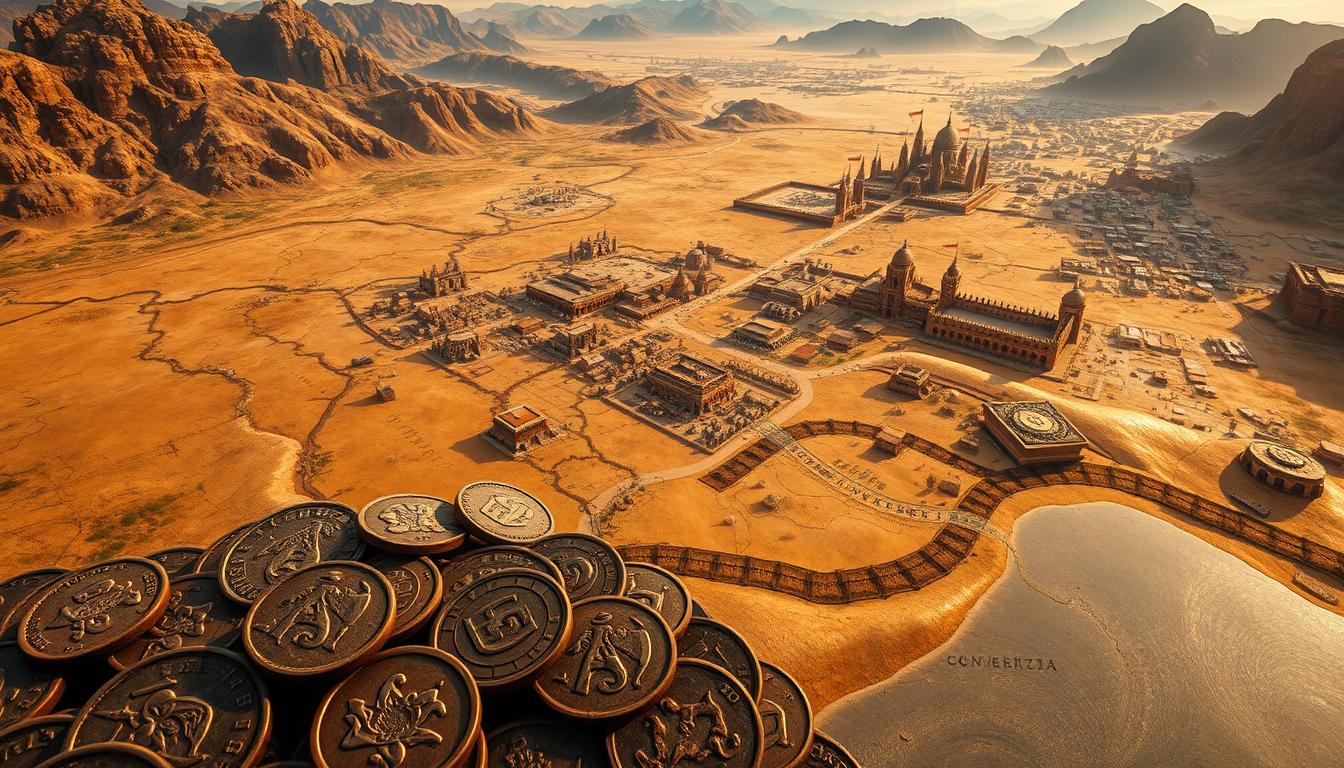
Ancient economies played a big role in the success and downfall of empires. The Achaemenid Empire, under Darius I, used strict taxes to build its power. They measured land and crops to collect silver from conquered lands.
Centuries later, the Byzantines controlled trade routes to keep their wealth. They turned Asia’s gold into treasure. These stories show how how trade shaped history—not just through battles, but through coins, taxes, and supply lines.
Rome’s collapse is a lesson in economic failure. By 476 CE, Rome’s economy was failing. Over 20 emperors in 75 years showed political chaos.
The real problem started earlier. After the Battle of Adrianople in 378, Rome used foreign mercenaries instead of citizens. This weakened both the military and economy. Even the denarius, once nearly pure silver, lost value as emperors diluted its metal—a silent crisis in ancient economic systems that mirrored its crumbling borders.
But not all empires fell. The Byzantine East survived for a thousand more years by mastering monopolies and trade. The West, on the other hand, relied on dwindling slave labor and fractured currencies. This article explores how these choices—taxes, trade routes, and coinage—drove the rise and fall of empires, proving that economies, not just emperors, forged history’s path.
Introduction to Trade and Its Historical Impact
Trade was more than just swapping goods. It played a big role in the rise and fall of empires. Ancient trade networks along rivers like the Nile and Tigris-Euphrates connected distant communities. This turned simple barter into complex economic systems that fueled civilizations.
These routes became lifelines for ideas, technologies, and wealth. They directly linked trade and imperial power.
Control over key trade corridors meant control over resources. Empires like Rome and Persia worked hard to secure these paths. This helped them maintain their dominance.
The Silk Road, starting as early as 130 BCE, connected Asia to Europe. It showed how trade routes could bind cultures together. Even small exchanges of goods like spices, metals, and textiles could change political boundaries and economies.
Historical trade impact is clear in the success of cities like Carthage and Alexandria. These cities were more than markets; they were cultural fusion engines. As empires grew, economic exchange systems became tools for diplomacy and warfare.
For example, controlling gold or silk could give a military advantage or lead to economic collapse. Trade’s effects went beyond markets, shaping laws, religions, and languages.
Today, studying these ancient systems helps us understand global commerce. The connection between trade and imperial power shows us that economic ties reflect human ambition and vulnerability.
Key Trade Empires of the Ancient World
Phoenician traders were maritime trade powers who sailed the seas. They built colonies from Spain to North Africa. Their ships carried purple dye, made from Mediterranean snails, to the wealthy.

Rome’s power came from its roads and laws. These turned the Mediterranean into a shared market. At the same time, the silk road economies linked China’s silk with Rome’s gold for 1,600 years.
The name “Silk Road” was coined in 1877. It honors its 2,000-year history of trade across continents.
These ancient trade empires used trade as a tool of power. The Phoenicians’ ships and Rome’s coins show how economics could rival armies. Even after their falls, their systems, like China’s silk monopolies, left blueprints for modern globalization.
The Role of Currency in Trade Development
Ancient currency systems replaced barter with trade coins, unlocking long-distance exchanges. The Lydian stater (600 BCE) and Persian darics turned metal into universal value, reshaping monetary history. Before coins, merchants relied on bulky commodities like salt or grain—limiting trade to local markets.
Empires used imperial coinage to expand control. Rome’s denarius and China’s early paper money under the Yuan dynasty (1260 CE) created economic standardization. Standardized coins meant merchants could trust a silver denarius in Gaul or a Chinese note in Persia, uniting diverse economies under shared value.
But currency management was risky. The Byzantine solidus, once a global standard, lost value as rulers diluted its gold content to fund wars. Short-term fixes like this weakened empires over centuries, proving monetary policies shaped their rise and fall.
These ancient lessons are relevant today. Just as the Yuan shifted to paper money, today’s digital currencies face similar trust challenges. From stamped coins to crypto, economic standardization remains a balancing act between innovation and stability.
The Interconnectedness of Civilizations
Trade networks linked ancient societies, creating a tapestry of shared ideas and goods. The Silk Road, spanning 4,000 miles, was a key route for cultural exchange. Merchants carried more than just spices and silk; they spread Buddhist teachings and Greek artistic styles across vast distances.
This network of ancient interconnected economies made cultures dependent on each other. For example, Chinese papermaking changed how people kept records globally. Mongol horses also transformed military strategies in Eurasia.

Economic ties often lasted even during wars. Roman emperors paid high prices for silk, despite tensions with China. Yet, these connections also brought risks, like the spread of diseases.
Maritime routes later became more important than land ones. Today, UNESCO protects parts of the Silk Road, recognizing its role as a cultural bridge. From Marco Polo’s journey to the Columbian Exchange, trade networks have shown their power to unite or divide civilizations.
Trade and Conflict: A Double-Edged Sword
In history, trade wars in history often hid deeper struggles for power. The Han Dynasty controlled silk, salt, and iron markets. This showed how economic warfare could build power but also weakness. Trade could either bring together or tear apart civilizations.
Athens and Sparta fought over trade routes in the Peloponnesian War. Rome defeated Carthage to control the Mediterranean. These battles show how trade competition between empires affects history. In the 1930s, a 20% import tax in the U.S. led to global trade crashes and WWII.
Japan invaded Manchuria in 1931 to get resources blocked by U.S. embargoes. This shows how economic actions can lead to war. Today, China’s claims in the South China Sea and U.S. tariffs on $360 billion of Chinese goods are similar. The 2022 U.S. trade deficit of $1.2 trillion shows the high stakes in today’s trade wars.
Agriculture and Trade: A Crucial Link
In ancient times, farming and trade were closely tied. The history of agricultural trade shows how food surpluses and commerce built power. Egypt’s Nile-fed agricultural production turned grain into wealth, powering empires through trade.
But Mesopotamia’s irrigation led to debt cycles, weakening their economies. This trapped farmers in systems that hurt their economies.
“The USDA has emerged as a leader in advancing climate-smart agriculture over the past three years.”
Today, we see similar patterns. U.S. agricultural exports are now over $200 billion, like ancient Egypt’s grain trade. Ethiopia and Rwanda have seen big gains in farming, showing how managing production boosts prosperity.
Like ancient empires, today’s nations grow when farming adapts to climate changes.
Global food security depends on this connection. The USDA’s push for sustainable farming echoes ancient innovations like Mesopotamia’s canals. Yet, challenges remain. Landlocked countries and small economies face hurdles, similar to ancient regions cut off from trade.
From Mesopotamia’s debt to Rwanda’s irrigation success, agriculture and trade’s story is one of growth and resilience.
Maritime Trade and Its Evolution
Ancient maritime trade started around 3000 BCE. Mesopotamian ships sailed rivers and coastal waters. Later, the Phoenicians mastered open-sea travel, making cities like Carthage and Athens key in naval commerce.
These early sailors used simple star navigation. They traded goods like tin, textiles, and amber between distant cultures.
A Chinese record from 200 AD describes Austronesian ships with 4 to 7 masts, capable of sailing against the wind.
By 1000 BCE, Austronesian sailors were trading across the Indian Ocean. Roman ports like Ostia and Alexandria were booming. Innovations like the magnetic compass in 11th-century China and the caravel in the 15th century expanded sea trade.
Venice’s Piraeus harbor became a key spot for silk and spices. This shows how port cities in antiquity were key to economic power, even without vast land empires.
From Viking longships to the Hanseatic League’s Baltic dominance, each era improved maritime systems. Today, container ships carry 80% of global trade. This shows the lasting impact of sea routes that once shaped empires.
The Impact of Geography on Trade
Geography was more than just a setting for ancient economies—it was a key player. The natural resource distribution in areas helped some places flourish. Spain’s silver mines, Lebanon’s cedar forests, and India’s spice trade drew merchants from far away.
Mountains, deserts, and rivers acted as both obstacles and pathways. They shaped trade route geography for thousands of years.

“Walls like Hadrian’s Wall and the Great Wall of China weren’t just borders—they were economic dividers, protecting resource-rich zones while limiting outside influence.”
Empires like Rome built roads and canals to tackle terrain and ancient commerce hurdles. The Persian Royal Road cut travel time, boosting silk and gold trade. China’s Grand Canal connected the north and south, showing how infrastructure can beat natural barriers.
Today, modern trade routes follow old paths, showing geography’s lasting impact. From the Silk Road’s legacy in Central Asia to today’s shipping lanes, the connection between land and commerce is as strong as ever.
The Influence of Trade on Culture and Society
Trade changed ancient societies by making merchants powerful and mixing cultures. In Carthage, traders became leaders, but in Rome, they were seen as lowly. This shows how trade can change social status.
Goods from far away became symbols of identity. Chinese silk and Indian spices were prized in Europe. The Silk Road and Incense Route carried goods like paper and frankincense, shaping beliefs.
Trade brought wealth, leading to an “Age of Affluence.” Empires built grand buildings and supported art. Wealth became more important than family background. In Mesoamerica, markets like Aztec ones connected different groups.
Today, global markets follow similar patterns. Phoenician ships brought glass to Egypt, just like modern trade spreads ideas. Commerce is more than just exchanging goods; it’s about building new societies.
Decline of Trade Routes and Empires
When empires focused on quick wins, they lost their footing. Rome’s farmers were overtaxed, and officials were corrupt. This led to an economic collapse of empires, with empty fields and lost trade.
The imperial economic downfall often started quietly. Tax hikes, debased currency, and ignored infrastructure failures were the first signs.

The trade route decline sped up when empires stopped protecting caravans. Cities like Palmyra lost their shine as bandits and chaos hit the commercial network disruption.
The Han Dynasty’s strict trade rules stifled new ideas. Byzantium’s loss of the Mediterranean hurt its silk and spice sales. Marco Polo’s journey showed how broken systems blocked exchange.
Studies found that imperial capitals decayed at 0.1% a year, eroding trust in money. When silver went east for silk, Rome’s economy fell apart. By the 3rd century, coins were just bronze with a thin gold layer.
History teaches us a lesson. Trade networks need balance. Overtaxing, ignoring corruption, or neglecting routes can kill an empire. The economic collapse of empires was a slow, silent death.
Lessons from Ancient Trade for Modern Economies
The Silk Road’s silk and spice routes teach us timeless truths. Ancient economies thrived on trust, low taxes, and open networks. Today, we face similar issues like inequality and trade deficits.
History teaches that over-taxation and inequality destabilize societies. Modern economies must balance growth with equity to avoid ancient fates.
The Economic Analysis of Ancient Trade project, led by the Booth School of Business, studied 4,000-year-old records. They found how Old Assyrian merchants used contracts and networks, similar to today’s supply chains. Their work shows ancient systems balanced innovation with fairness.
Rome’s collapse under strained trade policies warns us against unchecked wealth. Today’s digital age must ensure fair policies and sustainable trade. Ancient wisdom tells us to focus on infrastructure, fair taxes, and inclusive growth. Prosperity comes from timeless principles.
Conclusion: The Lasting Legacy of Ancient Trade
The impact of ancient trade is seen in today’s global economy. The Silk Road, from China’s Han Dynasty, is like today’s shipping routes. It carried goods like silk and spices, making cities like Palmyra and Petra rich and culturally vibrant.
The Roman Empire’s success with Chinese silk trade shows how important trade was. Today, we see similar struggles to balance security and commerce. This shows how ancient trade shapes our world.
Trade has greatly influenced civilization. The Silk Road spread Buddhism and shared innovations like papermaking. These exchanges blended cultures, creating our diverse world.
Today, we face similar challenges like banditry and political instability. Yet, the drive to connect remains strong. Debates on free trade versus protectionism show this.
Learning from ancient empires teaches us about wealth and stability. The Silk Road’s cultural exchanges, like Persian ceramics and Arabic languages, shape identities. As we navigate globalization, ancient trade’s legacy teaches us to see commerce as a bridge between cultures.
History’s economic threads connect our world. They guide our choices, shaping prosperity today and tomorrow. This shows the lasting impact of ancient trade.