






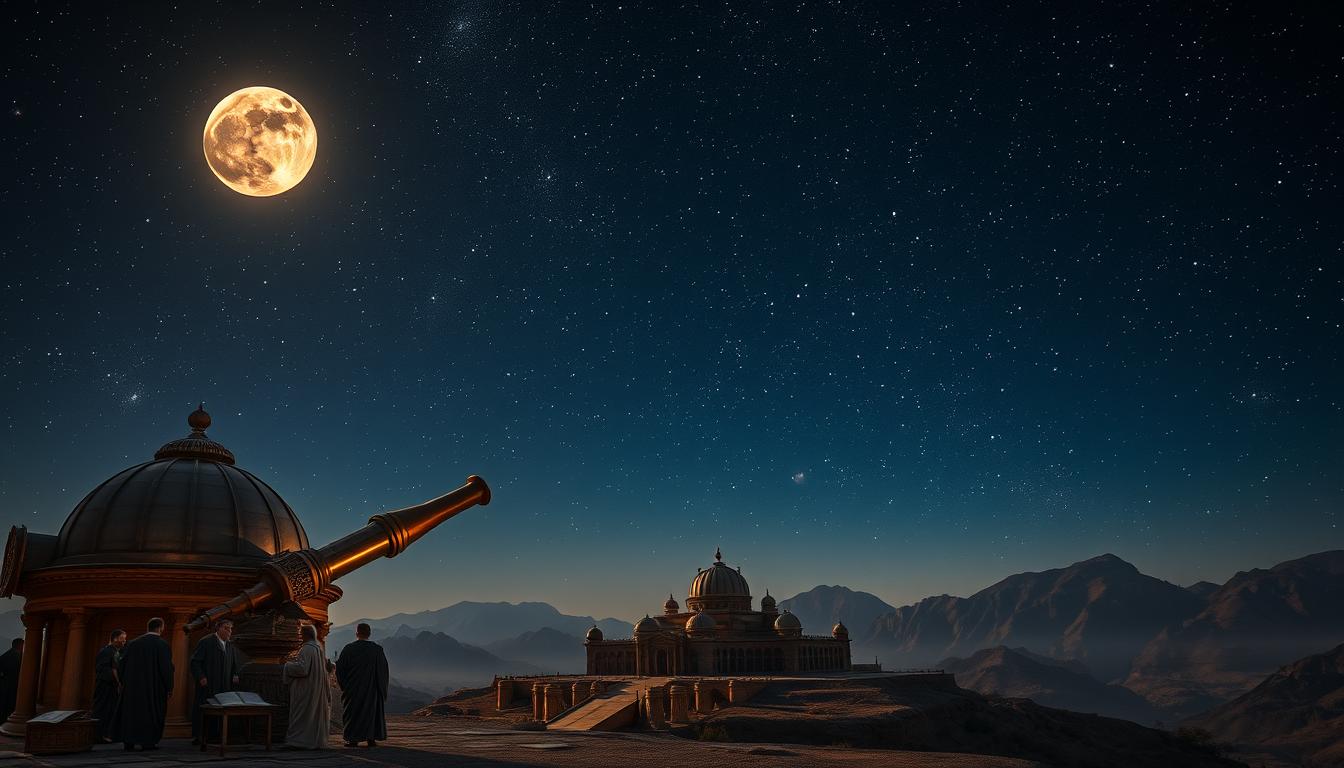
For thousands of years, ancient astronomy has fascinated humans. The Babylonians tracked the sun and moon by 1800 B.C. They even noted Halley’s Comet’s first sightings. They used the sky to map time.
These early societies saw the night sky as a guide. It helped with farming, navigation, and stories. They believed the sky was full of meaning.
Cultures linked star mythology to survival. Egyptians tied Sirius’s rising to Nile floods. Babylonians saw eclipses as omens for kings. The Mayans built calendars from celestial movements.
From the Dunhuang Star Atlas to Greek myths, every society wove meaning into stars. The Pleiades cluster marked planting seasons. The Milky Way became a celestial river in myths from Greece to Asia.
This journey explores how ancient eyes decoded the sky. It mixes science and story. From pyramids aligned to Orion’s Belt to calendars synced with Sirius, discover how cultures turned starlight into survival and myth into legacy.
The Role of the Night Sky in Ancient Cultures
Ancient calendars were key before modern tech. The Egyptians used Sirius to predict Nile floods, aligning farming. Greek farmers watched Hyades for spring rains, blending practicality with daily life.
Celestial navigation and rituals mixed with spirituality. Stonehenge’s summer solstice alignment suggests seasonal ceremonies. Egyptians saw pharaohs as stars after death, and Mayans followed Venus.
Their calendars were accurate for millennia, blending science and myth. The Pleiades, or “Flint Boys” to Navajo, linked stars to stories. The night sky was a tool and spiritual guide, shaping everything from farming to rituals.
The Storytelling Tradition
For thousands of years, people used constellation mythology to understand the universe. Star stories mixed practical advice with tales of heroes and gods. This made the stars and their patterns easy to remember.
Indigenous Australians saw the Milky Way as the path of their ancestors. The ancient Greeks thought Orion was chasing the Pleiades. These stories were more than just fun—they taught important survival skills like when to plant and how to navigate.

Inuit celestial folklore tells of Annigan, the moon god chasing his sister Malina, just like the moon’s phases. China’s oral astronomy traditions tell of ten suns that once threatened Earth, until nine were shot down. These stories, like Egypt’s creation myth where stars came from Ra’s tears, show common themes worldwide.
The study of 27 cultures found Orion seen as a hunter, a god, and a spirit. This shows how humans see patterns in the same way.
“Errors in oral transmission reflect personal beliefs, not random decay,” noted Sir Frederic Bartlett, highlighting how star stories evolved yet retained core truths.
Oral storytelling kept important information alive for generations. The Big Dipper helped Arctic travelers find their way, while Aboriginal star paths showed when to move with the seasons. Even today, people are making new constellations, showing our eternal need to name the stars.
These tales were not myths but humanity’s first textbooks. They combined science and story under the same sky.
Ancient Egyptian Beliefs
Egyptian star gods like Ra, Nut, and Sopdet were at the heart of their culture. Ra’s journey across the sky was like the Nile’s flow. Nut, the sky goddess, protected the earth from above.
The Sirius star in Egypt was very important. It helped them keep a 365-day calendar. This calendar was key for planting crops and celebrating festivals.
The pyramids show the Egyptians’ skill in building. The Great Pyramid points almost perfectly north, like Thuban, the pole star of their time.
These structures told myths. For example, the Great Pyramid’s southern shaft aimed at Orion’s Belt. This linked pharaohs to Osiris’s world.
“You shall rise like Ra, ascend to the imperishable stars.”
The Pyramid Texts promised pharaohs would join the “imperishable stars.” Sirius star Egypt’s cycles were key to life, death, and eternity. Their wisdom is in our day and star calendars, guiding us today.
Mesopotamian Astronomy
Babylonian astronomy was a big step forward. They recorded the sky’s secrets on clay tablets. These records included notes on planets and eclipses.
They even tracked Venus and Halley’s comet. Their work mixed science with predictions for leaders. Their Mesopotamian star charts showed 18 key constellations, laying the groundwork for the zodiac.
“The Sumerian cuneiform tablet describes the sighting of an exploding star in 4000 B.C.”
By 1800 B.C., they divided the sky into 360 parts. This idea is used today for measuring circles. They also split the ecliptic into 12 zones, naming them after symbols like the Twins and the Scorpion.
These names became the zodiac signs we know today. Their math was so accurate that errors were less than 1.5% a year. This was thanks to cuneiform tablets like the MUL.APIN lists.
They also worked on timekeeping. They created a 12-month calendar with five “holy days” to match the solar year. They even noted Mercury’s quick appearances in the sky.
This mix of math and mysticism helped future astronomers. It showed Mesopotamia’s key role in starting astronomy.
Greek Contributions to Astronomy
Ancient Greek astronomers turned myths into Greek cosmology, mixing philosophy with real-world observations. Aristotle’s work described a layered universe. Earth’s elements were surrounded by celestial spheres made of a divine fifth element, or quintessence.
His book On the Heavens showed Earth is round, based on lunar eclipses’ circular shadows.
“The Earth is round, and the Sun’s light casts a curved shadow on the Moon.”
Eratosthenes measured shadows in Syene and Alexandria to find Earth’s circumference. He estimated it to be about 45,000 km. Aristarchus of Samos even suggested the Sun, not Earth, was at the center, but his idea was ignored for centuries.
Hipparchus mapped star positions and found Earth’s axis wobbles slowly, taking 25,772 years to complete. Ptolemy’s Ptolemaic system was used for over a thousand years. His Almagest cataloged 1,000 stars, using Babylonian math and Greek geometry.
These ancient Greek star models are the basis of modern astronomy. Their methods and star catalogs showed the universe follows laws, not just gods. Ptolemy’s geocentric model, though wrong, led to later discoveries. Their work is remembered in terms like “asteroid” and “planet,” showing their lasting impact on our understanding of the universe.
The Indigenous Perspectives
Indigenous astronomy shows how Native American and Aboriginal star myths were key to survival and spirituality. The Navajo aligned hogans with the stars, while the Inuit used the sky to track time. These ancient stories guided farming and storytelling.
Jessie Kavanaugh, an Indigenous student, once shared, “I know more about Greek constellations than my own people’s star stories.” Her words highlight a growing push to revive these ancient systems.

Aboriginal sky stories are rich with meaning. The Cree believe the Pleiades are a hole in the sky. The northern lights dance as ancestral spirits. These stories, passed down through generations, teach us about the world and our place in it.
At Canada’s Science Museum, a display called “One Sky, Many Astronomies” shares these stories in Ojibway, Dakota, and more. It brings together science and Indigenous culture.
Wilfred Buck travels with a portable planetarium to teach Indigenous youth about their heritage. Events like Wood Buffalo’s Dark-Sky festival mix telescopes with cultural ceremonies. But, only 15% of traditional knowledge remains, threatening our cultural memory.
Neilson at the University of Toronto is working to include these stories in STEM education. Modern astronomy is recognizing the wisdom of First Nations in understanding the universe. Preserving these traditions is not just about history. It’s about honoring a science that connected survival with the stars.
Impact of Hindu Astrology
Indian star charts and Hindu astronomical texts merged math and mysticism in ancient Indian astrology. The Vedic cosmology in the Vedas described 27 nakshatras, or lunar mansions. These guided rituals and timing.
Texts like the Āryabhaṭīya by Aryabhata changed how we see the world. He figured out Earth’s rotation and eclipses as shadows, long before the West.
Core texts like the Siddhantas and Bṛhat Parāśara Horāśāstra organized planetary positions and zodiac signs. The Yavanajātaka, a 2nd-century translation, shows early cultural exchange. Ideas like kalpa—cosmic time cycles—match modern astronomy’s views of time.
Today, ancient Indian astrology is more important than ever. Families use jyotisha charts for naming children. Over 60% of clients of astrologers like H.S. Hande report accurate predictions.
Universities now teach “Jyotir Vigyan” despite some doubts. The Supreme Court even recognized its cultural value, saying it’s not religious.
From Aryabhata’s work to using star charts for names, these traditions live on. They show that Vedic cosmology is more than history—it connects ancient wisdom to today’s curiosity.
Astronomy in Ancient China
Ancient China’s skywatchers left a mark of precision and purpose. The Imperial Astronomy Bureau, filled with scholars, tracked the sky to keep balance. If their predictions were wrong, they faced harsh penalties, showing their importance to the emperor.
Early astronomers like Shi Shen mapped over 800 stars, creating one of the first Chinese star catalogs. Gan De even noted Jupiter’s moon long before Galileo. Their Chinese lunar calendar helped plan farming and festivals for thousands of years.

Zhang Heng’s water-powered armillary spheres were key to Chinese astronomical instruments. These tools tracked planets and eclipses with great accuracy. The Dunhuang Star Atlas, made before 700 CE, showed over 1,300 stars, showing their systematic work.
The ancient Chinese observatories, like Beijing’s Ming-era site, housed these tools. They kept the Chinese lunar calendar in sync with the earth.
For over 3,000 years, they focused on observing, not just guessing. Their Chinese star catalog entries, like the 1054 supernova, stood the test of time. Joseph Needham praised their observational skill, even before Islamic advancements.
Their records of eclipses, comets, and sunspots helped start modern timekeeping in East Asia. Today, their legacy lives on in space missions like Chang’e 5.
The Myths of the Ancient Celts
Celtic star myths connected the sky to everyday life. Festivals like Samhain and Lughnasadh were tied to the sun’s path. This guided farming and rituals, thanks to Druid astronomy.
The solstices were more than just dates. They were bridges between the earth and the divine. The rising of stars like Orion, linked to Cernunnos, was a key part of these traditions.
“The winter solstice light pierces Newgrange’s chamber, proving the Celts’ deep bond with the sky.”
Stone circles like Newgrange tracked time for the Celts. This tomb captures the sunrise on December 21st, merging light and myth. Similar sites across Europe show their cosmic knowledge, even without written records.
Druids passed down lore orally, linking constellations to seasonal changes. This knowledge is seen in sites like Newgrange and others across Europe.
Samhain, now Halloween, marked the year’s end with rituals for ancestors. Pumpkins and turnips symbolized this time when spirits roamed. The Druids’ two-season calendar shaped festivals like Imbolc and Beltane, linking harvests and battles to the heavens.
Though their astronomy lacked Greek texts, its impact lives on. Modern traditions like Lughnasadh fairs and Halloween’s eerie customs show this.
How Ancient Cultures Measured Time
Ancient people used star calendars and watched the sky to keep time. The Egyptians followed the rising of Sirius to make their 365-day year. They divided it into 12 months and added 5 extra days.
The Mayans had two calendars. One was for rituals, lasting 260 days, and the other was for the sun, 365 days. These calendars helped them plan for harvests and important events.

They also used sundials and water clocks to track time. Sundials, used by the Egyptians around 1500 BCE, split daylight into 12 parts. Water clocks measured hours by dripping water.
The Greeks made the Antikythera mechanism, a bronze device that predicted eclipses. These tools showed how ancient people combined engineering and math to understand the sky.
In Egypt, each day was divided into 24 hours, balancing day and night. Their calendar was a bit off, needing realignment every 1,460 years. The Sumerians also divided days into 12 parts, with each part further divided into 30 units.
These systems influenced our modern calendar. Our 12-month year comes from the Sumerians. The Mayans’ 260-day cycles are also seen in Mesoamerican cultures today. Ancient people used the sky to guide their lives.
Scientific Developments in Ancient Civilizations
Ancient math turned stargazing into a science. The Babylonians tracked Jupiter’s path with ancient astronomical calculations on clay tablets for centuries. Greek scholars like Eratosthenes used geometry to find Earth’s size.
Indian astronomer Aryabhata used trigonometry to explain eclipses. Chinese observers recorded the 1054 supernova explosion with great detail. These cultures saw the night sky as a math problem to solve.
Astronomical tools like gnomons and water clocks tracked time and the sky. The Greeks built armillary spheres to model planets. The Maya aligned El Caracol’s windows with Venus’ cycles.
Though early telescopes didn’t exist, these tools allowed for precise measurements. Egyptian pyramids and Chinese observatories like the Ming-era Beijing structure were both architecture and instruments. They captured the sky’s rhythms through stone and design.
Today, scientists study ancient records of supernovae or eclipses. They learn from these early pioneers. Their work shows how curiosity about the cosmos united cultures across continents.
The mathematical astronomy of the past laid the foundation for modern discoveries. It proves human ingenuity could map the universe, even without telescopes.
Modern Understanding of Ancient Beliefs
Today, archaeoastronomy research shows how ancient societies mapped the cosmos. Experts use laser scans and computer models to understand sites like Chaco Canyon’s sun dagger. These findings help us see how ancient astronomy shapes our view of early cultures.
Taurus, the Bull, was first sketched 17,000 years ago. It links to today’s constellations, showing humanity’s eternal curiosity about the stars.
Cultural astronomy preservation efforts protect these legacies. UNESCO protects sites like Stonehenge and the Nazca Lines as astronomical heritage. Indigenous groups in Polynesia use stars like the Pleiades for navigation, just like ancient Africans.
The Milky Way’s name varies across cultures—from a milk river in Greece to a snow path in Inuit lore. This shows how ancient knowledge lives on.
Modern science sometimes mirrors ancient insights. The three stars of Orion’s belt, sacred to Egyptians, are also fascinating to astronomers today. The Big Dipper, tracked for millennia, guides modern archaeoastronomy studies.
The aurora borealis, seen by Vikings as ghostly lights or Sami as celestial reindeer, shows our shared wonder. Astronomical heritage is more than history—it connects us to our collective past.
From Zimbabwe’s stone circles to Ekoi oral histories, these traditions teach us about shared curiosity. As research continues, ancient stargazing stories remind us of our shared quest to understand the universe.