




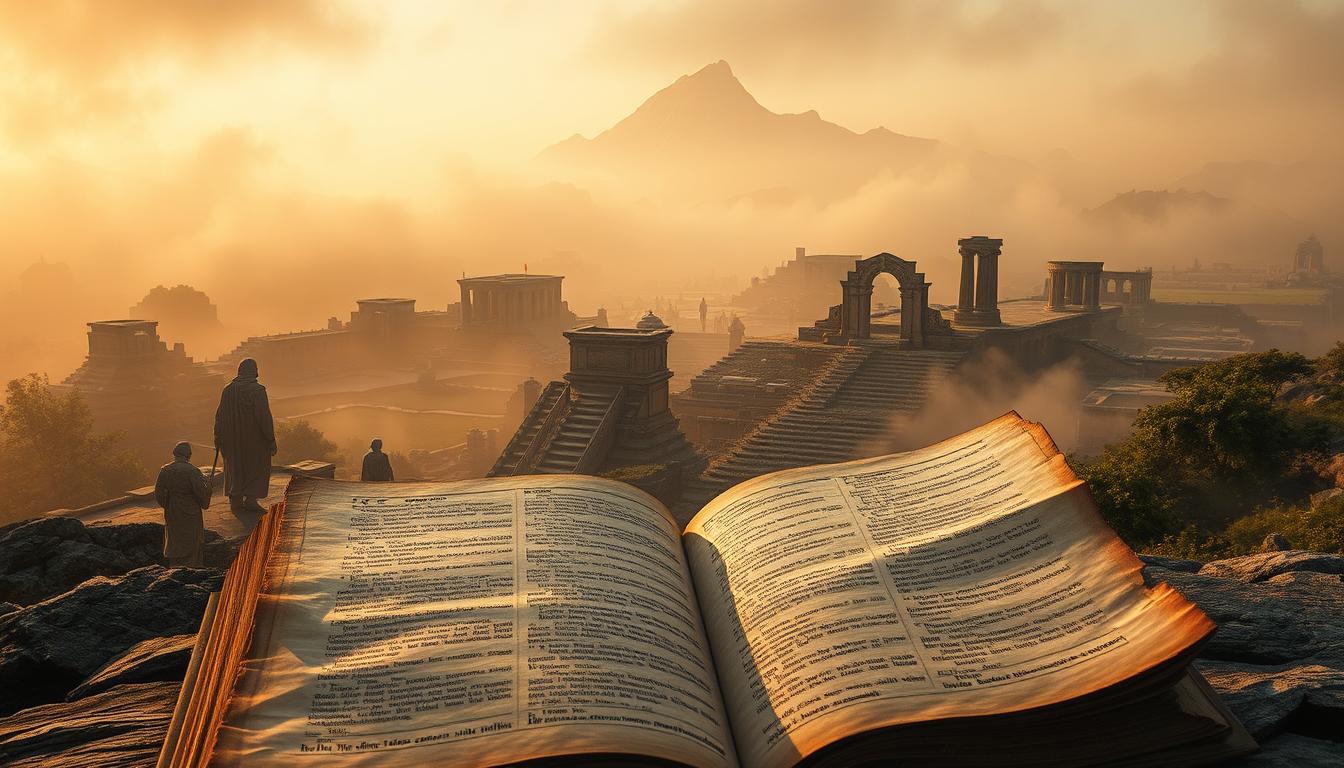
Discover the truth behind mythology and the famous myths origins that have shaped history. Myths are more than stories; they are windows into the past. They mix culture, science, and survival.
From ancient artifacts to today’s research, we see myths as real events. Like the legendary stories facts of the Kraken, first seen on film in 2004. Or the nine-layered Troy site found by archaeologists.
Paul Jameson shares how myths differ from fairy tales or legends. Myths explain natural phenomena, like the giant Haast’s eagle inspiring flight legends. But, debunking myths needs evidence.
The 2,600-year-old orichalcum shipwreck or the secrets of Iron Age smiths show science’s role. Join us as we explore myths and human curiosity. From Atlantis-inspired sunken cities to Homeric epics on 8th-century pottery.
Introduction to Myths and Their Origins
Myths and legends help us understand the world. Mythology origins often come from stories passed down by word of mouth. These tales tell of gods, heroes, and the forces of nature.
Myths are different from legends. Myths involve gods or the beginning of time. Legends mix history with fantasy, like King Arthur’s stories. Both use ancient storytelling to share values and identity.
Myths are key to cultures. Greek epics like Homer’s Iliad and Hesiod’s Theogony created the gods we know today. These stories explain the world and our place in it.
Even now, myths live on in movies and books. From Tolkien’s Middle-earth to Marvel’s gods, they continue to inspire us.
Myths can be grouped into types, like creation stories or tales of heroes. The Pawnee and Zulu have their own myths about the end of the world and a chameleon. Before writing, stories were shared orally.
The Beowulf saga and Robin Hood’s ballads mark a shift to written stories. By the Victorian era, myths like Arthur’s were used to build national pride.
These stories are more than just tales. They help us understand our curiosity about the world, morality, and the unknown. From ancient sites like Stonehenge to modern tales, myths connect us to our past and inspire new stories every day.
The Myth of Atlantis: A Lost Civilization
Plato’s Atlantis first showed up in his dialogues Timaeus and Critias. He said it was an island empire bigger than Libya and Asia together. It sank because it angered the gods, Plato wrote as a warning about being too proud.
Many later thought it was a real lost civilization. Today, scholars look into Atlantis origins through ancient disasters like the Minoan collapse and earthquakes.
A top historical Atlantis theories links it to the Minoan civilization. A big volcanic eruption on Santorini (Thera) around 1600 BCE caused tsunamis that destroyed coastal towns. This event matches Plato’s story of sudden destruction but doesn’t fit his timeline of 9,600 BCE.
The Minoans were known for their advanced society and quick downfall. This makes them a favorite choice for Atlantis origins.

Helike, a Greek city, also vanished suddenly in 373 BCE. Excavations starting in 1990 found a buried city with statues and ruins. Like Plato’s Atlantis, it vanished without warning, sparking theories about divine punishment. Real disasters might have turned into myths.
Even though no solid proof of Plato’s Atlantis has been found, the myth lives on. It blends real disasters with timeless themes of pride and downfall. Each historical Atlantis theories—from Santorini to the Black Sea—shows how ancient stories and imagination continue to fascinate us.
The Legend of Bigfoot: Fact or Fiction?
Bigfoot sightings have fascinated people for years. But what’s real and what’s just a story? The term “Sasquatch” comes from old stories of Indigenous people. It became popular in 1958 after a journalist named Andrew Genzoli shared stories from California loggers.
That same year, footprints found by Jerry Crew near Bluff Creek caught everyone’s attention. These footprints made “Bigfoot” a part of our culture.
The 1967 Patterson-Gimlin film is famous, even if some question its authenticity. Ever-since, cryptozoology research has looked into Sasquatch sightings. But many doubt Bigfoot’s existence because there’s no solid proof.
Scientists say they need bones, DNA, or clear signs of where Bigfoot lives. Some think Bigfoot might actually be a bear. For example, in 2013, a hunter in Oklahoma shot his friend thinking he was Bigfoot.
“Bigfoot’s myth blends Indigenous lore with modern media,” noted a 2007 study linking its popularity to cultural fears and fascination with wilderness.
Looking into Bigfoot, scientists often find problems with the evidence. The famous 1958 footprints were later found to be fake. Even the biggest footprints don’t make sense for a primate.
Authorities have warned about the dangers of mistaken identity. In 2017, North Carolina told people to be careful after a shamanist wore a fur suit. This shows how hoaxes and mistakes keep the Bigfoot legend alive.
Even though cryptozoology research keeps going, most scientists don’t believe in Bigfoot. But Bigfoot remains a mystery that captures our imagination. It mixes old stories with our curiosity about the unknown.
The Truth About Vampires: Origins and Evolution
Vampire stories have been around for thousands of years. They started in ancient Mesopotamia and Egypt. These myths mixed with medieval beliefs, leading to historical vampirism practices.
During plagues, people blamed vampires for the sickness. They would dig up graves and burn hearts to stop the undead.

In 19th-century New England, things got scary. When Mercy Brown died of tuberculosis in 1892, people thought her corpse was making her brother sick. They dug her up, saw her body, and burned her heart.
Her brother died soon after. Folklorist Michael Bell found over 60 similar cases in New England. He showed how evolution of vampire myths matched society’s fears.
“The vampire’s duality—monster and tragic figure—reflects humanity’s struggle to explain the unexplainable,” argued modern scholars studying these rituals.
Bram Stoker’s 1897 novel Dracula changed how we see vampires. It mixed horror with romance. This change made vampires popular in movies and TV, like True Blood.
Today, people online talk about being vampires. They discuss their “feeding” needs. This shows myths keep changing but never truly die.
Vampire stories have changed a lot over time. They reflect our deepest fears and desires. Their journey through history shows how folklore mirrors human experiences.
The Folklore of the Loch Ness Monster
Loch Ness Monster history goes back over 1,400 years. It started with a 7th-century story. The first written record was in 565 AD, when Saint Columba saved a man from a “water beast.”
In 1933, a London couple’s sighting made the monster famous worldwide. The Scottish lake monster myth grew after the 1934 “surgeon’s photograph.” This photo was later found to be a toy submarine with a model head. Yet, research on Nessie continues.
Researchers have used sonar, DNA, and cameras to study the monster. A 2018 study found no plesiosaur DNA in Loch Ness, only eels and fish. But, the mystery lives on.
Some say the loch’s depth (755 feet) and murky waters hide the monster. Others think sightings might be otters or logs. Despite failed searches, the legend brings in nearly $80 million yearly to Scotland’s economy.
Today, theories mix science and myth. Experts say plesiosaurs can’t survive from the dinosaur era. But, the loch’s cold waters might support them. The story of the Scottish lake monster is a mix of history, curiosity, and the human love for the unknown.
The Story of Robin Hood: Hero or Criminal?
Robin Hood’s story is a mix of medieval outlaws and English folklore heroes. Early records suggest he might have been based on real people. The first mention of Robin Hood is in William Langland’s 1377 work, Piers Plowman.
By the 1400s, stories like Robin Hood and the Monk made him a symbol of fighting against unfair nobles.

“Robin Hood permitted no harm to women, nor seized the goods of the poor,” wrote John Major in 1521, capturing the outlaw’s moral code.
Was Robin Hood real? Some think he might have been based on figures like Robert Hod of York or Roger Godberd. Sherwood Forest’s ancient oaks could be where he hid. But, modern Sherwood Forest history research finds little solid proof.
Ballads from the 1400s and 1500s made him a yeoman, fighting for justice. Even Shakespeare mentioned him in plays, making his legend stronger.
Archaeology and documents add clues: Little John’s “grave” had a giant femur bone. And 16th-century May Day plays featured his band. But, some stories don’t match. Was he loyal to Richard the Lionheart? That idea came later, in Anthony Munday’s 16th-century plays.
Even his death is unclear. Some say he died in Kirklees Priory, poisoned by a prioress.
Today, Robin Hood’s story is a blend of English folklore heroes and dreams. Whether true or not, his legend shows the power of resistance and fairness. It proves some myths can last forever.
The Urban Legend of Crop Circles
Crop circles, mysterious patterns in crops, have fascinated people for decades. Theories abound, from alien messages to magnetic field anomalies. Yet, most evidence suggests they are cereal art explanation by humans.
The phenomenon grew in 1980s England. In 1991, Doug Bower and Dave Chorley confessed to over 200 designs. Their pranks inspired a global agricultural phenomena, with over 10,000 formations by 2001.
Despite hoaxes, debates continue. Some argue unexplained cases show bent plants without breaks. Yet, the “Bend Test” often reveals snapped stems, pointing to human involvement.
In 2009, six formations in Wiltshire’s fields sparked theories about ancient Earth energy lines. Yet, many were near roads, suggesting easy access for creators. The 1996 Julia Set fractal design, once seen as a scientific marvel, was later revealed to be man-made by artists.
Legal cases, like Hungary’s 1992 incident, show crop circles’ dual nature. Today, they blend folklore and creativity. Festivals and competitions celebrate their artistry. Their appeal lies in the mystery and human ingenuity.
The Fame of Area 51: Conspiracy Theories Uncovered
Area 51 has been a secret military base for over 60 years. It tested Cold War aircraft like the U-2 spy plane. Its remote location in Nevada and strict secrecy sparked UFO conspiracy theories.
Even after the CIA confirmed its existence in 2013, the Nevada test site truth is not widely accepted.

“The technology tested here defied explanation,” claimed a former employee in the documentary Unacknowledged.
Bob Lazar’s claims from the 1980s about alien tech fueled the theories, though experts questioned them. The 2019 “Storm Area 51” event drew thousands, mixing humor with belief. Despite many debunkings, Area 51’s Area 51 history is linked to aliens.
Declassified files and pop culture keep the debate going. It shows some mysteries never disappear.
Myths of Ancient Greece: Gods and Monsters
Greek mythology origins blend fantasy with real-life hints. Stories of gods like Poseidon, who ruled the seas, might come from ancient Greeks’ wonder at storms or earthquakes. Mythological creatures evidence sometimes shows up in fossils—like elephant skulls mistaken for cyclops, sparking tales of one-eyed giants.
Myths were nature’s first textbooks—explaining what science couldn’t yet answer.
Legends of ancient Greece often mix history with drama. The Iliad’s Trojan War might have been inspired by real battles, with Troy’s ruins proving its ancient existence. Even creatures like the Hydra, with its nine heads, hint at fears of unstoppable threats.
Ancient Greek gods facts show how myths shaped culture. Heroes like Heracles battled monsters to teach courage, while gods enforced moral lessons. The labyrinth’s maze? Maybe inspired by real structures or complex coastal geography.
These stories continue to captivate because they reflect human struggles. Whether explaining volcanoes as Zeus’s lightning or fearing the sea’s dangers, myths bridged mystery and meaning. Their legacy lives on, proving imagination and history are often tangled threads in the same story.
The Mystery of Stonehenge: Purpose and Construction
Stonehenge’s massive stones are a puzzle from the past. Scholars try to figure out how ancient builders moved 25-ton stones. They used megalithic engineering to drag sarsen stones 19 miles and bluestones 145 miles. This work started around 3100 BCE and took over 1,500 years.
Archaeologists have many theories about Stonehenge’s purpose. Some think it was a ritual site or an ancient calendar. The alignment with summer solstice sunrises suggests a link to ancient astronomy. Excavations found 50,000 cremated bone fragments, showing it was also a sacred burial ground.
Builders used ball bearings and sledges to move the stones. The outer circle has 30 sarsen stones, each weighing 25 tons. The inner horseshoe of trilithons stands 24 feet tall. Recent studies suggest ice age glaciers might have helped move bluestones, changing earlier theories.
Today, the Stonehenge Riverside Project is uncovering more clues. While science explains some things, the true neolithic monument purpose is debated. This mystery makes us marvel at the ingenuity of those who created this iconic landscape.
Halloween Traditions: History and Myths
The roots of Halloween go back to the Samhain festival history, a Celtic ancient harvest celebrations marking the end of autumn. Celts believed this time was when the living and dead were close. They lit bonfires to honor spirits.
Over time, these Halloween origin facts mixed with Christian practices. The Catholic Church’s All Saints’ Day in the 800s changed Samhain into “All Hallows’ Eve.” This blended pagan and religious traditions.
Early evolution of Halloween traditions saw costumes as disguises to avoid spirits. Turnip lanterns, later replaced by pumpkins, came from Irish folktales like Stingy Jack. When Irish immigrants came to America in the 1800s, Halloween became a community event.
By the 1950s, trick-or-treating became a candy ritual, thanks to post-war prosperity.
“Trick-or-treating first gained popularity in the 1920s as a way to curb Halloween pranks,” notes historian Lisa Morton in “The Halloween Encyclopedia.”
Today, Halloween is a mix of Celtic rituals, Christian observances, and modern fun. The $11 billion spent on costumes and candy shows its global appeal. Yet, its origins are deep.
From carved pumpkins to spooky costumes, traditions connect us to ancient beliefs. Death and life are intertwined. Next time you carve a jack-o’-lantern, think of its Irish roots and the 1451 manuscript that showed witches flying on brooms. Halloween’s magic is in its timeless mix of history and imagination.
Conclusion: Myths and Their Enduring Legacy
Myths are more than old stories—they are a part of our culture today. For 5,000 years, they have shaped our view of the world. Now, they live on in movies, viral hoaxes, and brands like Nike and Amazon.
Modern myth interpretation keeps these stories alive. It shows that stories change but never disappear. This is how myths stay with us.
Legends shape our identity and culture. Armenian myths connect to Noah, and Greek tales like Prometheus warn us about technology. Schools teach Oedipus to discuss ethics, showing myths’ lasting impact.
Myths connect us through time and place. They are a way to understand courage and justice. Whether old or new, myths remind us of the power of stories.
By studying myths, we honor their place in culture and learn important truths. Every new myth, from superhero films to conspiracy theories, keeps our storytelling alive. This shows myths are key to understanding our world.