







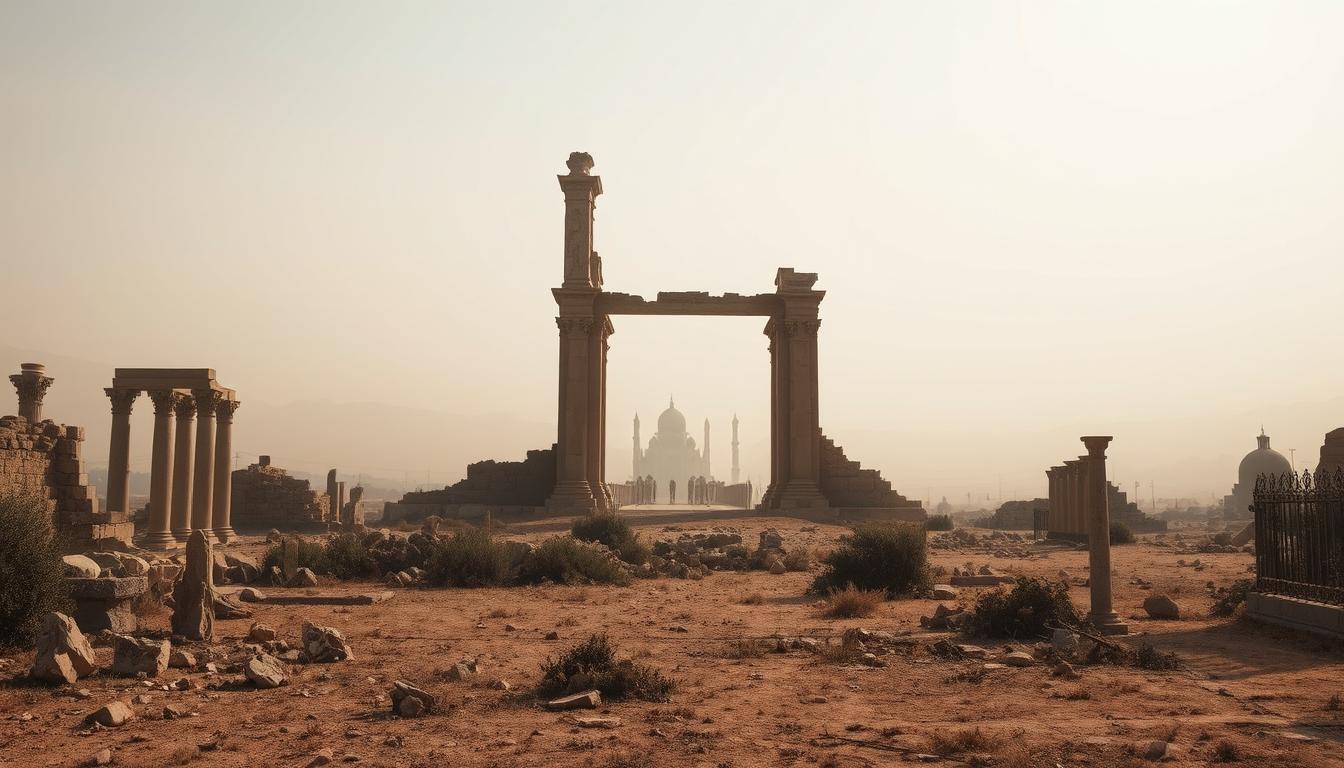
History shows us that even the strongest civilizations can fall. The average society lasts only 340 years. But, the Kushite Kingdom and Aksumite Empire lasted over a thousand years, showing that resilience is not always predictable.
Historian Samuel Arbesman says that collapse can happen suddenly. Yet, historical patterns do emerge.
A 2023 book reveals that the Roman Empire and the modern West declined in similar ways over 1,600 years. Both faced economic slowdowns and political splits, similar to today’s global changes. The book is available in hardcover ($27) and paperback ($18), and is a contender for the 2024 Edwards Award.
It shows how taking too many resources can lead to societal collapse. This has happened from medieval taxes to Soviet privileges.
From ancient Greece to today’s superpowers, these patterns remind us that even the U.S. faces risks. By studying these historical patterns, we can learn how to avoid making the same mistakes.
Understanding the Concept of Empire
Historical empires, like the Achaemenid Persians or Roman Empire, controlled vast lands and people. An empire is more than a big kingdom. It’s a system where one power rules over many areas. They used taxes, armies, and blending cultures to keep control.
The Achaemenid Empire grew fast under Cyrus the Great in 75 years. Its fall showed how empires go through growth, stability, and decline. The Roman Empire reached its peak in 117 CE under Trajan, managing lands from Britain to Mesopotamia.
“Societal collapse is a political process,” noted historian Joseph Tainter. This applies to empires like the Qin Dynasty, which unified China in 221 BCE but collapsed quickly due to harsh rule. Empires balance expansion with internal stability—a tension that shapes their fate.
Unlike today’s countries, ancient empires had no fixed borders. The Persian Empire under Darius I stretched from Greece to India, using roads and taxes to manage. Even ancient empires like the Akkadian or Neo-Assyrian shared traits: centralized leadership, complex bureaucracies, and reliance on resource surpluses. These systems thrived when governance adapted, but rigid structures led to vulnerability.
Understanding these dynamics reveals why empires like the Maurya or Han dynasties rose and fell. Their stories show how adaptability is key to imperial power. Ignoring economic or social issues can end even the strongest empires.
Key Factors Leading to the Rise of Empires
Empires grow when resources and geography meet. Ancient powers like Rome and Persia thrived on fertile lands and trade routes. These helped them produce more food and control key areas, building their power.
A strong government, taxes, and specialized jobs helped leaders manage big populations. This allowed them to grow and organize efficiently.
“Social technologies emerge not from crowds, but from visionary rulers shaping institutions.”
Great leaders were key. Figures like Cyrus the Great and Augustus united people with laws and religion. This boosted unity and helped empires expand by standardizing rules and managing diverse areas.
Military progress was also important. New weapons and disciplined armies helped conquer rivals. But, too much growth could lead to trouble, as seen with Carthage’s collapse.
Today, we see that stable empires have a central hub and satellite areas. This setup lets them manage territories well without being too centralized. Being able to adapt to new challenges, like changing trade policies or adopting new technologies, is also key. Without this, even strong empires can decline.
Internal Conflicts and Their Impact
Internal conflicts can weaken civilizations before outsiders even notice. Tensions between different groups can harm institutions, making civilization sustainability hard. When leaders focus on power, systems start to break down.
The Byzantine Empire fell due to power struggles, not just attacks from outside. Even strong empires like Rome failed because of internal problems. Without unity, even the strongest can fall.
Political fights waste resources needed for solving big problems. The Soviet Union collapsed due to economic issues and corruption, not just outside forces. Hidden weaknesses, like failing to share knowledge, can lead to societal collapse.
When one part of society weakens, others can too. Empires like the Ottoman or Spanish looked stable but were actually failing. Their systems couldn’t hide their decay for long.
Class divisions and greed among the elite can lead to distrust. The Roman elite’s focus on wealth hurt public projects and defenses. Today, ignoring inequality or corruption can lead to empire decline.
Sustainable civilizations manage power, address issues, and make institutions strong. Those that fail teach us about history’s patterns.
External Pressures on Empires
History shows that many empires fell due to forces they couldn’t control. The Sea Peoples, a group of raiders, attacked trade routes, weakening Egypt and the Hittites. Later, the Western Roman Empire fell to constant attacks from barbarians, showing how outside threats can lead to decline.
The Mongol invasions in the 13th century also had a big impact. Their attacks damaged economies and governments across Eurasia, making places like Russia and the Middle East more vulnerable.

Today, countries face similar problems. The U.S. spends over $800 billion on defense but has a huge $31 trillion debt. China’s Belt and Road Initiative is creating economic rivalries that challenge global peace. The EU also deals with threats from Russia’s $65 billion military spending and rising nationalism.
These challenges remind us of the Soviet Union’s downfall. Its war in Afghanistan in the 1980s drained its resources, leading to its collapse in 1991.
Empires grow by adapting to new situations but fall when they can’t keep up. The Mongols, once mighty, declined as they lost control over their vast lands. Today, countries must balance their global role with keeping their people happy or they might follow the same path as fallen empires. History teaches us that no empire, old or new, can avoid the effects of a changing world.
The Role of Leadership in Empire Stability
Leadership choices greatly affect an empire’s life cycle. The Roman Empire had 25 murdered emperors between A.D. 235–284. This shows how unstable imperial power can be without good succession.
When leaders don’t prepare capable heirs, institutions start to fall apart. Ancient Egypt’s failure to keep knowledge of Nile flood measurement systems is a clear example. This shows how losing state secrets can speed up decline.
Good leaders adapt, but being too rigid can lead to disaster. Rome’s switch from citizen soldiers to mercenaries weakened loyalty. This is similar to how Byzantium’s refusal to update military technology let Europe surpass it.
The Roman Senate’s loss of power after A.D. 300 shows how power vacuums can lead to chaos. History shows that empires that lasted the longest, like Han China, balanced tradition with innovation. This allowed them to handle crises effectively.
Today, organizations face similar issues. The ability of leaders to pass on knowledge to future generations is key to survival. The fall of Rome teaches us that empires built on charisma alone won’t last.
The Cultural Contributions of Empires
When empires fade, their power may go, but their cultural legacy stays. The Maya saw their power change, yet their art, language, and farming live on. This shows how ancient civilizations leave lasting traditions.

Roman law is a key part of this legacy. It shapes today’s courts, thanks to the historical empires like Rome. Innovations in governance from Persia also influenced later systems.
Engineering feats like aqueducts and roads from these times guide us today.
Languages and religions spread through empires. Latin, once local, became a global language. Their temples, scripts, and festivals are felt in today’s cultures.
From Greek philosophy to Mughal architecture, their ideas are powerful. They show empires’ true strength is in their ideas, not armies.
Today, we see the cultural legacy in our laws, languages, and creativity. Their art, writings, and tech inspire us. It proves even fallen historical empires make a mark on humanity’s story.
Environmental Factors in Empire Collapse
Environmental collapse has long been a silent foe to ancient civilizations. The 4.2-kiloyear event around 2200 BCE caused a drought that lasted for a thousand years in Africa and Asia. This drought disrupted monsoons and farming, weakening the Akkadian Empire and Indus Valley Civilization.
This pattern repeats throughout history. Often, civilization collapse follows ecological tipping points.
Climate shifts also played a role in the Late Bronze Age crisis. A 300-year drought started around 1250 BCE, as seen in pollen records. This drought coincided with the Mediterranean’s societal unraveling.
The Hittite king Mursili II wrote about a grim reality: “For twenty years, people continually died in the land of Hatti.” Such crises strained food systems, pushing societies toward decline.
“The land is barren; no fruit or herbs grow.”
Civilization sustainability relied on stable agriculture. Yet, empires like the Maya (900 CE) and Angkor (1400 CE) collapsed after prolonged droughts. Even the Egyptian Old Kingdom fell during a 4200-year-old drought.
Modern satellite data shows how ancient cities were abandoned as rivers dried or storms ravaged crops. History teaches us that ignoring environmental limits risks repeating these cycles.
Volcanic eruptions and pandemics worsened these crises—like the 536 CE dust veil that chilled the globe. Yet, adaptation was rare. Empires often prioritized expansion over resilience, leaving them vulnerable.
As we study these patterns, the lesson is clear: civilizations thrive when they align with—not dominate—their ecosystems.
The Cycle of Empire: Rise and Decline
History shows empire lifecycle patterns as regular as the seasons. Social scientist Luke Kemp found most civilizations last less than 340 years. The Roman Empire lasted 500 years, and Britain’s global power faded in 300.
These historical patterns reveal a common cycle: growth, innovation, and then decline. John Glubb’s eight-phase model explains this cycle. It starts with a pioneering spirit, followed by wealth from commerce, and then intellectual growth.
Eventually, this leads to civilization collapse. Ambition turns to complacency. When leaders focus on comfort over change, systems fail. Rome’s decline started when taxes funded city luxuries instead of defense.

Arnold Toynbee’s work shows collapse is not a disaster but a failure to solve problems. When societies stop innovating, like the Ming Dynasty stopping ocean voyages, they decline. Yet, there’s hope: early Christians endured 300 years of persecution and rebuilt society.
Their story contrasts with the Holy Roman Empire’s rigid hierarchy, which collapsed under its own weight. Toynbee said, “Civilizations die from suicide, not murder.”
Understanding these cycles offers hope. Modern nations face challenges like climate crises and inequality. But Toynbee’s warning is clear: survival depends on reinvention, not sticking to old ways. The empire lifecycle is a chance to learn from 3,000 years of human reinvention.
Case Studies of Notable Empires
The Roman Empire is a top example of fallen empires. At its height, it ruled nearly half of the world’s people. Its economy was built on war and slavery, which failed when it couldn’t expand anymore. Money problems, political mess, and attacks from other tribes led to its fall by 476 CE.
But Rome’s legacy lives on. Its laws and building designs are part of today’s world.
The Maya in Mesoamerica had a different story. Their cities flourished until the Spanish arrived with disease and war. Unlike Rome, the Maya kept their languages and traditions alive, even without power. Their calendars and buildings continue to amaze us today.
Environmental changes also played a big role in history. The Mississippian culture in North America fell apart after a long drought. This shows how climate changes can destroy societies. The Ancestral Puebloans left behind cliff dwellings, suggesting they moved due to environmental stress.
“Great empires do not die from a single wound but a thousand cuts.” — Edward Gibbon”
China’s Han dynasty offers a different view. Unlike Rome, China’s dynasties could start anew after each fall. This contrasts with the Aztecs, who quickly fell after meeting Europeans. Looking at these fallen empires shows common reasons for their downfall: too much expansion, environmental problems, and social inequality.
Lessons Learned from Empires’ Downfalls
History shows us how historical patterns led to the fall of great states. The Roman Empire’s split into East and West shows how divisions can lead to empire decline. Societies that ignore environmental limits, like the Maya, failed to sustain themselves, showing the importance of resource management.

Economic troubles, like Rome’s inflation and France’s colonial costs, weakened stability. Overextended territories, such as Britain post-WWI, mirrored ancient collapses. Political chaos and rigid systems, seen in the Ottoman Empire, often preceded downfall. Modern governance must avoid these traps.
Today’s world faces similar pressures. Sustainable practices and adaptable policies can prevent repeating past mistakes. Learning from these historical patterns, societies must prioritize resilience. Balancing centralized control with local flexibility, like the Byzantines, offers clues for building durable systems. The lessons are clear: neglecting environment, economy, or unity invites collapse.
The Future of Empires in a Globalized World
Today’s world is more connected than ever, changing what we know about imperial power. History shows us that empires rise and fall, from Rome to the Bronze Age collapse. Can today’s systems avoid the mistakes of the past?
“The average empire lasts 250 years—a span of ten generations,” noted historian Sir John Glubb. His model tracks stages from conquest to decline, mirroring patterns seen in Rome and Byzantium.
Today, civilization sustainability depends on finding a balance. Digital networks make things more efficient but also spread problems quickly. A cyberattack could hurt economies as much as droughts did in the Bronze Age.
Modern institutions, built in the 1900s, face new challenges. The “Global American Empire” shows signs of trouble: wealth gaps, cultural divisions, and slow growth. Glubb said wealth can lead to moral decay, a lesson Rome’s leaders ignored.
But there’s hope. Today, we have tools like AI and renewable energy to tackle old problems. Success depends on learning from history. We must adapt, share resources, and focus on the long term. The empire lifecycle may continue, but we have the power to change its story.
Conclusion: Reflecting on the Patterns of History
Historical patterns show us that civilizations don’t collapse overnight. The Roman Empire lasted 500 years, with achievements like aqueducts and trade networks. But, wealth gaps and wars with the Persians led to its downfall. Today, we learn from these patterns to prevent similar failures.
Studies show that societies that grow fairly and balance wealth last the longest. The Roman Empire’s wealth gap grew tenfold, weakening it. On the other hand, innovation and fairness helped others thrive, like the Tang Dynasty and the Islamic Golden Age.
To make civilizations last, we must learn from history. We need to adopt policies that are fair and sustainable, like the Romans’ engineers did. The Roman Empire’s failure to adapt to the Hunnic migrations shows the dangers of not being flexible. By tackling wealth gaps and encouraging innovation, we can create lasting systems. History teaches us valuable lessons, but it also shows us the path to a better future.