







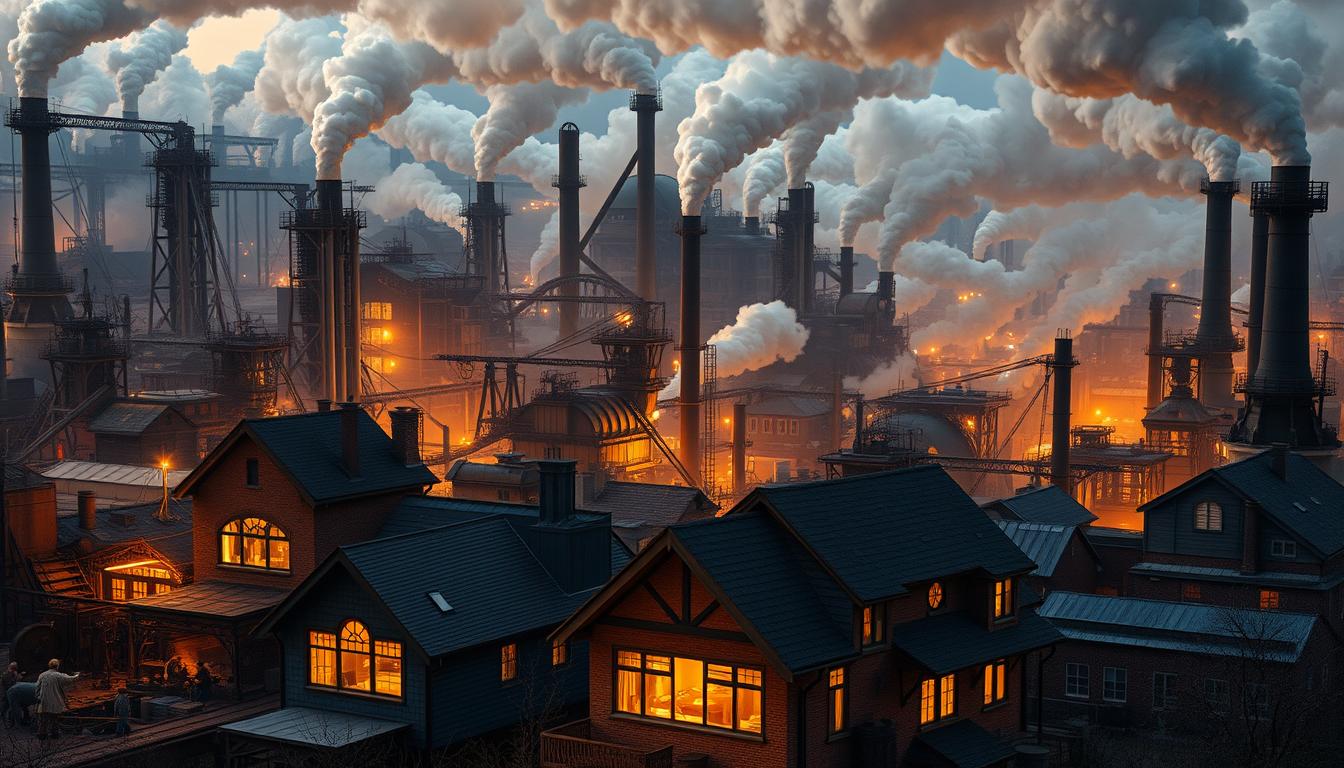
Imagine a world without machines. The Industrial Revolution changed society, starting in Britain around 1760. It brought technological advancements like steam engines and the spinning jenny. These innovations made work and daily life different.
These changes made products faster and cheaper. The term “Industrial Revolution” was coined by Arnold Toynbee. It shows the huge social transformation it caused.
Machines replaced hand tools, moving workers from farms to factories. Cities grew as people moved for jobs. Inventions like the telegraph connected distant places. This shift mirrors today’s tech-driven world.
From coal-powered factories to assembly lines, these changes sparked economic growth. But they also brought challenges like child labor and pollution. How did these machines shape our world?
This article explores the industrial revolution impact in modern life. It looks at the gadgets we use and the cities we inhabit.
Introduction to the Industrial Revolution
The Industrial Revolution origins started in 18th-century Britain. It marked a big change from farming to factory-based economies. By 1765, new inventions like the spinning jenny and water frame made cloth faster to produce.
This time, later called the Industrial Revolution by historian Arnold Toynbee, saw early factories become centers of mass production.
The steam engine impact was huge, moving from waterpower to coal-driven machines. James Watt’s improvements in the 1770s let factories work anywhere, increasing textile output. At the same time, mechanization history changed work: people moved from handcrafts to machine tasks.
By the 1800s, cities like Manchester grew fast as people moved from the countryside to factory jobs.
“The steam engine did more to change society than any political revolution.”
Britain’s lead set off changes worldwide. The U.S. followed, with textile mills leading its move from farms to manufacturing. The era’s problems, like child labor and long hours, showed the need for labor reforms.
This change didn’t just change how things were made. It also changed daily life, setting the stage for today’s industrial systems.
Changes in Production Methods
Manufacturing changed when home-based cottage industries moved to big factories. The factory system turned small workshops into huge mills powered by steam. In 1793, Samuel Slater’s mill in Pawtucket, Rhode Island, marked the start of mass production.
These factories made tasks like spinning cotton faster by using machines. 
“The division of labor soaks up time once spent on switching tools,” observed economist Adam Smith in 1776. This principle fueled industrial efficiency as machines took over repetitive tasks.
By the 1800s, British canals stretched over 2,000 miles. They carried coal and iron to power factories. Factories made textiles 10 times faster than hand looms, making things cheaper and more available.
But, there were downsides. Workers worked 14-hour shifts in dangerous places. Children as young as 7 worked on machines.
Production changes also changed landscapes. Manchester, England, grew from a small village to a big factory area. This shows how industrial changes affected both economies and environments. These changes led to modern manufacturing’s use of machines and debates about progress and human impact.
Urbanization and Population Growth
During the Industrial Revolution, rural to urban migration changed everything. Cities like Manchester grew from small towns to huge cities. By 1911, Manchester’s population jumped from 10,000 in 1717 to 2.3 million.
This growth showed how industrial cities development transformed places like Birmingham and New York. Factories drew workers, making these cities boom. In 1801, only 20% of Britons lived in big towns. But by 1901, 75% of the UK was urban, showing population shifts were unstoppable.
New York’s tenements were home to 2.3 million by 1900. Two-thirds of its residents lived in cramped spaces. Overcrowded industrial towns faced dire conditions.
Sanitation failures and pollution spread diseases like tuberculosis. Railroads helped cities like Scranton grow, attracting workers despite harsh realities.
“Many aspects of programming and development are about to be significantly deskilled, or perhaps bifurcated.”
Urbanization changed lives, not just cities. Families moved from farm life to factory work. Though overcrowded industrial towns offered jobs, they also trapped people in poverty.
By 1920, half of Americans lived in cities. This marked a global shift, seen today in cities like Tokyo. The move to cities brought both progress and danger, changing where and how people lived.
Transformation of Labor Practices
The Industrial Revolution introduced strict factory discipline. It replaced rural craft traditions with strict factory schedules. Workers faced endless routines in dangerous industrial workplace settings. Children as young as six worked on dangerous machinery, part of a dark working conditions history.

The labor transformation brought both chances and worker exploitation. Immigrants and children filled factories, earning just pennies. Philadelphia’s shoe industry turned skilled artisans into sweatshop workers. Carnegie’s steel mills demanded 16-hour shifts.
Ten thousand New Yorkers marched in 1882, demanding fair wages and hours, sparking a national movement.
Unions like the Knights of Labor fought back. The 1877 railroad strike and legal reforms slowly improved conditions. Though progress was slow, these efforts reshaped labor ethics. They showed that workers could demand better, even in tough times.
Social Changes in Daily Life
The industrial era changed how families lived. Cities grew, moving millions from rural areas. In Manchester, people married younger, with mining towns seeing marriages at 20 compared to 27 in the countryside.
Families moved from farms to factories, with kids as young as seven working. Wives sewed clothes by gaslight, while husbands worked in coal mines. They split their days between work and home.
The consumer goods revolution made things like clothes and kitchen tools cheaper. Factory workers bought clothes instead of making them. But, many families struggled with poverty, with New York tenements housing six to a cellar and earning just $4 a week.
There was a big gap between the rich and the poor. Factory owners built grand mansions, while workers rented damp rooms. Miners lived to be 19, while factory bosses made it to 44, showing the huge difference in life expectancy.
Daily life changed a lot, with people working longer hours. Girls worked 14 hours in candy factories. But, new inventions like sewing machines helped some families buy furniture or books.
By 1880, 80% of Britons lived in cities, their lives ruled by factory whistles. These changes led to labor reforms and the start of modern consumer culture. They showed how industrialization affected every part of life.
The Role of Transportation
The transportation revolution started with steam locomotion. It moved goods and people across vast networks. In 1825, the Erie Canal cut shipping costs to 1/12th of what they were before. This made Buffalo a key place for grain.
By 1860, U.S. railroads covered over 48,280 km. This led to a huge increase in freight from 1840 to 1860. Railways connected isolated areas, making them part of a larger market.

Railroads like the 1869 transcontinental line made traveling faster. They linked coasts and boosted market growth. Farmers in the Midwest sent crops to New York, and Chicago became a key rail hub.
Steam locomotion made daily commutes possible. This allowed suburbs to grow around cities. By 1929, freight volumes reached 450 billion tons, showing the power of mobility.
By 1850, costs dropped by 95%, making goods more affordable for families. The Baltimore and Ohio Railway introduced iron tracks in the 1830s, improving safety. The 1841 wheat surge through canals showed how infrastructure fueled industrial growth.
These networks didn’t just move cargo. They changed how societies worked. They turned distant places into neighbors, thanks to the relentless march of progress.
Education and the Industrial Workforce
The industrial education history reveals how factories changed learning. Early technical skills development became key as machines took over farm work. Schools taught reading for manuals, math for measurements, and discipline for factory life.
The 1840s saw Britain’s public schooling origins with laws for school attendance. This ensured a literate workforce.
Workforce training moved from apprenticeships to formal classes. By 1900, U.S. high schools grew, matching the Second Industrial Revolution. Literacy soared as states like Massachusetts funded schools, raising graduation rates from under 10% in 1900 to 50% by 1940.
“Modern education’s focus on early schooling may no longer fit today’s needs,” noted experts, linking it to 19th-century factory demands.
Germany’s technical institutes and America’s land-grant colleges showed technical skills development could create experts in steel, textiles, and medicine. These systems, born from industrial needs, continue to shape learning—showing education’s role in powering economies.
Impacts on Women’s Lives
Women during the industrial revolution faced harsh realities in factories and homes. Female factory workers in textiles worked on machines that needed precision, not strength, but they earned just pennies. Isabel Wilson’s story is a harsh reminder: she worked in coal mines, lost seven children, and suffered physical harm.
Laws like the 1842 Mines Act banned women from underground work. This changed changing gender roles by moving men into mines and women into factories or homes.

In Lowell, Massachusetts, over 30,000 women worked in textile mills by 1843. They earned wages that challenged traditional roles. Yet, they worked 80-hour weeks and earned little, sometimes losing half an hour’s pay for being 15 minutes late.
Domestic technology helped ease household chores, but working-class women had to balance factory work with home duties. The Lowell Female Labor Reform Association formed in 1844, demanding ten-hour workdays. But, legal barriers blocked progress until 1874.
Women’s labor history shows a mix: mills offered independence but trapped many in poverty. Some women chose careers over marriage, showing their determination. Domestic technology like sewing machines reduced handwork, but only the wealthy benefited.
By mid-century, the idea of “True Women” as homemakers clashed with their factory work. This highlighted the tension in women’s labor history. Their struggles paved the way for labor reforms, showing their strength in the face of industrial change.
Environmental Consequences
Coal consumption has changed ecosystems over time. Cities like London were once covered in thick “pea soup” fogs from factory smoke. By 1850, coal burning made respiratory illnesses common, affecting workers’ health.
Public health in industrial cities like Manchester and Birmingham was severely impacted. Contaminated water spread cholera outbreaks. Over 2.3 trillion tonnes of CO₂ have been released into the atmosphere, with CO₂ levels rising from 275 to 415 ppm by 2023.
Industrialization has also damaged landscapes worldwide. Timber harvesting and mining operations have stripped forests. Metal ore extraction has left toxic waste in rivers.
By 1850, miners had to dig deeper shafts, leading to frequent cave-ins. High chimneys may have dispersed smoke, but they couldn’t stop mercury and lead poisoning in factory towns.
Public health in industrial cities faced major crises. Liverpool’s 1832 cholera epidemic killed 1,500 residents. Overcrowded tenements lacked sanitation, with 16 people often sharing a single privy.
Studies like Dr. Duncan’s 1830s report showed 1/3 of Liverpool families lived in damp cellars. This worsened health outcomes. Modern climate data shows this era’s emissions have warmed Earth by 1.1°C, a legacy we feel today.
Though 19th-century workers endured harsh conditions, today’s innovations aim to reverse environmental harm. The history of coal-driven growth teaches us to balance human needs with the planet’s limits.
Legacy of the Industrial Revolution
The Industrial Revolution’s industrial revolution legacy shapes our lives in many ways. It built cities around factories and created global trade networks. Mechanized production started today’s tech industries, and urbanization patterns from then shape where we live.
Today, debates on labor rights and automation echo old conflicts. These include child labor in mills and the fight for an eight-hour workday.
Today’s technological revolution lessons remind us of the past. AI and automation are changing jobs and societies like steam engines did before. The mechanization consequences of the 1800s warn us about unchecked innovation.
Yet, the industrial age inheritance also brought progress. Mass production improved living standards, and labor movements fought for worker protections. Today, we see a shift from farms to factories, similar to the shift to gig economies and remote work.
From coal-powered factories to electric grids, past innovations led to today’s energy systems. As AI changes jobs and climate change worsens, history teaches us to balance progress with fairness. The Industrial Revolution’s story guides us in today’s tech world, showing the importance of every innovation’s promise and responsibility.