







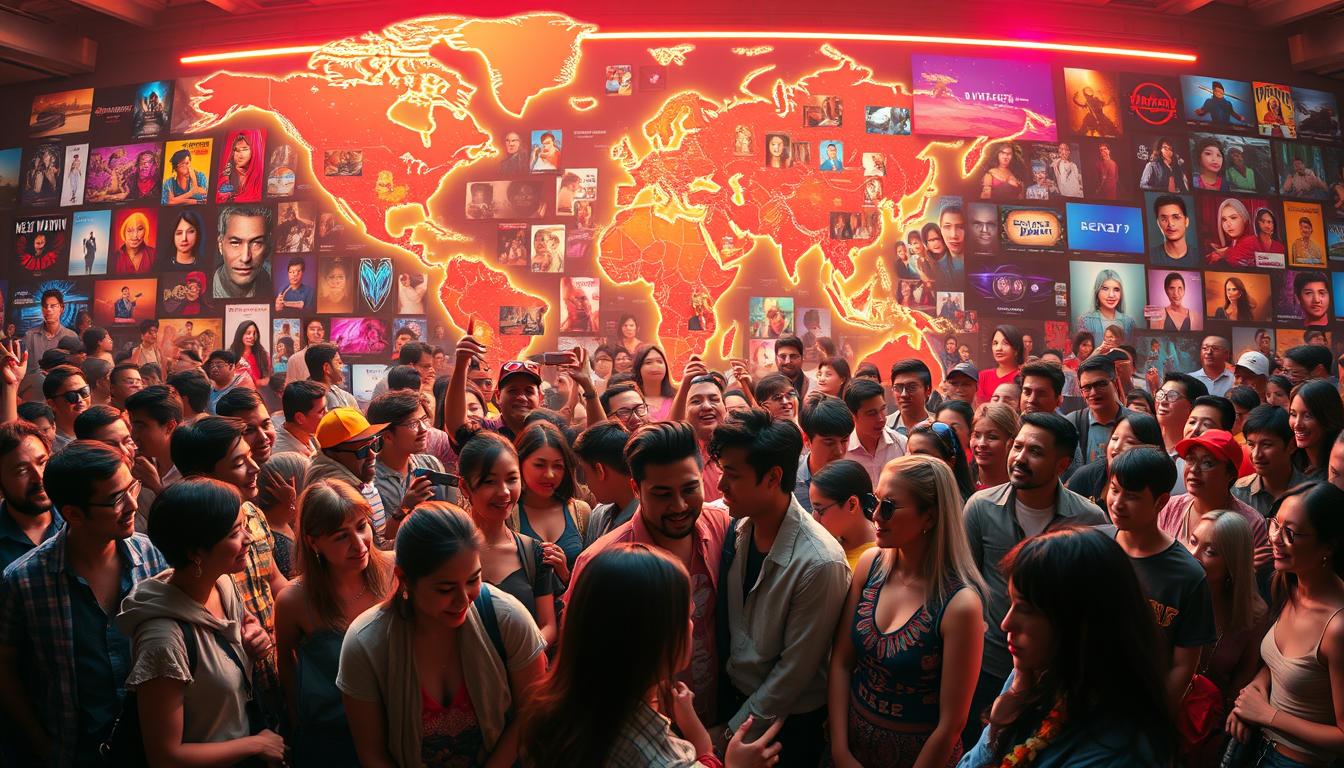
Pop culture is more than movies or music. It shapes how we connect worldwide. TikTok trends and K-pop hits like BTS’s 20 million albums in 2020 spread fast. YouTube, with over 1 billion monthly users, makes viral moments global.
This cultural exchange goes both ways. American brands like Nike and Levi’s influence global fashion. Gen Z discovers artists from around the world on TikTok.
The entertainment industry is expected to be worth $2.2 trillion by 2023. This shows pop culture’s big impact on economies and identities. From Hollywood hits to social media beauty standards, pop culture affects our daily lives.
It’s not just about trends. It’s a shared language that connects us, blending traditions and creating global communities.
Introduction to Pop Culture’s Worldwide Influence
Pop culture today is more than movies and music. It’s a powerful force shaping how billions connect worldwide. Global entertainment now links continents, making local trends into cultural phenomena. K-pop hits in Brazil and Hollywood movies in Mumbai show a world united by stories and styles.
Digital platforms like TikTok and Netflix have made international media a 24/7 hub of ideas. A 2022 study found 65% of viewers change their views on social issues after watching TV shows or films. This cross-pollination isn’t just fun—it’s cross-cultural understanding in action. When a South Korean dance trend goes viral in Argentina, it’s more than a hit song; it’s a moment where cultures meet and change each other.
Behind the trends are big economic forces. The global music industry’s $23 billion value in 2022 shows how tastes turn into dollars. Brands use this: 80% of consumers follow influencers, and 70% of Gen Z buy things based on social media trends. Yet, this connection also raises questions. While France protects its films, Hollywood takes 80% of global box office revenue. This mix of unity and uniqueness will shape pop culture’s future.
Movies: A Universal Language
International cinema has long been a bridge between cultures. Films like Black Panther and Crouching Tiger, Hidden Dragon show that stories can cross borders. They spark conversations about identity and humanity.
These films mix local traditions with universal themes. They invite global audiences to see the world in new ways.

Streaming platforms are changing the film industry. Services like Netflix and Amazon Prime make global movies easy to access. They let viewers from Ohio to Oslo explore foreign stories.
Blockbusters like Parasite or Roma win big awards. They show that subtitles don’t limit appeal; they expand it.
“May the Force be with you.”
Even phrases from English movies become global touchstones. They echo in classrooms and boardrooms worldwide. Films like The Handmaid’s Tale start discussions about rights. Spider-Man: Into the Spider-Verse celebrates diversity.
Film festivals like Cannes and Sundance amplify these stories. They turn local hits into worldwide phenomena.
As cross-cultural films grow, they challenge stereotypes. They highlight shared human struggles. The result? A richer, more inclusive global movie landscape where every story has a seat at the table.
Music: Uniting Diverse Audiences
Music has the amazing ability to connect people across borders and languages. The global music industry is all about cultural fusion. It mixes sounds from different traditions. Platforms like Spotify and Apple Music let listeners discover international artists from all over the world.
A 2023 study found that 68% of teachers in Newark, NJ, saw better focus in students who were in music programs. This shows how music can touch everyone.
Collaborations like Bad Bunny and J Balvin’s Latin trap songs or Blackpink’s K-pop hits with Western artists are big hits. These songs mix languages and rhythms, creating new sounds. Research from the University of Groningen found that upbeat music makes us recognize positive emotions better.
Historic movements, like the Civil Rights era’s freedom songs, used music to inspire change. Today, artists like Burna Boy (Nigeria) and Rosalía (Spain) mix traditional instruments with modern beats. They create sounds that reach people all over the world.
These artists are not just performers. They are ambassadors of their cultures. They turn stages into places of shared joy.
Television: Reflecting Cultural Narratives
Streaming services have made global TV shows cultural bridges. Platforms like Netflix and Disney+ change how stories are shared worldwide. Shows like South Korea’s Squid Game or Spain’s Money Heist show international television can reach far beyond their origins.
These series blend local traditions with universal themes. This makes cross-cultural programming a big part of today’s entertainment.

Streaming giants invest in local productions and make them global. For example, Netflix’s Bahar from Turkey or Elite from Spain mix regional stories with universal human struggles. This makes viewers in the U.S. curious about other cultures.
This shift challenges old norms. For instance, in 1980, only 8% of TV characters were Black. Now, shows like Emily in Paris or Never Have I Ever have diverse casts.
Binge-watching trends, with 70% of viewers preferring full-season releases, let audiences dive deep into other worlds. Shows like Germany’s Babylon Berlin or India’s Paatal Lok educate and entertain through historical or cultural contexts. This cross-cultural programming doesn’t just entertain—it invites viewers to see life through different lenses, breaking down old biases.
As streaming platforms grow, global TV shows will keep changing how we understand each other. From political dramas in Latin America to family sagas in Japan, screens now show a mosaic of human experiences. This proves stories have no borders.
Social Media: Amplifying Voices
From TikTok dances to Instagram campaigns, social media influence changes how we connect with culture worldwide. TikTok and Twitter make regular people into trendsetters. Hashtags like #BlackLivesMatter or #ClimateAction start big movements.
Over 731,200 posts under #racism and 473,300 under #equality show viral content’s power. It starts conversations that reach far and wide.
Today, global online communities thrive. People share stories, challenge norms, and push for change. The 55 Strong movement in West Virginia used social media to make educators’ voices heard. It shows digital cultural exchange is more than just trends—it’s a way to take action.
TikTok’s #NeurodivergentPride and #TransIsBeautiful hashtags show how voices once ignored get a chance to be heard.
“Digital tools let us restory narratives, turning personal struggles into collective power,” says researcher Dr. Amanda Carter.
But algorithms can also block us. Viral content spreads quickly, but filter bubbles can keep us isolated. Despite this, movements like #StopASAP or #SaveOurStreets show online activism works.
From petitions to protest guides, social media’s strength is in its wide reach. It can turn one voice into a global movement.
Fashion: Trends that Bind Us
Today, global fashion trends mix styles from around the world. Tokyo’s streetwear, Seoul’s minimalist looks, and Paris’s high fashion all blend together. Social media lets anyone become a trendsetter, making a simple video on TikTok go viral.
Platforms like Instagram and TikTok play a big role in international style influence. For example, Lil Nas X’s floral suit by Richard Quinn made the brand famous overnight. Hailey Bieber’s dress also caused a big spike in searches, showing how fast trends can spread.
Celebrities help make these trends even bigger. Hailey Bieber’s dress, for instance, saw a huge spike in searches. Even big brands like Balenciaga get in on the action, teaming up with Fortnite and seeing a big rise in demand.
The fashion cultural exchange works both ways. K-pop and anime are now big influences on high fashion. At the same time, old TV shows are making a comeback, with trends like puffy shoulders and neon colors.
Today’s worldwide style movements are all about nostalgia and fast trends. Disney and streetwear collaborations, along with pixelated accessories, show how fashion can turn childhood memories into trends. Trends like astrology jewelry or sci-fi watches are becoming popular, mixing personal style with global culture.
With 2023 seeing a huge spike in Balenciaga searches during Paris Fashion Week, it’s clear that fashion is changing. It’s now made by everyone, everywhere.
Literature: Stories Without Borders
International literature has long been a bridge connecting global audiences. Recent trends in the global book market show a growing interest in translated fiction. A BBC Culture poll found classics like Homer’s Odyssey and Chinua Achebe’s Things Fall Apart to be highly influential. These works share diverse histories and perspectives, bridging cultures.
Thanks to digital platforms and e-readers, translated fiction now reaches more people. But, challenges remain. In the U.S., only 3% of books are translations, unlike France’s 30%. Publishers like Hachette International face cultural barriers in sharing international stories. Scholars like David Damrosch emphasize the need for translations that are both faithful and easy to read.
“National literature is a somewhat meaningless term,” Goethe said in 1827, envisioning a world where literature knows no borders.
Today, debates rage over whether translations capture the essence of the original. Critics say 59% of global translations come from English, threatening smaller languages. Yet, works like Gabriel García Márquez’s magical realism and Khaled Hosseini’s The Kite Runner show the power of cross-cultural storytelling. As readers seek more diverse voices, the global book market slowly moves toward inclusivity.
Art: Bridging Cultural Divides
Art has always been a bridge between cultures, connecting the international art scene through shared creativity. Today, global art movements grow by mixing different styles. Artists like Jason Noushin blend Persian designs with Western pop culture. His work, inspired by migration, challenges stereotypes.

Digital art platforms have opened doors for creators like Hayv Kahraman. She shares her family’s Iraqi story through her paintings. Online shows and NFTs on sites like SuperRare let her work reach people worldwide. “Art speaks where words fail,” said Ronald Carter, showing its power to cross language barriers.
Art is a universal language that connects hearts across borders.
Artists like Kourosh Sotoudeh and Azin Valy use their cultural roots to innovate. Even artists like Maryam Palizgam, who breaks through heritage stereotypes, add to the international art scene. By using digital tools and global platforms, today’s artists share cultural stories freely. This creates a vibrant tapestry where every piece is a dialogue—uniting, not dividing.
Gaming: A New Frontier of Connectivity
The global gaming industry has grown to include over 3 billion players worldwide. Games like Fortnite and Apex Legends connect players from Seoul to São Paulo. They turn virtual battles into cross-cultural collaborations.
These shared experiences create bonds that go beyond screens. Gaming communities are among the most interconnected in pop culture.
Cross-cultural video games now blend traditions into their worlds. Titles like Assassin’s Creed explore historical sites and folklore. Mobile hits like Genshin Impact mix mythologies from East Asia and Europe.
International esports events, such as the Fortnite World Cup, draw millions of viewers. They show competitive gaming’s mass appeal.
Gaming communities thrive on platforms like Discord and Twitch. Players share tips and stories there. Even with language barriers, games like Among Us use visual cues and teamwork to connect strangers.
Authenticity drives choices too: 80% of TikTok gamers prioritize creators who share honest opinions. This shapes trends and purchases.
The industry’s growth—projected to hit $384 billion in 2023—shows its role as a cultural bridge. Mobile gaming, with 2.2 billion players, ensures accessibility. VR and AR tech promise even richer immersive experiences.
As gaming evolves, it’s not just a pastime—it’s a global conversation.
Sports: A Shared Global Passion
Sports bring people together like nothing else. The global sports influence crosses borders, with events like the Olympics and World Cup reaching billions. These international competitions make fans cheer together, even when they disagree politically.
Take the 2018 FIFA World Cup, for example. Mexican and South Korean fans celebrated a historic win together. This was a powerful symbol of sports cultural exchange.

Legendary athletes like Cristiano Ronaldo and Serena Williams have a big impact. Their careers inspire fans all over the world, mixing sports with cultural stories. Even moments like the 1971 Ping Pong Diplomacy between the U.S. and China show sports can ease tensions.
Today, athletes speak out on social issues, starting global conversations. They use their platforms to make a difference.
Sports go beyond the stadium today. Social media connects fans instantly, and leagues like the NBA and Premier League draw viewers worldwide. But sports also face challenges, like sportswashing, where events hide controversies.
Despite this, 75% of fans believe sports bring us together. As the $620 billion industry grows, sports continue to weave our shared human story.
The Future of Pop Culture in a Globalized World
Virtual reality concerts and interactive films are changing future entertainment trends. Imagine watching a global cultural fusion performance. It could mix K-pop’s energy with traditional Indian dance, all through a VR headset. Platforms like Netflix and TikTok already connect billions, but the next wave of digital entertainment evolution promises even deeper immersion.
Technology like AI and the metaverse will let audiences explore stories from diverse perspectives. Yet, the challenge remains balancing cultural authenticity with mass appeal. K-pop’s $5 billion global market shows how niche art forms can gain worldwide fans without losing their roots. Netflix’s localization efforts prove that adapting content to regional tastes drives engagement—like its hit series Squid Game, which became a global sensation while reflecting Korean culture.
As streaming giants and startups invest in cross-cultural collaborations, the line between local and global blurs. Fans now expect stories that honor traditions while embracing innovation. The digital entertainment evolution isn’t just about tech—it’s about creating spaces where every culture can thrive and connect. The future of pop culture isn’t a single trend but a mosaic of voices, united by technology yet rooted in heritage.
Conclusion: Embracing Our Shared Experiences
Pop culture connects us through shared moments. K-pop fans and Hollywood moviegoers alike feel a bond. Apple Music and Amazon Prime make local trends global, bringing cultures closer.
When we talk about new movies or dance to hits, we join a global chat. This shows pop culture’s strength in uniting us.
Studies show pop culture’s big impact. Over 150 U.S. colleges now teach Korean. KAACHI’s 10 million YouTube views show niche genres can unite us.
Music, films, and fashion teach us about different cultures. Exploring beyond our local scenes enriches our appreciation for diversity.
As pop culture grows, so does our duty. We must celebrate diversity and avoid cultural mistakes. The next generation can learn about traditions through TikTok and streaming.
By embracing these shared moments, we build bridges, not walls. Every playlist or movie night can bring us closer together.