




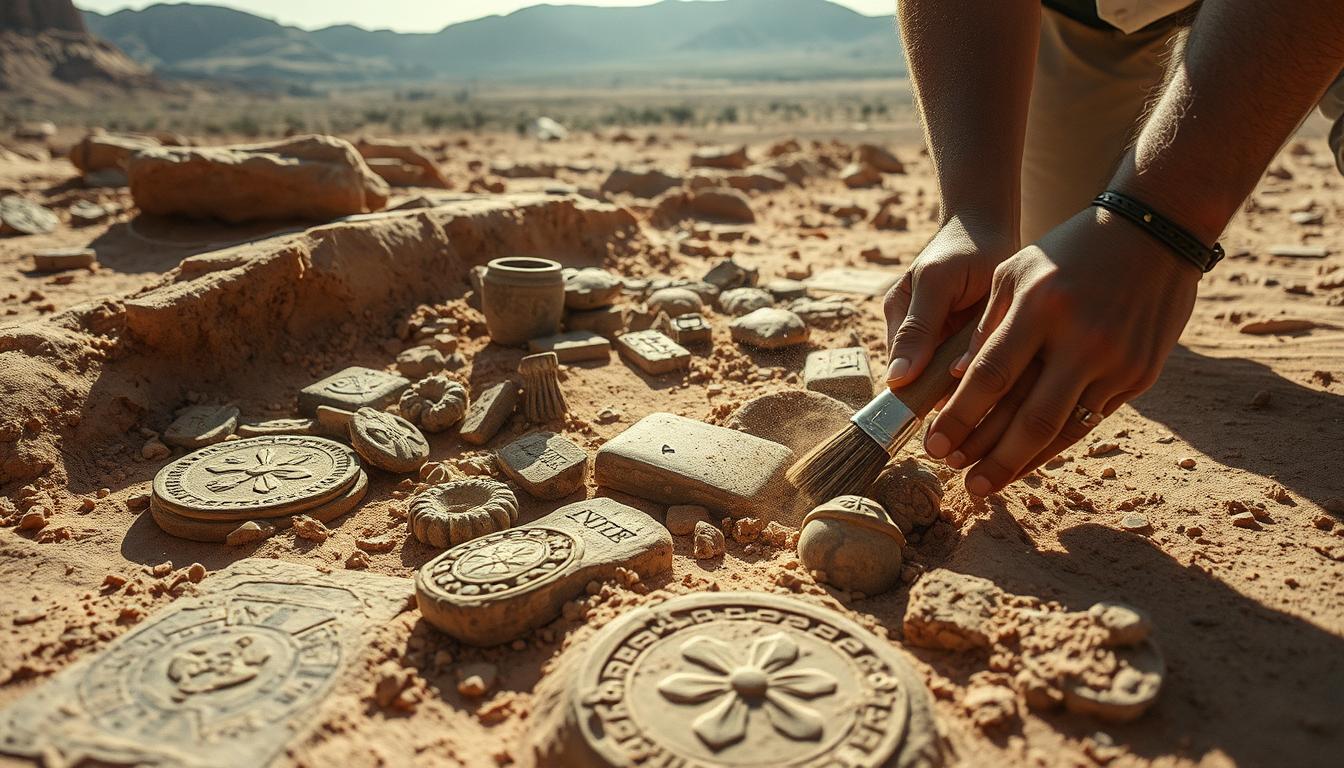
The world of archaeology is full of surprises. Every year, new finds rewrite history. Imagine finding a 2,200-year-old Rosetta Stone or a 3,000-year-old gold mask from Sanxingdui.
These discoveries show us lost languages, forgotten technologies, and ancient ingenuity. They challenge what we thought we knew.
Recent finds like a 16th-century pendant linked to Henry VIII or 2,000-year-old musical instruments in Vietnam are changing history. These artifacts connect us to the past.
Each find, like the £3 million Anglo-Saxon treasure or 1.9-million-year-old fossils, adds to humanity’s story. Every shovelful of dirt could redefine our shared heritage.
The Rosetta Stone: Unlocking Ancient Egyptian Secrets
In 1799, French soldiers found the Rosetta Stone near the Nile Delta during Napoleon’s Egyptian campaign. This black basalt slab had a 196 BCE decree in three scripts: Egyptian hieroglyphics, demotic, and ancient Greek. It was a key for understanding Egyptian archaeology and language.
Scholars like Thomas Young and Jean-François Champollion worked hard to crack the hieroglyphs. They used the Greek text to help them. Champollion made a big breakthrough in 1822, showing that hieroglyphs stood for sounds and ideas. This opened up ancient Egyptian language, turning temple inscriptions into history we can read.
By linking Greek names to hieroglyphic cartouches, Champollion showed hieroglyphs were a full writing system. They weren’t just for religious use.
Now, the Rosetta Stone is at the British Museum, inspiring new discoveries. It helped us understand pharaonic decrees, religious texts, and administrative records. This has changed how we see Egyptian governance and spirituality. Today, researchers keep using its secrets to improve translations, like the Canopus decree. This 2,100-year-old artifact is a treasure for archaeology.
Machu Picchu: The Lost City of the Incas
Machu Picchu is a wonder of the Inca civilization, hidden in the Andes. Hiram Bingham found it in 1911, looking for Vilcabamba’s lost capital. This ancient mountain city was untouched by the Spanish, keeping its stone buildings intact.
At 2,400 meters high, the city’s foundations are 60% underground. They show off the Inca’s smart drainage and earthquake-proof designs.
Peruvian archaeology is always finding new secrets at Machu Picchu. In 1999, three mummified children were found in caves nearby. They give us hints about the Capacocha ceremony.
The site’s terraces and alignment with the stars show its importance. It was a center for both religion and politics. Though its exact purpose is debated, its stonework is a testament to the Inca’s skill.
Today, Machu Picchu attracts millions. It’s a UNESCO World Heritage Site and one of the New Seven Wonders of the World.
The Terracotta Army: China’s Silent Guardians
In 1974, farmers near Xi’an stumbled upon an incredible discovery: the terracotta warriors. These 8,000 life-sized clay soldiers, horses, and chariots were buried for over 2,000 years. They guard the tomb of Emperor Qin Shi Huang, China’s first emperor. The Chinese imperial tombs show a ruler’s obsession with lasting power, even after death.
Each terracotta warrior has its own face, armor, and pose. This shows the Qin Dynasty’s skill in art. They were made in sections but finished by hand, mirroring the ancient Chinese army.
Found with the figures are bronze weapons, some sharp today. This shows the advanced skills in metallurgy. Pigment traces suggest they were once colorful.
“These soldiers aren’t just relics—they’re a portrait of a civilization’s ambition.”
Underneath lies more than just warriors. The Chinese archaeology team believes the emperor’s mausoleum is huge, covering 56 km². It has unexcavated pits with chariots, musicians, and acrobats. Ancient texts describe a world below with rivers of mercury and a gemstone ceiling.
Over 700,000 workers spent years building this legacy. It shows Qin’s total control.
Today, only 10% of the site is open to us. The emperor’s burial chamber remains a mystery. As Chinese archaeology advances, these silent guardians continue to change our view of the Qin Dynasty’s power and innovation.
Göbekli Tepe: The World’s Oldest Temple

Göbekli Tepe in southeastern Turkey was hidden for thousands of years. It changed Neolithic archaeology forever. Built over 11,000 years ago, it’s older than Stonehenge by 6,000 years.
The site has massive T-shaped pillars, some reaching 16 feet tall. They show carvings of foxes, snakes, and abstract symbols. This hints at a complex prehistoric religion.
These monuments were made by hunter-gatherers. This discovery challenges the idea that farming came before settling in one place.
Excavations show circular structures, like Building D’s 12 pillars in a ring. Over 100,000 animal bones, mostly gazelle, were found. This suggests huge gatherings.
But only 5% of the site is uncovered. Most of its secrets are hidden. The early human settlements nearby suggest a shift in society. Rituals might have led to settling, not farming.
“This site turns history upside down,” said archaeologist Klaus Schmidt, who led digs until his death in 2014.
Carbon dating shows Göbekli Tepe was built by nomadic groups. This challenges old ideas about ancient stone structures. The pillars’ artistry and scale show organized labor, long before cities.
UNESCO protects the site now. Turkey’s Ministry of Culture funds ongoing preservation. Nearby Karahan Tepe, a related site, may hold more clues about this era’s spiritual practices.
Tutankhamun’s Tomb: A Treasure Trove of History
In 1922, British archaeologist Howard Carter found the King Tut discovery. He uncovered a nearly untouched ancient Egyptian tomb in the Valley of the Kings. After a decade-long Howard Carter excavation, the tomb revealed over 5,400 artifacts.
These included gold masks, chariots, and linen garments. They preserved Egyptian burial treasures for millennia.
Inside tomb KV62, the pharaoh’s 22-pound gold mask and 143 jewelry pieces amazed the world. Carter’s team took 1,400 photos. They showed details like 200-threads-per-inch linen under Tut’s mummy wrappings.
Despite myths of a “curse,” most of the 26 on-site workers lived past the excavation’s 10-year span.
“This discovery rewrites our understanding of royal family links,” said Egyptologist Zahi Hawass. Recent finds near the tomb—including Queen Neith, a previously unknown wife of Pharaoh Teti—add new layers to dynasty histories.
Scientific analysis showed Tut suffered malaria and bone defects, dying at 19. His short reign contrasts with the tomb’s grandeur. It showcases New Kingdom artistry.
Modern scans found wine residue in 30 jars and 46 bows among the Egyptian burial treasures. The Howard Carter excavation changed archaeology from treasure hunting to scientific study. It sparked global “Egyptomania” in fashion and film.
Today, Tut’s legacy lives on. His artifacts, like a 296-pound gold coffin, attract millions to museums. A century later, the King Tut discovery continues to unlock ancient Egypt’s secrets.
The Dead Sea Scrolls: Ancient Manuscripts Rediscovered
For over two millennia, the Dead Sea Scrolls lay hidden in the Qumran caves. In 1947, Bedouin shepherds found clay jars with ancient Hebrew texts and biblical manuscripts. These finds changed our view of Jewish history.
The scrolls, preserved in the desert, are the oldest known Hebrew Bible copies. They are a thousand years older than previous versions.
More than 900 original manuscripts were found in 11 caves. These include the War Scroll and Isaiah Scroll. Fragments show how scribes copied texts with great care, ensuring their accuracy over time.
The scrolls also reveal writings from a secret community, possibly the Essenes. They lived near the caves.

Today, technology helps preserve these ancient texts. Digital imaging and multispectral photography reveal damaged parts. The Israel Antiquities Authority keeps over 15,000 pieces safe.
In 2011, Google helped digitize key scrolls. This made them available worldwide. Recent digs near the caves found a 10,500-year-old basket and a 6,000-year-old child’s skeleton. These discoveries show how ancient people preserved religious documents.
These finds highlight the durability of parchment and ink. They teach us about ancient faiths. From apocalyptic prophecies to legal codes, the scrolls help us understand Second Temple Judaism and early Christianity.
Each fragment is a window into the past. It shows how words survived for millennia, waiting to be heard again.
Stonehenge: Mysteries of the Megaliths
Stonehenge is a famous Neolithic structure in ancient British history. Recent scans near Durrington Walls found 90 buried stones in a C-shape. This shows the area was a dynamic ritual landscape, not just one site.
Rituals here might have marked life’s journey, from birth to death. They linked prehistoric monuments into a vast ceremonial network.
Stonehenge’s astronomical alignments are clear. Its heel stone frames the summer solstice sunrise. The winter solstice sunset lines up with the altar.
The bluestones, from Wales’ Preseli Hills, were moved 180 miles without metal tools. The altar stone, weighing 6.6 tons, came from over 500 miles away. This shows Neolithic builders moved stones across vast distances.
Excavations found grooved ware pottery, showing long-distance trade networks. These findings change how we see Stonehenge. It was part of a continent-wide cultural exchange.
Megaliths spread across Europe, but none match Stonehenge’s mystery. Each stone tells of a society mapping time and cosmos with precision.
The Lost City of Pompeii: Time Frozen in Ash
The Mount Vesuvius eruption in 79 AD buried Pompeii under volcanic ash. This created a volcanic preservation of Roman daily life. Over 1,100 casts of victims, from a dog to a mother with her child, show the tragedy’s human toll.
The city’s ancient urban planning is clear in its grid streets and underground sewage systems. Thermopoliums—fast-food stalls with duck-decorated counters—hint at bustling markets.

Modern archaeological excavation techniques now use 3D scans and DNA analysis. These methods help map unexplored zones. Recent finds, like a 2020 discovery of a tavern with duck frescoes, reveal food storage methods and wine jars.
Graffiti in red paint shows political slogans and tavern reviews. This gives voice to commoners often ignored in history books.
Despite two-thirds of the site buried, challenges like weather and tourism threaten exposed areas. Yet, every discovery—whether a preserved loaf of bread or a frescoed Priapus—continues to rewrite our understanding of life in 79 AD. Over 98% of residents were non-elite, their stories now emerging through artifacts like bronze coins and carbonized walnuts.
Viking Settlements: Evidence of North America’s First Explorers
In 1960, Norwegian explorers Helge and Anne Stine Ingstad found proof that Norse exploration reached North America before Columbus. They discovered an 11th-century Viking camp at L’Anse aux Meadows in Newfoundland. This changed early American history forever. Today, this site is a UNESCO World Heritage Site, marking the earliest known European settlement in the Americas.
“We built houses and spent a winter there,” noted Viking sagas, matching clues found in Newfoundland.
Excavations showed eight turf-and-wood buildings where Vikings made tools and fixed ships. They found a bronze pin and jasper tools, linking to Norse origins. The Viking archaeology at the site shows they used it as a base for exploring “Vinland,” a name fitting Newfoundland’s geography. Tree-ring dating in 2021 confirmed the settlement was in 1021 CE, matching Norse records.
Though their stay was brief, L’Anse aux Meadows proves pre-Columbian contact happened before 1492. Today, visitors can see reconstructed huts and imagine the Vikings’ journey. This discovery challenges old stories, showing Norse sailors were among the first to cross the Atlantic. Their legacy changes how we see who first explored these shores.
Ötzi the Iceman: Insights into Prehistoric Life
Ötzi, found in 1991 in the Ötztal Alps, is a 5,300-year-old discovery that changed alpine archaeology. He had a copper axe, the oldest complete tool found. His gear showed us a lot about prehistoric humans and their Neolithic lifestyle.
His clothes and backpack frame told us how they survived in tough places.

Ötzi’s tools, like a flint dagger and a yew wood bow, highlight copper age technology. Forensic tests showed he died from an arrow and had Lyme disease. His 61 tattoos near injuries suggest early ancient forensics for pain relief.
Studies also found heart disease and lactose intolerance in him. This links him to modern health issues.
Ötzi is kept at -21.2°F in Italy’s South Tyrol Museum. Over 800 researchers have studied him. They found out he ate ibex meat and einkorn wheat before he died.
With 2,140 papers, Ötzi is rewriting history. He shows that Neolithic communities were more advanced than we thought.
Angkor Wat: A Testament to Khmer Civilization
Angkor Wat is the heart of Cambodia’s ancient temple architecture. It stands as a monumental achievement of the Khmer Empire. Built in the 12th century, it covers 400 acres and was once home to a population as large as medieval Europe’s biggest cities.
Its towering spires and detailed carvings show the Khmer Empire’s skill in both religion and engineering.
Modern Cambodian archaeology has uncovered secrets hidden for centuries. Lidar scans revealed Angkor’s true size: a 400-square-mile urban network with canals, reservoirs, and over 1,000 structures. This shows the Khmer Empire engineered sophisticated water systems to support a population of 750,000.
The West Baray reservoir, spanning 8km, and the canals controlled floods and irrigation. This proves the Khmer’s advanced urban planning.
Construction used sandstone quarried 25 miles away, floated down rivers via canals. Over 5 million tons of stone were moved—a feat rivaling Egypt’s pyramids. Bas-reliefs stretching half a mile depict battles, ceremonies, and daily life, giving insights into Southeast Asian history.
The temple’s alignment with Mount Meru myths highlights its spiritual significance. It blends Hindu and later Buddhist beliefs.
Today, Angkor Wat draws nearly a million visitors yearly. UNESCO recognized its value in 1992, later removing it from the “in danger” list after restoration efforts. As a pilgrimage site and cultural icon, it remains a window into the Khmer Empire’s ingenuity, proving Southeast Asian history’s richness.
The Nazca Lines: Giant Geoglyphs of Peru
The Nazca Lines are a mystery in archaeology, found in Peru’s dry plateau. They were made by the Nazca people over 2,000 years ago. These designs, showing animals, plants, and shapes, were carved into the desert.
They cover almost 190 square miles. Their size and detail show a deep connection to the sky and farming. Early researchers like Maria Reiche thought they were linked to the stars. Today, aerial views reveal more secrets every day.
Recently, AI and drones found 303 new figures, almost doubling the known sites. These tools scan huge areas quickly, unlike old methods. Teams like Yamagata University and IBM have made these finds.
These designs changed over time, with new ones added to old ones. Some figures are as long as the Empire State Building. Yet, details as small as 3 meters wide need careful study.
But, the Nazca Lines are at risk from people and machines. Squatters and equipment have harmed parts of the site. This shows we need to protect them.
Despite this, the Nazca Lines show human creativity. Their true purpose is a topic of debate. As we use new tools and old methods, we learn more about the Nazca people.
The lines show that even in dry places, ancient cultures left lasting marks. They invite us to keep exploring their secrets.