





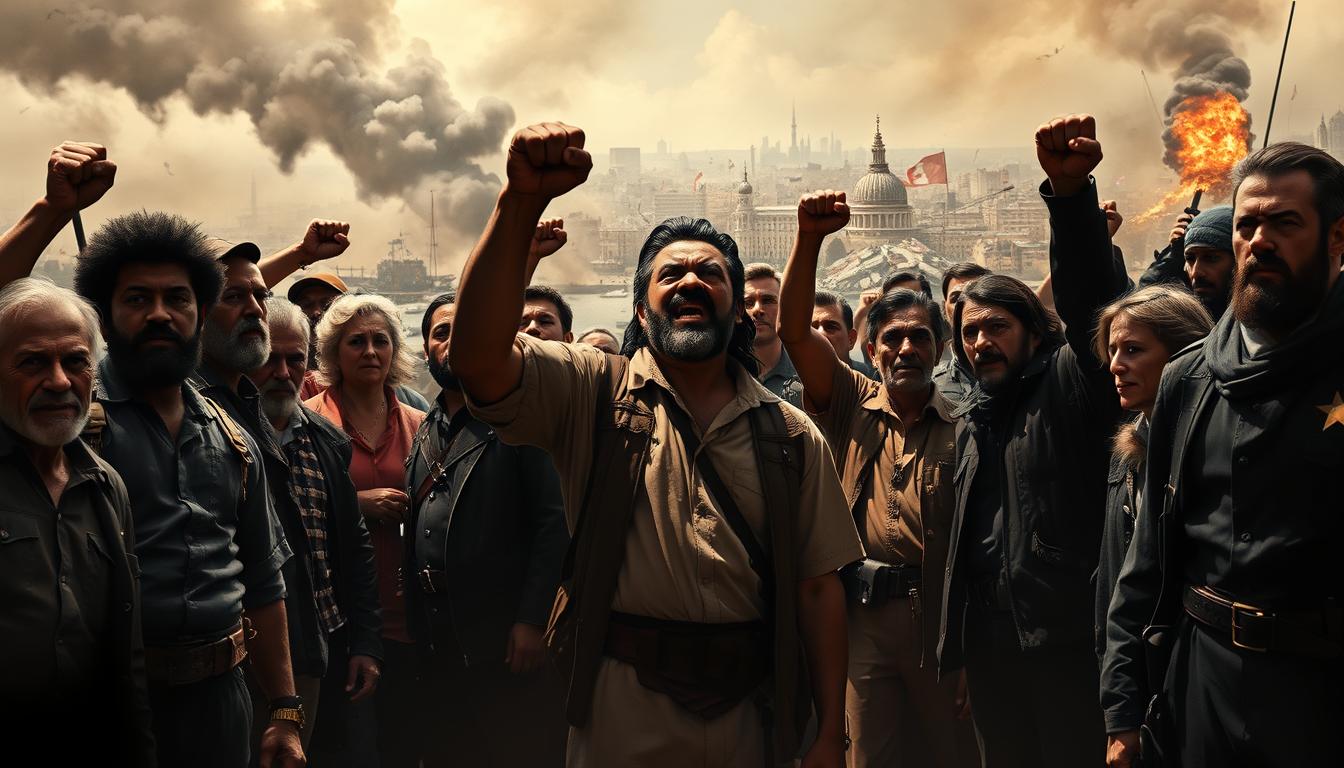
Historical figures like those who stormed the Bastille in 1789 or Greek rebels against Ottoman rule from 1821–1829 show courage can change the world. They turned desperation into defiance, starting revolutions that changed what freedom means. Their stories show how people can become leaders when they stand up against injustice.
The French Revolution’s streets and 20th-century fights for equality show how societies can change. The storming of the Bastille symbolized people’s power, while Greek independence struggles showed victories against huge odds. These movements teach us that every uprising starts with a call for justice.
Today, their impact is seen in protests and reforms. The spirit of the French Revolution or the Bolsheviks inspires today’s activists. This article looks at how historical figures and modern activists show that change starts with people refusing to accept the current state of things.
The Definition of a Revolutionary
Understanding what makes someone a revolutionary involves key traits: vision, courage, and a desire to change societies. Change agents like Fidel Castro and Thomas Müntzer are examples. They use their revolutionary mindset to challenge oppressive systems.
Unlike simple rebels, true revolutionaries have a clear goal and a plan to achieve it. They are not just about causing trouble; they aim to bring about real change.
Historical figures show that true revolutionaries defy authority and are ready to risk everything. People like Ruhollah Khomeini and Rosa Parks show how personal conviction can lead to big changes. Their stories show that often, revolutionaries come from groups that are overlooked or mistreated.
Studies today show that nonviolent change agents are more likely to succeed than those who use violence. Erica Chenoweth’s research found that campaigns with over 3.5 million participants were successful 53% of the time. This is compared to 26% for armed struggles. This supports the idea that a revolutionary mindset focuses on getting people involved, not just using force.
Political dissidents often face huge risks, like those in the 1989 Velvet Revolution. Yet, their actions can change the way power works. Whether through speeches, protests, or writings, their impact can change a nation. For example, the Cuban Revolution’s 26th of July Movement combined ideology with grassroots support to overthrow Batista’s regime.
Key Figures in History
Figures like Spartacus symbolize defiance. This Thracian gladiator led 120,000 slaves against Rome. His 73 BCE uprising used kitchen tools, showing even the oppressed can challenge empires. He remains a rebellion leader who showed Rome’s weaknesses.
The Gracchi brothers, Tiberius and Gaius, fought for land reforms in Rome. Their efforts sparked decades of turmoil. In China, Wang Mang briefly ruled as a political revolutionary after overthrowing the Han Dynasty. These early revolutionary heroes show how one person can change a society.
In modern times, figures like Toussaint Louverture united Haitian slaves against Napoleon. Simon Bolivar, known as “The Liberator,” freed South America from Spain. Sun Yat-sen’s 1911 revolution ended China’s imperial rule. Their stories show courage and strategy can change history.
Women Who Changed the Course of History
Women like the Trung Sisters fought against Chinese rule in 40 CE. Boudica, a Celtic leader, rallied 100,000 warriors against the Romans. Zenobia, queen of Palmyra, expanded her empire, defying Rome.
These women showed that women in revolutions can change power structures. Their stories inspire future generations.
Despite facing challenges, these women freedom fighters found ways to fight back. Rani Lakshmibai of Jhansi led battles against the British. Comandanta Ramona organized resistance in Mexico, blending tradition with activism.
They focused on community needs, combining social reforms with political goals. Their stories show the lasting impact of their leadership, from Vietnam to Palmyra.
The Impact of the French Revolution
In revolutionary France, the storming of the Bastille in 1789 sparked a global political revolution. This event reshaped society, ending feudal privileges and spreading ideas like liberty, equality, and fraternity. By 1789, France’s population of 28 million faced stark class divides.
The Estates-General, absent for 175 years, became a catalyst for change when the Third Estate demanded reform. 
The revolution’s core ideas, etched into the Declaration of the Rights of Man, challenged monarchical rule and inspired movements worldwide. “Liberty, equality, fraternity” became a rallying cry. Yet, the Reign of Terror later revealed the dark side of political revolution effects.
Over 17,000 executions underscored the cost of radical change.
Revolutionary France’s reach extended beyond its borders. The Napoleonic Code abolished feudalism in conquered regions like the Rhineland, spreading legal reforms. Belgium’s industrial growth under French rule laid foundations for later economic dominance.
Latin American leaders like Simón Bolívar drew inspiration from revolutionary principles to fight colonial rule.
Though marked by violence, the French Revolution’s legacy endures. It dismantled feudalism, promoted merit over birthright, and reshaped Europe’s political map. From constitutional monarchies to nationalist movements, the revolution’s echoes are felt in modern democracies.
Its ideals, though flawed in practice, remain a cornerstone of global human rights discourse.
The Role of Social Media in Modern Uprisings
In 2011, Asmaa Mahfouz’s viral video sparked Egypt’s uprising. Twitter and Facebook became key for online revolutionary movements. But, these tools now face criticism for enabling technological resistance against activists.
Social media activism made voices louder, but it also showed weaknesses. During the 2021 Capitol attack, platforms failed to stop extremist recruitment. This mirrors how Arab regimes used algorithms to silence dissent.
Over 40 civil organizations have criticized Big Tech for silencing movements. They point out cases where Meta shared user data, leading to arrests of activists.
Cybersecurity flaws and corporate policies now threaten the very freedoms these platforms claimed to protect.
In Tunisia, Microsoft teamed up with repressive regimes in 2011. By 2020, platforms removed hundreds of accounts linked to disinformation. Yet, critics say these efforts are not enough.
The 2019 Tunisian elections saw unclear political ads due to missing Facebook Ads Library. This deepened distrust. Also, 99% of sex workers reported worse safety after FOSTA-SESTA.
Social media has a double role: it empowers social media activism but can also be used to oppress. Finding a balance between innovation and accountability is key to keeping digital organizing powerful.
Revolutionary Leaders Across Continents
Global revolutionaries like Queen Nzinga of Ndongo and Gabriela Silang changed societies. Nzinga, ruling in the 1600s, fought Portuguese colonialism with Dutch help. Silang, after her husband’s death in 1763, led a revolt against Spain, showing women’s key roles.

In Asia, leaders like Mahatma Gandhi and Ho Chi Minh mixed local traditions with global ideas. Gandhi’s satyagraha nonviolence helped India gain independence. Ho Chi Minh, influenced by Marxism, fought French rule, becoming a symbol of resistance.
Africa saw Queen Nzinga’s long resistance and Kwame Nkrumah’s push for Ghana’s 1957 independence. Nelson Mandela ended apartheid, showing how movements adapted to local needs. Mandela once said, “To be free is not merely to cast off one’s chains,” capturing their fight for lasting change.
In Latin America, Simón Bolívar united South American nations against Spain. Emiliano Zapata’s Plan de Ayala demanded land reforms. Fidel Castro’s Cuban Revolution brought social justice and political change together.
“Be the change you wish to see in the world.”
These leaders show that revolutions are about both universal ideals and local struggles. From Vietnam’s Ho Chi Minh to India’s Gandhi, their stories highlight how movements shaped modern nations.
The Influence of Literature on Revolutions
Revolutionary literature has long been a spark for change. Works like Thomas Paine’s *Common Sense* and Frantz Fanon’s *The Wretched of the Earth* laid out plans for action. Influential manifestos, such as *The Communist Manifesto*, also challenged the status quo.
Revolutionary writers like José Martí and Václav Havel combined art and activism. They used their words to inspire and guide movements.
“The first duty of a writer is to write well, but the first duty of a revolutionary writer is to fight well,” stated José Martí, embodying the link between words and action.
Before revolutions, literature played a key role. Some texts sparked change, while others failed. In Egypt, for example, pre-revolution writings were often complaints that led to little action.
But in places like Russia before the October Revolution, determined writings ignited change. During times of war, like the Russian Civil War, literature took a backseat as survival became the main focus.
After revolutions, literature took two paths. In Soviet Russia, writers mourned the old and celebrated the new. In China, the lack of literature suggests unfinished goals. Yet, anti-colonial writers like Ngũgĩ wa Thiong’o used stories to reclaim cultural identity, showing the power of words in rebuilding.
Even when revolutions focus on action, their stories live on through books. From protest songs to secret pamphlets, writers ensured ideas survived regimes. These works remind us that words can endure even in the most chaotic times.
Economic Factors Behind Revolutions
Economic causes of revolution often come from wealth inequality revolution and economic injustice. When people face high prices, job loss, or land taking, they revolt. The 1789 French Revolution started with bread shortages and heavy taxes on peasants.
Kings spent a lot while the Third Estate struggled to survive. This is a clear example of class conflict. In Saint Domingue, enslaved workers fought against planters who owned 90% of the colony’s wealth. This led to the Haitian Revolution.

Today, we see similar patterns. Tunisia’s 2010 uprising began when Mohamed Bouazizi set himself on fire over unfair taxes. His act showed economic injustice in a country where 15% lived in poverty by 2020. Nearby, Syria’s 2011 protests started when police arrested teens for selling snacks without a permit.
This shows how small economic issues can spark big anger.
“Bread, freedom, and social justice” became Arab Spring protesters’ rallying cries, proving economic demands drive revolutions as much as political ones.
Even after successful revolutions, fixing revolutionary economic conditions is hard. Post-revolution governments often face inflation, corruption, or new inequalities. Yet, history shows that when economic gaps grow too wide, people revolt.
They do this to overthrow kings, slaveholders, or corrupt regimes. The cycle continues, showing that class conflict is a timeless driver of change.
The Legacy of Revolutionaries
How we remember revolutionaries impacts their revolutionary legacy. Monuments, holidays, and school lessons create our historical memory of these movements. For example, Che Guevara’s image is a rebel iconography in Cuba, but others see him as controversial. This shows how revolutionary heritage changes over time.
Nations often change history to fit today’s values. George Washington, once a rebel, became a founding father. Nelson Mandela’s image changed from “terrorist” to global icon, showing how politics can rebrand figures.
The French Revolution’s 1889 centennial, marked by the Eiffel Tower, is a great example of
School textbooks and museums shape our views, turning radicals into heroes. The Napoleonic Code’s legal impact and modern protests quoting “Liberty, Equality, Fraternity” show these legacies live on. As we debate who our heroes are, we reflect on today’s fights for identity and justice. The past’s rebellions continue to influence today’s struggles for change.
Lessons Learned from Past Revolutions
History teaches us many revolutionary lessons. We see historical revolutionary patterns when we look at past events. For example, the French Revolution’s violence was caused by ignoring moderate reforms.
Crane Brinton found that revolutions often go through a cycle. This cycle includes radicalism followed by backlash. We see this in Russia and China’s failed attempts at revolution.

Today’s movements use new tools but keep old principles. Egypt’s 2011 uprising, fueled by social media, showed the power of digital tools. Yet, it faced the same challenges as 19th-century uprisings, like the lack of unified leadership.
“Revolution is not a dinner party,” Mao Zedong once warned. Yet even he underestimated how revolutionary lessons from China’s 1949 victory would shape global movements.
In Egypt, 40% of people live in extreme poverty. This shows that revolutionary strategies must tackle deep inequality. The Iranian Revolution’s success in 1979 came from uniting different groups.
But, Ukraine’s Orange Revolution failed to do the same. Algeria’s 2023 protests, like the 1968 global unrest, show youth can challenge power. But, they must avoid splitting apart.
Learning from history helps today’s activists. From Lenin’s mistakes to Tunisia’s tech-savvy protests, we see that lasting change needs more than just slogans. It requires plans for fair governance and justice.
Continuing the Fight for Justice
Leaders like Yulia Tymoshenko and Aya Virginie Toure are at the forefront of today’s justice movements. They carry on the legacy of Tommie Smith’s 1968 Olympic protest against racism. Their efforts show that fighting for equality means finding new ways to tackle old problems.
The battle for justice today includes using digital tools and focusing on global climate issues. John Lewis’s work to increase Black voters by 1970 inspires today’s activists. Movements like Hong Kong’s protests and Indigenous land rights fights show how old and new methods are combined. Despite changing challenges, the quest for justice remains strong.
Today’s justice movements, from climate strikes to racial equality efforts, honor the past while forging new paths. Smith’s iconic gesture and Lewis’s marches remind us that the fight for freedom is ongoing. Each generation must continue the fight, ensuring freedom’s pursuit never ends.