





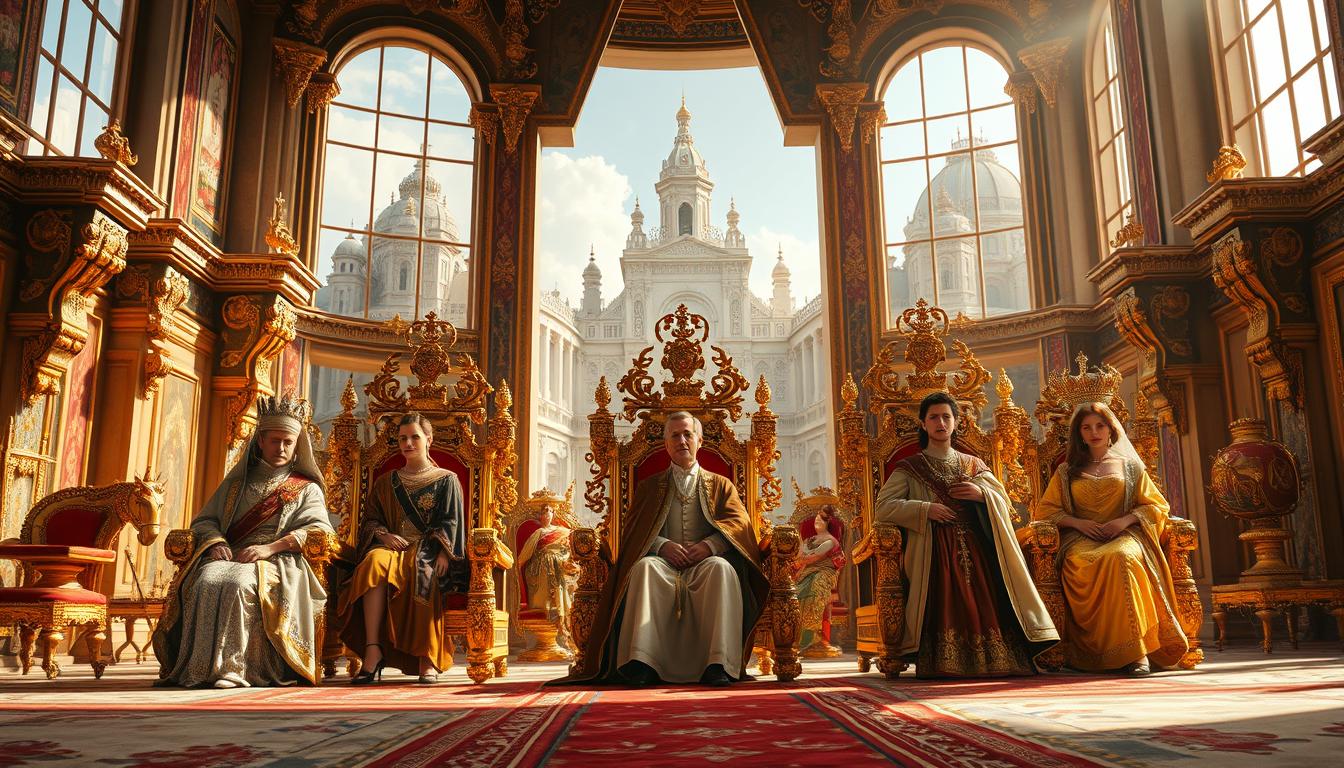
History is filled with mighty dynasties like the British and Mongol. Ancient rulers, such as the Roman and Maurya, also left their mark. These families controlled vast lands, wealth, and people, shaping our world.
The British Empire, for example, covered 13 million square miles in 1920. It ruled over 20% of the world’s population. The Mongol Empire, at its peak, spanned 17% of the planet. The Qing dynasty governed over 432 million people in 1851.
These dynasties’ influence is seen in our culture, trade, and politics today. Their legacy is profound and lasting.
So, what makes a dynasty powerful? It’s about land, lasting power, and influence. The Abbasid Caliphate, for instance, covered 4.29 million square miles. The Habsburgs ruled Europe for centuries.
Even smaller dynasties, like the Gupta Empire, had a big cultural impact. These families used marriages, wars, and economics to maintain their power. The Ottoman Empire lasted 600 years, thanks to its military and trade networks.
The Ming dynasty’s control of the Silk Road shows how wealth can fuel dynasty power. Today, we see the effects of these empires in our modern nations.
The Roman Empire’s laws, the Mongol’s Silk Road, and the British’s colonies have shaped our world. Let’s explore how these royal families transformed small kingdoms into world-changing empires. We’ll see why their choices are important even today.
The Rise of Dynasties: A Historical Overview
Dynasties started with China’s Xia dynasty (2070–1600 B.C.E.), marking the first dynasty origins. These systems grew through military conquests, strategic marriages, or economic control. The Mongol-founded Yuan dynasty and banking families like the Rothschilds showed different ways to gain power.
The Zhou dynasty ruled for 790 years, thanks to and claims. Their legacy influenced later , like the Han Dynasty’s class system.
Dynasties like the Han expanded their territories through , but faced challenges when succession or governance failed. Their stories show how family rule, blending tradition with ambition, shaped history for millennia.
The Roman Empire: A Legacy of Power
The Julio-Claudian dynasty was key in shaping ancient Rome’s power. Augustus, Caesar’s nephew, started this dynasty in 27 BCE. He changed Rome from a republic to an empire, building the first permanent theater.
His successors—Tiberius, Caligula, Claudius, and Nero—expanded Rome’s territories. They conquered lands from Spain to Egypt. But their reigns were filled with paradoxes.
“I found Rome a city of bricks and left it a city of marble.”
Augustus’s successors used conquest to grow their power. Claudius annexed Britain, while Nero’s reign was marked by extravagance. His death in 68 CE ended his rule.
Yet, their power was built on myths. Augustus claimed divine ancestry. Public games and bread kept people loyal, but senators feared their power. Caligula’s extravagance showed the dynasty’s grandeur and decay.
The dynasty fell in 68 CE, starting a civil war. But their legacy lived on. The Senate’s rejection ended their rule, but they left a lasting impact.
Their laws and buildings shaped Europe’s future. From aqueducts to the origins of Romance languages, their mark is seen worldwide. It shows ancient Rome’s lasting influence.
The Ming Dynasty: Golden Age of China
The Ming Dynasty (1368–1644) was a golden age for Chinese emperors and imperial China. It was founded by Zhu Yuanzhang, the first Zhu family ruler. Emperor Hongwu, who started as a peasant rebel, united China after defeating the Mongols.
His rule saw the building of the Forbidden City in Beijing. This was finished in 1420. Today, it’s a UNESCO site and the heart of the empire.
During this time, China’s navy reached new heights under Admiral Zheng He. His fleets sailed to Africa, showing off Chinese naval power. These journeys expanded trade and diplomacy, beating European explorers.
Also, Jingdezhen’s porcelain factories made ceramics that were loved all over the world. These Ming achievements were famous for their beauty.
But, the dynasty faced big challenges. Corruption, too many people, and natural disasters like the Little Ice Age were hard to handle. By 1644, rebel leader Li Zicheng took over, ending the Ming rule.
The last Ming emperor died by suicide. The Qing took over, but the Ming’s impact is seen in art, architecture, and the Forbidden City.
The Habsburg Dynasty: European Dominance
The Habsburg monarchy ruled European royalty for over six centuries. They used strategic marriages to gain global influence. Their journey started in the 13th century with Rudolf I.
But, true power came when Frederick III became Holy Roman Emperor in 1452. For 250 years, every Holy Roman Emperor was a Habsburg. This showed their control through royal intermarriage.
A famous saying, “Let others wage wars, but you, happy Austria, shall marry,” reflected their approach. This strategy helped them grow from Austria into Spain, Hungary, and the Netherlands.

The Austrian Empire and Spanish Habsburgs became two strong branches by the 16th century. Charles V, a Habsburg ruler, once controlled lands from the Holy Roman Empire to the Americas. His division in 1556 split the dynasty into Austrian and Spanish lines.
The Spanish branch declined due to inbreeding, known as the “Habsburg jaw.” But, Maria Theresa of Austria kept her realms together after a disputed succession in 1740.
“Austriae est imperare orbi universo” (“Let Austria rule the world”).
By 1804, the Habsburg monarchy became the Austrian Empire, later the Austro-Hungarian Empire. Their legacy is seen in art, architecture, and alliances. Though the dynasty ended in 1918, their mark on European royalty is a lesson in ambition and adaptation.
The Ottoman Empire: Bridging East and West
The Ottoman Empire started in Anatolia and grew into a huge Islamic empire. It took Constantinople in 1453, ending the Byzantine era. Istanbul became the center of a vast power that spanned three continents.
Suleiman the Magnificent ruled at the empire’s peak. He expanded to Hungary and the Mediterranean. He built the Süleymaniye Mosque and reformed Islamic law.
For over 600 years, Ottoman sultans ruled a diverse realm. They used a centralized system and the devshirme system. This trained Christian boys as elite Janissaries. Though it declined after the 17th century, its legacy remains in art, law, and architecture.
The British Royal Family: A Modern Monarchy
Today’s British monarchy blends old traditions with new expectations. The Windsor dynasty, started by King George V in 1917, is a constitutional monarchy. This means the royal family has ceremonial duties, while Parliament holds the power. Queen Elizabeth II’s 70-year rule showed how to keep traditions alive for a global audience.

The British monarchy’s reach goes beyond the UK as the head of the Commonwealth. This group has 54 member nations. Queen Elizabeth II worked to unite these countries, even as they changed and grew apart. Her son, King Charles III, now carries on this work, focusing on the environment and helping others.
Legal changes have shaped royal traditions. The Succession to the Crown Act of 2013 made sure all heirs, like Princess Charlotte, can inherit equally. Rules about marriage have also relaxed, showing how the monarchy keeps up with society. Despite being in the public eye, the monarchy stays relevant by using social media and other modern tools.
The monarchy also brings in £550 million a year from tourism. This money comes from visitors to places like Windsor Castle. Even with challenges, Queen Elizabeth II was seen as the most admired woman in 2019. The British monarchy manages to stay relevant by balancing its rich history with today’s world.
The Maurya Empire: Ancient Indian Power
The Mauryan dynasty emerged in ancient India, uniting the subcontinent’s regions into one state. Founded by Chandragupta Maurya around 321 BCE, it stretched from Afghanistan to Bengal. This marked a significant shift in Indian unification.
Under Chandragupta, fragmented kingdoms were brought together through alliances and military campaigns. This laid the foundation for an administration that inspired future rulers.
Ashoka the Great, Chandragupta’s grandson, expanded the empire to 5 million square kilometers. It became the largest in ancient India. After the Kalinga War, Ashoka turned to Buddhism, changing the empire into a Buddhist empire.
His edicts, carved on pillars, promoted nonviolence and moral governance. These principles reshaped ancient India’s culture.
Chandragupta’s policies created a network of roads, boosting trade and communication. This system supported a population of over 30 million. The Mauryan dynasty became a center of economic and intellectual activity.
Buddhist monasteries and universities thrived, leaving a lasting legacy. The empire fell in 185 BCE, but its lessons in governance and tolerance continue to inspire.
The Tsars of Russia: An Unbroken Line
The Romanov dynasty ruled Russia from 1613 to 1917. They made the Russian monarchy one of history’s longest-lasting autocratic regimes. Over three centuries, they grew their empire through marriages, wars, and strong leadership.
Peter the Great’s reforms made Russia a European power. He expanded the empire by claiming Siberia and founding St. Petersburg. His rule saw tax revenues triple, funding military and cultural projects.
By the 1800s, the empire covered 22.8 million km², the world’s largest land empire.  Catherine the Great added Crimea and parts of Poland, boosting the population to 38 million by 1795.
Catherine’s successors struggled with modernization and tradition. Nicholas II’s reign ended with his family’s assassination in 1918. The Romanovs’ lavish courts and strict rule contrasted with the peasants’ hardships, leading to the 1917 revolution.
Though the dynasty fell, its mark on Russia’s identity remains. The mystery of its final tsars is a haunting chapter in Russian history.
The Bourbon Dynasty: France’s Royal Influence
The Bourbon dynasty ruled France for over two centuries. They started in 1589 and ended in 1792 with the French Revolution. Louis XIV, known as the Sun King, made Versailles Palace a symbol of power.
He believed, “L’état, c’est moi” (I am the state). This palace showed his absolute power through art and architecture.
At Versailles, Louis XIV focused on art, fashion, and architecture. But his spending and strict rules made people unhappy. By 1789, the French Revolution ended the monarchy.
But, the Spanish Bourbon line kept going. Today, Spain’s monarchy is a part of the House of Bourbon. Their story shows how they lasted through tough times.
The Bourbons were powerful from the 1500s to today. They ruled in Naples and Parma, mixing politics with culture. Even though they lost power in France, their history is key to Europe’s royal past.
The House of Saud: A Modern Dynasty in the Middle East
The Saudi royal family leads Saudi Arabia as a Middle Eastern power. They manage Islam’s holiest sites and follow Islamic governance. Their bond with Wahhabism started in the 18th century, giving them religious power. King Abdul-Aziz founded the kingdom in 1932, thanks to oil and strategic partnerships.

In 1938, oil was found near Dammam, making the Arab monarchy a world leader in energy. Today, their oil wealth is over $1.4 trillion. Yet, they face pressure to diversify. The 2017 Allegiance Council vote, which raised Mohammed bin Salman, shows ongoing power struggles.
They now face the challenge of mixing Islamic governance with economic changes. Their future depends on blending tradition with global needs. They must keep their role as guardians of Mecca and Medina.
Conclusion: The Enduring Legacy of Powerful Dynasties
The Roman Empire’s laws and the Tang Dynasty’s poems are just a glimpse of their lasting impact. Their legacy is seen in our laws, art, and national borders. These dynasties, through family ties or alliances, shaped empires that changed the world.
The Cyrus Cylinder, a key human rights document, shows the influence of these dynasties. The Tang Dynasty’s golden age, with over 48,900 poems, highlights their cultural peak. Today, their impact is seen in modern systems and architecture.
These dynasties knew how to pass on power through marriage, patronage, and military might. The Ming’s porcelain, the Habsburgs’ alliances, and the Gupta’s science show their mix of tradition and innovation. Even though some empires fell, their legacies live on, teaching us about the past’s influence on today.
When you visit museums, read laws, or explore historic sites, think of these dynasties. Their stories are not just history. They are the roots of our shared human journey.