







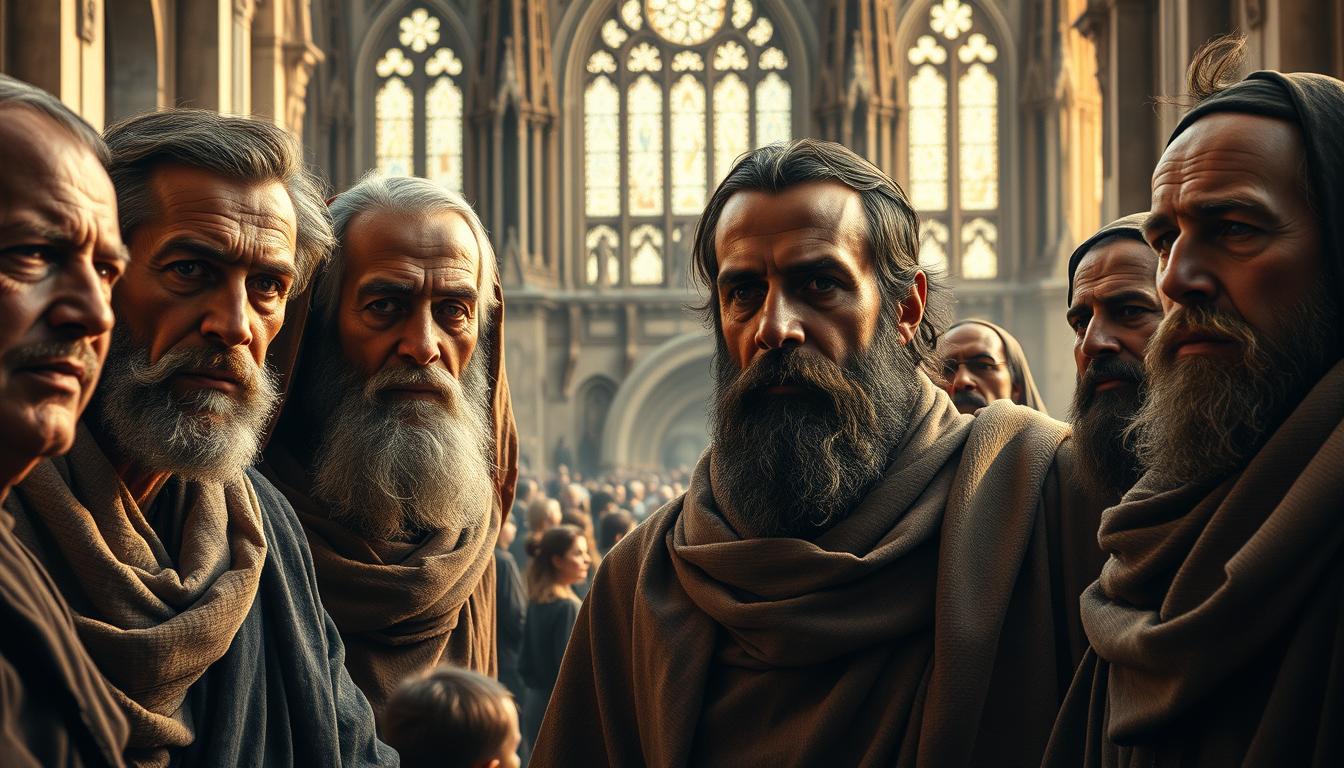
Figures who challenged the church have changed history. They questioned long-held beliefs. During the Renaissance and Reformation, leaders like Martin Luther spoke out against corruption.
In 1517, Luther’s 95 Theses attacked indulgences, starting big debates. This split Europe. The Catholic Church fought back, excommunicating Luther and starting the Counter-Reformation in 1545.
These battles show the risks of questioning authority. Yet, they led to more freedom in religion. Leaders like Henry VIII also challenged old power structures, creating the Church of England in 1534.
The printing press helped spread these ideas. It made more people read and think about corruption. This shows how dissenters risked everything to change faith and society.
The Counter-Reformation, led by Pope Paul III, tried to fix clergy problems. But Protestant movements kept growing. Leaders like Luther showed that questioning norms can lead to change, even if it’s risky.
Their fights show a constant battle between keeping traditions and embracing new ideas. This struggle shapes today’s debates on freedom in religion and politics.
Historical Figures Who Challenged the Church
In 2017, we celebrated 500 years of the Protestant Reformation leaders movement. Martin Luther’s 95 Theses started it all. His call for change joined others like Jan Hus and John Wycliffe, who were executed for speaking out.
Their bravery paved the way for the Reformation to spread across Europe.
Luther stood firm at the 1521 Diet of Worms. He believed in faith over indulgences, attracting followers but also excommunication. The 1525 Peasants’ Revolt showed the tension between reform and rebellion.
Church reformers like John Calvin also played a big role. His Institutes of the Christian Religion shaped Reformed traditions. The Catholic Church tried to fight back but couldn’t stop the change.
Many were called religious heretics, but their ideas lived on. Figures like Hus and Wycliffe’s writings inspired later reformers. Today, their impact is seen in many modern denominations.
Luther’s courage shows us that one voice can change history. It proves the power of dissent to transform faith.
Enlightenment Thinkers and Religious Critique
Enlightenment thinkers changed how people saw faith and government. Voltaire, a key figure, criticized dogma but valued reason. He argued for a creator God who doesn’t interfere with the world.
Thomas Jefferson, inspired by deism, edited the Bible to focus on ethics. He removed stories of miracles. Denis Diderot and Baron d’Holbach went further, doubting supernatural claims.
Voltaire used humor to attack corruption in *Candide*. He said:
“It is difficult to corrupt a man who is determined to be honest.”
But he also pushed for tolerance, not atheism. John Locke’s ideas on natural rights helped shape the U.S. Constitution. George Washington, influenced by these, fought for religious freedom in America.

These thinkers combined skepticism with hope. They rejected strict beliefs but sought morality through reason. Their ideas sparked revolutions, from France’s 1789 to Latin America’s fight for freedom.
Today, we debate science vs. faith, religious tolerance, and secular governance. Enlightenment thought didn’t erase faith but changed its role in society. It showed that questioning and spiritual curiosity can go hand in hand.
Women Who Defied Religious Conventions
Medieval mystics like Hildegard of Bingen and Julian of Norwich were key female religious leaders. They used visions to challenge men’s control. Their writings claimed divine inspiration, showing women’s right to lead spiritually.
In 1630s Massachusetts, women’s religious authority faced strong opposition. Anne Hutchinson held weekly meetings for over 60 people, breaking Puritan laws. She was tried in 1637 while pregnant and exiled in 1638.
Her story mirrors others like Anne Askew, burned at the stake in 1546 for not conforming.
By the 1800s, thinkers like Elizabeth Cady Stanton applied feminist theology. She exposed gender bias in scripture. Her “The Woman’s Bible” (1895) started debates on religious gender equality that continue today.
Modern movements, from Catholic nuns pushing for ordination to Muslim scholars reinterpreting the Quran, carry this legacy.
Despite facing persecution, these women church reformers changed faith traditions. Their stories show how fighting against exclusion can lead to change, even when systems resist. Today, debates over spiritual power echo their calls for inclusion and justice.
Modern Activists Resisting Religious Authority
Today, progressive religious activists are changing what faith means to include LGBTQ people. Groups like Faith in America and DignityUSA are reinterpreting old texts to support LGBTQ+ identities. This challenges old rules that left out many people.
Leaders like Linda Kay Klein, who used to follow strict teachings, now work to change them. They aim to create faith communities that welcome everyone, keeping traditions but adding diversity.

Survivors of religious abuse are key to this movement. Organizations like The Freedom Institute help those hurt by strict beliefs. They push for openness in religious groups.
Interfaith groups like Shoulder to Shoulder bring together Christians, Muslims, and Jews. They fight against strict beliefs that lead to discrimination. Their work shows how strict thinking can cause harm.
Numbers show why this fight is so important: 21% of Americans don’t follow any religion anymore. This shows a big desire for change. Even with laws like Hungary’s 2012 law that took away many religious groups’ rights, activists keep speaking out. They use social media to reach more people and challenge authority.
“Faith shouldn’t require silence.”
Recent Supreme Court decisions, like allowing state money for religious schools, show the challenges. But, faith leaders keep pushing for change. They show that even with more rules, faith can be inclusive and caring.
Philosophers Who Questioned God
Nietzsche’s “God is dead” shook the foundations of old beliefs, asking us to face life’s unknowns alone. Existentialists like Sartre and Camus said our purpose comes from living, not from sacred texts. They changed how we think about existence and our role in it.
Atheist thinkers, from Ibn al-Rawandi to Bertrand Russell, used reason to debunk religious myths. Al-Rawandi saw miracles as tricks, and Russell called many religious statements “nonsense.” Their work made people question faith more deeply.
“Existence precedes essence”
Sartre said, challenging the idea of a divine plan. Camus agreed, calling life’s search for meaning “absurd.” Even Kierkegaard, who believed in God, criticized empty religious rituals, showing skepticism’s depth.
From Epicurus’ ancient doubts about evil to Ayer’s logical positivism, thinkers have questioned divine logic. Nietzsche and Sartre’s ideas changed how we think about morality without a god. Their work connects ancient doubts with today’s ethical views.
Writers Who Explored Religious Themes
Mark Twain’s Letters from the Earth sparked debates about religion. He used satire to question biblical stories. This made him a key figure in literary religious criticism.
His work challenged readers to think differently about faith. Twain’s humor highlighted hypocrisy but also touched on deeper moral truths.

After Twain, other writers explored religious themes. Fyodor Dostoevsky’s The Brothers Karamazov made readers think about faith and suffering. Flannery O’Connor’s stories mixed dark humor with Catholic themes.
Even Margaret Atwood’s The Handmaid’s Tale critiques strict religious rules. These stories show fiction’s power to question faith.
Today, writers like Shusaku Endo continue this tradition. His Silence explores faith under persecution. These stories let readers ponder big questions without being preachy.
Scientists Who Challenged Religious Dogma
Galileo’s discoveries with his telescope sparked the Galileo church conflict. This conflict was between what we can see and what the Bible says. In 1616, the Church banned his ideas about the sun being at the center. His trial in 1633 showed how serious the science religion conflict was.
His book on physics in 1638 made things worse. But, being buried in Santa Croce in 1737 showed the Church was starting to see him in a new light.
Charles Darwin’s evolution religious debate started in 1859 with On the Origin of Species. This book challenged the idea of creationism. The early universities in Europe, once supported by the Church, became places where scientists like Copernicus and Descartes questioned old beliefs.
Copernicus’ idea in 1543 that the sun is at the center went against the Bible. James Hutton’s ideas in 1785 about the Earth’s age also didn’t match the Bible’s story.
Newton’s work showed that science and faith can coexist. The Vatican’s 1992 apology for wrongly condemning Galileo showed the long journey of understanding between science and religion. Today, debates about evolution continue, showing the darwin religious controversy is not over. These stories show how science and faith have both clashed and worked together, changing how we see the world.
Artists Who Criticized Religious Norms
Artists have made waves by creating controversial religious art. Chris Ofili’s The Holy Virgin Mary is a prime example. It features elephant dung and porn clippings, sparking a big religious art controversy. This controversy almost cut the museum’s funding by $7 million.
These blasphemous artists challenge what we think of as sacred. They create works that shake up our traditional views.

Andres Serrano’s Piss Christ and Ofili’s pieces show taboo religious imagery. They make us think about our faith in a new way.
Anti-religious musicians like Sinéad O’Connor and Pussy Riot also challenge norms. O’Connor’s 1992 Bible-burning TV performance and Pussy Riot’s church protests mix music with defiance. Madonna’s Like a Prayer was criticized by the Vatican for mixing faith with explicit visuals.
This art doesn’t just preach; it provokes. From Michelangelo’s hidden gestures in the Sistine Chapel to today’s performances, art challenges who gets to decide what’s sacred. It asks: Can art’s power to shock also free us from dogma?
Activist Movements That Opposed Religion
From the Reformation’s anti-clerical activism to today’s secular movements, efforts to limit religious power have changed the world. Martin Luther’s 95 Theses in 1517 started big debates about church power. Now, groups like the Freedom From Religion Foundation and American Atheists push for church state separation. They make sure laws don’t favor religious groups over others.
James Madison wrote about religious freedom advocates in 1821. His ideas helped shape the First Amendment. This led to global rules like the 1948 Universal Declaration of Human Rights, which says:
“Everyone has the right to freedom of thought, conscience, and religion.”
Today’s secular movements fight for things like equal marriage rights and science education without religious bias.
Modern secular movements balance criticizing power with respecting personal beliefs. They push for policies like public funding neutrality. This way, everyone’s voice, including non-religious ones, is heard. This legacy connects Luther’s challenge to today’s efforts for a world where religious freedom protects all, believers and skeptics alike.
The Ongoing Legacy of Religious Challenge
Modern religious reform modern efforts show that questioning norms isn’t new—it’s part of faith’s evolution. From progressive religious movements advocating gender equality to digital spaces amplifying dissent, today’s debates mirror past revolutions like the Protestant Reformation. Younger generations, like many in conservative groups, now prioritize LGBTQ+ inclusion over older political alliances, as seen in shifting voter preferences among white evangelicals.
Tools like social media accelerate interfaith dialogue, linking reformers worldwide. Yet challenges persist. The Christian Reformed Church, for instance, struggles with diversity and slow ecumenical steps. Global Christianity’s growth contrasts with declining attendance in North America, pushing traditions to adapt or risk losing relevance.
Religious tradition change demands balancing ancient teachings with modern ethics. Movements like interfaith alliances and LGBTQ+-inclusive congregations show how faith can evolve. The CRC’s cautious approach highlights this tension, but younger voices push for faster progress on issues like racial justice and gender roles.
Future religion future trends will depend on whether institutions embrace change. The Reformation taught that questioning norms can renew faith. Today’s progressive religious movements and digital platforms offer new tools for reimagining tradition. As debates over LGBTQ+ rights and global growth continue, faith’s future hinges on whether communities choose openness over rigidity.