




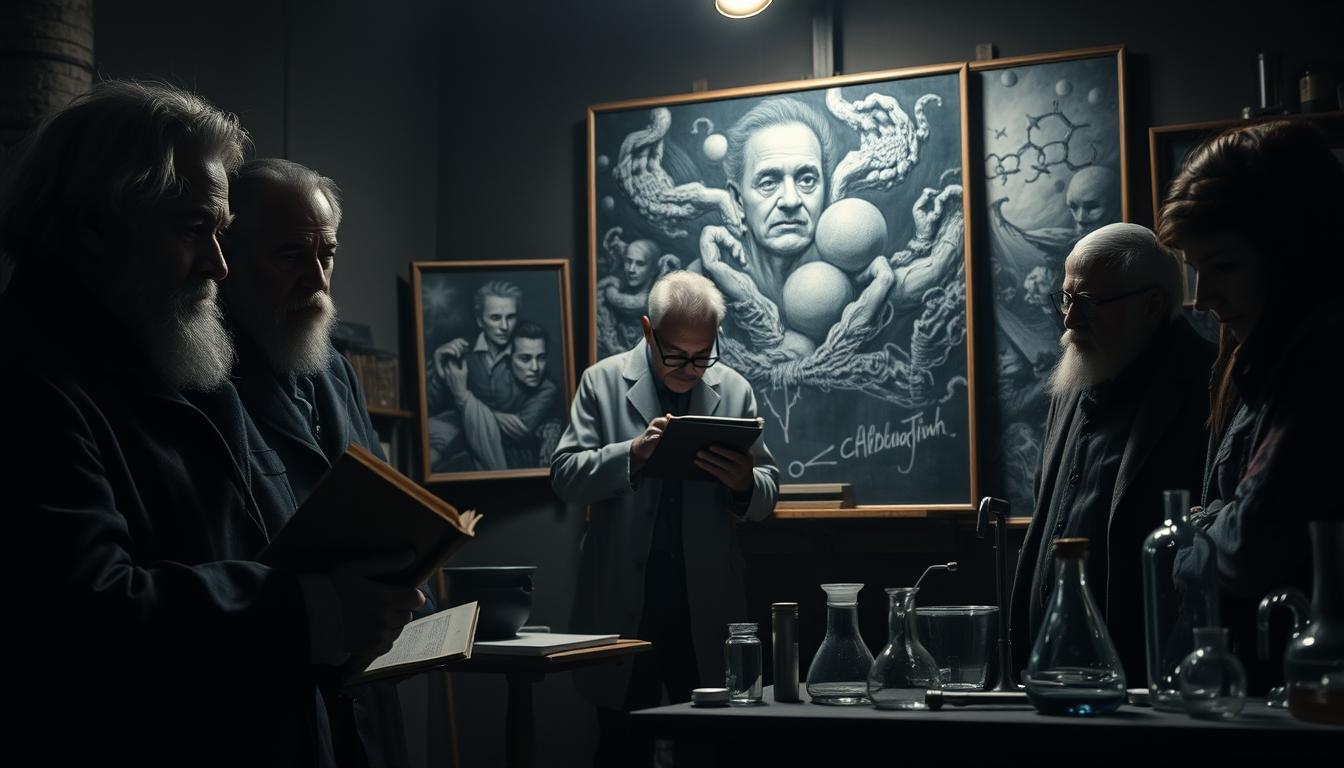
Neil deGrasse Tyson’s 2022 argument with Terrence Howard shows how famous thinkers face criticism. Even though they are geniuses, they get questioned for their words. This debate, like Richard Feynman’s bold book, shows that being smart can also mean causing trouble.
Studies say creativity comes from not filtering thoughts too much. Thinkers like Alexander Grothendieck, who disappeared after solving 14 math problems, are examples. Innovators like Newton, who was paranoid from mercury experiments, show that being brilliant can also be tough.
Their work, from Feynman’s physics to Tyson’s podcasts, makes us think. They challenge us to see the good and bad sides of genius. Their stories ask: Can we celebrate smart people without ignoring their flaws?
What Defines a Controversial Genius?
Genius traits often clash with societal norms. Take Nikola Tesla’s battle over alternating current (AC) technology. His intellectual disruption challenged Thomas Edison’s direct current (DC) dominance, sparking the “war of the currents.” This clash shows how revolutionary thinking can upend established systems. Tesla’s 280 patents—from AC motors to wireless communication—show how controversial intelligence reshapes industries.
Psychologists like Howard Gardner say genius isn’t just IQ. He identified eight intelligences, from logical to interpersonal. This explains why some geniuses thrive outside traditional metrics. Yet, even high IQs miss many gifted individuals.
Lewis Terman’s 140+ IQ threshold captures only 0.4% of the population. Leta Hollingworth’s 180+ standard excludes 99.9995%. These gaps highlight how genius traits often defy measurement.
Historically, creative minds face trade-offs. Bipolar disorder affects many innovators, yet most with the condition aren’t geniuses. As psychiatrist Kay Jamison noted, moderate mania might boost productivity but rarely outweighs personal struggle. This paradox shows why controversial geniuses persist despite societal pushback, driven by visions others dismiss.
Historical Figures Known for Controversy
History’s most impactful minds often faced fierce opposition. Historical geniuses like Socrates faced trial for “corrupting youth,” leading to his execution. His ancient controversial thinkers legacy endures despite his condemnation. Centuries later, Galileo’s clash with the church over heliocentrism forced him into house arrest, proving renaissance innovators paid steep prices for challenging norms.
Enlightenment philosophers like Baruch Spinoza were excommunicated for writings rejectingig religious dogma. His historical intellectual debates reshaped modern ethics. Hypatia of Alexandria, a scholar murdered by a mob in 415 CE, embodied the dangers of defying societal norms. Even Mary Wollstonecraft, a pioneer of women’s rights, faced backlash for her 1792 A Vindication of the Rights of Woman.
“I bid you search into your own breasts, and see if woman has not been tried by a partial tribunal,” Wollstonecraft wrote, challenging gender norms that historical geniuses sparked debates that redefined societies. Their legacies, once deemed dangerous, now form pillars of modern thought. From Socrates’ cross-examinations to Wollstonecraft’s radical essays, controversy has long been a catalyst for progress.
Modern Controversial Geniuses in Science
Scientists like Nikola Tesla show us that new ideas often meet resistance. He called quantum physics “voodoo” and disagreed with Einstein on relativity. This shows how new theories can start big debates.
Even though Tesla’s wireless energy plans didn’t work, his legacy shows the struggle between new ideas and established science.
Today, figures like Terrence Howard also spark big debates. He said “1 x 1 = 2,” which challenged math basics. Neil deGrasse Tyson and others criticized him, saying his claims lack proof.
Yet, Howard stands firm, saying, “I’ve seen very little refutation of the specifics—only personal attacks.” This shows how new ideas face challenges in science today.
“The line between visionary and crackpot often depends on time and evidence.”
Tesla’s oddities and financial troubles show the risks of being different. Today’s scientists must balance bold ideas with solid evidence. They face public doubt and pushback from institutions.
But history shows that some mavericks change the game. Their stories teach us that progress in science often starts with controversy.
Artists Who Ruffled Feathers
Artistic provocateurs like Marcel Duchamp and Frida Kahlo pushed art’s boundaries. Duchamp’s readymades, like a urinal, questioned what art is. Kahlo’s raw self-portraits tackled gender and pain, sparking both outrage and acclaim.
In 2021, protests broke out at Barcelona’s Picasso Museum over his views on women. Eric Gill’s statue outside BBC HQ has been a point of contention for decades. His past abuse contrasts with his sculptural work, as Marina Picasso pointed out in 2001.
In Texas they lynch Negroes… An unjust law in no law at all. Which means I have a right, even a duty to resist. With violence or civil disobedience.
Paul Gauguin and Caravaggio faced personal scandals despite their artistic brilliance. Gauguin’s Tahiti paintings are celebrated but ignore his exploitative relationships. Caravaggio’s violent life influenced his dramatic realism, showing how scandal fuels rebellion.
The 1971 essay Why Have There Been No Great Women Artists? sparked ongoing debates. In 2021, exhibitions highlighted Élisabeth Vigée Le Brun and Artemisia Gentileschi. Thames & Hudson’s 50th anniversary edition of the essay shows how rebellion shapes today’s art.
Influential Thinkers in Philosophy
Philosophical debates have shaped our views on right and wrong, freedom, and existence. Thinkers like Friedrich Nietzsche and Simone de Beauvoir challenged old norms. Nietzsche said “God is dead,” questioning religious ethics. De Beauvoir’s Second Sex changed how we see gender roles.
Independent thinkers aren’t given much time on television today.
History shows that genius often comes from conflict. Socrates was tried and executed in 399 BCE for “corrupting youth.” Yet, his questioning methods are key to critical thinking. Aristotle’s works cover ethics, politics, and biology, showing his wide influence.
The InfluenceRanking list names 25 thinkers from 1000 BCE to 2000 CE. It misses voices from non-Western traditions. Yet, figures like Avicenna, with 450 works, show ideas can cross cultures. Immanuel Kant’s Critique of Pure Reason is a cornerstone of ethics today.
Martha Nussbaum believes Socratic inquiry teaches us to debate well. His method, seen in Plato’s dialogues, encourages questioning assumptions. Thinkers like Nietzsche and Heidegger remind us that challenging norms sparks progress.
Icons of Technology and Innovation
History’s tech geniuses often sparked controversy. Nikola Tesla and Thomas Edison’s rivalry over AC/DC power systems is a prime example. Tesla’s alternating current won out, but his work with George Westinghouse faced strong opposition.
Hedy Lamarr’s 1941 frequency-hopping patent, made with George Antheil, was ignored during World War II. But it later helped create Wi-Fi and GPS. Lamarr’s story shows how societal biases and timing can hide breakthroughs. Her work highlights how visionaries can be ahead of their time.
Steve Jobs’ perfectionism helped Apple grow, but his strict management style was divisive. Innovators like Jobs and Elon Musk show that genius and controversy often go hand in hand. Musk’s work at Tesla and SpaceX pushes limits and raises questions about ethics and feasibility.
Elizabeth Holmes’ Theranos scandal shows the dangers of unchecked ambition. Her false claims about blood testing damaged trust in tech. On the other hand, pioneers like Tim Berners-Lee’s open-source World Wide Web show the positive side of innovation.
Even Ada Lovelace’s 1843 algorithms for Babbage’s engine were doubted, showing the challenges tech pioneers face. Today, AI and biotech breakthroughs like CRISPR and quantum computing bring both hope and ethical concerns. The key lesson is that true innovation needs courage, but it must also be accountable to benefit society.
Literary Giants and Their Controversies
Boundary-pushing literature comes from controversial authors who dare to challenge norms. John Steinbeck’s The Grapes of Wrath was met with outrage in 1939. Critics called it “obscene” and banned it from libraries. Yet, Steinbeck won the Nobel Prize in Literature in 1962 for his work on poverty and injustice.
Today, writers like Jonathan Franzen face similar challenges. His 2001 novel The Corrections was a hit after Oprah’s Book Club picked it. But, backlash followed, accusing him of favoritism towards male authors. The hashtag #Franzenfreude trended, highlighting the debate over media’s focus on women writers.
Writers like James Joyce and Toni Morrison have also faced bans for their work. Joyce’s Ulysses was banned for its themes, while Morrison tackled race head-on. Even Bob Dylan’s Nobel win in 2016 sparked debate on whether lyrics are literature. Their stories show that great writing often pushes boundaries.
Political Figures Who Made Waves
History’s most transformative leaders often sparked both praise and outrage. Winston Churchill, voted Britain’s greatest ever in a 2002 BBC poll, is a perfect example. His political genius guided Britain through WWII, yet his colonial policies are debated.
He served in top roles for nearly five decades. His legacy shows how political vision can inspire and alienate.
“The time for justice and equality is always right now!”
Churchill’s Nobel Prize in Literature honored his rhetoric. Yet, his WWII blunders, like the Norway campaign, faced scrutiny. Revolutionary leaders like Nelson Mandela and Malcolm X also balanced visionary goals with public resistance.
Modern political mavericks like Alexandria Ocasio-Cortez continue this tradition. They challenge norms to drive change.
Such controversial politicians prove that progress often demands uncomfortable truths. Their stories show how daring to defy norms—whether Churchill’s wartime defiance or AOC’s climate policies—forces society to confront its ideals. Even flawed legacies remind us that change rarely happens without waves.
Athletes Who Challenged Social Norms
Revolutionary athletes like Muhammad Ali and Billie Jean King showed that sports is more than winning. Ali lost titles but became a civil rights icon for refusing to fight in Vietnam in 1967. King’s 1970 boycott led to equal prize money at the U.S. Open by 1973. Their actions reflect the spirit of The Great Debaters, where debate is activism.
Controversial athletes like Dutee Chand and Caster Semenya faced bans for their natural testosterone levels. The IAAF’s 2011 rules forced them to choose between their bodies and careers. This sparked debates worldwide about fairness and identity. These athletes fought against policies that marginalized them, changing sports forever.
Revolutionary athletes like Oscar Pistorius and Markus Rehm changed what’s possible. Pistorius competed in the 2012 Olympics with carbon-fiber blades, challenging disability stereotypes. Rehm’s long-jump records today show inclusion is key, not just right.
In 1968, Tommy Smith and John Carlos raised fists for civil rights, facing bans but inspiring change. Earlier, the 1961 Celtics boycott and 1965 AFL All-Star Game relocation to Houston after Black players protested segregation showed protests drive progress.
From Ali’s courage to today’s athletes, these pioneers show greatness is more than medals. Their fights for justice—through protest, policy changes, or innovation—prove sports activism and trailblazing are intertwined.
The Impact of Controversial Genius on Society
Controversial ideas often start with disagreement. Think of the 1968 debate between Gore Vidal and William F. Buckley. Their clash changed how we talk about politics and media. This shows how societal transformation can come from intellectual debates.
Charles Darwin’s theory of evolution and Albert Einstein’s relativity were once seen as wrong. But, through hard work, they became key to new ways of thinking. This shows how paradigm shifts happen when people keep pushing for change.
Simone de Beauvoir faced a lot of criticism for her feminist ideas. But now, her work is a big part of modern gender studies. This pattern shows that radical ideas first meet with anger, then slowly become accepted.
These thinkers make us face hard truths. Research shows that creative people often think differently. Yet, their work leads to progress, even when it’s first rejected.
“Genius is the art of making the impossible possible,” said Marie Curie. Her work on radioactivity was doubted, but it changed science.
Studies link creativity to certain thinking patterns. But, social impact of genius isn’t always clear. Einstein’s brain studies showed that brain structure doesn’t define genius. What matters is how people use their knowledge in tough situations.
Looking at today’s debates, like AI ethics and climate science, we see a pattern. History shows that progress starts with ideas society first doubts. The key is to know which ideas are worth considering and which cross ethical lines.
How Controversial Geniuses Influence Future Generations
“We do what we have to do in order to do what we want to do.” — James Farmer Jr.
Trailblazers like Marie Curie and Alan Turing have changed how we learn and innovate. Schools now teach about radiation therapy for cancer, thanks to Curie’s work. They also teach about Turing’s codebreaking, linking history to modern tech.
Steve Jobs’ innovations, like the iPhone, show the power of defiance. His “move fast and break things” approach mirrors Edison’s endless experimentation. Edison’s lab, the first R&D facility, inspires today’s tech hubs to value creativity over rules.
Stories of perseverance, like Kurt Vonnegut’s banned novels or Vinnie Van Gogh’s misunderstood art, teach us to see criticism as a chance to grow. Biographies of figures like Jobs or James Madison show how history shapes today’s leaders. Their struggles, from Edison’s long work hours to Baldwin’s civil rights work, teach us to be resilient.
These legacies inspire classrooms and boardrooms. By studying their paths, from Curie’s labs to Jobs’ Apple, we find the courage to challenge the status quo. The past’s controversies become tomorrow’s innovations.
Engaging With Controversial Ideas in Everyday Life
Starting to engage with controversial ideas is simple—it begins with curiosity. Sites like the Journal of Controversial Ideas offer a safe space for debate. This can lead to real progress. Even famous people like Terrence Howard say that personal biases can stop us from thinking creatively.
They encourage us to focus on the ideas, not our own pride. Critical thinking helps us separate facts from feelings. This makes it possible to disagree without ending the conversation.
Artists like Michael Jackson show us that art and ethics don’t always go hand in hand. The Kenan Institute talks about immoral artists, showing that dismissing their work misses a chance to understand the context. Keeping lines of communication open is key, whether in meetings, classrooms, or online.
Productive disagreement can help us understand each other better. Like top lawyers who can see both sides, we can learn from each other in everyday talks. Schools and workplaces that encourage debate can turn differences into chances for growth.
History shows us that controversial ideas, like ending slavery or accepting evolution, came from respectful debates. Critical thinking is about understanding, not just agreeing. By valuing open dialogue, we celebrate our ability to grow and change. As Ray Bradbury’s Fahrenheit 451 warns, suppressing ideas can hold back our progress. Let curiosity lead the way in our discussions.