





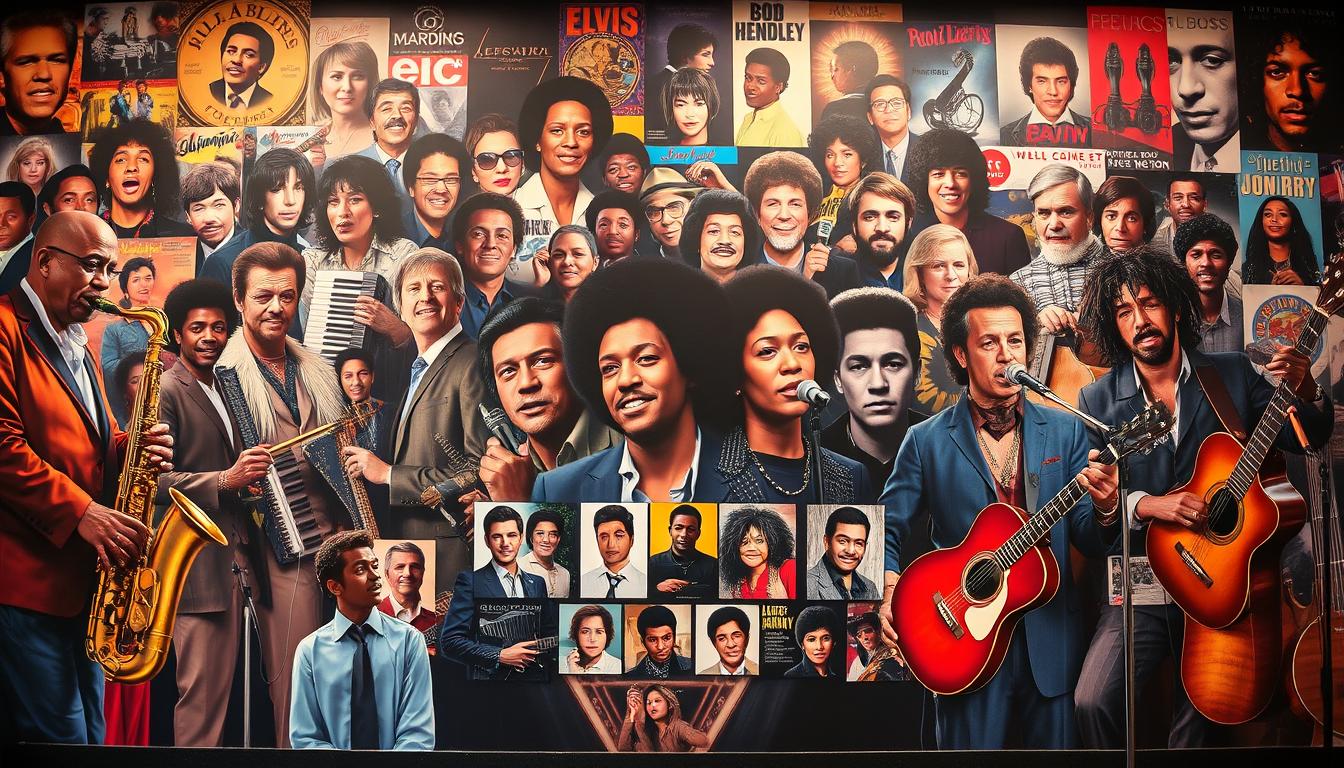
Icons like David Bowie and The Beatles did more than just make music. They changed the rules of pop culture. From The Stooges’ raw energy to Aretha Franklin’s soulful voice, they shaped eras. This article looks at how their innovations in music, film, and art continue to shape entertainment today.
Legendary figures like Jimi Hendrix and Madonna changed genres with bold creativity. Their work, from Prince’s albums to Andy Warhol’s pop art, shows the power of art and activism. These pop culture legends inspire famous creatives in music, film, and art today.
Michael Jackson’s Thriller and Joni Mitchell’s lyrics have had lasting impacts. This guide shows what makes these icons special: their groundbreaking ideas, the cultural shifts they caused, and the timeless appeal of their art. Learn how their stories continue to shape our world.
The Innovators: Pioneers of Pop Culture
David Bowie, Marcel Duchamp, and Jimi Hendrix changed what we think of creativity. These genre innovators and artistic innovators made rules and broke them. Bowie’s bold personas and Duchamp’s creative revolutionaries like Fountain changed how we see art and identity.
Jimi Hendrix’s 1967 Woodstock performance made guitar solos poetic, showing rock’s depth. Even when faced with doubt, these visionaries kept pushing. Marcel Duchamp’s 1917 Fountain was mocked but is now a symbol of innovation.
“The artist’s job is to question, not confirm.” – Marcel Duchamp
Dick Clark shaped culture through TV. His 1950s American Bandstand and 1973’s American Music Awards gave fans a voice. MTV, launched in 1981, honored this legacy, making music videos key to fame. From the Beatles’ 1964 TV debut to today’s TikTok trends, their impact endures.
Trendsetters in Film: Directors Who Changed the Game
Filmmaking innovators like Francis Ford Coppola showed that talent can beat tradition. His 1963 film Dementia 13 used fast cuts to create intense tension. Shooting You’re a Big Boy Now on 35mm film was a bold move, showing his creativity.
These groundbreaking directors dared to be different. They used rockabilly music in horror, a bold choice back then. Early works like Battle Beyond the Sun and Finian’s Rainbow showed his talent in mixing art and commerce.

Ousmane Sembene was a trailblazer as Africa’s first acclaimed director. His 1966 film Black Girl tackled colonialism, winning the Jean Vigo Prize. Later, films like Xala and Moolaadé critiqued society, blending history with urgency.
Starting as a factory worker and soldier, Sembene’s journey was reflected in his films. His Emitai told Diola history, showing cinema’s power to share forgotten stories.
Coppola and Sembene show how influential film directors change stories. They pushed boundaries, showing film’s power to educate and stir emotions. Their work turned screens into platforms for change.
Influential Artists in Visual Culture
Visual arts pioneers like Édouard Manet and Marcel Duchamp broke the mold. Manet’s 1863 Le Dejeuner sur l’Herbe shocked Paris, while Duchamp’s 1917 Fountain changed what we think of art. They led the way for new movements that challenged old ways.
Pop Art emerged in the 1950s in Britain and the U.S. It made everyday things into art. Eduardo Paolozzi’s 1947 collage I Was a Rich Man’s Plaything mixed ads with tech images, showing what was to come. Richard Hamilton’s 1956 collage Just What Is It That Makes Today’s Homes So Different, So Appealing? became a key piece. Andy Warhol’s Marilyn Diptych and Roy Lichtenstein’s comic-inspired works questioned fame and media. They mixed art and commerce in new ways.
Artists like Andres Serrano with Piss Christ sparked debates on faith and freedom. The Guerilla Girls used posters and protests to highlight gender gaps in galleries. Their bold messages turned galleries into places of change.
Artistic provocateurs like Ai Weiwei and Tracy Emin pushed the limits. Ai’s Sunflower Seeds challenged authority, while Emin’s unmade beds redefined intimacy. Their work shows art can spark thought as much as it can be beautiful.
These artists changed culture. Warhol’s soup cans and Lichtenstein’s dots are seen today, showing art’s power to challenge the norm.
Legends of Television: Shaping the Small Screen

Walter Cronkite and Edward R. Murrow changed how we see news. Cronkite was a key figure in major events like the moon landing and the Vietnam War. He was known as “the most trusted man in America.”
Murrow’s 1954 See It Now exposed Senator McCarthy’s wrongdoings. This was a big moment in investigative journalism.
Influential TV personalities have shaped our culture. Barbara Walters was the first woman to co-anchor network news. Oprah Winfrey used daytime TV to talk about important social issues.
Shows like The Golden Girls and Jeopardy! changed TV forever. Betty White holds the record for the longest TV career. Her role in The Golden Girls showed the power of humor and friendship.
David Letterman and Arsenio Hall also made a big impact. Letterman’s humor and Top Ten Lists changed late-night TV. Hall brought hip-hop culture to TV, giving a voice to the underrepresented.
Today, TV’s impact is seen in streaming and diverse stories. Cronkite and Betty White’s work shows TV’s power to reflect society. Streaming and new stories keep TV exciting and transformative.
Music Mavericks: Legends Who Transformed Genres
Artists like the Beatles changed what pop music could be. They spent 59 weeks at the top of the Billboard Hot 100. Their 1965 Shea Stadium concert was a huge deal for rock bands.
Albums like Sgt. Pepper’s Lonely Hearts Club Band set new standards. They mixed studio tricks with storytelling. This made albums more than just music.
Jimi Hendrix and David Bowie were true musical revolutionaries. Bowie mixed glam rock with new sounds. This opened up pop music in new ways.
Bob Marley’s Exodus was named the best album of the 20th century by Time. It made reggae a symbol of unity worldwide. His music is a cultural touchstone, showing how artists can connect people across the globe.
Taylor Swift changed from country to pop, showing artists can control their own paths. Her 2023 Eras Tour and re-recorded albums show her growth. Adele’s 21 and 25 changed pop’s emotional depth. Stromae’s Alors on Danse was a hit in 14 countries, showing the power of blending genres.
These artists didn’t just make hits; they changed the game. From the Beatles’ studio tricks to Marley’s political songs, they showed that true innovators break all the rules.
Cultural Commentators: Writers Who Influenced Society
Writers like Charles Dickens and Jane Austen are true literary icons. Their work changed how we see the world. Dickens’s stories, like A Christmas Carol, changed holiday traditions. He introduced the idea of a “white Christmas” in 1843, even though London was cold.
His characters, like Oliver Twist and Ebenezer Scrooge, are now part of our culture. Dickens also used his writing to point out social problems. His literary impact on society is felt even today.
“Modern deprivation mirrors the times of Dickens,” said the 2009 president of the Association of Teachers and Lecturers. This shows Dickens’s journalistic influence. His stories, like Bleak House, exposed poverty and inequality, topics we debate today.

Jane Austen’s sharp wit and social commentary paved the way for feminism. Her novels were not well-received when she was alive. But today, they are translated into almost every language.
Her work is celebrated in over 15 countries, including Pakistan and Argentina. Modern adaptations, like Clueless, show her literary impact on society is alive and well. Scholars now study her sharp social commentary, proving her status as a global literary icon.
These writers show how words can lead to change. Dickens combined storytelling with social advocacy, while Austen used satire to critique society. Their works reflect and challenge the world they saw, proving they are more than just literature.
Technology and Culture: The Digital Revolution
Daft Punk’s music and NFT art markets show how digital culture pioneers use screens and algorithms. They mix music, code, and visuals, making tech a storytelling tool. Early computer animation grew into today’s digital galleries, where new media artists sell art as blockchain tokens.
Social platforms like TikTok and Instagram let online culture shapers start trends fast. K-pop and #MeToo show digital tools can spread messages worldwide. But, NFTs and algorithms also raise issues, like art sales and echo chambers.
VR and AI art generators let creators skip studios, like punk bands did. But, the line between creator and consumer gets fuzzy with live art streams on Twitch. Gaming worlds like Fortnite host concerts, showing the digital revolution’s impact, from Seoul to Silicon Valley.
Icons of Fashion: Designers Who Shaped Style
Style revolutionaries like David Bowie and Prince changed how we see fashion. Bowie’s Ziggy Stardust mixed spandex and makeup, breaking gender barriers. Prince’s bold outfits showed clothes can be a political statement. These style influencers made fashion a way to express oneself, inspiring others to be unique.

Designers like Christian Dior left a lasting mark. His 1947 “New Look” set a new standard for elegance. Yves Saint Laurent and Valentino also made waves with their designs, pushing boundaries.
Salvatore Ferragamo’s dedication to craftsmanship in the 1950s was unmatched. He made 350 handmade shoes every day, blending art with tradition.
Tom Ford’s work at Gucci in the 1990s was a game-changer. He grew the brand from $230M to $3B in a decade. Diane von Furstenberg’s wrap dresses became symbols of female strength.
Today, designers like Christian Siriano and Rihanna’s Savage X Fenty are leading the way. They focus on inclusivity and sustainability. Their work shows fashion is a reflection of our values, showing courage, creativity, and change.
Activists Who Changed Pop Culture
Cultural activists have long used creativity to push for change. They’ve made protest posters and songs that change minds and policies. The Guerilla Girls, for example, used humor and facts to show gender bias in art, fighting for equality.
Prince was not just a musical genius; he was also an advocate for artists’ rights and social justice.
Prince’s fights with record labels were more than just about money. They were about fair treatment for artists. His music and actions made him a symbol of justice in the arts. His 1993 song “The Most Beautiful Girl in the World” even challenged beauty standards, blending art and activism.
Today, Prince’s legacy continues. Artists are making a difference with Black Lives Matter murals and climate-focused films. Every protest song and viral campaign shows that art is more than entertainment. It’s a powerful tool for change.
The Legacy of Pop Culture Icons: Their Lasting Influence
Pop culture icons do more than create art or music. They shape cultural memory and cultural heritage. Prince’s music, like Purple Rain’s lasting appeal, shows how lasting artistic influence goes beyond time. Walt Disney’s legacy, seen in Disneyland’s 650 million visitors, shows how cultural legacy boosts global economies.
Beyoncé’s 28 Grammys or Madonna’s chart-topping songs highlight legacies built on innovation and reinvention. Preservation efforts, like Paisley Park and digital archives, keep icon preservation alive for future generations. The Beatles’ $10 billion franchise or Elvis’s 600 million records show how pop culture heritage drives industries.
Modern platforms like streaming let new fans discover icons. Artists like Rihanna blend creativity with business, just like Andy Warhol did with Marilyn Monroe prints. These icons inspire and redefine what’s possible.
Steve Jobs’ iPhone changed tech and culture, showing legacy can change societies. Even controversies, like backlash against Monroe’s activism, show legacies are ongoing stories. From Oprah’s book club to Taylor Swift’s evolution, each generation reimagines these icons.
Cultural icons last because they reflect and shape our world. Their work connects past and future, guiding creativity and change.