







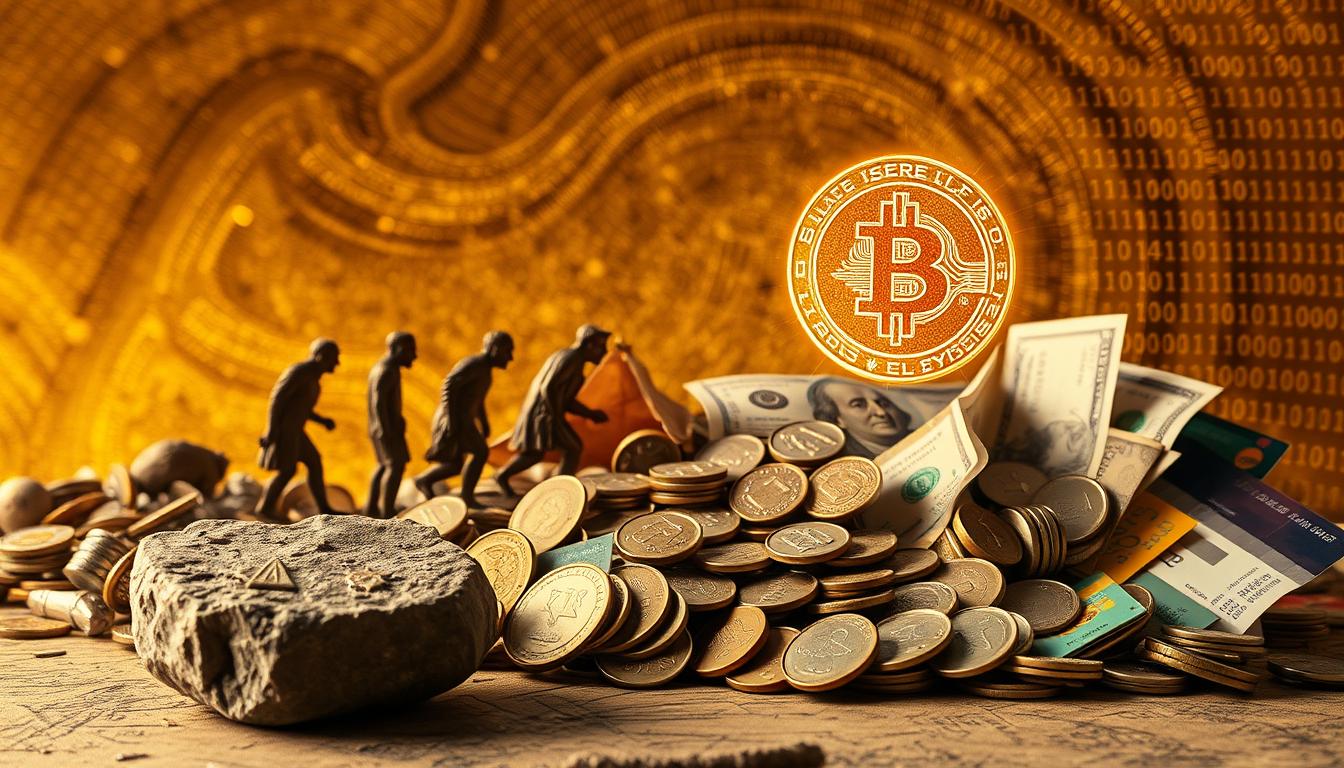
For over 5,000 years, humans have moved from trading goods directly to using money. In the beginning, people swapped items like livestock or grain. As societies grew, they needed better ways to manage money.
Early tally sticks and bones, like the 30,000-year-old Aurignacian artifact, helped count and track values. This laid the foundation for money.
By 7,000 years ago, Mesopotamia started using clay tokens as money. This was a big step from using perishable goods like grain. These early systems had problems, like trading a cow for tools that couldn’t be split or stored.
The invention of money made things easier. Rome used bronze bars, and Lydia used gold coins in the 7th century BC. This allowed societies to grow beyond local markets.
Every step, from bartering to coins, shows humanity’s quest for better ways to trade. The shekel from 2150 BC and China’s bronze spades show how money reflected cultural needs. These ancient steps led to paper money, banks, and today’s digital systems.
The Origins of Trade: Bartering Explained
The barter system started around 6000 BC in Mesopotamia. Tribes there traded goods like grain for tools or textiles. This direct exchange was the start of primitive trade. It helped communities share resources without using money.
In ancient Rome, soldiers traded military service for salt. Colonial Americans swapped crops for blacksmith services. These were goods for goods deals.
Early barter system had big trade limitations. Trading a cow for seeds was tricky. How do you split the cow fairly?
Without a common value, disagreements often happened. Even in 1990s Russia, when the ruble failed, bartering came back. But, tax authorities there made people report these trades as income.
Trust was key. A hunter’s furs might seem too much for a potter. This led to tension. These issues pushed societies to find better ways, leading to the rise of money.
Though bartering is used today, it can’t keep up with growing economies. It relies too much on agreement and lacks a standard value.
The Need for a More Efficient System
Early commerce used barter, but it had big problems as societies grew. Imagine a farmer needing tools but couldn’t trade grain for them. This made trade slow and hard.
During the Neolithic Revolution, populations grew fast. This led to farming and more goods. But, it also made trading harder. How could you fairly trade cloth for livestock or pottery for seeds?

Trade needed a better way. Without a common medium, barter was tough. Markets grew, and direct swaps became impossible. Farmers, artisans, and traders needed a way to measure value across cultures and goods.
These struggles led to the creation of commodity money. It changed how we exchange value. Even today, we face similar challenges in modern markets. Just like ancient societies, we’re looking for better ways to trade.
The Introduction of Commodity Money
Early societies moved from barter to commodity currency. They used items like shells and salts that had real commodity value. These early money forms became widely accepted trading tokens across cultures.
In Africa, cowrie shells were key in trade routes. Himalayan salt cakes funded empires. Their durability and easy recognition made them perfect for exchange.
Asia’s ancient Mesopotamia used barley-based Shekel units. Japan used arrowheads and rice grains as currency. North American tribes traded wampum beads, and China valued salt slabs for their scarcity and utility.
Good commodity money had to be portable, divisible, and have consistent value. Agricultural goods like grain were perishable. But durable items like shells or metals lasted longer.
As time went on, societies looked for materials with stable commodity value. This led to the creation of standardized systems. This evolution paved the way for coins and paper money later on.
The Concept of Precious Metals
Precious metals currency changed global trade by combining usefulness and value. Metals like gold and silver were valuable because they didn’t spoil like food or shells. Their rarity and lasting nature made them perfect for keeping wealth and for trading over long distances.
Silver money, like the coins of Lydia, was the first to be stamped with official marks. These marks showed the coin’s purity and weight. This made trade easier and more reliable.

Coins like the Lydian electrum pieces (17.2 grams and smaller fractions) helped standardize transactions. Greek city-states like Athens started minting silver coins. Later, Rome used gold aureus coins.
These coins made it easier to agree on value. Their weight and purity could be checked easily. The gold standard origins began when governments like the U.S. in 1792 tied currency to silver and gold. This ensured stability.
“Money exists not by nature but by law,” observed Aristotle, highlighting how societies agreed on metals’ worth to boost commerce.
Gold was trusted because it was rare and didn’t corrode. Silver was used for everyday transactions because it was more common. These metals helped build monetary systems, allowing economies to grow beyond local markets.
They paved the way for later innovations like coinage and paper money. Their role in trade tokens and as intrinsic value money was key.
The First Coinage: A Game Changer
Early first coins came out around 640 BCE in China. They were spade-shaped metal pieces that showed value. In Lydia, King Alyattes started ancient minting with Lydian staters made from electrum, a mix of gold and silver. These coins had official stamps to prove their worth.
Lydia’s move to currency standardization changed trade. Each stater had a set weight and purity, ending disputes over metal quality. Merchants didn’t have to test every exchange anymore.
By 600 BCE, Greek cities like Corinth followed suit, making silver coins with the same weights. This early monetary systems spread fast, boosting regional economies by up to 30%.
These innovations solved a big problem: how to trust value without weighing raw metals. The Lydian staters’s design—a lion’s head symbol—became a sign of authenticity. China’s spades and Lydia’s coins aimed for reliable exchange. Over time, this trust helped build global trade networks that we feel today.
Paper Money: A Revolutionary Development
The first paper money came to life in China during the Tang Dynasty (618–907 CE). Merchants made promissory notes to carry less heavy copper coins. These paper currency history steps grew under the Song Dynasty (960–1279 CE), which issued the world’s first government-backed banknotes called jiaozi.
The Song used six ink colors and expiration dates to fight counterfeiting. By 1265, they introduced nationwide standardized notes. This was a big step in currency evolution that helped trade grow.

Marco Polo’s 13th-century travels shared stories of Chinese monetary innovation in Europe. Italian merchants then used similar systems, leading to England’s 1694 Bank of England banknotes. But early tries had problems: the Yuan Dynasty’s unbacked chao caused inflation, and the Ming stopped paper money after troubles.
It wasn’t until the late 1800s that China started printing again. This showed the fragile yet powerful nature of first paper money. From simple credit notes to worldwide currency, these changes changed economies. They showed how trust in systems can go beyond metal’s weight.
The Role of Banks in the Evolution of Money
Banking history shows how banks changed the world. The first central banks, like Sweden’s Riksbank (1668) and the Bank of England (1694), started using standardized notes backed by gold. These notes replaced local barter systems with trusted, government-backed money.
The Bank of England’s notes, introduced in 1695, were a big step towards centralized control. By 1913, the U.S. had the Federal Reserve to keep the system stable after the Panic of 1907. This central bank helped prevent bank failures like those in the 1930s, which wiped out 9,000 banks. The Glass-Steagall Act of 1933 then split commercial and investment banking, making rules clearer.
Now, modern central banks, including the Fed, work to keep prices stable and help the economy grow. Paul Volcker’s 1979-1982 policies raised interest rates to fight inflation, showing how monetary policy shapes economies. Today, digital banking, used by 41% of Americans, builds on centuries of central banks work to avoid big economic downturns like the Great Depression.
Digital Currency: The New Frontier
Electronic payments have changed how we buy and sell things. Now, we use credit cards and apps like Venmo. This has made digital money a part of our daily lives. It’s making cash less necessary.
Innovations like virtual currency systems are changing what money means.
In 2009, Bitcoin was launched, marking a big change in cryptocurrency development. Satoshi Nakamoto created it, starting a boom. Today, over 14,000 cryptos exist.
But, there are challenges like price swings and debates over rules.
Now, central banks are racing to catch up. Over 130 countries are looking into digital money options. Eleven have already started.
The Bahamas’ Sand Dollar and Nigeria’s eNaira show how CBDCs can help. Even the U.S. Federal Reserve is studying a digital dollar.
CBDCs could slash cross-border costs by up to 50%, says the Bank for International Settlements.
These systems promise faster, cheaper ways to send money. For 1.7 billion unbanked adults, CBDCs could be a game-changer. But, there are risks like cyber threats and the need for global rules.
As bitcoin history shows, innovation and caution go hand in hand in this new era.
From Bitcoin’s blockchain to central bank experiments, digital money’s rise is unstoppable. The next chapter in money’s evolution isn’t just about making things easier. It’s about rethinking trust, security, and how value moves in a connected world.
The Psychological Aspect of Money
Money’s value isn’t just about coins or paper. It’s deeply rooted in money psychology and shared beliefs. Fiat currency, like the dollar, holds worth only because societies agree it does. This currency trust forms the basis of monetary social contracts, as economist Nicholas Barbon noted centuries ago. Without collective agreement, even shiny coins lose their luster.
Money is “an imaginary value made by a law for the convenience of exchange.”
Hyperinflation disasters, like 1920s Germany, show what happens when fiat currency beliefs collapse. Yet cultural attitudes toward money vary widely. In some societies, wealth symbolizes power; in others, it’s a tool for community. These cultural aspects of money shape spending, saving, and social status.
Modern economies thrive on psychological trust. Even digital payments today rely on the same principles as ancient barter systems—shared faith in value. Without this unwritten monetary social contracts, economies would crumble. Understanding this reveals how deeply human psychology intertwines with every financial transaction.
The Impact of Technology on Money
From paper notes to digital wallets, currency technology has changed how we trade value. Now, money security features use encryption and biometrics, not just watermarks. The blockchain revolution brought cryptocurrencies like Bitcoin, which don’t need central control. Today, digital payment innovations let us send money instantly worldwide. Smartphones have become payment tools thanks to financial technology evolution.

Blockchain’s decentralized networks make transactions transparent and cut fraud. They’re faster too. Central banks are looking into digital currencies to stay current with currency technology. The blockchain revolution shows trust in money now relies on code and institutions.
Apps like Venmo and Apple Pay show digital payment innovations making shopping easier.
Money is a technology of social accounting.
As cash use drops, money security features must fight cyber threats. The future looks bright for quicker, global systems thanks to financial technology evolution. Whether it’s crypto or central bank digital currencies, tech keeps redefining money.
The Future of Money: What Lies Ahead?
The move from gold-backed dollars to digital money is like past big changes. Nixon’s 1971 move away from gold is a good example. Now, over 130 countries, like China and Sweden, are making their own digital money systems.
These new systems aim to make transactions easier and safer. But, they also face risks like cyberattacks. For example, North Korea stole $1 billion in crypto in 2022.
Experts think the future will mix digital money from banks and crypto. The digital yuan is a big step, but it’s only 0.1% of China’s money. Bitcoin’s rise and fall, including a $60,000 peak in 2022, shows crypto’s ups and downs.
But, more people are using crypto. Over 17% of U.S. adults now have some crypto. This shows crypto is becoming more popular.
Money is changing to include more people. Digital money could help those without bank accounts. But, there are worries about privacy and who controls the money.
Like before, when we moved from bartering to using money, the future depends on trust and being able to change. Money is always evolving, whether it’s Bitcoin or digital money from banks. The idea of value has been around as long as trade itself.