







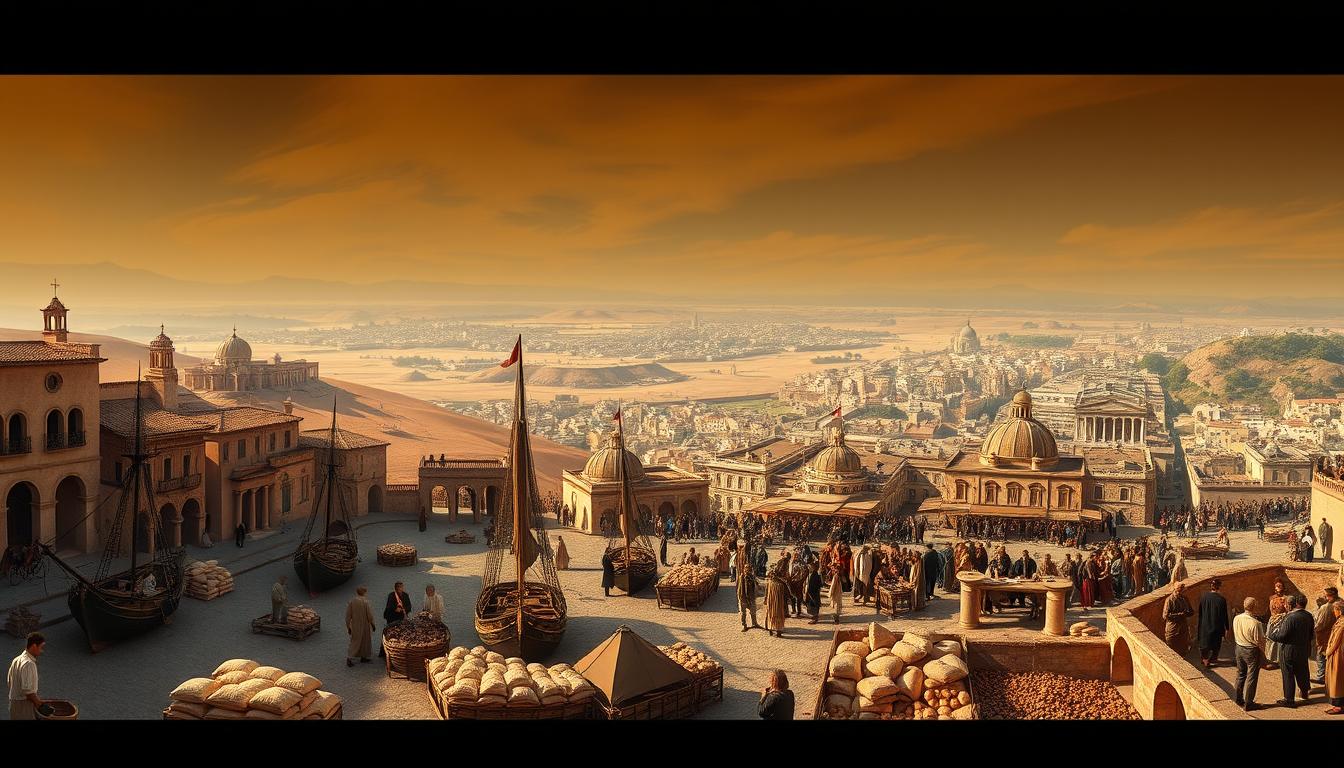
Imagine a humble bean that reshaped civilizations. Coffee’s journey started in Ethiopia, where wild coffee plants thrived for millennia. By 800 AD, communities there found its energizing power.
By the 1400s, roasted beans fueled Arab coffeehouses, sparking debates. These debates became seeds of global coffee history. Early gathering spots weren’t just for sipping—they were hubs where ideas brewed revolutions.
From Yemen’s monopolized trade to Europe’s buzzing coffeehouses, this drink became a catalyst for change. London’s 2,000 coffeehouses hosted discussions that birthed institutions like Lloyd’s of London. This cultural shift wasn’t just about taste—it was a story of coffee impact on society.
By the 1700s, coffee cultural significance spread, turning plantations into colonial power plays. It drove innovations that echo today.
Coffee’s rise wasn’t just about caffeine—it was a force that turned small Ethiopian berries into a global empire. From revolution-planning taverns to modern chains like Starbucks, this drink’s legacy is woven into every corner of human progress.
A Brief History of Coffee
Coffee’s story starts in Ethiopia, where wild coffee plants grew for thousands of years. Nomadic tribes chewed berries for energy long before roasting coffee beans became common in the 1400s. This coffee origin in Ethiopia shaped its global journey.
By the 15th century, Ethiopian coffee reached Yemen. Sufi monks used it to stay alert during prayers. The first recorded coffee cultivation history emerged in Yemen, with beans traded across the Red Sea.
Yet, coffee’s rise wasn’t smooth. In 1511, Mecca’s governor banned it over health concerns. Sultan Suleiman I later lifted the ban in 1524, but resistance continued.
Ottoman ruler Sultan Murad IV famously outlawed it in 1633, even executing offenders. But coffee’s appeal grew. By the 1600s, it reached Europe, fueling bustling coffeehouses in Venice (1645) and London, where 2,000 establishments thrived by the 1600s.
Europeans faced their own controversies. London wives in 1674 accused coffee of causing impotence, sparking the Women’s Petition Against Coffee. Despite bans, coffee’s popularity soared, thanks to the Boston Tea Party in 1773. This turned Americans toward this coffee bean history.
Ethiopia’s role as coffee’s birthplace remains central, even as cultivation expanded globally. From tribal rituals to global commodity, coffee’s past is a tale of defiance and discovery.
Coffeehouses: The Birthplace of Ideas
In the 17th century, coffeehouses became centers of innovation. They played a big role in coffeehouse history as places where people from different backgrounds met. London’s Grecian Coffee House, for example, was a favorite spot for scholars like Isaac Newton.
These places were like “penny universities,” where you could learn for just a penny. Working-class people and nobles debated together, sparking the coffee intellectual history that led to many discoveries during the Enlightenment.
In London, Lloyd’s Coffee House started the insurance industry, which became Lloyds of London. Jonathan’s Coffee House was where the London Stock Exchange was born. Coffeehouses also played a key role in America’s history, like Boston’s Green Dragon Tavern, where the Tea Party was planned.
“A school without a master”—this 1674 critique of coffeehouses’ free-flowing debates ironically highlights their revolutionary social impact. Unstructured yet transformative, these venues democratized learning, making knowledge accessible to all who paid their penny.

Even when faced with royal bans, like Charles II’s in 1675, coffeehouses kept going. Today, modern cafes carry on this tradition. They show that a shared cup of coffee can bring people together to change the world.
The Role of Coffee in the Age of Enlightenment
In 18th-century Europe, coffeehouses became centers of learning. They fueled debates on science, politics, and philosophy. This shift from alcohol to caffeine’s clarity changed minds.
Voltaire, a big fan of coffee, drank 40–50 cups a day at Paris’s Café Procope. There, he wrote plays and essays. Rousseau and Newton also visited these places, making coffee a key to modern thought.
European coffeehouses were called “penny universities” for spreading ideas. People paid a penny for coffee and to join discussions that shaped democracy and science. Even places like Lloyd’s of London and the London Stock Exchange started here, showing coffee’s impact.
In post-revolution Paris, cafés like La Rotonde and Café de Flore kept the tradition alive. Hemingway and Sartre later joined, but the link between coffee and creativity was already set. From Newton’s physics to Voltaire’s satire, coffee may have sharpened minds during humanity’s biggest leap.
Coffee and Colonial Trade
Coffee colonialism changed economies and lives. By the 18th century, European empires grew coffee plantations in colonies. They used enslaved labor to meet Europe’s growing coffee demand.
The Dutch started this in Java by the 1690s. Brazil got its first coffee bushes in 1727. It later became the world’s biggest coffee producer. These coffee plantations heavily relied on the coffee slave trade.
This forced millions into harsh conditions. Haiti, then Saint-Domingue, produced two-thirds of global coffee by the late 1700s. Enslaved Africans harvested it under violent regimes.

Brazil’s economy was all about coffee until 1888, when slavery ended. The coffee global trade boom destroyed ecosystems. Forests were cleared for plantations.
Today, many coffee-producing regions face poverty. This mirrors the dark legacy of the past. Over 44% of smallholder farmers globally live in poverty.
The coffee industry’s roots in exploitation remain. From Java to the Americas, this coffee plantation history affects today’s struggles for fair trade and sustainability. Knowing this history is vital to solving today’s challenges in the $100 billion coffee market.
Coffee and the Industrial Revolution
In 18th-century Britain, the coffee industrial revolution changed work. Coffee helped factory workers stay awake during long hours. It was key for early factories to keep running.
“The drink of the aristocracy had become the necessary drug of the masses, and morning coffee replaced beer soup for breakfast.”
Factories started using clocks instead of sunlight. Workers moved from alcohol to coffee, a cleaner choice. This change cut down on sickness and increased work output.
Coffee breaks became short pauses in work. Instead of long meals, workers drank coffee. Historian Mark Pendergrast said this habit started in factories and spread to offices.
The Industrial Revolution’s success was linked to coffee. It wasn’t just a drink; it was a key to progress.
Wars and Coffee: A Surprising Connection
Coffee’s role in coffee military history started with George C.L. Washington’s invention. He made instant coffee during World War I. This allowed soldiers to make quick cups in the trenches.

In World War II, the U.S. Army needed 140,000 coffee bean bags every month. This was ten times more than before the war. Civilians had to ration coffee, so soldiers got it instead.
Soldiers called instant coffee “a cuppa Joe.” This term is now linked to American service members.
“A warm cup of George Washington’s coffee was the one comfort that kept us going,” wrote a WWI soldier in a 1918 letter. “It felt like a lifeline.”
After 1945, companies marketed instant coffee to veterans. They tied it to patriotism. This made coffee a big part of American culture, replacing tea after the Boston Tea Party.
Coffee’s journey in wars shows how a simple drink became important. It helped with survival, identity, and history. Its legacy lives on in every “cuppa Joe” we drink today.
Global Coffee Culture Today
Today’s global coffee culture is a blend of old and new. Starbucks changed coffee culture, making it a daily habit for many. Howard Schultz’s 1983 trip to Milan inspired the idea of third places.
By 2020, Starbucks had over 30,000 locations worldwide. This shows how powerful Schultz’s vision was.
The specialty coffee movement is also growing. It focuses on quality, from farm to cup. Now, over 60% of coffee lovers seek out specialty coffee for its rich flavors and ethical practices.
Sustainability efforts, like Direct Trade and agroforestry in Costa Rica, are part of this change.
Third-wave coffee isn’t just a drink—it’s a connection to the people and places that grow it.
Today’s cafes mix efficiency with skill. The U.S. coffee market is worth $45.4 billion, and the global market is near $237 billion by 2025. Coffee is a $100 billion industry.
Whether it’s a latte or a single-origin pour-over, each cup has a story. It’s a mix of convenience and craftsmanship that makes modern global coffee culture. It shows coffee’s lasting role in bringing people together.
Environmental Impact of Coffee Production
Coffee is loved worldwide, but it has a big environmental price tag. In Brazil, old farming ways like slash-and-burn harmed the rainforests. Now, farming is causing 5% of global deforestation. Every cup of coffee might take a piece of rainforest, hurting wildlife and coffee biodiversity.

Today, we face new problems like water pollution from pesticides and carbon emissions. Just getting coffee to us adds 15% to its carbon footprint. Climate change could make 50% of coffee land unsuitable by 2050, threatening farmers.
Monoculture farming and pesticides also harm the environment. But, there’s a glimmer of hope.
Shade-grown coffee helps keep ecosystems alive, boosting coffee biodiversity.
Research by CIRAD shows shaded farms in Mexico boost yields by 30%.
Certifications like Fair Trade help farmers grow coffee sustainably. By choosing “shade-grown” or “bird-friendly” beans, we support eco-friendly brands. We can also reduce waste by using coffee grounds again. Every choice we make affects coffee’s future.
Coffee and Health: Myths vs. Reality
For centuries, coffee myths scared people. In 1511, Mecca’s leaders banned it due to health worries. In 17th-century London, it was blamed for impotence. Now, coffee medical research tells us more about its coffee health effects.
The World Health Organization said coffee might cause cancer in 1991. But by 2016, new coffee medical research showed it might actually lower cancer risks in some people. Today, studies find that drinking coffee in moderation can help your heart and brain.
Experts say 3–5 cups of coffee a day is okay, according to the FDA. Pregnant women should stick to 200 mg. Caffeine stays in your system for six hours, so when you drink it matters. But studies show it can improve performance, like a 2020 study on cyclists.
Unfiltered coffee, like French press, has more cholesterol-raising compounds than filtered coffee. But, decades of research say drinking coffee in moderation is safe for most. Enjoying it responsibly means you can enjoy its benefits without harm.
The Future of Coffee: Trends and Innovations
Coffee’s future is bright, thanks to new coffee technology. This tech helps farmers grow coffee even in harsh weather. It also makes farming more efficient and cuts down on waste.
Lab-grown coffee and AI in roasting are changing how we get our coffee. These innovations are making the coffee industry more sustainable. They ensure coffee stays a global favorite.
What we want from coffee is changing fast. Cold brew is up 300% in the U.S., showing we want easy, quick coffee. Mobile apps connect us straight to coffee farms.
Big names like Starbucks and Nestlé are adjusting to these changes. They’re changing packaging and prices to keep up with the market. New cafes use robots and drones for fast, green service.
Even with rising costs, the coffee world keeps moving forward. Future cafes might use tech to order coffee instantly. Sustainability is key, with water recycling and eco-friendly roasting.
Despite challenges, coffee’s story is far from over. From ancient forests in Ethiopia to smart kitchens, coffee’s journey continues. It shows coffee’s lasting place in our lives.