






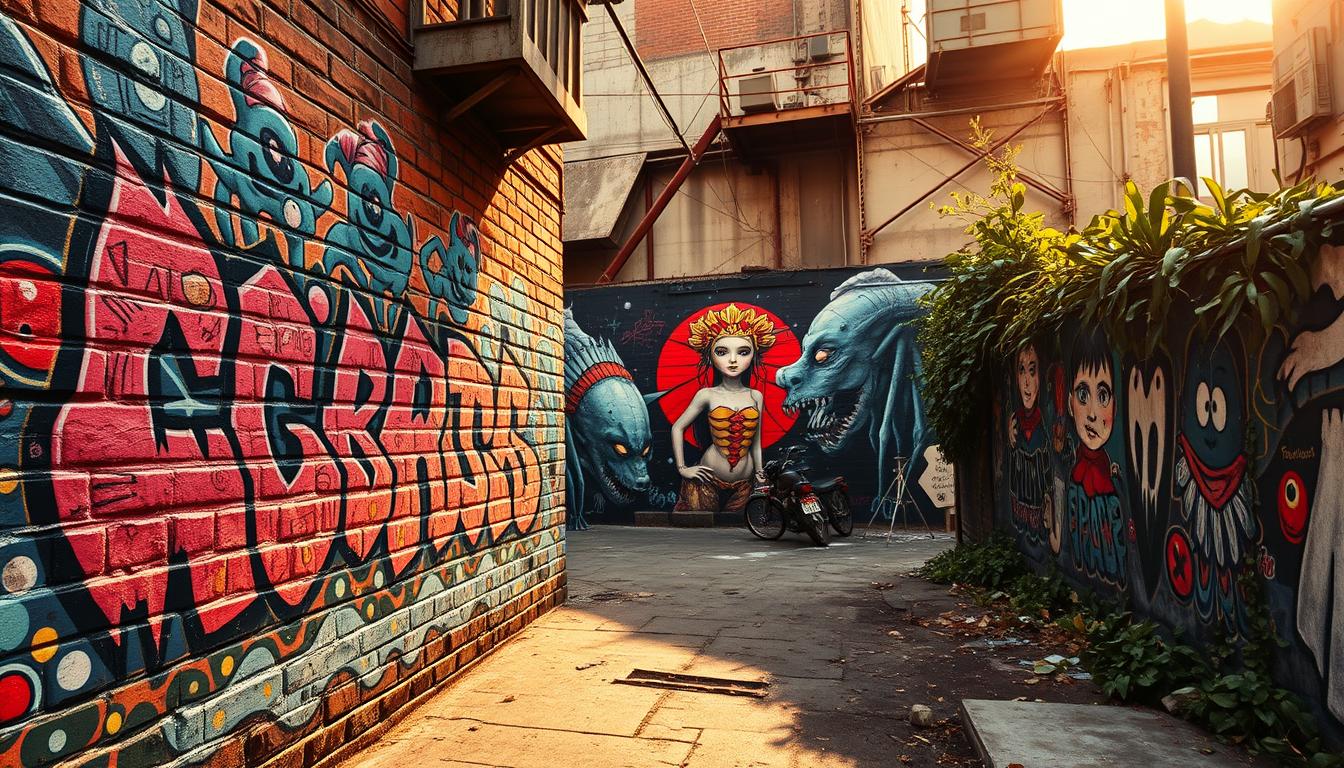
Street art has deep roots, going back thousands of years. The word “graffiti” comes from Italian, meaning “scratched.” It reminds us of ancient writings like Egyptian hieroglyphs and Greek inscriptions. Today, graffiti has grown into a worldwide art movement, mixing culture with urban creativity.
Modern art pieces like Jean-Michel Basquiat’s “$110.5 million “Untitled”” and Banksy’s “$1.37 million “Girl with Balloon”” show graffiti’s worth. Works by artists like Retna and Mr. Brainwash have turned city walls into famous landmarks. But, in places like Los Angeles, graffiti is often seen as a crime, mainly in Black and Latinx neighborhoods.
This shows the two sides of street art. It can empower those who feel marginalized. Yet, it’s also seen as a problem in some areas, showing how race and class affect what we see as art.
The Roots of Street Art as Cultural Expression
Street art history shows a deep desire to mark public spaces. Ancient graffiti in Egypt, Greece, and Rome had love notes, political messages, and religious symbols. The word graffiti comes from Italy, meaning “scratched,” showing early ways to leave marks.
These early signs were a way to express culture, showing humans always wanted to share messages through art.
In the 1970s, New York City’s subway trains became art canvases. Artists like Jean-Michel Basquiat and Lady Pink turned tags into bold self-portraits. This movement merged with hip-hop, reflecting community struggles and pride.
Today, artists like Banksy and Shepard Fairey create murals and posters that connect past and present. Street art has moved from being seen as vandalism to being celebrated in museums and fashion. Brands like Gucci and Dior work with artists, showing its shift to high fashion.
Yet, 70% of artists use it to talk about issues like inequality, just like ancient graffiti did.
The Evolution of Street Art Over Decades
Street art started in the 1960s and 1970s in cities like New York and Philadelphia. It began with simple tags and “throw-ups.” These grew into detailed “wildstyle” lettering, showing off artists’ skills.
In the 1980s, artists like Basquiat and Haring made street art more recognized. They brought street art into galleries, changing how people saw it.
The 2000s saw street art become even more popular. Banksy’s 2006 protest at Disneyland and Shepard Fairey’s “Obey” campaign made big waves. Places like Miami’s Wynwood Walls and Berlin’s East Side Gallery turned old, neglected areas into art spaces.
“The result is that Los Angeles has a really unique graffiti style,” notes artist Illescas. Mexican-American influences now define LA’s aesthetic, merging cultural heritage with bold modernity.

In São Paulo, street art started as a way to speak out in the 1980s. By the 2000s, artists like Os Gêmeos made it famous worldwide. The Open Museum of Urban Art, started after 2011, keeps this art alive.
Today, Instagram helps street art reach more people. But its true spirit remains about speaking out and changing cities.
The Role of Street Art in Urban Communities
Street art does more than just look good. It helps change neighborhoods in cities. In Los Angeles, young people turn empty lots into lively spots with graffiti. This turns forgotten places into signs of community identity.
These public space art projects let people take back their surroundings. They build pride and start conversations in places ignored by officials.
“In a city where these youth are marginalized, graffiti is a way for them to become visible,” says artist José Illescas, highlighting how marginalized communities use art to assert presence.
Research shows street art’s impact. Areas with it see 20% more people walking around and 15% more money for local shops. Murals in Yelahanka, India, show a similar effect, mixing culture with urban renewal.
These projects cut down on vandalism by 30% and bring people together. This shows how art can unite a community.
But, there are also challenges. When artists from outside take over, it can cause problems. True community identity comes from locals leading the art. It’s important to balance creativity with respect to keep street art a force for good, not harm.
As cities expand, street art becomes more than just decoration. It’s a living conversation between people and their surroundings.
Street Art as a Reflection of Society
Street art turns city walls into giant canvases for political street art and social commentary. Artists like Banksy and Keith Haring show that spray cans and stencils can challenge the status quo. Banksy’s “Love is in the Air” shows a skull over Jerusalem’s West Bank barrier, questioning occupation and resilience.
Keith Haring’s “Crack is Wack” turned a basketball court into a visual protest against the 1980s drug crisis. This shows how art can speak truth to power.

Today, artistic activism is booming in public spaces. Murals honoring George Floyd popped up worldwide during the Black Lives Matter movement. There was a 300% increase in such works.
Over 70% of street artists focus on marginalized communities. They use art to bring attention to issues ignored by mainstream media. These pieces act as real-time cultural reflection, capturing crises like the pandemic’s toll or climate change.
Data shows 60% of artists use their work for social commentary. 85% believe their art sparks important conversations. Murals addressing mental health or LGBTQ+ rights engage people in ways galleries can’t.
Even temporary pieces have a lasting impact: 40% of urban residents feel street art strengthens community identity. This art form’s raw, accessible nature ensures voices often unheard gain visibility. It turns cityscapes into living diaries of societal struggles and triumphs.
The Techniques and Styles of Street Artists
Spray paint art is everywhere in cities, but artists use many ways to express themselves. Retna’s calligraphic designs on Mexico City’s Cuauhtemoc building are just one example. Banksy’s stencils are another, each telling a unique story. Street art combines old and new, using everything from spray cans to new materials.
Stencil art, started in 1980s France, became famous worldwide thanks to Banksy. Shepard Fairey’s stickers, part of the Obey Giant campaign, have spread far and wide. Ernest Pignon-Ernest’s posters from the 1970s are a quick way to make art that can be easily removed.
Invader’s pixel mosaics, tracked by 240,000 app users, mix old video games with street art. This shows how urban art reflects local cultures. LA graffiti often uses Mexican calligraphy, while Brazilian pixação is known for bold letters in favelas.
Tape art, like Mark Jenkins’ realistic figures, started in the 1980s. Yarn bombing, beginning in 2005, covers buildings in cozy knits. Even cleaning surfaces to create images adds to the city’s beauty.
Today, artists use technology to create new effects. AR overlays and 3D illusions, like Philippe Echaroux’s video projections, blend digital and real. Street art turns cities into galleries, showing its endless creativity.
Contemporary Platforms for Street Art
Street art platforms like the Portland Street Art Alliance (PSAA) have changed how artists work together legally. They get permissions and support local artists, turning walls into art while respecting property rights. Social media helps this movement, sharing digital street art with millions quickly.

Graffiti festivals like Pow! Wow! and Upfest draw people from all over, mixing street art with urban art shows. These events offer legal places for artists to display their work, encouraging creativity safely. Apps and virtual tours also let people see street art from anywhere, keeping murals alive for the future.
Even when it is clearly a trespass, it often has a realness, an unfiltered energy and impact, that no gallery art can equal.
Platforms like Instagram and websites increase street art’s visibility, but there are debates. Does making money make street art lose its edge? Or does it make it more accessible? The key is finding a balance—keeping the tradition alive while exploring new ways to share stories legally and digitally.
The Impact of Street Art on Local Economies
Street art tourism is changing cities, making once-neglected areas lively. Places like Miami’s Wynwood and Brooklyn’s Bushwick show how commercial street art can transform neighborhoods. These areas now have galleries, cafes, and shops, thanks to the cultural vibe.
Big sales, like Jean-Michel Basquiat’s $110.5 million Untitled or Banksy’s $1.37 million Girl with Balloon, show street art’s value. But its impact goes beyond auctions. In Santa Ana’s downtown, events like the DTSA First Saturday Artwalk boost local businesses.
“Street art isn’t just decoration—it’s a catalyst for community growth,” says a Santa Ana business owner, noting increased sales during artwalk weekends.
Urban renewal projects bring jobs and investment but can also raise rents. This makes it hard to balance economic impact with keeping costs low. Projects like the Jaguar Parade and Art of Love show how to create jobs without pushing out locals. By working with artists in city planning, cities can grow fairly and keep their culture alive.
Street Art Legality and Ethics
Street art legality is about finding a balance between graffiti laws and ethical street art. The vandalism debate is about property rights versus artistic freedom. Laws differ greatly, with some cities banning unauthorized art and others setting up legal walls.
In Portland, the “Free Walls” program lets artists work in certain areas. This helps avoid conflicts over street art legality.
Street art often serves as a platform for empowering marginalized voices, contributing to social equity and community dialogue.
The debate centers on whether unauthorized art is a form of freedom or a violation of property rights. In New York, the 5Pointz case awarded $6.5M to artists after their work was destroyed. This shows the tension between preserving art and following the law.
In France, graffiti is seen as property damage under the Criminal Code. But in the U.S., courts sometimes see temporary art as protected expression.
Ethical street art respects communities. Artists must think about the environment and cultural sensitivity. Working with property owners or local governments can turn walls into celebrated spaces.
Philadelphia now hosts permitted murals, turning the vandalism debate into a chance for dialogue.
As policies change, the goal is to honor creativity while respecting property rights. This balance helps street art thrive without being illegal.
Street Art as an Educational Tool
“The graffiti that we see up in the streets may seem like an insignificant tag or scribble to some people, but there’s a lot of meaning behind it,” he said. “There needs to be a recognition that graffiti is actually a visual representation of someone’s identity, and it’s also potentially their starting point to a very meaningful artistic career.”
Educational street art programs like Positive Street Art (PSA), founded in 2012, are changing how students learn. These programs mix art with community learning. They use murals and public art to teach about history, social justice, and culture.
In Nashua, New Hampshire, artists like Manuel Ramirez and Cecilia Ulibarri lead workshops. They turn city walls into learning tools. Ramirez won the 2022 Rising Stars Award, and Ulibarri is one of Nashua’s 40 Under 40.
PSA welcomes everyone, including BIPOC, LGBTQIA+, and differently-abled people. They create murals that spark talks about inequality and the environment. For example, a mural in Manchester, NH, showed local Indigenous histories, starting conversations about land rights and culture.
Street art teaches youth to tackle real-world problems through art. PSA will celebrate 12 years of service in 2024. Their work shows street art is more than decoration; it connects communities and classrooms, promoting creativity and empathy.
Street art helps build skills in self-expression and critical thinking. As PSA’s work shows, it’s not just for art classes. It’s a tool for lifelong learning.
Iconic Street Art in the United States
Across the country, American street art turns cities into vibrant galleries. In Portland, the Lovejoy Columns show how preservation meets creativity. These pillars, once part of a highway, now display Tom Stefopoulos’s colorful designs in the Pearl District. Such examples show how famous murals shape community identity.

New York’s Wynwood Walls in Miami turned an old industrial area into a major US urban art spot. Philadelphia’s Mural Arts Program has made over 4,300 murals, weaving community stories into public spaces. For example, Black Lives Matter Plaza in D.C. uses iconic graffiti to share important messages, showing art’s ability to start conversations.
Artists like Keith Haring and Banksy have made lasting impacts. Haring’s “Crack Is Wack” murals and Banksy’s bold stencils changed American street art. Today, artists like JR and Swoon carry on this tradition, blending old and new. Now, 30% of artists use eco-friendly paints, and 50% of murals include AR tech, letting viewers see more with their phones.
In Detroit, “Detroit Rising” celebrates the city’s strength. Chicago’s sound-reactive art by Echo shows the nation’s diversity. The Love Letter Project in Philadelphia and Cincinnati’s ArtWorks initiatives unite communities through US urban art. As cities like Nashville honor music legends with famous murals, street art continues to grow and evolve, connecting culture and community.
The Future of Street Art
The future of street art combines new ideas with old traditions. Tools like augmented reality and drones are changing city views. Imagine using your phone to see hidden layers in a mural, making art interactive.
Artists are also focusing on being green. They use paints that break down easily or create art by cleaning surfaces. In Berlin and Barcelona, solar-powered art shows that beauty can be eco-friendly.
Cities are looking at new ways to use space. Portland lets artists paint temporary murals on blank walls. This idea could grow, turning empty lots into art spaces. Partnerships between public and private groups might support these projects, blending creativity with community needs.
Technology and ethics are guiding street art’s direction. But its essence remains the same: challenging the status quo. Will it stay a bold voice or become a commercial product? Its path depends on balancing innovation with its roots in conversation and opposition.
How to Get Involved in Street Art Culture
Ready to join the street art movement? Start by exploring local events like Portland’s Weekly Graffiti Night. Here, art, food carts, and community come together for vibrant evenings. Attend guided tours or festivals such as POW! WOW! to learn more about street art.
Follow artists on social media to see their work and hear their stories. This way, you can go from just looking to truly appreciating street art.
Supporting artists means more than just liking their work. You can buy prints, go to gallery shows, or support crowdfunding for public art. The Portland Street Art Alliance needs donations to protect and promote ethical graffiti.
Volunteer for projects that paint murals in areas that need them. This turns empty walls into cultural landmarks.
Aspiring artists should focus on ethics. Practice legally in designated zones and understand local laws. Learn new skills through workshops or online tutorials before you start.
Always think about the community first. Ask permission, work with locals, and don’t erase other art.
Stay updated with documentaries like Banksy Does New York or books like Street Art: The Graffiti Revolution. Follow global inspiration on platforms like Google’s Street Art Project. Your actions, from mural donations to respectful photos, help keep street art alive.