




The Sumerians introduced the 24-hour day, and Rome’s concrete is found in the Pantheon. These ancient cultures left a mark on our world. Their traditions, like Egypt’s hieroglyphs and the Maya calendars, shape our math and architecture today.
These ancient practices, such as the use of zero in math or papyrus paper, connect us to the past. They show how innovations from thousands of years ago are part of our lives now.
Universities now teach hieroglyphs as interest in cultural heritage grows. The Great Pyramid’s precision and China’s early dynasties show the lasting impact of these traditions. By exploring these connections, we see how ancient wisdom lives on in our daily lives.
This proves that timeless traditions are not just history. They are very much alive today.
The Lasting Impact of Ancient Rome
Roman legal ideas are key in today’s courts. The Roman legal system brought us “innocent until proven guilty” and “due process.” These ideas are alive in today’s justice systems.
Laws from ancient Rome guide contracts, property rights, and digital privacy. Judges around the world look to Justinian’s codes for fairness. This shows Rome’s legal legacy is a foundation of justice.
Roman architecture’s durability is awe-inspiring. The Colosseum’s arches, made with volcanic ash concrete, have lasted 2,000 years. Modern engineers study these Roman architecture techniques for bridges and dams.
Aqueducts inspired today’s water systems. And domes in buildings like the U.S. Capitol mirror Rome’s Pantheon. This shows the lasting impact of Roman architecture.
Latin’s influence is seen in everyday words. Over 60% of English words come from Latin, from “justice” to “computer.” Romance languages, spoken by 920 million, come from Latin, showing its global Latin language legacy.
Medical terms like “appendicitis” and legal phrases like “actus reus” show Latin’s impact. It shapes many modern professions.
Roman ideas about cities influence urban planning. Grid layouts, public baths, and paved roads set modern city standards. The seven-day week and 12-hour clock also come from Rome.
From law to language, Rome’s mark is everywhere. Its influence is seen in many aspects of our lives today.
The Wisdom of Ancient Greece
Ancient Greek wisdom shapes our thinking, governance, and exploration today. Greek philosophy is a key part of Western thought, influencing debates and ethics. The Socratic method, which questions to find truth, is used in law schools, showing its enduring value.
Thinkers like Socrates, Plato, and Aristotle founded logic and ethics. Plato’s talks on justice and knowledge inspired medieval scholars. Aristotle’s works on science and politics guided Renaissance thinkers. His biology and physics writings sparked curiosity in the natural world.

Greek democracy started in Athens, where citizens voted on laws. This idea inspired modern democracies. Pericles’ leadership in the 5th century BCE made Athens a hub of innovation, funding the Parthenon and encouraging debate. This model of civic engagement is seen in town halls and parliaments today.
“The only good is knowledge, and the only evil is ignorance,” said Plato, reflecting how Greek ideas on education guide schools today.
Scientific achievements like the Pythagorean theorem and Hippocrates’ medical ethics continue to influence us. The Hippocratic Oath, written over 2,000 years ago, guides doctors to “do no harm.” Greek contributions also shape modern medicine, math, and astronomy. From trial by jury to the Olympics, their legacy is all around us, showing how ancient ideas can lead to progress.
Traditions Passed Down from Ancient Egypt
From calendars to construction, ancient Egyptian traditions today shape modern life in unexpected ways. Their Egyptian mathematics astronomy skills allowed them to predict the Nile floods accurately. This led to a 365-day calendar that influences our yearly cycles. Farmers then, as now, rely on timing, a lesson from a civilization thriving over 5,000 years ago.
The Pyramids of Giza stand as monuments to Egyptian architecture influence. How did they lift and align stones without modern tools? Their geometry and engineering principles inspire today’s skyscrapers and bridges. The Yale Peabody Museum’s “Echoes of Egypt” exhibit highlights this legacy, displaying tools and blueprints that echo in today’s construction zones.
Even medicine bears their mark. Egyptian medical knowledge included herbal remedies and surgical tools later validated by science. Their mummification process advanced anatomy understanding, aiding today’s medical imaging tech. The exhibition’s online archive (see here) shows how their practices laid groundwork for modern medicine and art.
Contributions from Mesopotamian Cultures
Mesopotamian contributions today are all around us, but often unnoticed. The Sumerians created cuneiform, the first script, on clay tablets. By 3100 BCE, it helped record trade, literature, and laws. This system lasted for thousands of years, shaping administrative systems in the Middle East.

Sumerian math changed how we solve problems. Their base-60 system, known as Mesopotamian mathematics, is in our 60-minute hours and 360-degree circles. The Plimpton 322 tablet shows they knew about Pythagorean triples long before the Greeks.
Ancient Babylonian law started with Hammurabi’s Code, setting rules for justice like “an eye for an eye.” Though strict by today’s standards, it helped create fair legal systems. These laws influenced trade, property, and labor, shaping modern contracts.
From writing to timekeeping, Mesopotamia’s ideas are in our daily lives. They solved farming problems with irrigation, a technique we study today. Their legacy is not just history; it’s a guide for our modern world.
The Cultural Heritage of the Indus Valley
The Indus Valley civilization left us cities that were both innovative and sustainable. Over 4,000 years ago, Harappan urban planning created cities like Harappa and Mohenjo-daro. These cities had grid-based streets and multi-story homes, housing tens of thousands with precision.
Their design focused on order, setting a blueprint for today’s cities.
Their ancient sanitation systems were also groundbreaking. Every home was connected to covered sewers. The Great Bath of Mohenjo-daro used filtered water, showing clean living wasn’t just a modern idea.
“Winter monsoons strengthened as summer rains faded,” researchers found, explaining how climate shifts pushed communities eastward.
Indus Valley standardization played a big role in trade and governance. Uniform bricks, weights, and seals show a unified system. This enabled long-distance commerce, similar to today’s trade networks.
Their dock facilities hint at early globalization. Though the civilization faded by 1700 BCE, its ideas live on. From clean water channels to city grids, its blueprint for living is seen in today’s infrastructure.
Today, their story teaches us: adapting to change is as vital now as it was 4,000 years ago.
Ancient Chinese Influence on Modern Society
Everyday life today is shaped by ancient China’s breakthroughs. The Chinese paper printing legacy changed how we share knowledge. It helped spread literacy and led to today’s digital world.

Confucian teachings are part of today’s governance. The Confucian influence modern shows in China’s diplomacy. It focuses on harmony and mutual respect.
Traditional Chinese medicine connects the past and present. It uses acupuncture and herbs, now recognized worldwide. This approach to health is growing, blending old wisdom with new medicine.
China’s ancient engineering feats, like the Grand Canal and Great Wall, inspire today’s projects. The ancient Chinese innovations today also influence AI and sustainable planning. Even the old imperial exam system’s idea of merit-based education is seen today.
“Harmony is the way of Heaven, and humanity’s practice should follow it.”
From paper to health practices, ancient China’s legacy shapes our lives. Its ideas continue to evolve, showing their lasting value in our changing world.
The Legacy of Native American Cultures
Indigenous governance systems laid the groundwork for U.S. principles. The Haudenosaunee Confederacy’s focus on consensus and shared power influenced the U.S. Constitution. Benjamin Franklin studied their model, adding checks and balances to early American democracy.
Indigenous farming practices changed global diets. The Three Sisters—corn, beans, and squash—thrived together, improving soil health. These methods, developed by the Mississippians at Cahokia, inspire sustainable farming today.
Their crop varieties, like potatoes and tomatoes, are now worldwide staples.
Native environmental management techniques, like controlled burns, boosted biodiversity. These practices managed forests and prevented wildfires, ideas modern ecologists are reviving. Sustainable hunting and land stewardship show their deep ecological wisdom.
Native American cultural legacies endure through resilience. The Wampanoag tribe revived their language using a 1663 missionary’s documents, creating a dictionary and the documentary We Stil Live Here. Legal milestones, like the 1978 Religious Freedom Act, protect traditions, while the 1990 Repatriation Act returned sacred objects. Today, over 574 tribal nations uphold these legacies.
Sequoyah’s Cherokee syllabary and figures like Vice President Charles Curtis reflect enduring contributions. From governance insights to ecological foresight, these traditions offer solutions for modern challenges. Their lessons in balance—between people, land, and governance—remain vital for a sustainable future.
What We Learn from African Civilizations
Ancient African civilizations have a lasting impact on our world today. They introduced African metallurgy traditions and African mathematical systems. The Great Zimbabwe’s massive stone walls, built without mortar, show advanced engineering skills.
Its African trade networks reached from India to the Mediterranean. They traded gold and ivory. These networks connected continents before European explorers.
Metallurgy in Africa reached unmatched heights. Tanzanian furnaces burned hotter than Roman ones. This allowed for detailed bronzes in Benin and goldwork in Mali.
These traditions improved tools and art, influencing metalworking worldwide. Egyptian mathematicians calculated pyramids’ angles using formulas we study today. The Yoruba’s base-20 counting system and the Swahili’s maritime trade routes show Africa’s early grasp of complex systems.
“The Dogon people mapped Sirius’ orbits centuries before telescopes,” says modern astronomy research, echoing their deep astronomical knowledge.
Trade cities like Gao and Timbuktu became centers of learning and commerce. They linked the Sahara to the Indian Ocean. These ancient African civilizations’ impact on trade, science, and urban planning is clear.
Their legacy lives on in architecture, education, and technology. It challenges outdated historical narratives.
Ancient Persia’s Contributions to Civilization
The ancient Persian legacy lives on in today’s governance and technology. Their Persian administrative systems under Darius I managed 20 provinces with one set of laws and taxes. This idea inspired many later empires and modern governments.
The Royal Road, a 2,500 km path, connected far-off lands. The Chapar Khaneh postal system also set a standard for mail services. Even the US Postal Service looks up to it as an early model.
Persian engineering feats, like qanats—underground water channels—, are used to irrigate dry areas. These systems, over 2,500 years old, show smart design. The yakhchal ice towers and lush chahar bagh gardens also influenced landscaping worldwide.
Their farming innovations, such as crop rotation and diversity, are key to farming today. These ideas help farmers grow food sustainably.
Zoroastrian teachings shaped religious and ethical views. This 4,000-year-old faith promoted monotheism and moral living. It taught about caring for the environment and justice.
The Cyrus Cylinder’s decree on respecting cultures was a human rights milestone. It showed the importance of tolerance and freedom of worship.
From roads to religious ideas, ancient Persia’s innovations last. Their mix of innovation and inclusivity shows how old ideas can lead to progress. Their legacy of fairness, connection, and sustainability is often overlooked but continues to shape our world.
The Influence of the Maya and Aztec Societies
Today, cities and farms take cues from ancient Mesoamerica. The Maya’s Mesoamerican calendar systems were incredibly precise. Their 260-day sacred calendar is a prime example.
Their Maya Aztec modern influence also shaped farming. Techniques like chinampas, or floating gardens, are used today. These gardens, found in Mexico, increase crop yields in wetlands.

Maya and Aztec cities, like Tikal and Teotihuacan, show advanced urban planning. They had drainage systems and structures like the pyramid at Chichén Itzá. These designs are studied today for water management in dry areas.
Maya math, including the concept of zero, helped start modern computing. Their Mesoamerican calendar systems also sparked global interest. They showed ancient societies could track the stars without today’s technology.
In Guatemala, farmers plant crops by traditional lunar cycles. This mix of old and new methods is fascinating.
The Role of Ancient Cultures in Modern Religion
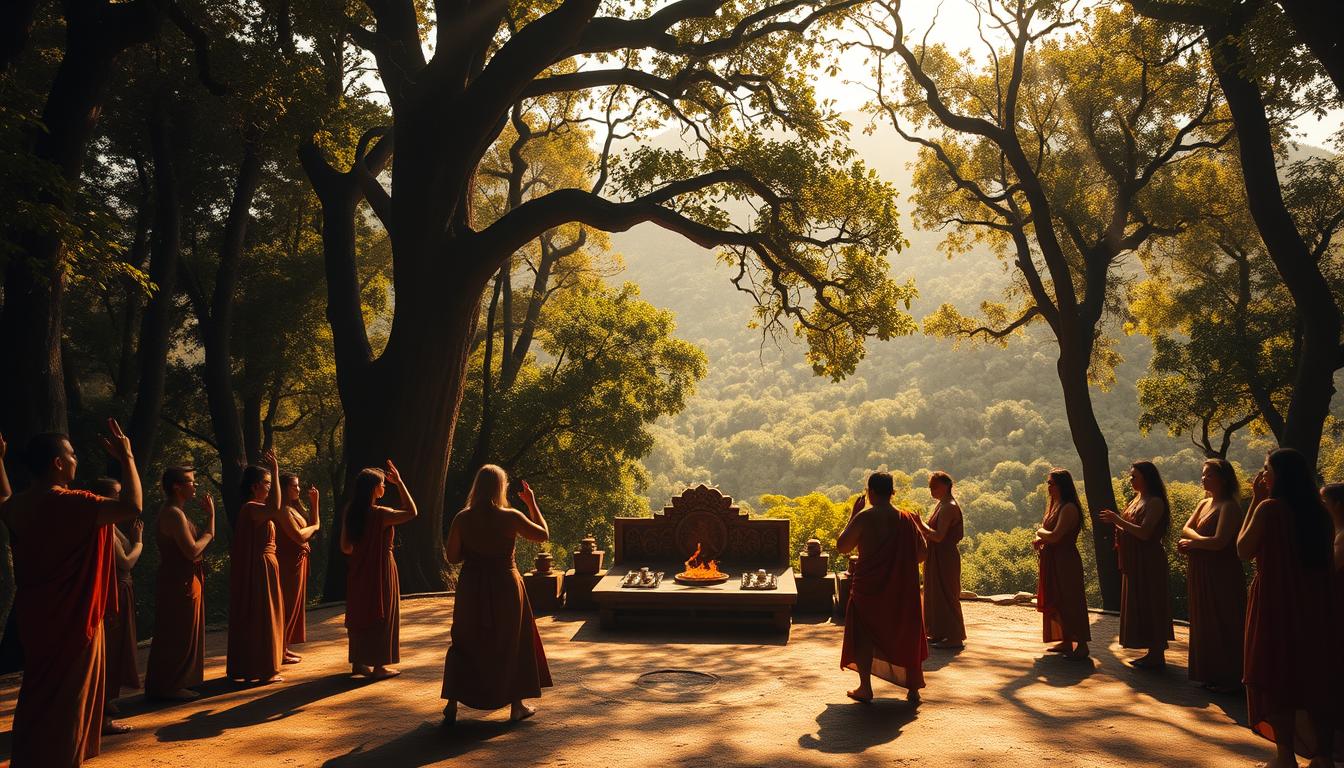
Every time we light a candle in a church or visit a temple, we unknowingly carry forward ancient religious influences today. Festivals like Easter and Halloween trace to pagan solstice rites. This shows how ancient ritual modern practice endure. These traditions remind us spirituality evolves but never fully leaves its roots.
Walk into any grand cathedral or mosque and you’ll see the religious architectural legacy of antiquity. Ancient temples used symmetry and light to inspire awe—a design philosophy that guides places of worship today. The Roman Pantheon’s dome echoes in modern spaces, proving sacred geometry is timeless.
Even symbols hide ancient stories. The cross, aniconic in early Christianity, borrowed from Egyptian ankh motifs. Hindu mandalals and Islamic geometric patterns all trace to older belief systems. These religious symbol origins show how faiths reinterpret but rarely erase the past.
“Polytheism’s adaptability hints at ways modern religions could embrace diversity,” notes scholar Maurizio Bettini in In Praise of Polytheism.
From prayer postures to sacred texts, ancient faiths live on in rituals we practice daily. Their legacy isn’t just history—it’s a living thread in every spiritual journey.
The Preservation of Ancient Knowledge
From the Library of Alexandria to today’s digital archives, ancient knowledge preservation connects past and present. Early civilizations used written records, like China’s ancient texts, to keep wisdom alive. Now, archaeological techniques today like DNA analysis and radar uncover history without harming sites.
Projects like the digital heritage projects of the Buddhist Digital Resource Center and the Israel Museum’s work with Google digitize ancient texts. This shows how technology keeps ancient voices alive.
Efforts to save historical document conservation go beyond museums. Apps like Headspace or Calm teach meditation based on ancient practices. Virtual reality recreates sacred spaces, letting users explore temples or Silk Road routes virtually.
Yet, challenges remain. Simplified online content can distort meanings, and fast digital culture can overshadow deep study of ancient texts.
The Eurasian region, once a hub of knowledge via the Silk Road, now has digital platforms reviving its historical role. Ancient philosophies, like those in Chinese and Eurasian traditions, are more urgent today due to climate crises. By using modern tools with respect for original contexts, we ensure ancient knowledge preservation is a global resource. As information spreads fast, these efforts remind us that wisdom from millennia past guides our future.