







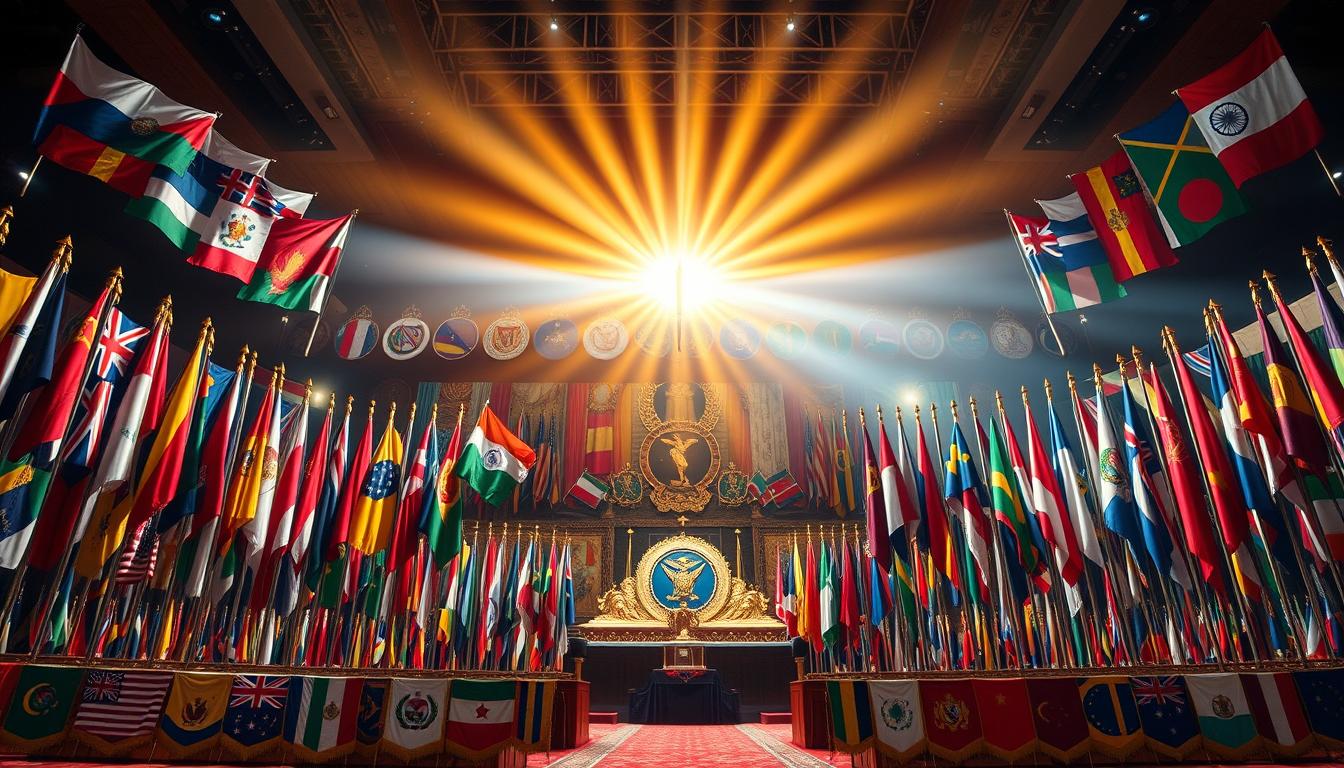
National flags wave outside the United Nations Headquarters. Here, all 193 member states show their cultural symbols. These symbols mean more than just waving in the wind. They carry history, values, and a sense of belonging.
A flag’s meaning can change over time. The Star-Spangled Banner, for example, has a rich history. Its original, made by Mary Pickersgill, is now at the Smithsonian. Despite missing stars, it remains a symbol of freedom.
Flags have evolved over centuries. Denmark’s Dannebrog dates back to the 13th century. South Africa’s rainbow flag was introduced in 1994. The UK’s Union Jack and Canada’s maple leaf also have interesting stories.
These symbols tell of past struggles and present pride. They connect us to our heritage. The Eiffel Tower and Statue of Liberty are symbols of liberty and reinvention.
Ukraine’s blue-and-yellow flag, introduced in 1991, is a powerful symbol. It shows a nation reclaiming its voice. Cultural symbols are living stories that evolve and unite us.
The Importance of Cultural Symbols in a Globalized World
Cultural symbols like flags and traditions are key in a world where cultural unity is tested by globalization impact. These symbols hold shared values that shape communities. They keep histories alive as borders fade. For example, the American flag changes with society but always stands for national pride.
Japan’s Hello Kitty, starting as a 1974 coin purse, now symbolizes both Japanese collective heritage and global pop culture. This shows symbols can thrive by balancing local roots with global appeal. Indigenous groups like Cultural Survival fight to keep ancestral symbols alive, showing shared values can respect diversity. Anthropologist Ulf Hannerz’s work shows global networks often celebrate cultural differences.
Symbols are not fixed; they evolve with society. When used wisely, they help communities adapt to change while honoring their heritage. This way, national pride grows, not through staying the same, but through meaningful change that values tradition and progress.
Understanding Flags: More Than Just Colors and Shapes
National flags tell stories in fabric. The Star-Spangled Banner, a 30-foot flag, flew over Fort McHenry in 1812. It survived a 25-hour British attack, becoming a symbol of American strength.
This event inspired Francis Scott Key to write the national anthem. It showed the flag’s power as a patriotic emblem of courage.
“We, sir, are ready at Fort McHenry to defend Baltimore against invading by the enemy,” Major George Armistead declared. His demand for a “flag so large the British could see it” set the stage for its iconic status.
Every flag history has a purpose. The U.S. flag’s red, white, and blue stand for courage, purity, and justice. European flags, like Denmark’s Dannebrog or Switzerland’s cross, have medieval roots.
Modern flag symbolism is also deep. Japan’s sun disc symbolizes eternity, and South Korea’s yin-yang represents balance.

Colors and shapes mean a lot. The Netherlands’ red-white-blue stripes honor the Prince of Orange. Poland’s white and red reflect its ancient coat of arms.
State flags, like Alaska’s northern star or Texas’s lone star, connect to local history. These symbols bring people together, showing flags are more than fabric. They are visual anthems of shared identity.
Emblems: What They Represent for Nations
National emblems like coats of arms and seals tell a nation’s story. The U.S. Great Seal shows a bald eagle with olive branches and arrows. This symbolizes peace and strength. Canada’s maple leaf represents its environment and identity.
These emblematic imagery elements are rooted in heraldry. They mix natural symbols, historical events, and cultural motifs. This creates instantly recognizable icons.
National seals used to verify documents. Now, they show a nation’s power, appearing on currency and passports. The American eagle, for example, has 13 stars and stripes, reflecting the original colonies.
The UN flag’s design inspired others, like Cyprus’s olive branches. This shows how emblematic traditions connect across borders.
These symbols bring people together. The Statue of Liberty’s torch and the Liberty Bell’s crack share a common heritage. National seals and coats of arms are part of everyday life, boosting pride in our shared identity.
They appear on state buildings and merchandise. They remind us of our shared story. Even small designs can hold big meanings.
National Anthems: The Soundtrack of National Identity
National anthems are more than just patriotic songs. They are symbols that tell a nation’s story. The Star-Spangled Banner, for example, started as a poem by Francis Scott Key during the 1814 Battle of Fort McHenry. It took over a century to become official, with Congress passing it in 1931 after five tries.
This long journey shows how
Key’s lyrics were set to a drinking song melody, creating lasting musical symbolism. The high notes in The Star-Spangled Banner are a challenge for singers today, reflecting its origins in war. Japan’s anthem, for instance, was created in 1880 using a Heian-era poem, showing anthem history varies globally. The Netherlands’ Wilhelmus, from 1568–1572, is the oldest melody in use.
Anthems also reflect societal changes. South Africa’s anthem combines five languages, while India’s Jana Gana Mana is based on a poem by Rabindranath Tagore. Debates over outdated lyrics keep these national anthems alive. Even Sweden and the UK have de facto anthems, showing tradition and change can coexist.
Cultural Icons: Figures That Inspire National Sentiment
Dolley Madison and Uncle Sam are symbols of a nation’s spirit. Dolley Madison changed the role of a first lady, using her charm to connect people in Washington’s early days. Her famous 1809 inaugural ball made her a cultural hero, mixing hospitality with political power.
Uncle Sam started as a supplier’s initials but became a giant symbol. He began as slang for government rations in the War of 1812. Artists later made him a bearded, star-spangled figure, urging patriotism.
This symbolic character grew from military jokes to a symbol of American values. It shows symbols gain power through stories.
These figures connect because they share our ideals. Dolley’s elegance and Uncle Sam’s folksy charm represent American values. Even today, cultural heroes like athletes or activists carry similar weight, embodying hopes and struggles.
Their stories remind us that identity is shaped by those we honor. And how their legacies live on beyond their lifetimes.
The Role of Language as a Symbol of Unity
Language is more than just talking—it’s a bond that ties communities together. National languages like French in Canada or Welsh in Wales help shape cultural identity. Governments that support linguistic unity show they value their people’s unique ways of speaking.

Efforts to save endangered languages, like Indigenous tongues in the U.S. or Basque in Spain, are vital. These actions keep linguistic heritage alive for the next generations. In Switzerland, four national languages live together, showing unity doesn’t mean everyone must speak the same.
Language can also create divisions, but it can unite us. In schools and courts, language identity is celebrated every day. Iceland and New Zealand, for example, protect their languages as part of their national identity. This isn’t just about keeping traditions alive—it’s about connecting with our past and future.
The Significance of Traditional Dress and Symbols
Traditional clothing is more than just clothes; it’s a living story. Ghana’s kente cloth and Ethiopia’s habesha kemit are full of history. Each piece tells a story through its colors and patterns.
In India, red saris mean fertility. Japan’s kimonos have cranes for longevity. These clothes connect us to our heritage.
Scotland’s tartan kilts were once banned but became symbols of pride. Vietnam’s ao dai mixes French and Vietnamese styles. These clothes show how symbolic attire changes yet stays true.
Folk patterns like the Sankofa in kente cloth tell stories. They turn fabric into a language.
“Traditional clothing is a map of identity,” says Dr. Emily Hanna, a cultural anthropologist. “They remind us who we are.”
Today, traditional clothes face a challenge. Modern designers make them fashionable, but communities worry about authenticity. Peru’s chamanto ponchos mix old and new.
But, when does admiration turn into disrespect? The key is respect. Learning the stories behind these clothes and supporting artisans is important. From the barong Tagalog to the qipao, these outfits show cultural dress’s enduring value.
Sports Teams as Cultural Symbols
National teams and their symbols carry a nation’s hopes and history. When Brazil wins the FIFA World Cup, it’s more than just a game. It’s celebrating a sports identity built over years. The 1995 Rugby World Cup victory in South Africa, celebrated by Nelson Mandela, showed how sports can unite a nation.
“One nation. One team.”—Nelson Mandela, 1995 Rugby World Cup

India’s cricket wins in 1983 and 2011 were celebrated by millions. They saw a shared sporting heritage that goes beyond language and borders. Local teams, like the Green Bay Packers in Wisconsin, also unite communities through colors and chants.
Modern athletic symbols show how the world is changing. China’s success in gymnastics and table tennis shows discipline. The rise of e-sports challenges old views of sports. Yet, symbols like the Brazilian jersey or the Olympic flame remind us that sports reflect who we are.
Art and Architecture: Visible Tokens of Identity
Buildings tell stories that words cannot. The Statue of Liberty, a national landmark, rises as a beacon of freedom. Its torch and form embody the architectural identity of welcoming immigrants—a symbol bridging past and present. Nearby, the Lincoln Memorial stands as a cultural monument to democracy’s evolution. These structures are more than stone; they are living records of shared values.
From the artistic heritage of the shotgun house to the grandeur of the U.S. Capitol, design choices shape collective memory. The shotgun house’s narrow layout reflects African architectural traditions brought to the South, merging survival with innovation. Public art like Maya Lin’s Vietnam Veterans Memorial blends symbolic buildings with healing, proving memorials can evolve with societal change.
Controversies over Confederate statues highlight how cultural monuments spark debate. Just as Kosovo’s architectural identity faced erasure, U.S. landmarks like the Edmund Pettus Bridge in Selma remind us of civil rights struggles. Each national landmark carries layers of history, challenging viewers to confront uncomfortable truths.
Architectural heritage evolves yet endures. The 19th Amendment’s legacy lives in the Belmont-Paulson House, a symbolic building preserving suffrage history. As cities redesign parks and memorials, they reshape what artistic heritage means. Architecture remains a canvas where culture’s past and future meet.
Religion and Spiritual Symbols in Nations

Religious symbols play a big role in how nations show their spiritual heritage and faith traditions. The U.S. Department of Veterans Affairs lists 57 official symbols for headstones. These symbols range from Christianity to non-religious options. They show how sacred imagery connects personal faith with public identity.
More than 64 nations have religious symbols on their national flags. Christian symbols are on 31 flags, like Nordic crosses and Latin American emblems. Islamic symbols are on 21 flags, and Buddhist and Hindu imagery is on five.
Israel’s Star of David and Iran’s Faravahar are examples of how sacred imagery becomes a nation’s identity. Even secular nations use faith-linked symbols. The Star and Crescent, from Ottoman history, now represents Turkey’s cultural identity.
126 countries include religious themes in their national anthems. This unites citizens through shared rituals. But, balancing religious diversity is complex: 33% of flags with religious symbols reflect majority faiths. This raises questions about minority representation.
In the U.S., the national flag doesn’t have religious references. But, state emblems like South Carolina’s palmetto or Texas’s lone star sometimes include sacred motifs. This shows how faith traditions evolve into cultural touchstones, uniting communities even as interpretations vary. As societies grow more pluralistic, symbols must adapt to honor both historic roots and modern diversity.
Festivals and Celebrations as Cultural Symbols
Cultural celebrations like national holidays and festival traditions are key parts of our global identity. Events like Dia de Muertos in Mexico and Japan’s Obon Festival mix history with today’s life. Oktoberfest in Munich is a great example, where millions celebrate with beer and tradition.
Nowruz, a 3,000-year-old tradition, is recognized by UNESCO as Intangible Cultural Heritage. It brings over 30 nations together with its renewal rituals. These include setting Haft Sin tables and jumping over bonfires, passed down through generations.
National holidays like the U.S. Fourth of July or India’s Republic Day are filled with symbolism. They feature fireworks, parades, and flag-raising to show shared values. Japan’s Obon and East Asia’s Ghost Festival honor ancestors in unique ways, blending rituals with community gatherings.
Festival traditions grow but keep their essence. Spain’s castells, human towers from 1712, now attract worldwide fans. Madagascar’s Famadihana, where families rebury loved ones, shows how traditions adapt to today. Slovenia’s Shrovetide carnivals, marking spring, blend old and new with digital elements.
These events connect the past with the future. Through Mexico’s sugar skull art or Vietnam’s mooncakes, traditions evolve. They remind us of our shared stories and our journey ahead.
Moving Forward: The Future of Cultural Symbols
Cultural adaptation changes how we see symbols. The swastika, once a symbol of good luck, now symbolizes hatred because of its Nazi connection. Colin Kaepernick’s protest during NFL games also sparked debates about the meaning of symbols. These moments show that symbols evolve with each new generation.
Digital identity is now part of symbol evolution. Online movements, like viral hashtags and virtual rallies, create new ways to show unity. Social media allows communities to share stories and update traditions, blending the old with the new.
The 2019 Salzburg Global Seminar showed leaders trying to balance preserving heritage with embracing new traditions. Even ancient languages, like those in Papua New Guinea, face challenges. UNESCO works to protect these languages, showing the importance of preserving cultural roots and innovation together.
Communities in Denver and Charlottesville show symbols can unite or divide. But their true power is in their ability to change. Museums and youth using memes to redefine pride show that innovation is key to keeping traditions alive. Debates over names, art, and rituals will continue, but one thing is clear: healthy cultures adapt.