







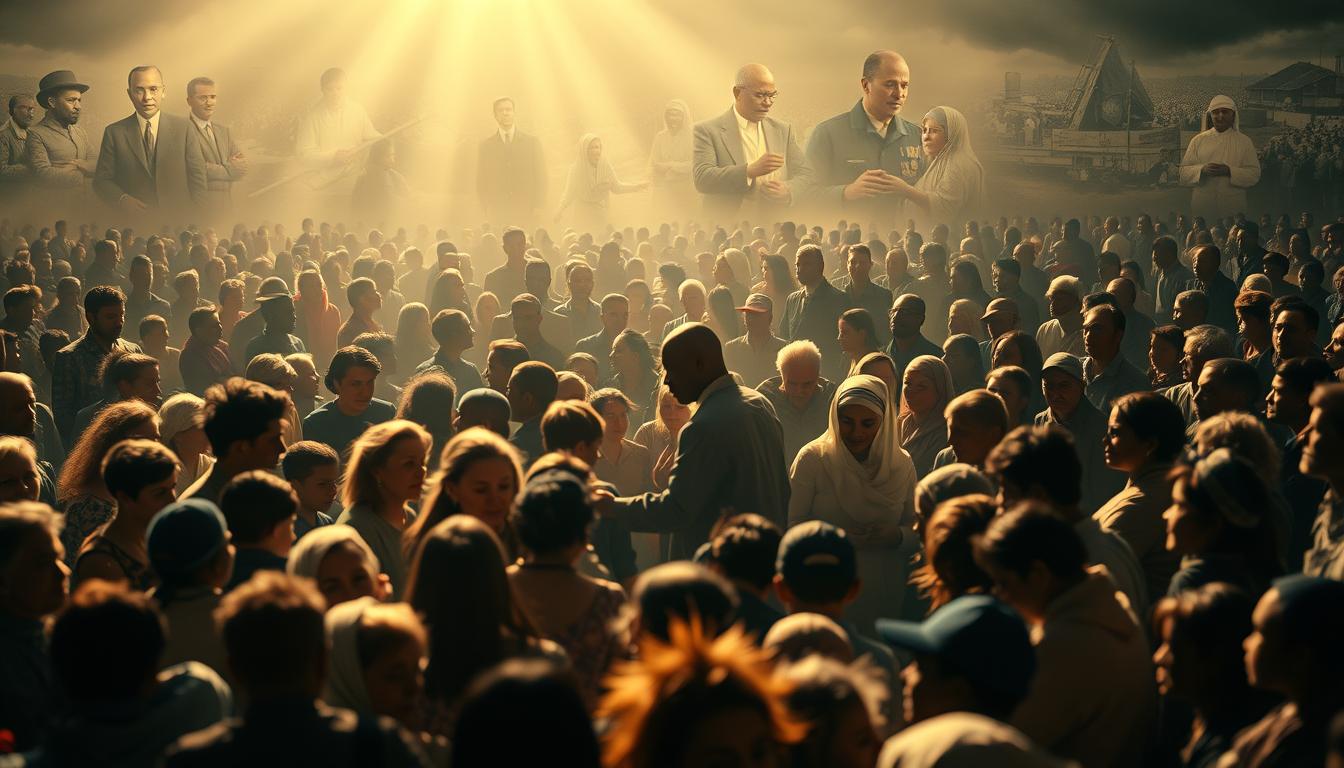
Compassionate acts in history show us that kindness can change the world. Oskar Schindler saved over 1,000 Jewish lives during World War II. This proves that kindness can exist even in the darkest times.
Harriet Tubman freed 70 slaves through her 13 missions on the Underground Railroad. Her courage and empathy show how we can fight against injustice. These stories, along with many others, show how kindness has shaped history.
From Raoul Wallenberg saving Hungarian Jews with passports to the Gates’ $28 billion in grants, kindness has spanned centuries. The Skilled Veteran Corps helped 400 in Fukushima, and JJ Watt raised $41.6 million for hurricane relief. Even small acts, like Nikki Hamblin and Abbey D’Agostino’s kindness at the Olympics, have made a lasting impact.
These stories teach us valuable lessons. They show how our choices, like Michael Jordan donating to 9/11 victims or Project Linus’ 1,155 blankets, reflect our humanity. This article looks at how these acts of kindness continue to shape our future. It proves that kindness is as powerful as any challenge we face.
The Power of Kindness: An Overview
Kindness has been a quiet but powerful force in humanity’s progress. The historical significance of compassion shows its ability to change societies. Roman Krznaric, a leading empathy researcher, believes compassion is more than personal—it’s a social force that can break down barriers.
His research shows how compassion can lead to political and cultural changes. This proves kindness is not just a moral virtue but a driver of change.
“Empathy isn’t just a commercial tool—it’s a social force that can challenge prejudices and create political change.”
Dr. Brian Goldman’s book, *The Power of Kindness*, explores how empathy changes us. His brain scans during kind acts showed increased activity in the reward center. This links compassion to better health and happiness.
His research took him from a Japanese lab with empathetic androids to a Pennsylvania therapist caring for dementia patients. He found that small acts of kindness can build a stronger society. Goldman’s travels show compassion’s impact of kindness knows no bounds.
Modern studies back up this legacy. The University of Sussex’s Kindness Test found 78% of people felt happier after doing kind acts. Workplaces that practice kindness see 20% higher employee satisfaction.
Communities with kindness see 40% stronger social bonds. These numbers reflect history’s patterns: empathy’s effects last through time.
Goldman’s work connects the past and present, showing kindness’s role in both personal choices and societal change. From ancient philosophers to today’s movements, compassion remains a timeless force for progress.
Historical Icons of Compassion
Compassionate figures like St. Francis of Assisi and Mother Teresa show kindness can change the world. St. Francis’s act of swapping clothes with a beggar in 1206 changed how people saw each other. These icons chose to help, leaving us with lessons that guide us today.
“In spite of everything, I believe people are really good at heart.”

Mother Teresa won a Nobel Prize for caring for the poor in Calcutta. Harriet Tubman risked her life 19 times to free enslaved people. Her bravery defied the Fugitive Slave Act of 1850, making her a legendary leader.
Malala Yousafzai fought for girls’ education after surviving an attempt on her life. Like Elizabeth Fry, who improved British prisons in the 1800s, these figures show compassion is action. Their stories teach us that kindness can overcome injustice and unite us.
These legends teach us: kindness is more than a virtue—it’s a powerful force that changes history.
Acts of Kindness in War and Conflict
Even in the darkest moments of war, stories of kindness emerge. During World War I’s 1914 Christmas Truce, German and British soldiers paused to exchange gifts and play football. This rare moment of kindness shows humanity’s spark can persist, even in conflict zones.
World War II also saw acts of courage. German general Erwin Rommel refused to execute Jewish prisoners and British commandos. He chose morality over war’s brutality. Hungarian forces also saved U.S. pilot Richard Carroll after his plane crash, showing compassion can cross ideological divides.
Today, the Ukraine-Russia war shows modern acts of kindness. Anna, a volunteer, delivers food to displaced families. Dr. Viktoria provides medical care across frontlines. These efforts remind us of past heroism, showing kindness can heal wounds.
In Gaza, activists like Nataliya organize dialogues to bridge divides. This proves empathy’s power. These stories matter because they show small acts can disrupt violence.
Kindness during wartime can tip the balance between division and unity.
These stories inspire hope. They prove compassion can endure, even in war’s chaos. They remind us that humanity’s light never fully goes out, no matter how dark the conflict.
Everyday Heroes: Local Kindness that Changed Lives
Kindness doesn’t need headlines to make a difference. Local heroes of kindness quietly change communities with small acts of compassion. Beatrice Webb, for example, disguised herself as a factory worker to fight for labor rights. Her actions sparked lasting change.
Today, community compassion stories are everywhere. Retired workers help find jobs, teachers offer emotional support, and neighbors deliver meals to those in grief. These neighborhood compassion projects show how small gestures can start big movements.

In 2017, a retired construction worker helped a struggling man find a job. This act led to six years of stability for the man. A Colorado police department also dressed up as superheroes to cheer up kids in hospitals. These acts show kindness has no limits.
Even small, anonymous acts can make a big difference. Like when someone covers your groceries or returns a lost blanket. These everyday acts of kindness can inspire many people.
Today, we have modern local heroes of kindness like Josh Coombes, who has given free haircuts for years. Molly McGinley also donates her birthday funds to feed the homeless. A tweet by Carlos Davis about kindness went viral, reaching 100k likes. These stories show how generosity can grow.
Whether it’s through food drives, job referrals, or just listening, these stories remind us: compassion starts at home. Every community compassion story is a blueprint for a kinder world. It’s all about small acts of kindness.
Acts of Kindness in Modern Times
Modern compassion initiatives like the Malala Fund show kindness can change lives. Founded by Nobel laureate Malala Yousafzai, it supports education in six countries. It combines local efforts with global support.
Oprah Winfrey’s Angel Network is another example. It uses celebrity power to help, making sure all donations go to real projects. These include schools and healthcare.
The digital world also sees kindness grow. The Global Kindness Challenge (GISHWHES) set a world record in 2023. It involved over 50,000 people worldwide.
Even small acts can make a big difference. A seven-year-old’s gift of a shoebox started a lifelong friendship. Technology helps too, raising over $3.2 billion for disaster relief in 2022.
Today, kindness tackles big problems. Events like #PayItForward and Random Acts of Kindness Day involve millions. A U.S. waitress got a $50,000 gift and a car from a grateful patron.
Even small, secret acts can change lives. A $100 bill given to a homeless man bought him essentials. These acts show the power of trust and empathy.
But, there are also challenges. Social media can be both a blessing and a curse. Critics say it leads to “slacktivism,” where people just click without taking action. Yet, places like Cairns, Australia, show kindness can create a chain reaction.
Every act, online or offline, helps build connections. Malala’s work shows kindness is more than just a gesture. It’s a way to bring about lasting change.
The Science Behind Kindness
Research into the neuroscience of kindness shows how compassion changes our biology. When we give, our bodies release oxytocin, which lowers stress and improves heart health. This “helper’s high” also boosts serotonin and dopamine, making us feel better. 
Being kind has more than emotional benefits. A 2018 study found that generosity can lower blood pressure and increase happiness. Even small acts of kindness can reduce inflammation, which is linked to chronic diseases. Long-term studies show that kindness can lead to longer lives and stronger immune systems.
The psychology of helping others helps us understand why kindness is so powerful. When we see kindness, our brains reward us, making us more likely to help others. Schools that teach empathy see better mental health in their students. Companies are also recognizing the value of kindness in their missions, showing its impact on teamwork and culture.
Kindness fosters connections that improve well-being and resilience.
Science proves that kindness is not just good for our feelings—it’s essential for survival. Studies suggest that early humans thrived because of shared care. By embracing kindness, we improve our health and strengthen our communities. This shows that compassion is a science-backed way to create a healthier, happier world.
The Role of Kindness in Education
Schools are changing their kindness in school curriculum to teach students to care for others. Empathy education programs like Roots of Empathy use visits from infants to help kids practice compassionate classroom practices. These programs help kids see things from others’ perspectives, reducing bullying and making schools more welcoming.
Teachers across the country are teaching kids to be kind through clubs and mindfulness. For example, Bexley City Schools now have a kindness elective that focuses on fairness and helping the community. Studies show that teaching kids to be kind can improve their grades by up to 17%, showing that kindness is good for both heart and mind.
Schools like Bexley also work with groups like No Place for Hate to fight bullying. They celebrate kindness with events like Random Acts of Kindness Week, where students write nice notes or help with food drives. This work supports Malala Yousafzai’s idea that education is a kind act, helping students who are often overlooked to succeed.
There are challenges, like fitting in kindness lessons with schoolwork. But schools keep going, knowing that kindness makes students stronger. By focusing on empathy, classrooms become places where the next generation of kind leaders is shaped.
Celebrating Random Acts of Kindness
Every February 17th, people around the world celebrate Random Acts of Kindness Day. This tradition started in 1995 by the Random Acts of Kindness Foundation. It’s a day to do small, unplanned acts like buying a stranger’s coffee or leaving a kind note.
These acts are part of the pay it forward movement. They make everyday moments special by connecting us.

In 2019, a barista in Portland started a chain of kindness. When a customer paid for the next order, it inspired 100 people to do the same. Such unexpected compassion examples show kindness can spread quickly.
Schools like those in the Great Kindness Challenge are also involved. With over 39,000 schools participating, small acts add up to big positivity.
Science backs up the benefits of kindness. It increases oxytocin, which lowers stress and boosts energy. Companies like Google even host kindness challenges. Neighbors are leaving inspirational rocks in parks.
Some say acts of kindness are staged for social media. But research shows even small gestures can improve our mental health. Whether it’s buying groceries for a neighbor or sending a thank-you note, kindness is a universal language.
Join the movement on February 17th or any day. One act can start a chain reaction. Let’s make sidewalks and workplaces places for unexpected kindness.
Kindness in Literature and Media
Stories of compassion have shaped cultures for centuries. Anna Karenina and A Tale of Two Cities show how kindness can change lives. Charles Dickens’ characters, like Scrooge, teach us about empathy’s power.
Modern tales like Wonder and The Rabbit Listened teach empathy through adventures. These stories remind us that kindness is important.
Kindness-themed movies like It’s a Wonderful Life and Crazy, Stupid, Love show how compassion can change lives. Documentaries like He Named Me Bruce share real acts of kindness. Social media platforms like Upworthy’s Instagram share daily acts of kindness.
Their book Good People collects true stories of kindness. It shows kindness’s lasting impact.
Literature about empathy goes beyond books. Anne Frank’s diary, published in 1947, is a symbol of resilience and human connection. Films like Schindler’s List and TV shows like This Is Us show kindness in their stories.
Even children’s media, like Paddington Bear, teach kindness through adventures. These stories show empathy is a universal language.
Recent titles like Food for the Future, a 2023 award-winning book, mix kindness with environmental themes. Picture books like Be Kind and Little Fox in the Forest teach young readers about compassion. By sharing these stories, media and books keep kindness alive, inspiring future generations.
The Future of Kindness: Building a Better World
Kindness is changing, becoming next-generation compassion by mixing tech and big changes. Innovative kindness projects like the Malala Fund show how kindness can fight inequality. Over 100 companies at a Washington, D.C., event showed they now focus on helping society.
Technology is helping a lot. Apps find food for those who need it, and AI finds global needs. The future of compassion is also in work places. NBA offices and the Work Kind program show kindness makes work better.
Over 8,367 handwritten notes during World Kindness Day show small acts can make a big difference.
“A thousand points of light”
—President George H.W. Bush’s metaphor—now fits digital platforms. Young people link kindness to fighting for the planet and fairness. They want to do more than just watch.
They look to the “Civic Century” for answers, inspired by Dr. King’s dream of love winning over hate.
Projects like microfinance and restorative justice show a big push for kindness-based social change. As work places and laws start to value kindness, the next-generation compassion movement is changing history. It’s all about taking small steps together.
Conclusion: Your Role in History’s Ongoing Kindness Story
History’s biggest moments started with small acts. Luz Long’s sportsmanship, Chiune Sugihara’s visas, and Texas A&M students shielding a hero are examples. These acts changed lives and futures.
Today, we have many chances to be kind. We can mentor students, volunteer, or just say a kind word. Just like Franz Stigler, our actions can be part of tomorrow’s stories.
Building a kindness legacy means seeing yourself as part of a journey. We can apply historical lessons by joining Live Below the Line or trying a “God swap.” Every action, big or small, counts.
Like the Skilled Veterans Corps at Fukushima or the global support for Winnie Blagden’s 100th birthday, kindness grows when we share. Your choices today add to humanity’s story of resilience and care. Let’s make kindness a daily habit, proving compassion is history’s greatest legacy.