







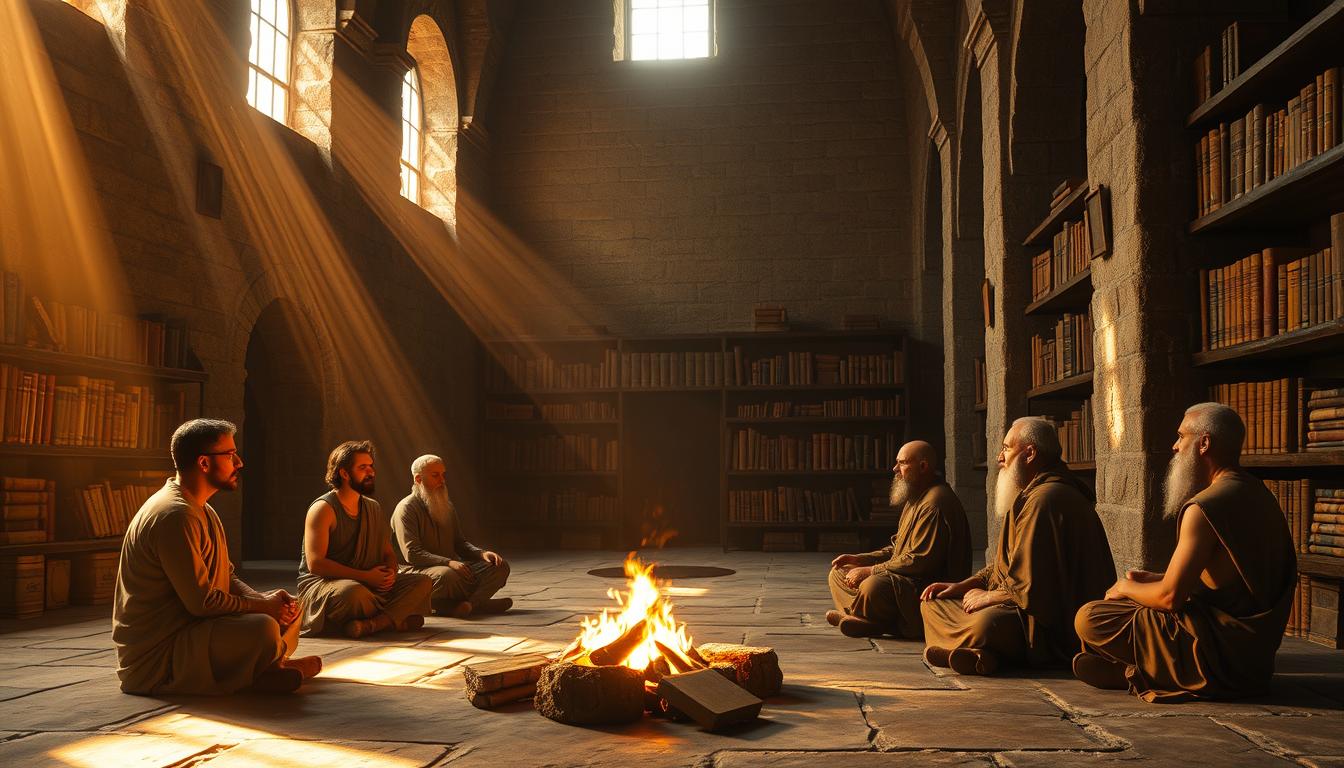
Ancient philosophy is key to our ethics and self-improvement today. Confucianism and Stoicism give us wisdom that never gets old. These teachings help us face today’s challenges, showing the power of ancient ideas.
Confucius’s Lunyu talks about ren—humanity, respect, and helping others. Mengzi believed humans are naturally good, needing effort to grow ethically. His views, like Wang Yangming’s on knowledge and action, show how old teachings shape our actions.
Confucianism’s influence goes beyond Asia. It shaped dynasties from Han to Qing. Today, it guides global talks on ethics and leadership, proving its timeless value.
Understanding the Cultural Impact of Philosophy
Philosophy shapes our world today. Confucianism teaches harmony and respect, guiding education and governance in East Asia. Stoicism’s lessons on resilience are now in self-help books and business training, showing the lasting power of ancient wisdom.
Early Greek thinkers like Thales and Heraclitus questioned reality. They laid the groundwork for democracy and science. Their ideas spread, influencing Christianity through figures like Augustine, who mixed Plato’s ideas with theology.
Even contradictions, like Parmenides’ static universe versus Heraclitus’ changing rivers, sparked debates. These debates continue to shape modern philosophy.
Philosophy’s impact is seen in laws, art, and education. The Renaissance brought back Plato and Aristotle, fueling humanism. Today, we see Socrates’ “know thyself” in debates on AI ethics and environmental policy.
From Anaxagoras’ “mind” ordering matter to Pythagoras’ cosmic cycles, ancient ideas are woven into our culture. They remind us: philosophy is not just history. It’s a guide for tackling today’s challenges.
Confucianism: Values and Social Harmony
Confucian ethics focus on harmony through values like ren (benevolence) and li (ritual propriety). These values guide relationships in families and governments. Filial piety, or respect for elders, is key, shaping family life in East Asia.
Confucian virtues like honesty and justice are the base of social harmony. They help keep communities stable.
Confucianism is based on texts like the Five Classics. It teaches that moral character is key to societal order. For example, the concept of yi (righteousness) promotes ethical choices in work and politics.
In 2015, China’s Confucian Church was established. This shows a renewed interest in these timeless values.
“The root of ren is loving one’s parents,” said Mencius. This shows how filial piety builds strong social bonds. Today, schools in Korea and Japan teach these values, promoting respect and responsibility.
Ritual propriety ensures proper behavior in all interactions. The Confucius Temple in Qufu, a UNESCO site, symbolizes this legacy. By following Confucian virtues like wisdom and sincerity, communities can tackle today’s challenges.

Confucianism’s focus on integrity and fairness inspires leaders globally. Its teachings on personal growth and social duty are practical for building inclusive societies today.
Stoicism: Embracing Adversity
Stoicism teaches us to see adversity as something to understand, not fear. It focuses on what we can control—our choices—and lets go of what we can’t. This ancient Greek philosophy helps build emotional resilience. Daily reflection on this idea reduces stress for over 50% of modern followers.
The four Stoic virtues—wisdom, courage, justice, and temperance—guide us to live ethically. When faced with a work crisis, a Stoic asks, “What can I control?” This mindset helps us focus on action, not worry. Studies show a 40% decrease in stress levels for those who follow this approach.
Practices like negative visualization, imagining the worst, prepare us for life’s surprises. It’s like training for challenges we might face.
“Difficulty shows what we’re made of. If we never faced challenges, we’d never know our strength.” — Epictetus
Today, adversity management uses Stoic Stoic wisdom in many ways. Apps like “Daily Stoic” offer exercises like journaling to track progress. Schools using these methods see a 45% increase in student perseverance.
Even tech-free days, inspired by Stoic detachment, help fight digital overload. These practices are about being proactive and calm in chaos.
Now, 34% more young professionals follow Stoic principles to balance work and mental health. By seeing challenges as teachers, they build resilience without losing empathy. Stoicism isn’t about hiding emotions but focusing on what truly matters. Its lessons remind us that virtue and self-mastery lead to a fulfilling life, no matter the external storm.
The Role of Platonism in Western Thought
Plato’s Academy, started in 385 BCE, lasted over nine centuries. It showed how Plato’s ideas shaped Western education and philosophy. The school taught that abstract ideals like justice and beauty are real, even if we can’t see them.

Plato’s influence went beyond schools. His work, “The Republic,” started big debates on justice. Thinkers like Augustine mixed Plato’s ideas with Christianity. Later, the Renaissance brought back Plato’s thoughts, and modern logicians like Frege argued for abstract truths.
The Allegory of the Cave warns us to think deeply, not just believe what we see. It’s a message for today’s world, full of digital lies.
Western philosophy owes a lot to Plato. His ideas are seen in medieval thought and political theories. He taught us to question everything, a lesson that Alfred North Whitehead said is key to European philosophy.
European philosophy is largely “footnotes to Plato.”
Taoism: Nature and Balance
Taoist principles teach us to live in harmony with nature. They come from ancient texts like the Tao Te Ching, written by Lao Tzu over 2,500 years ago. This philosophy focuses on aligning with the Tao, the fundamental force of existence.
At its core is the wu wei concept, which means action without force. It encourages us to respond to life’s challenges with flexibility, not rigid control.
The balance philosophy of Taoism is shown in the Yin-Yang symbol. It teaches us to accept opposing forces as part of life. This approach helps us find inner peace and care for the environment.
Today, Taoist wisdom is seen in mindfulness and sustainable living. These practices align with our modern environmental concerns.
Taoism has shaped Chinese history. During the Tang Dynasty (618–907 C.E.), Emperor Xuanzong made Taoism the official state doctrine. This influenced art and governance. After being suppressed in the 20th century, Taoism is now experiencing a revival.
Practices like qigong and feng shui are gaining global attention. They inspire people, even those who don’t know much about Taoist rituals.
Natural harmony is key in Taoist rituals, from temple ceremonies to daily meditation. Today, wu wei offers ways to deal with stress in our fast-paced world. Whether through tai chi or mindful decision-making, Taoist ideas remind us that balance is a continuous practice, not a fixed goal.
The Legacy of Ancient Greek Philosophy
The Greek philosophical tradition is a key part of Western thought. It shapes our views on ethics, logic, and democracy. The Socratic method, which involves questioning to find truth, is used in classrooms and courts today. It shows the value of ancient wisdom in modern times.

Aristotelian ethics has given us a lasting gift. Aristotle’s concept of eudaimonia (flourishing) is key in today’s discussions on well-being. His focus on virtues like courage and compassion is seen in self-help and moral education. His ideas on character development are debated even now.
“The European philosophical tradition is a series of footnotes to Plato.” — Alfred North Whitehead
Ancient Greek ideas have shaped modern life, from democracy’s start in Athens to the philosophical foundations of science. The ancient Greek legacy has its flaws, like systemic inequalities. Yet, its methods live on. Courses like the 32-lecture Plato series ($199) help us see how ancient questions influence our world.
Existentialism: Questioning Meaning and Purpose
Existential philosophy changed how we view life’s unknowns. Jean-Paul Sartre and Albert Camus said we must make our own meaning. Their thoughts became popular after World War II, as people dealt with the war’s effects and changing values.
Sartre believed “existence precedes essence.” He said humans have no set purpose. Instead, we find meaning through our choices. This freedom comes with a big responsibility, needing courage to act without knowing the outcome.
“Man is condemned to be free,” Sartre wrote, highlighting how choices define authentic existence. Rejecting societal scripts, individuals face the weight of their decisions.
Camus talked about facing life’s absurdity. His story, the Myth of Sisyphus, encourages us to accept our struggles without hope. True existence means not hiding behind excuses or roles.
Today, existential ideas help us deal with digital distractions. Sartre’s call for self-made purpose is more relevant than ever. Living authentically means fully engaging with life, even when we don’t have all the answers.
Existentialism’s impact is seen in psychology and art. Viktor Frankl’s logotherapy, inspired by his time in concentration camps, shares its focus on finding meaning in suffering. This philosophy is essential for finding purpose in today’s world.
The Influence of Ancient Philosophy on Art and Literature
Philosophy has shaped art and literature for thousands of years. Greek tragedies and Taoist scrolls show how old ideas turned into stories. Plato’s dialogues, for example, used dramatic scenes to talk about ethics, mixing philosophy into daily life.
Chinese painters showed Taoist harmony in their landscapes. European Renaissance artists brought Aristotle’s ideas to life in their work.

Plays like Euripides’ Medea questioned Stoic virtues, showing the power of art. Dante’s Divine Comedy mixed Plato’s ideas into poetry, making complex thoughts easy to understand. Even today, movies like The Matrix reflect Parmenides’ thoughts on reality, showing how philosophy lives on in media.
“Art is the alphabet of the unconscious mind,” said artist Kandinsky, showing how philosophy’s big questions—about truth, morality, and existence—come to life in art.
Socrates’ ideas inspire modern novels, while Confucian ideals shape Japanese haiku. These traditions connect ancient wisdom to today’s creativity. Art blends logic and emotion, keeping philosophy alive in every piece of art.
Education and Philosophy: Then and Now
For thousands of years, philosophical education has shaped our learning. Ancient thinkers like Socrates and Confucius saw education as more than just memorizing facts. They believed it was about building character.
Confucius once said, “When walking with two other people, I will always find a teacher among them.” This idea of learning from others in everyday life is key in today’s classrooms.
“Education’s goal is to create free human beings, who are able to use their reason and experience and so speak and act in independence.” —Hannah Arendt
Socrates’ method of using questions to spark thought is used in law schools today. This method, known as the Socratic method, encourages students to debate and think critically. It reflects ancient Greek educational philosophy history.
Confucian values of respect and moral growth are also alive in East Asian education. These values connect ethics with academic study.
Today, learning philosophies mix old and new ideas. Plato’s focus on reason meets Dewey’s hands-on approach. Both aim to prepare students for life.
Modern educators blend Aristotle’s emphasis on virtue with modern technology. This shows how philosophy guides schools in creating thinkers who question, create, and lead with integrity.
Bringing Ancient Wisdom Into Contemporary Life
Adapting ancient wisdom to today means finding ways to apply it to our current problems. Sites like Headspace and Calm make Buddhist mindfulness easy to follow. They use technology to bring Taoist ideas into our daily lives.
Digitized archives, like the Tibetan Buddhist Resource Center, make ancient teachings easy to find. Social media influencers share Stoic tips, showing old ideas can thrive online.
Living philosophically today means choosing values that guide us. A Stoic morning reflection or Confucian respect can help us stay focused. Aristotle’s ethics and modern sustainability goals help us make better choices.
Starting small is key to applying wisdom traditions. Try a Socratic pause before reacting online, or simplify your life with Taoist principles. Apps like Ayurvedic health guides show how ancient health systems fit into our lives.
The goal is to pick practices that feel right, not to force old ways into new ones. Whether you mix ideas or focus on one, these lessons help us live with purpose and ethics.