





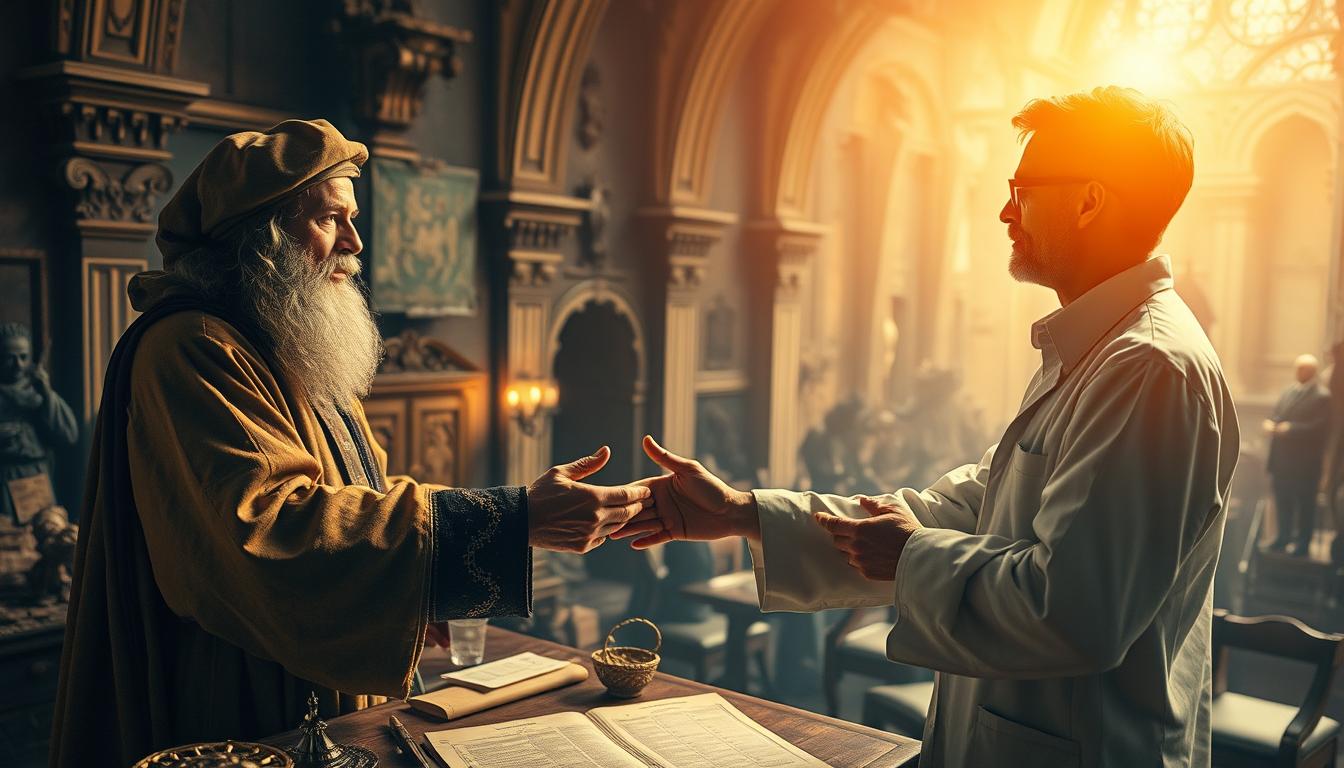
Imagine standing in a tomb near Luxor, Egypt, watching history unfold as a sarcophagus lid opens. This moment shows how unexpected relationships shape our world. Artists and politicians have formed bonds that have changed history.
These connections often happen between people or groups you wouldn’t expect. Yet, their impact lasts for centuries.
Van Gogh’s 26 portraits of the Roulin family show how unexpected relationships can change art and emotion. Political alliances like Sinn Fein and the DUP’s 2007 partnership turned enemies into friends. Such famous friendships challenge norms and inspire progress.
This article looks at how unlikely alliances and deep bonds have changed the world. These bonds, often formed in tough times, have been catalysts for change.
The Power of Unlikely Relationships
History’s most transformative relationships often start as surprises. When enemies become allies or rivals find common ground, the friendship power unleashed can reshape communities. Think of boxer Joe Louis and Max Schmeling, whose 1938 rivalry turned into decades-long support after boxing’s spotlight faded. Their boundary-breaking bonds defied racial and political divides, proving relationships can outlast conflict.
“Uncovering layers and looking deeper isn’t exclusive to archaeology. True understanding emerges when we confront the tapestry of differences.”
Friendship power also fueled reconciliation between John Adams and Thomas Jefferson. After a bitter political feud, their 1812 letter exchange rekindled mutual respect. Their correspondence spanned 14 years, blending philosophy with personal growth—a testament to how social change through relationships can transcend divides. Even adversaries like Houdini and Arthur Conan Doyle, clashing over beliefs in the supernatural, initially deepened their curiosity before disagreements arose.
Data shows 54% of people believe cross-generational ties break stereotypes. These bonds aren’t just personal—they’re engines of progress. When two minds bridge divides, they plant seeds for broader shifts. Whether in boxing rings, political circles, or literary exchanges, boundary-breaking bonds remind us that connection thrives where differences intersect.
Icons from Different Walks of Life
History’s most famous unlikely friendships often spark innovation and challenge norms. Take Supreme Court Justices Ruth Bader Ginsburg and Antonin Scalia. They debated fiercely in court but shared a love of opera. This shows celebrity odd couples can go beyond disagreements.
Art worlds collided when Andy Warhol, the pop icon, teamed up with Jean-Michel Basquiat, the street artist. Their surprising celebrity bonds produced over 150 works. Warhol’s mechanical style merged with Basquiat’s raw energy. A NY Times review called their 1985 exhibit “one of Warhol’s manipulations,” highlighting tensions in their unexpected celebrity alliances. Both artists’ legacies continue to resonate, with their art now fetching millions at auction.

Even in unexpected pairings like Martha Stewart and Snoop Dogg, differences fuel creativity. Their TV collab on Martha & Snoop Go Green turned stereotypes upside down. Such partnerships remind us collaboration thrives when minds and worlds collide.
Friendships across divides aren’t just personal—they’re catalysts for change.
From the boardroom to the courtroom, these bonds prove shared goals can bridge any gap. Their stories aren’t just about success—they’re blueprints for a more connected world.
Bridging the Divide: Unlikely Alliances
History teaches us that unexpected political alliances can change societies. Thomas Jefferson and John Adams, once rivals, became pen pals. Their letters helped shape America’s early thoughts. Even foes like Winston Churchill and Joseph Stalin worked together during WWII. They showed that facing common enemies can bring strategic unusual partnerships.
In today’s world, competing groups collaborating have led to progress. The Florida Rights Restoration Coalition collected 800,000 signatures. They aimed to give 1.4 million ex-felons the right to vote. This effort shows how coalitions can overcome differences.
The California Healthy Nail Salon Collaborative is another example. It brought together workers, scientists, and lawmakers. They passed AB 647, protecting 100,000 salon employees. These alliances succeeded because of their shared goals, like health or justice.
Research shows 70% of breakthroughs come from teamwork. The ResilNam initiative trained 300 women leaders. Their work protected 12 coastal communities, showing empathy and teamwork can turn enemies into allies. Such strategic unusual partnerships show us that unity can conquer even the hardest challenges.
Friendship Beyond Borders
Throughout history, international unexpected friendships have changed how we see the world. Henry Kissinger and Zhou Enlai’s talks in 1971 are a great example. They turned enemies into friends, starting a new chapter in U.S.-China relations.

Albert Einstein and Rabindranath Tagore exchanged letters for years. They mixed science and mysticism, showing how different cultures can learn from each other. Their letters crossed continents, breaking down barriers between East and West.
“Douglass was one of the most meritorious men in the United States,” Abraham Lincoln noted. Though their bond crossed racial lines, it illustrates how personal trust can shift societal norms—even within borders.
Everyday people have also made a big impact. Pen pals became activists, and student exchanges started cultural institutes. These stories show that international unexpected friendships can last long, even through tough times. They remind us that kindness knows no borders.
Unexpected Partners in Progress
History’s biggest breakthroughs came from unlikely scientific collaborations. Physicist Niels Bohr and biologist Max Delbrück joined forces, creating a new field in molecular biology. Their different skills made their partnership strong.
Alan Turing and Joan Clarke worked together at Bletchley Park during WWII. They used math and language to crack Enigma, shortening the war. This shows how different ideas can lead to great discoveries.
Unexpected business partnerships have changed industries too. Steve Jobs and Steve Wozniak’s team at Apple is a great example. Their mix of vision and engineering built Apple’s success.
Chevron’s 2011 deal in Argentina is another example. It showed how to balance environmental concerns with energy needs, even in tough times. Such partnerships work when different styles aim for the same goal.
Innovation often comes from unlikely teams. Yvon Chouinard of Patagonia and Craig Mathews, a fly-fishing guide, teamed up to fight for the environment. Their unexpected business partnerships changed how companies think about responsibility. History shows that differences can drive progress.
Animals and Humans: Cross-Species Bonds
Unusual animal-human bonds have changed how we see intelligence and emotion. Koko the gorilla and psychologist Penny Patterson showed great apes can learn language. This challenged old ideas. Jane Goodall’s studies of chimpanzees also changed our view of animals, showing they have complex social lives.

Surprising friendships between species help protect them. Dian Fossey’s work with mountain gorillas led to global protection efforts. A blind 40-year-old horse has a goat to guide him, showing how important these bonds can be.
These partnerships are not just in research. Dogs help law enforcement find explosives, and dolphins protect US Navy harbors. They show how animals and humans can work together.
“Females with stronger social bonds live longer,” found studies on rhesus macaques, linking friendship to survival. This mirrors how therapy animals reduce human stress, with 84.6 million US homes now sharing lives with pets.
Animal-human partnerships also lead to new ideas. Cheetahs and dogs work together during training, helping them trust each other. Over 16,000 rescued animals were returned to the wild in 16 years, thanks to these bonds.
The bond between humans and animals goes back 15,000+ years. From warhorses in WWI to today’s service dogs, it shows empathy can connect us. These connections change science, ethics, and our hearts.
Overcoming Adversity Through Friendship
Friendships can form in the most unexpected places, even in hard times. During World War I’s Christmas Truce, soldiers from both sides came together. They shared songs and stories, showing that even in war, we are all human.
In Uganda’s Bondo district, many children face HIV and lose their parents. Yet, peer-group interventions have made a big difference. A 2023 study found that orphans in weekly support sessions saw a 40% drop in depression symptoms.
“When my father died, my friend’s family became my new support system,” said a 15-year-old participant. “We learned to heal together.”
Psychologists say crises reveal our true selves, building trust. This is true for Holocaust survivors and those in conflict zones. Even in quieter struggles, like managing Rejection Sensitive Dysphoria (RSD), friends can help a lot. They do this by checking in and showing empathy.
These stories show a big truth: human connection grows when society breaks down. Whether it’s through wartime truces or support circles in Uganda, hard times can bring us together. In the darkest moments, friendship can be a beacon of hope.
Friendship that Shaped Art and Culture
Artistic partnerships have led to many groundbreaking achievements. Helen Keller and Mark Twain’s friendship is a great example. When they met in 1893, Twain supported Keller’s education, despite doubts from others.
His financial help allowed her to attend Radcliffe College. Their letters show deep respect for each other. Twain even called her “a miracle of nature.”
Patti Smith and Bob Dylan’s friendship is another example of creative partnerships. They started in 1975, mixing punk and folk music. After facing challenges, Smith returned to performing in 1995, often with Dylan.
At Dylan’s 2016 Nobel Prize ceremony, Smith sang his song, showing her raw emotion. She whispered, “And I’ll know my song well before I start singing,” showing her growth. Dylan said, “We’re not here to sell records, just to make something true.”
These stories show how trust between different people can lead to innovation. Keller changed education for the disabled. Smith and Dylan showed the power of staying true to art. Their friendships show that creativity grows where differences meet, not despite them.
Unconventional Friendships in Literature
Literary unexpected friendships often go against what society expects. In Mark Twain’s Huckleberry Finn, Huck and Jim’s friendship breaks down racial barriers. This shows how fictional relationships can reflect real-life struggles.
Authors create these bonds to explore big themes like freedom and morality. Characters like Don Quixote and Sancho Panza show loyalty even in absurd situations.
Famous literary bonds come from real-life friendships between authors. C.S. Lewis and J.R.R. Tolkien debated faith while creating fantasy worlds. Their friendship, like Flannery O’Connor’s with Elizabeth Hardwick, enriches their writing.
Modern works like Helen Macdonald’s H is for Hawk show deep connections between humans and animals. Even conflicts, like in Harry Potter, reveal 50% of friendships hide deeper connections. These stories show how bonds, between authors or characters, change literature and our view of trust.
Political Friendships that Altered History
Political alliances often surprise us. Take Ronald Reagan and Tip O’Neill, leaders from different parties who became close. Despite their differences, they worked together to pass important laws. Reagan even called O’Neill “my best friend in Congress,” showing respect can overcome differences.
Their friendship was real. They talked after 6 p.m. and O’Neill visited Reagan after an attempt on his life. This showed how personal bonds can shape policy.

Diplomatic relationships sometimes prevent disasters. During the Cuban Missile Crisis, President Kennedy talked openly with Soviet ambassador Anatoly Dobrynin. This allowed secret talks to happen.
Years later, Egyptian President Anwar Sadat and Israeli PM Menachem Begin’s friendship led to the Camp David Accords. Their personal trust and strategic goals came together.
Neither embraced the other’s worldview,” noted O’Neill’s son, “but both respected the right to hold beliefs.”
Friendships between opposing politicians can face criticism. Yet, Reagan and O’Neill’s work together is remembered positively. Sadat and Begin also chose peace over threats.
These stories show trust and humor can help leaders find common ground. History remembers these friendships for showing cooperation can solve big problems.
Bringing Change through Friendship
Friendships between people with different views often spark movements that reshape communities. Pauli Murray and Eleanor Roosevelt’s partnership in the 1960s helped shape civil rights policies. Later, disability advocate Ed Roberts and engineer Ralf Hotchkiss designed life-changing wheelchair tech together. These relationship-based activism examples show how trust across divides drives progress.
“125 letters over years kept us focused on the mission, not the differences,” said Mary Potter Kenyon, reflecting on her decade-long correspondence with Cecil Murphey. Their collaboration led to landmark accessibility laws, proving that social movements through relationships can outlast political barriers.
In neighborhoods, small alliances make big impacts. A former gang member and police officer in Chicago co-founded a youth program that cut local crime by 40%. In Oregon, a logger and environmentalist partnership created sustainable logging practices after decades of conflict. These unlikely alliances show how shared goals override old rivalries.
Even global tensions melt through personal ties. Ronald Reagan and Mikhail Gorbachev’s 40+ letters turned Cold War foes into arms-control pioneers. Their friendship-driven change ended a 40-year standoff. Age gaps matter less—Bill Greenhaw, an 85-year-old educator, and 23 year-old tech innovator Giovanni co-launched a climate app. Trust built over coffee, not treaties.
Friendships act as quiet revolutionaries. Susan, a conservative, and Connie, a liberal, turned 43 years of debates into a community food bank. Their story mirrors countless others where empathy outlasts disagreements. When people listen, they change policies—and each other.
Lessons Learned from Historical Friendships
History’s most transformative relationships show us that bridge-building relationships succeed when we choose curiosity over judgment. People from different places and cultures can find common ground. This is how even the biggest divides can be bridged.
From soldiers becoming friends in war to artists working together across borders, these historical friendship lessons teach us a valuable truth. Meaningful connection across differences begins with humility and openness.
Successful friendships across divides follow three simple rules. Stay curious about others’ worlds, focus on shared goals, and use humor in tough talks. These principles turned enemies into friends and strangers into allies.
Today, we need these fostering unusual bonds more than ever. Whether it’s bridging political gaps or uniting on climate action, technology helps us connect. But the heart of empathy remains the same as in the past.
Modern challenges like polarization or environmental crises require the same courage as pioneers. Start small by inviting someone new for coffee or listening without judgment. The power of unexpected bonds lies in everyday choices to reach out.
These lessons remind us that even small acts of connection can start something new. They weave a tapestry of understanding and friendship.