

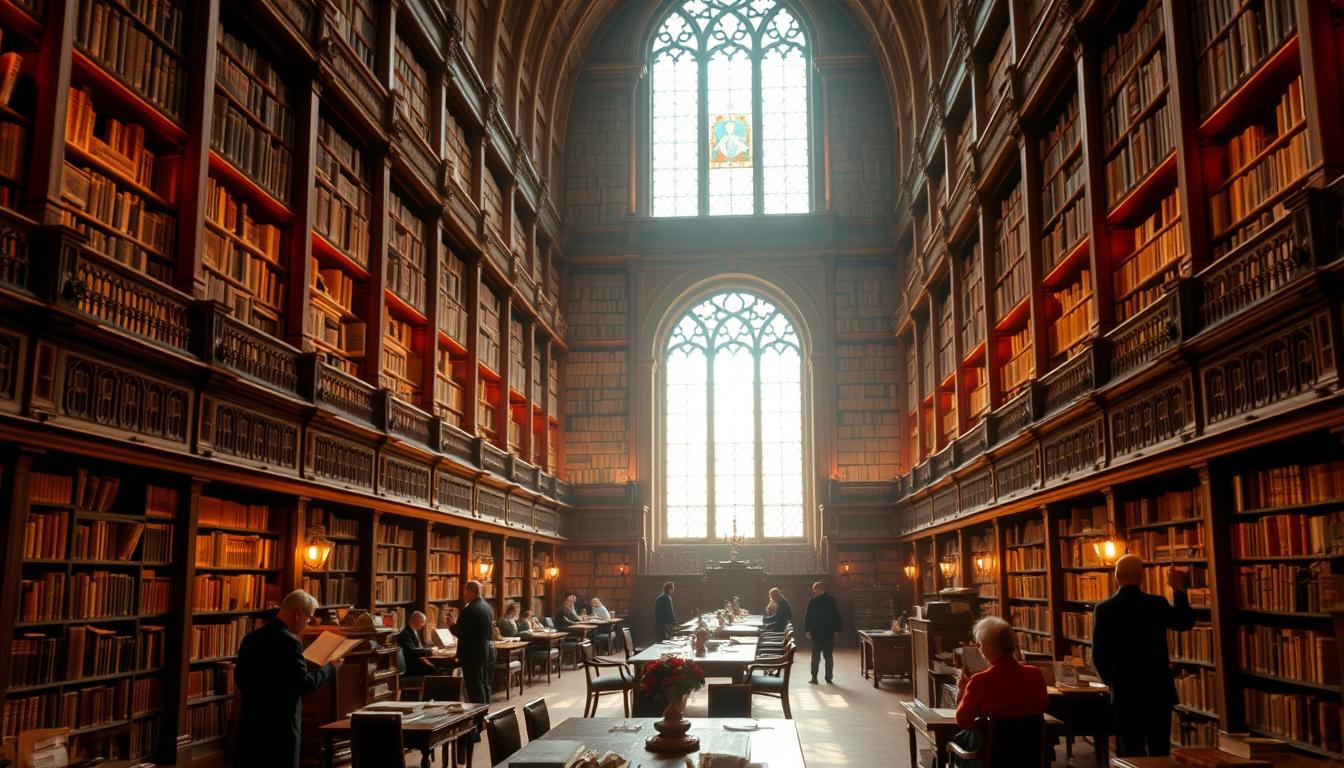
Throughout history, knowledge preservation has depended on historical libraries like the Library of Alexandria and Baghdad’s House of Wisdom. These book repositories kept ancient wisdom safe, helping cultural heritage survive wars and time. Libraries have been humanity’s protectors of ideas, from Sumerian archives to medieval academies.
The House of Wisdom in Baghdad shone brightly during the Islamic Golden Age. Scholars like Hunayn ibn Ishaq and al-Kindi translated Greek classics into Arabic. They saved works by Euclid and Aristotle. When it was destroyed in 1258, books were thrown into the Tigris River, but scholars like Nasir al-Din al-Tusi saved 400,000 manuscripts.
From Sumerian clay tablets to the House of Wisdom‘s Arabic manuscripts, these cultural heritage sites have shaped global knowledge. This article looks at how these centers, from ancient Egypt to Baghdad and beyond, kept humanity’s stories alive through centuries of change.
Introduction to the Greatest Libraries in History
Throughout history, famous libraries like the House of Wisdom and Library of Alexandria have shaped library history. They kept ancient texts alive through their book collections and manuscript preservation. The Library of Ashurbanipal had 30,000 clay tablets, and Pergamum used parchment to get past papyrus shortages.
These knowledge institutions started as places for the elite but became open to everyone. They protected ideas for centuries.
Early knowledge institutions like Rome’s 28 public libraries and Byzantine scriptoriums show our desire to keep cultural heritage alive. From Alexandria’s 500,000 scrolls to today’s digital archives, their impact is huge. They remain key places for understanding humanity.
The Library of Alexandria: A Beacon of Ancient Knowledge
In ancient Alexandria, the Alexandria library was a key part of Ptolemaic Egypt’s culture. It was started by Ptolemy I Soter in the 3rd century BCE. It was part of the Mouseion, a temple for the Muses, dedicated to learning.
By copying scrolls from ships and scholars, it grew to hold hundreds of thousands of texts. These texts ranged from Mesopotamian myths to Greek philosophy.

Scholars like Euclid and Archimedes studied there, making big strides in math and science. The library’s scholars also cataloged texts, debated ideas, and translated works into Greek. This made knowledge available across cultures.
But its story ends in mystery. Fires, political strife, and religious conflicts scattered its treasures. This left gaps in history’s record.
Stories of its destruction mix fact and myth. Julius Caesar’s 48 BCE siege may have sparked fires that damaged parts of the collection. Later, religious clashes in late antiquity and the 7th-century Arab conquest added to its decline.
What remains is lost knowledge—fragments of scrolls and theories about what was lost forever.
Today, the Bibliotheca Alexandrina stands near the original site. This modern library, opened in 2002, honors the legacy of ancient Alexandria’s first great center of learning. Its mission mirrors the Ptolemaic vision: preserving knowledge across borders and time.
The Bodleian Library: Oxford’s Crown Jewel
Founded in 1602 by Sir Thomas Bodley, the Bodleian Library is a key part of Oxford University’s history. It started with 2,000 books but now has over seven million. It’s a copyright library, getting a copy of every book published in Britain, making it a center for scholarly research.
Its rare book collections include the 1215 Magna Carta and Shakespeare’s First Folio. Visitors must promise not to damage books or bring fire into the library.
“I will not deface books or bring fire into the library.”
The library’s buildings, like Duke Humphrey’s Library (1487), show off medieval architecture. It also has modern parts, like the Gladstone Link, which added 120 study spaces.
Researchers use seven reading rooms, including the famous Divinity School. It has an underground system with conveyor belts to get books from 11 floors. But, you can’t borrow books; they must stay in the library for everyone’s use.
The Bodleian has the Gutenberg Bible and hosted 2019 exhibitions of Ethiopian manuscripts. It’s a mix of old and new, attracting scholars from all over.
The Vatican Library: A Treasure Trove of Manuscripts
The Vatican Library, also known as the Vatican archives, has protected ancient stories for over 500 years. It houses more than 75,000 manuscripts, including the Codex Vaticanus, an early Bible from the fourth century. Its shelves, stretching 26 miles, hold texts that shaped Western civilization.

It’s home to Henry VIII’s 17 love letters to Anne Boleyn and the oldest Lord’s Prayer copy. The library has 1.1 million printed books and 8,500 incunabula—books printed before 1500. It also has ancient Roman coins and 500-year-old scientific texts.
Today, scholars from all over the world study here, thanks to a €9 million renovation. The library is digitizing its collections to preserve them and share them worldwide. Every year, 6,000 new items are added, showing its importance as a bridge between faith and knowledge. It offers wisdom from medieval times to modern research.
The British Library: A Modern Marvel
The UK national library has been a keeper of knowledge for over 40 years. It started in 1973 and now has over 170 million items. These range from ancient texts to the latest research materials.
It moved to St. Pancras in 1997. The building’s design is inspired by the sea and is full of modern technology. The library’s vaults house important items like the Magna Carta and original Beatles lyrics.
The library has made many items available online. For example, it has 1 million images from old books on Flickr Commons. A robot named the Mechanical Curator shares interesting items every hour.
Microsoft helped scan public domain books. This makes them free for everyone to see online. This way, people all over the world can explore the library’s treasures without leaving home.
The library keeps every book published in the UK. It has a special collection of 65,000 volumes in the King’s Library. Visitors can see exhibitions or attend events that connect the past and present.
Whether you’re interested in medieval manuscripts or modern sound archives, the British Library is a place of discovery. It shows how heritage and innovation can go hand in hand.
The Library of Congress: America’s Largest Library
The US national library, founded in 1800 by President John Adams, is a key part of American knowledge. After British troops burned the original 3,000-volume collection in 1814, Thomas Jefferson helped. He sold his Thomas Jefferson collection of 6,487 books to rebuild the library, setting its path.
Today, it has over 170 million items in 470 languages, making it the world’s largest library.

Its American history archives hold the rough draft of the Declaration of Independence and the Gutenberg Bible. The copyright repository manages U.S. copyright laws, protecting creative works. As a research institution, it supports Congress and offers free access to treasures like the 1507 Waldseemüller world map and 100 rare children’s books.
The Library of Congress blends history with innovation. It has three Capitol Hill buildings and digital projects that reach people worldwide. Its mission—to preserve, protect, and share knowledge—follows Jefferson’s vision. It ensures every voice, from presidents to pioneers, is heard by future generations.
The New York Public Library: An Urban Icon
For over a century, the New York Public Library (NYPL) has stood tall in Manhattan. Its Fifth Avenue building, finished in 1911, is a masterpiece of Beaux-Arts architecture. It boasts grand columns and two marble lions, Patience and Fortitude. Today, the NYPL has 92 branches and over 56 million items in its collections.
These resources are free for all New Yorkers. From rare manuscripts to digital archives, the library offers something for everyone.
Inside the Stephen A. Schwarzman Building, the Rose Main Reading Room is a sight to behold. Its 70-foot ceiling inspires study and creativity. The NYPL holds the only complete First Folio of Shakespeare in the U.S., available to all.
Every year, 3.5 million people visit. The library combines historic beauty with modern facilities. It has tech labs and hosts poetry readings, meeting the needs of today’s learners.
The NYPL was created by merging private libraries and the Tilden Trust. It has become a cornerstone of the community. Its Beaux-Arts design and free access show that knowledge should be for all. Whether you’re borrowing a book or exploring its archives, the NYPL connects past and present.
The National Library of France: A Historical Archive
The Bibliothèque nationale de France (BnF) protects France’s cultural heart. It started in 1461 as Charles V’s library. The French Revolution made it public. Today, it has over 42 million items.
Its libraries in Paris are historic. They include the Richelieu-Louvois and the modern François Mitterrand building. This building looks like four open books.

Preserving manuscripts is key. It has 5,000 Ancient Greek manuscripts and Charles V’s Coronation Book. Gallica, started in 1997, has 10 million digital items.
This European archives center shares 48 billion web archives. It works with partners worldwide through Europeana. This keeps French literature alive.
Gallica has 864,000 books, 5.8 million images, and 1.8 million maps. It works with 19 countries through the Shared Heritage program. The BnF protects 16 million physical books with 2,300 staff.
It has a €254 million budget each year. This ensures Europe’s literary history is open to all.
The Harvard University Library System: Academic Excellence
Harvard’s university library system started with 400 books in 1638. Now, it has over 70 libraries and more than 20 million academic resources. It even has a copy of the Gutenberg Bible in its rare book collections.
This scholarly archives center helps 23,000+ researchers every year. They find everything from ancient manuscripts to digital databases here.
Houghton Library has 15th-century illuminated manuscripts. The Harvard-Yenching Library has 1.4 million East Asian texts. The research materials are in 458 languages, with the Middle East Branch covering over 40.
Over 800 staff work on these collections. They digitize fragile items to keep history alive and share knowledge openly.
Students and scholars get access to 500+ research databases and digital archives. The libraries also offer interlibrary loans. Harvard works with 8 other universities through the Research Collections and Preservation Consortium, giving access to 90 million books.
Harvard’s libraries serve everyone, with services for disabled readers and a focus on diversity. They mix tradition with innovation, making knowledge available to all.
Conclusion: The Enduring Legacy of Libraries
The story of the Library of Alexandria shows how important libraries have been for ages. Today, places like the New York Public Library and the Vatican Library keep this tradition alive. They adapt to our changing world, keeping knowledge safe for the future.
Libraries like the NYPL are key today. They offer digital books and community programs. The NYPL has over 900,000 digital items and 300,000 e-books. They make sure everyone can access information.
These libraries are more than just books. They offer job help, literacy classes, and free events. The British Library and Harvard show how libraries evolve while staying true to their mission.
Libraries face challenges like funding and keeping up with technology. But, through partnerships and new ideas, they keep moving forward. Libraries connect the past with the present, ensuring knowledge is always available. Their work is a living legacy, not an end.