





History is full of historical coincidences that seem too perfect to be just chance. Thomas Jefferson and John Adams, for example, both died on July 4, 1826. This was exactly 50 years after they signed the Declaration of Independence. James Monroe, the fifth president, also died on Independence Day, adding to the eerie American historical pattern.
These events are not just strange facts. They suggest statistical anomalies in history that are hard to explain.
Robert Todd Lincoln, for instance, saw three presidential assassinations. His father, Abraham Lincoln, was murdered in 1865. Later, he witnessed Garfield and McKinley’s assassinations. Mark Twain, born in 1835 and died in 1910, also had a comet connection.
Such unexplained historical events make us question chance versus fate. Psychologists say we naturally look for patterns, even in random things. But when presidents elected 100 years apart share similar assassinations, it feels like a script.
This article delves into these enigmas. Are they mere coincidences, or signs of deeper forces guiding history?
The Parallel Lives of Abraham Lincoln and John F. Kennedy
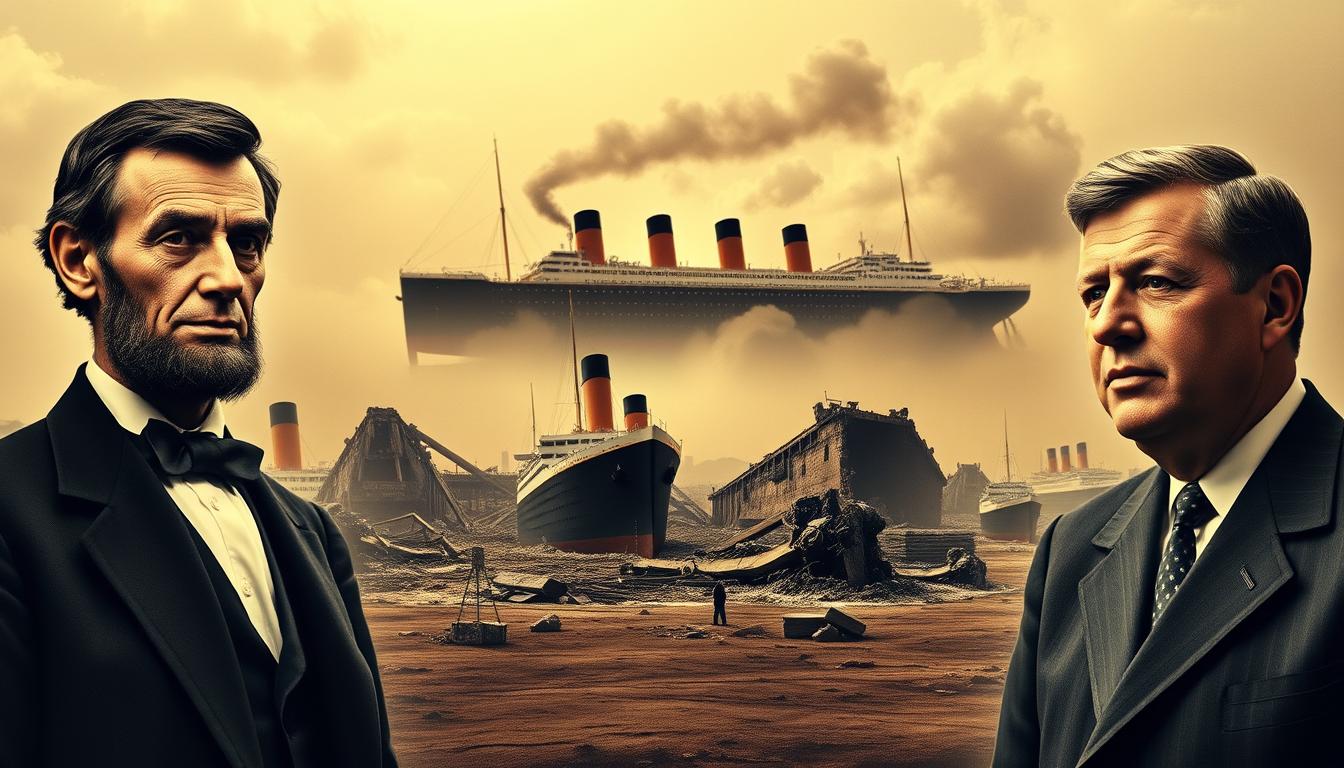
Lincoln Kennedy coincidences have puzzled historians for decades. Both presidents were elected to Congress in 1846 and 1946, a century apart. A century later, they entered the White House in 1860 and 1960. Their lives and deaths mirror each other in ways that defy simple explanation.
presidential assassination patterns surface in their tragic ends. Lincoln was shot in Ford’s Theatre, while Kennedy fell in Dallas. Both were struck in the head on a Friday, survived by spouses who escaped injury. Their assassins—John Wilkes Booth and Lee Harvey Oswald—shared eerie similarities: three-word names, a 100-year gap between their births (1839 and 1939), and escapes ending in death before trials. Even their vice presidents, Andrew Johnson (1808) and Lyndon B. Johnson (1908), were born exactly 100 years apart.
historical president parallels extend beyond politics. Both leaders had 24-year-old wives who spoke French fluently. Each lost a child early: Lincoln’s son Willie and Kennedy’s infant Patrick. They each had three children, were second-born siblings, and held roles as boat captains. Family ties to prominent political figures like U.S. senators and mayors further link their backgrounds.
“Sometimes, surviving a disease is a one out of a million chance. But that just means it happens once in a million times.”
These parallels, from election years to personal tragedies, fuel debates about chance versus destiny. Though dismissed by some as coincidence, the Lincoln Kennedy coincidences remain a haunting footnote in presidential history.
Natural Disasters and Presidential Elections
History shows a strange connection between election year disasters and big moments in American politics. Hurricane Sandy hit in 2012, during Obama’s re-election campaign. His quick response to the storm helped him win over voters.
On the other hand, Mitt Romney’s plan to cut FEMA hurt his campaign. This shows how presidential weather patterns can affect elections. For example, the 1900 hurricane in Galveston happened before McKinley’s assassination, sparking debates about American disaster cycles and timing.
Research shows a clear pattern: Texas, California, Florida, and New York, with the most electoral votes, are hit by disasters often. In 1996, President Clinton declared 75 disasters, more than double the number in 1995. This trend of political climate coincidences has continued, with more disasters in the 2000s than in the 1980s.
Hurricane Milton in 2004 and Hurricane Ian in 2022 are examples of disasters that happened around election times. They caused big evacuations and deaths, adding to the mystery of election year disasters.

Some say these events are just coincidence, but the numbers don’t support that. With over 10 disasters declared in early 2008, it’s hard to ignore the connection between crises and campaigns. Voters often remember how leaders handled storms, showing that election year disasters can influence the outcome.
Whether it’s fate or chance, the storms that hit during election seasons keep everyone wondering.
The Repeating Patterns in American Wars
History often shows itself in surprising ways. War pattern coincidences have shaped American military history. They reveal striking American military cycles. For example, Thomas Jefferson and John Adams both died on July 4, 1826. This was exactly 50 years after the country gained independence.
Looking at major wars, we see patterns in conflict timing patterns. The Revolutionary War and Civil War were about 80 years apart. World Wars I and II were 20 years apart. These gaps suggest cycles tied to societal tensions and shifts in the world.
Military leaders like Ulysses S. Grant and Dwight D. Eisenhower also show wartime leadership parallels. They balanced strategic aggression with diplomatic restraint, despite being a century apart.
Battles like Bull Run (1861) and later conflicts in foreign theaters show repeated tactical mistakes. Even personal fates align oddly—Robert Todd Lincoln witnessed three presidential assassinations, spanning 36 years. These repetitions aren’t mere coincidence but reflect enduring human and political dynamics.
As Mark Twain said, history may not repeat, but its rhythms echo in the choices leaders make and the paths nations follow.
Economic Crashes and Presidential Inaugurations
Major inauguration market crashes have often happened when new leaders took office, starting in the 1920s. Herbert Hoover’s presidency began just before the 1929 stock market crash. Franklin D. Roosevelt took over when unemployment hit 25%, showing a financial crisis cycle.
In 2008, the subprime mortgage crisis peaked as Barack Obama was about to start his term. This mirrors historical presidential economic patterns. It makes us wonder if there’s a connection between leadership changes and economic downturns.
“Improbable things happen all the time, because there are many improbable events that could happen, so it is not surprising if some improbable event does happen, even though for any event that is fixed à priori, it is very unlikely to happen.”

For decades, there have been administration economic coincidences. The 1929 crash, the 1987 market plunge, and the 2008 collapse all happened near inaugurations. Scholars say economic downturns happen 30% of the time during election years.
Even policies seem to repeat over time. FDR’s New Deal agencies and Obama’s stimulus plans had similar goals, 80 years apart.
Numbers show the impact: GDP fell 30% in Hoover’s first year, and markets dropped 37% before Obama’s inauguration. Yet, economic recessions keep happening every 5-10 years, often around political changes. This overlap makes us question how leadership affects the market.
The Curious Case of Repeated Names in History
Historical name repetitions in politics are not random. The Roosevelts and Bushes have had a big impact on the White House. Presidents like Johnson have followed both Lincoln and Kennedy, years apart. These patterns suggest family ties, but some are truly surprising.
Namesake coincidences aren’t just in politics. Violet Jessop survived three major ship sinkings, all with “ic” in their names. The Jim Twins, born to different parents, chose similar careers and had sons named James Alan. These stories make us wonder: is it fate or just chance?
“Just by chance, amazing, crazy things are supposed to happen. How often do one out of a million days happen on earth? 7,000 times a day.”
King Umberto I and his double had the same birth details and wives named Margherita. They both died tragically. Mark Twain’s life spanned the same time as Halley’s comet cycles. These stories show that names are more than just labels—they connect us through history.
Sports Events That Reflect History
Athletic historical patterns often mirror larger events. The Washington Commanders (then Redskins)’ pre-election game outcomes from 1940 to 2000 became a quirky political indicator. The team’s last home victory before an election supposedly predicted the incumbent party’s success—a sports history parallels so striking it became the “Redskins Rule.”

Baseball’s quirks highlight game history coincidences. Frank Thomas and Jeff Bagwell, born on the same day in 1968, both won MVP awards in 1994. Decades earlier, father-son duo Cecil and Prince Fielder each hit 319 career home runs. Even pitchers like Dennis Eckersley share odd milestones, picking off Kenny Williams twice in different years. These numbers aren’t random—they hint at deeper trends.
Sports national significance extends beyond stats. The 17th-century Pasuckuakohowog game involved 1,000 players, blending sport with cultural identity. The Minoans’ bull-leaping rituals symbolized courage and agility. Modern parallels persist: when Ryan Dempster and Homer Bailey faced each other on their shared birthday in 2012, it mirrored historical traditions of communal competition. These events remind us how athletics often echo societal shifts, even if chance plays a role. From presidential elections to ancient rituals, sports remain a lens to view history’s rhythms.
The Unlikely Timing of Presidential Deaths
History is full of stories that are hard to understand. Thomas Jefferson and John Adams, two key Founding Fathers, died on July 4, 1826. This was the 50th anniversary of the Declaration of Independence. Their deaths, along with James Monroe’s five years later, make for a striking pattern.
These founder death coincidences raise questions. Was it a sign from the universe or just a coincidence? The pattern of presidential death patterns is intriguing.
Adams’ granddaughter shared a story about a doctor’s dilemma. The doctor had a choice that could have either saved or ended Adams’ life. Yet, Adams lived until July 4, as if he knew the historic date.
The chances of two people dying on the same day are 1 in 365. But, three presidents died on Independence Day. Monroe’s death in 1831 added to the mystery. All three men were important in shaping America’s early years.
“The doctor’s remedy could either prolong his life or end it swiftly.”
Other presidents also died on unusual dates. Truman and Ford died on December 26, while Fillmore and Taft died on March 8, decades apart. These historical death coincidences lead to theories about fate or symbolic legacy.
Critics say such overlaps are bound to happen over centuries. Yet, the July 4 cluster remains a haunting mystery. Whether it’s myth or math, these moments show how history’s threads can sometimes weave in mysterious ways.
Unintended Consequences in American Legislation
“Just by chance, amazing, crazy things are supposed to happen. How often do one out of a million days happen on earth? 7,000 times a day.”
Historical laws often show surprising similarities. For instance, the Reconstruction era and the 1960s Great Society programs had unexpected side effects. Both aimed to improve society but ended up creating access gaps.
Laws meant to help sometimes made things worse. This pattern has repeated over decades, showing how policies can go awry.

Regulatory patterns also repeat. After the Depression, strict banking laws were followed by calls for less regulation, just like in the 19th century. Each time, we see similar problems, like the 1929 and 2008 stock market crashes.
Environmental laws also follow a cycle. They try to balance growth and conservation, but it feels like we’re stuck in a loop. This shows how laws and human actions interact in complex ways.
These patterns suggest that laws and human behavior are hard to predict. Yet, their outcomes often echo past mistakes. Learning from history might help, but we keep making the same mistakes. It’s a story of trial, error, and repetition.
Mirrored Events in Pop Culture and Politics
Cultural political parallels between entertainment and real-world events often leave audiences wondering what’s fiction and what’s fate. The 1990 British series House of Cards aired just days before Margaret Thatcher’s resignation. This timing sparks debate.
Dexter’s dark themes influenced real-life criminals. At least six incidents in the Philippines were linked to karaoke performances of Frank Sinatra’s “My Way.” This echoes the show’s twisted inspirations.
Entertainment history coincidences like these blur reality and art. The 2012 Seinfeld scam, where Brian Everidge tried to exploit bottle deposit laws, shows how media stories can inspire real schemes.
Even presidential quirks fit celebrity political patterns. 42% of U.S. presidents after WWII were left-handed. This is a stark contrast to the 10% left-handed rate in the general population.
“We tend to notice the 1-in-1.6-million meteor strike but ignore the millions of everyday events that don’t align,”
Christina Cigala’s novel XX v XY: The Final World War mirrors real-life issues like #MeToo. It blends media historical parallels with speculative fiction. Its fictional president hosting beauty pageants echoes Donald Trump’s Miss Universe ties.
This highlights how entertainment shapes political narratives. From TV plots predicting scandals to music influencing violence, these overlaps remind us how culture and power often dance to the same rhythm.
Strange Coincidences in Scientific Discoveries
Scientific history is full of mysterious moments. The 1876 race between Alexander Graham Bell and Elisha Gray is a prime example. They both filed for the telephone patent on the same day. This is a classic case of invention timing coincidences.
These coincidences suggest there might be forces beyond chance at work. Why do breakthroughs often happen at the same time? It’s as if they’re guided by hidden rhythms.
Natural disasters often lead to parallel scientific advances. The 1906 San Francisco earthquake and Hurricane Katrina both spurred engineering breakthroughs. This is part of discovery historical patterns.
Even fiction can predict reality. The 1898 novel *Futility* predicted the Titanic’s fate with eerie accuracy. Such parallels suggest science’s progress isn’t always random.
Even small events hold clues. In 1950, a Nebraska church’s choir narrowly avoided an explosion when all 15 members arrived late. This is a real-life research coincidence history.
Psychologist Carl Jung called such moments “synchronicity,” meaning they are meaningful yet unexplained. Surveys show most Americans experience weekly coincidences. Yet, science debates their cause.
These threads weave into history’s broader tapestry. Mark Twain’s life mirrored Halley’s Comet’s 76-year cycle. His birth and death coincided with its appearances. Could these scientific coincidence patterns hint at forces shaping both labs and legacies?
As history’s quirks repeat, they invite us to ponder. Are breakthroughs shaped by more than just genius?