





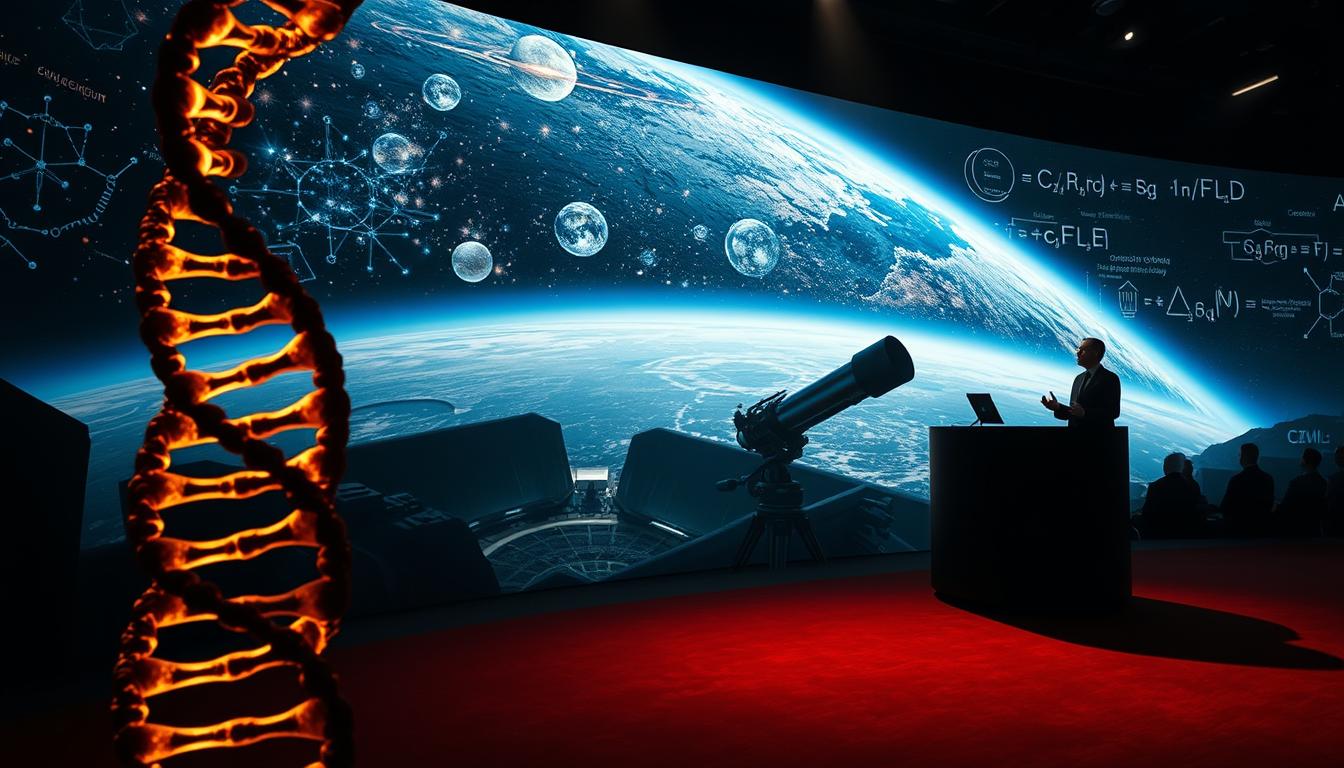
From Copernicus’s 1543 heliocentric theory to modern innovations like CRISPR gene-editing, scientific discoveries have reshaped our world. Each historical breakthrough—like the first gravitational waves detected by LIGO in 2015—has pushed humanity forward. These moments show how science milestones and human progress are connected. They reveal new ways of seeing life itself.
The Renaissance era saw math and exploration fuel breakthroughs, much like the 2010s. In the 2010s, 3,000-scientist teams advanced genetics and space tech. From the Human Genome Project to Pluto’s first images in 2015, these science milestones show how curiosity drives societies.
Every discovery—from Neanderthal DNA studies to Gaia’s star maps—proves science’s power. It transforms daily life and our cosmic view.
Today’s National Labs, with their 17 facilities, continue this legacy. They advance energy, medicine, and climate research. Whether decoding ancient fossils or battling pandemics, these efforts embody the timeless link between innovation and human progress.
The Intersection of Science and History
Science and history are deeply connected, like the ebb and flow of the tides. In the Bronze Age, early historical scientific developments started with the need for math in trade. These tools laid the groundwork for the scientific historical timeline.
Every transformative discovery has shown how science and society influence each other. Think of the printing press or germ theory. These discoveries have reshaped our world.
Today, students learn about these connections in classes like “Unexpected Connections.” They see how innovations come from solving current problems. For example, the scientific revolution impact of the 17th century was fueled by social changes.
Modern researchers also study how discoveries like germ theory in the 19th century changed laws and health practices.
Bret S. Blackham, a student, said, “Revolutions aren’t just past events—they’re ongoing. Technology today is part of this same cycle.” This shows how the science historical context of each era shapes what we discover next. From ancient math to today’s climate science, each breakthrough adds to our story.
How the Scientific Revolution Shaped Society
Between 1543 and 1687, the Scientific Revolution changed everything. It brought the experimental method and rational inquiry to replace old theories. Pioneers like Copernicus and Newton’s work had a big scientific methodology impact.
This change reshaped science and society. It challenged the old ways of politics and religion.

The Royal Society and Bacon’s Novum Organum (1620) led the way. They focused on enlightenment science and empirical evidence. This shift made societies more curious and data-driven.
This era’s legacy is key to today’s innovation. It touches everything from astronomy to governance.
This period valued observation over dogma. It changed how we see knowledge. Its principles guide fields like medicine and technology. This shows the strong link between science and society.
The Discovery of Penicillin and Its Impact
In 1928, Alexander Fleming found penicillin, starting the antibiotic revolution. This mold-based compound changed disease treatment history. It turned deadly infections into treatable ones. By 1945, Fleming and his team won a Nobel Prize for its life-saving effects, marking it as a major medical breakthrough.
“Penicillin’s legacy isn’t just in saving lives—it jump-started antibiotic drug discovery, shaping all modern medicine,” said Madison Fletcher, a postdoctoral researcher at the University of California Irvine.
During WWII, penicillin went from a lab find to a lifesaver. By 1944, Pfizer’s Brooklyn plant made enough to treat millions, changing infectious disease control. Early tests saved lives, like Ann Miller, showing penicillin’s strength. But, making it was hard: it took 2,000 liters of mold to treat one patient.
Later, finding a mold from a cantaloupe made making it easier, helping more people. Lizzie Mann of King’s College London says, “This discovery changed how we deal with disease.” After penicillin, surgeries, childbirth, and childhood survival rates went up. But, we face new challenges: only two new antibiotics in 30 years, and drug-resistant TB strains.
The CDC’s budget cuts threaten TB services, showing penicillin’s double role. It saved lives but also highlights the ongoing fight against resistance in medicine.
The Role of the Industrial Revolution
The Industrial Revolution started in Britain around 1760. It was a time when industrial science and practical innovation came together. This era changed daily life, moving from farm fields to factory floors.
Steam engines, powered by new discoveries in thermodynamics, were at the heart of this change. James Watt’s improved engine design used steam power impact to power machinery and transport. This cut travel times across regions.

The manufacturing revolution changed how textiles and metal were made. New tools like the power loom and Bessemer process made goods faster and cheaper. Factories grew, with Britain’s factory count doubling in 90 years.
These changes led to an economic transformation. People moved from rural areas to cities like Manchester. New class structures formed in these cities.
Chemistry and metallurgy also advanced, leading to stronger materials and fertilizers. By 1850, over half of Britain’s population lived in cities. This showed how science-driven tools reshaped society.
This era set the stage for modern economies. It showed that scientific discovery can boost productivity and wealth.
The Theory of Evolution: A Paradigm Shift
Charles Darwin’s On the Origin of Species started the Darwinian revolution. It changed how we see life, moving away from old views. His natural selection idea said species change over time through inherited traits. This idea changed how we see ourselves and our place in nature.
Today, we build on Darwin’s work. For example, studies on species development show how the environment pushes change. Research on Arabidopsis plants found changes lasting 31 generations. These changes affected traits like root size.
Denis Noble’s lab also showed how fast natural selection can work. Bacteria grew new tails in just days when they lost their old ones. This shows how quickly life can adapt.
“Bacteria adapt to survive—evolution’s mechanisms work across time scales,” said Denis Noble, highlighting rapid trait changes under stress.
Now, evolutionary theory is used in many fields like medicine and anthropology. It helps us understand genetic diseases and human behavior. It also guides ethical discussions on what makes us unique.
The idea of species development has grown. It now includes things like symbiosis and how our microbiome works. This new view challenges old ideas and keeps changing how we see life’s diversity and connections.
Understanding the Structure of DNA
In 1953, Watson and Crick discovered DNA’s double helix structure. This was a major breakthrough in molecular biology. It showed how genetic information affects our health, ancestry, and evolution.
“The molecular structure of DNA – So much of our modern-day research revolves around genetics: from pinpointing the causes of genetic disorders, such as Huntington’s disease, to manipulating the genome of animal models and observing how this affects their behaviors.”
Today, DNA evidence helps solve crimes. Doctors use genetic data to create personalized treatments. The double helix structure is key to advancements like CRISPR and ancestry tests.

The discovery has changed medicine, agriculture, and our view of humanity. It has led to new ways to diagnose diseases and improve crops.
The Impact of Vaccination on Public Health
In 1796, Edward Jenner created the first vaccine. He used cowpox to fight smallpox, a disease that killed millions. This breakthrough changed disease prevention history from treating diseases to preventing them.
Jenner’s work started modern immunization development. It saved many lives and changed healthcare forever.
By 1980, smallpox was eradicated worldwide. This was thanks to global efforts. It showed vaccines can defeat diseases that once seemed unstoppable.
Vaccines now protect against diseases like polio and measles. They have cut down on childhood deaths and increased lifespans worldwide.
Even though Jenner’s work is remembered, challenges remain. There are gaps in access and misinformation. But his idea of using science to prevent disease is more important than ever.
The smallpox eradication shows that immunization development can change how we fight diseases.
The Space Race and Its Innovations
In the 1950s, the Cold War science rivalry between the U.S. and USSR sparked the Space Race. Sputnik 1, launched in 1957, kicked off this competition, pushing aerospace technology ahead. By 1969, Apollo 11’s Moon landing showed humanity’s reach beyond Earth.
This era’s satellite development paved the way for today’s GPS and weather tracking. Rocket research also led to medical imaging and computer chip advancements.

“We choose to go to the Moon,” President John F. Kennedy said in 1962. This vision led to breakthroughs like thermal protection systems in firefighter gear and freeze-dried foods. By 1975, the Apollo-Soyuz mission marked a shift from competition to collaboration, setting the stage for the International Space Station.
Today, over 80 nations operate satellites, with U.S. private sector spending on space research growing from $1B to $5B annually. The Artemis program aims to create a lunar base by 2024, targeting helium-3 deposits for future energy. Yet, geopolitical tensions remain: Russia’s 2021 anti-satellite test created 1,500 pieces of debris, threatening $19 trillion economies dependent on space tech.
The U.S. Space Force now focuses on defending satellites vital to both military and civilian systems. The Space Race’s legacy continues to shape our lives, from daily technology to lunar resource races. As nations compete, the lessons of Cold War science highlight the need for innovation and cooperation in space.
Climate Change Research and Historical Perspectives
Scientists started studying the atmosphere in the 1820s. They linked greenhouse gases to Earth’s temperature. Now, we use ice cores and tree rings to study global warming for thousands of years.
The IPCC’s 2014 report found that humans cause most climate changes. This is key to understanding how we impact the climate.
“Climate change refers to any change over time, whether natural or human-caused.”
Research by Finné et al. (2017) shows how climate changes destroyed ancient civilizations. For example, the Mycenaean Palace of Nestor fell due to climate shifts. The fall of the Ming Dynasty in 1644 also coincided with cooling caused by volcanic eruptions.
These events show how environmental changes can affect societies. The “Storm Cloud” exhibition (Sept 2024–Jan 2025) explores this theme, supported by the National Endowment for the Arts.
Today, atmospheric science uses data from various sources. It combines African climate cycles with CO2 records from Antarctic ice. This helps predict future risks and shows that today’s CO2 levels are much higher than natural levels.
As Lewis and Maslin point out, the Anthropocene marks humanity’s lasting impact on Earth. This science shows our power to change the planet, not just through equations.
The Role of Technology in Modern Society
Today’s technological society moves at incredible speeds and scales. The digital revolution has made smartphones global communication transformation tools, with 3.8 billion people online. Advances in computer science advancement
“Understanding electricity’s role in neural systems shows how far science has taken us,” says Maria Diehl, a University of Puerto Rico researcher. “Yet modern tech’s ethical challenges mirror its great promise.”
AI is changing economies: PwC expects a $15.7 trillion GDP boost by 2030. Merantix’s AI cuts medical imaging costs by automating analysis, saving $250,000 for 10,000 scans. Autonomous vehicles use LIDAR systems to navigate, while Chicago’s AI-driven crime analytics aim to reduce jail populations by 42% without raising crime rates.
Educators teach students to balance engineering constraints with ethics. Yet, 70% of engineering projects fail due to overlooked limits. As Ihde noted, “technologies transform how we perceive reality,” changing privacy, work, and thought patterns.
This computer science advancement era demands careful navigation. As societies grow more interconnected, the line between innovation and responsibility grows clearer—but no less urgent to address.
Reflections on Future Scientific Breakthroughs
CRISPR gene editing and quantum computing show us what’s coming. These emerging technologies are pushing past what we thought was possible. They let scientists edit DNA with great precision, giving hope for genetic disease cures.
At the same time, quantum systems might solve complex problems. These include climate modeling and drug design, which today’s computers can’t handle.
3D printing has come a long way from Chuck Hull’s early days to today’s prosthetics. It shows how ideas grow and change. Future breakthroughs might include lab-grown organs, thanks to bioprinting.
But, we must remember the past. Breakthroughs like penicillin and the printing press changed society. Yet, they also raised ethical questions. Today’s innovations must learn from these lessons.
Looking ahead, renewable energy and nanotechnology could change how we live sustainably. Solar panels and wind turbines are already helping reduce emissions. But, we must act fast to make a difference.
The next decade will decide our path on climate action. History shows that scientific progress thrives on teamwork. The Royal Society’s 17th-century model is a good example.
Fields like neuroscience and AI hold great promise, but also risks. Misuse of CRISPR or AI could lead to problems similar to nuclear weapons. Researchers must balance curiosity with responsibility.
The Doomsday Clock’s warnings remind us to think ahead. As we move forward, we should follow the Scientific Revolution’s path. It’s about curiosity and wisdom together.